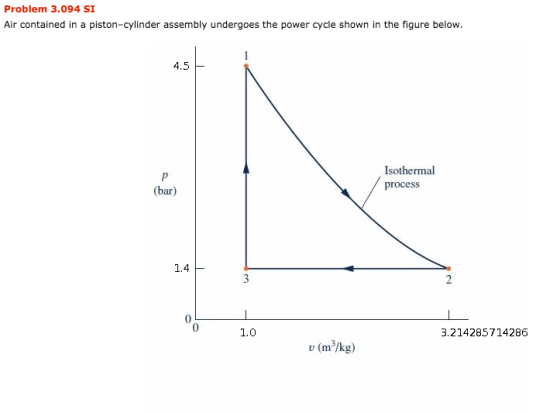
Assuming ideal gas behavior for the air, evaluate the thermal efficiency of the cycle.
Homework Answers
Add Answer to:
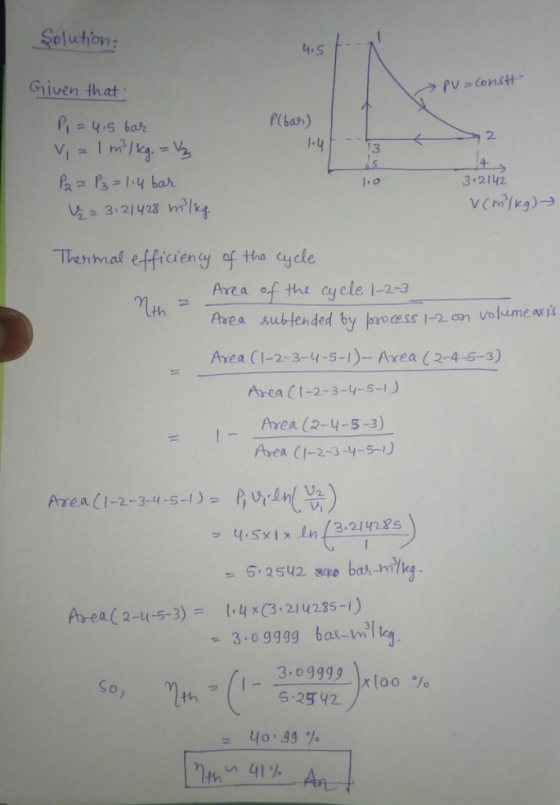
Assuming ideal gas behavior for the air, evaluate the thermal efficiency of the cycle.
*Problem 3.094 SI Air contained in a piston-cylinder assembly undergoes the power cycle shown in the...
 *Problem 3.094 SI Air contained in a piston-cylinder assembly undergoes the power cycle shown in the figure below 3.0 Isothermal process (bar) 1.4 0 0 1.0 2.142857142857 v (m3/kg) Assuming ideal gas behavior for the air, evaluate the thermal efficiency of the cycle. 1%
Problem 3.094 SI Your answer is incorrect. Try again. Air contained in a piston-cylinder assembly undergoes...
 Problem 3.094 SI Your answer is incorrect. Try again. Air contained in a piston-cylinder assembly undergoes the power cycle shown in the figure below. 4.5 Isothermal process (bar) 1.6 0 0 1.0 2.8125 v (m3/kg) Assuming ideal gas behavior for the air, evaluate the thermal efficiency of the cycle
Find thermal efficiency of cycle Moran, Shapiro, Boettner, Bailey, Fundamentals of Engineering Thermodynamics, 9e Air contained...
 Find thermal efficiency of cycle
Moran, Shapiro, Boettner, Bailey, Fundamentals of Engineering Thermodynamics, 9e Air contained in a piston-cylinde sembly undergoes the power cycle shown in the figure below. 6.0 dy process (bar) 1.0 0 1.0 6.0 e (m/kg)
Find thermal efficiency of cycle
Moran, Shapiro, Boettner, Bailey, Fundamentals of Engineering Thermodynamics, 9e Air contained in a piston-cylinde sembly undergoes the power cycle shown in the figure below. 6.0 dy process (bar) 1.0 0 1.0 6.0 e (m/kg)
3.93 w Air contained in a piston-cylinder assembly undergoes two processes in series, as shown in...
 3.93 w Air contained in a piston-cylinder assembly undergoes two processes in series, as shown in Fig. P3:93. Assuming ideal gas behavior for the air, determine the work and heat transfer for the overall process, each in kJ/kg. Isothermal process Ti = 300 K (bar) 1 °C 0.1 0.2 0.3 0.4 V (m) 0.5 0.6 FIGURE P3.93
Air behaving like an ideal gas contained in a piston–cylinder assembly undergoes an isothermal process between...
Air behaving like an ideal gas contained in a piston–cylinder assembly undergoes an isothermal process between end states, 1 and 2, where P1 = 10 bar, V1 = 0.1 m3, T1 = 300 K and P2 = 1 bar, V2 = 1 m3, T2 = 300 K. The work done by the process is:
1. A) Argon contained in a closed, rigid tank, initially at 36.3°C, 2.8 bar, and a...
1. A) Argon contained in a closed, rigid tank, initially at 36.3°C, 2.8 bar, and a volume of 1.4 m3, is heated to a final pressure of 9.9 bar. Assuming the ideal gas model with k = 1.53 for the argon, determine the heat transfer, in kJ. B) Nitrogen (N2) contained in a piston–cylinder arrangement, initially at 6 bar and 435 K, undergoes an expansion to a final temperature of 300 K, during which the pressure–volume relationship is pV1.5 =...
A piston-cylinder assembly contains air modeled as an ideal gas with a constant specific heat ratio,...
A piston-cylinder assembly contains air modeled as an ideal gas with a constant specific heat ratio, k = 1.4. The air undergoes a power cycle consisting of four processes in series: Process 1-2: Constant-temperature expansion at 600 K from p1 = 0.5 MPa to p2 = 0.4 MPa. Process 2-3: Polutropic expansion with n = k to p3 = 0.3 MPa. Process 3-4: Constant-pressure compression to V4 = V1. Process 4-1: Constant volume heating. Sketch the cycle on a p-v...
One kg of air is in a piston-cylinder assembly. Air is modeled as an ideal gas...
 One kg of air is in a piston-cylinder assembly. Air is modeled as an ideal gas with a constant specific heat ratio, k = 1.4. The air undergoes a power cycle consisting of four processes in series: Process 1-2: Constant-temperature expansion at 600 K from P, = 0.5 MPa to P2 = 0.4 MPa Process 2-3: Polytropic expansion with n=k to P; - 0.3 MPa Process 3-4: Constant-pressure compression to V4-V Process 4-1: Constant-volume heating. (a) Sketch the cycle on...
1.Water vapor contained in a piston–cylinder assembly undergoes an isothermal expansion at 277°C from a pressure...
1.Water vapor contained in a piston–cylinder assembly undergoes an isothermal expansion at 277°C from a pressure of 5.1 bar to a pressure of 2.7 bar. Evaluate the work, in kJ/kg. 2.Nitrogen (N2) contained in a piston–cylinder arrangement, initially at 9.3 bar and 437 K, undergoes an expansion to a final temperature of 300 K, during which the pressure–volume relationship is pV1.1 = constant. Assuming the ideal gas model for the N2, determine the heat transfer in kJ/kg. 3.Argon contained in...
1.Argon contained in a closed, rigid tank, initially at 62.3°C, 3.9 bar, and a volume of...
1.Argon contained in a closed, rigid tank, initially at 62.3°C, 3.9 bar, and a volume of 4.2 m3, is heated to a final pressure of 9.4 bar. Assuming the ideal gas model with k = 1.6 for the argon, determine the heat transfer, in kJ. 2.Water vapor contained in a piston–cylinder assembly undergoes an isothermal expansion at 223°C from a pressure of 5.4 bar to a pressure of 1.9 bar. Evaluate the work, in kJ/kg. 3.A mass of 4 kilograms...
 *Problem 3.094 SI Air contained in a piston-cylinder assembly undergoes the power cycle shown in the figure below 3.0 Isothermal process (bar) 1.4 0 0 1.0 2.142857142857 v (m3/kg) Assuming ideal gas behavior for the air, evaluate the thermal efficiency of the cycle. 1%
 Problem 3.094 SI Your answer is incorrect. Try again. Air contained in a piston-cylinder assembly undergoes the power cycle shown in the figure below. 4.5 Isothermal process (bar) 1.6 0 0 1.0 2.8125 v (m3/kg) Assuming ideal gas behavior for the air, evaluate the thermal efficiency of the cycle
 Find thermal efficiency of cycle
Moran, Shapiro, Boettner, Bailey, Fundamentals of Engineering Thermodynamics, 9e Air contained in a piston-cylinde sembly undergoes the power cycle shown in the figure below. 6.0 dy process (bar) 1.0 0 1.0 6.0 e (m/kg)
Find thermal efficiency of cycle
Moran, Shapiro, Boettner, Bailey, Fundamentals of Engineering Thermodynamics, 9e Air contained in a piston-cylinde sembly undergoes the power cycle shown in the figure below. 6.0 dy process (bar) 1.0 0 1.0 6.0 e (m/kg)
 3.93 w Air contained in a piston-cylinder assembly undergoes two processes in series, as shown in Fig. P3:93. Assuming ideal gas behavior for the air, determine the work and heat transfer for the overall process, each in kJ/kg. Isothermal process Ti = 300 K (bar) 1 °C 0.1 0.2 0.3 0.4 V (m) 0.5 0.6 FIGURE P3.93
 One kg of air is in a piston-cylinder assembly. Air is modeled as an ideal gas with a constant specific heat ratio, k = 1.4. The air undergoes a power cycle consisting of four processes in series: Process 1-2: Constant-temperature expansion at 600 K from P, = 0.5 MPa to P2 = 0.4 MPa Process 2-3: Polytropic expansion with n=k to P; - 0.3 MPa Process 3-4: Constant-pressure compression to V4-V Process 4-1: Constant-volume heating. (a) Sketch the cycle on...
Most questions answered within 3 hours.
-
Where is the error in this code sequence?
String s1 = "Hello";
String s2 = "ello";...
asked 10 months ago -
Financial data for Joel de Paris, Inc., for last year
follow:
Joel de Paris, Inc.
Balance...
asked 10 months ago -
Consider this reaction:
Al2(SO4)3 (aq)+ BaCl3
(aq) Al2Cl6 (aq)- +
3BaSO4(s) . What is the...
asked 10 months ago -
Suppose that Savneet is considering increasing her
recent random sample from 20 car rentals to 40...
asked 10 months ago -
Trucks arrive at an unloading terminal at an average rate of 120
per hour.
Trucks arrive...
asked 10 months ago -
Why are methanol and ethanol completely soluble in water while
octanol is not very little soluble....
asked 10 months ago -
A facilities manager at a university reads in a research report
that the mean amount of...
asked 10 months ago -
When the CuSO4 is rehydrated by adding water to the anhydrous
compound, is this an endothermic...
asked 10 months ago -
A ray of sunlight is passing from diamond into crown glass; the
angle of incidence is...
asked 10 months ago -
A block of mass 0.249 kg is placed on top of a light, vertical
spring of...
asked 10 months ago -
how do the kidneys compensate in the presences of acidosis
a) trigger hyperventilate
b) reserve acid...
asked 10 months ago -
Question 501 pts
The rental rate of capital to the firm increases. Which of the
following...
asked 10 months ago