
Homework Answers
Add Answer to:
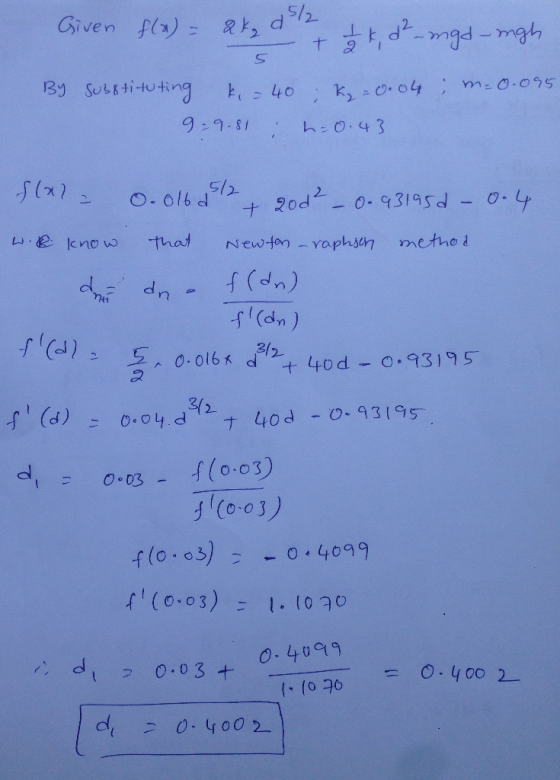
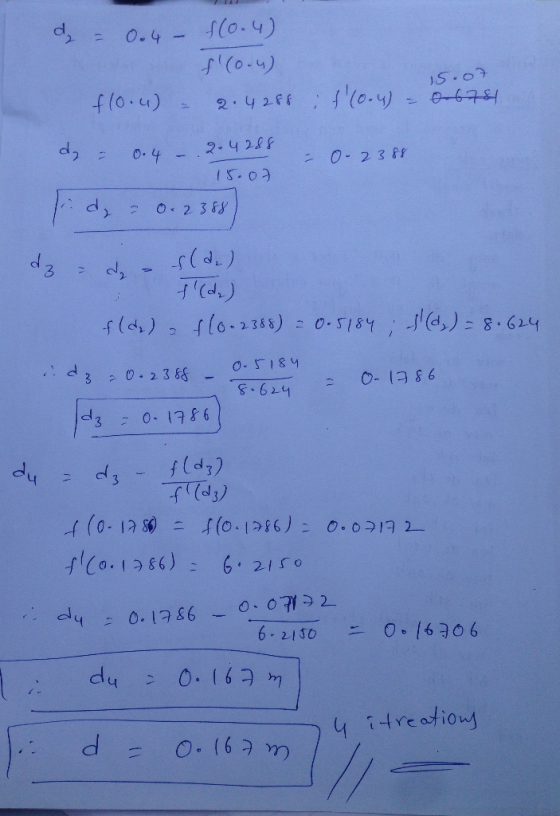
In mechanical system, as shown in Figure 1, the resistance force, F of spring can be related to t...
The mechanical system shown in the figure below is excited by a sinusoidal force f(t)-Fi cos(ut...
 The mechanical system shown in the figure below is excited by a sinusoidal force f(t)-Fi cos(ut + ?) N. The differential equation of the displacement x(t) is Use phasor techniques to solve for the displacement phasor Xin terms of the excitation frequency ? , and the mechanical elements M = 0.1 kg, D = 8 N-s/m , and K = 2,000 N/m . If Fi-10 N and ?? = 30°, determine the excitation frequency w (in rad/s) at which the...
Q5 The equation of the motion of the mechanical system shown in the following figure is...
 Q5 The equation of the motion of the mechanical system shown in the following figure is governed by the following differential equation d2 x dx m7+9+= -f(t) - 3kx dt2 dt where m, C and k are mass, damping coefficient and spring constant, respectively. Consider the system with m = 10 kg, c = 80 Ns/m, k = 50 N/m, and the system is at rest at time t = 0 s. f(t) is the external force acting on the...
Problem 1 (Harmonic Oscillators) A mass-damper-spring system is a simple harmonic oscillator whose dynamics is governed...
 Problem 1 (Harmonic Oscillators) A mass-damper-spring system is a simple harmonic oscillator whose dynamics is governed by the equation of motion where m is the mass, c is the damping coefficient of the damper, k is the stiffness of the spring, F is the net force applied on the mass, and x is the displacement of the mass from its equilibrium point. In this problem, we focus on a mass-damper-spring system with m = 1 kg, c-4 kg/s, k-3 N/m,...
Question 3 (35 marks) Consider a mechanical system shown in Figure 3. The system is at rest for t
 Question 3 (35 marks) Consider a mechanical system shown in Figure 3. The system is at rest for t<0. The input force f is applied at 0. The displacement x is the output of the system and is measured from the equilibrium position. kI b2 bi it Figure 3. Schematic of a mechanical system. (a) Obtain the traf) (10 marks) X (s) F(s) (b) Use of force-voltage analogy, obtain the equations for an electrical system (5 marks) (c) Draw a...
Consider the translational mechanical system shown in the figure. A 1-pound force, f(t), is applied at...
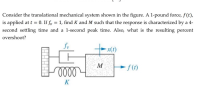 Consider the translational mechanical system shown in the figure. A 1-pound force, f(t), is applied at t = 0. If fo = 1, find K and M such that the response is characterized by a 4- second settling time and a 1-second peak time. Also, what is the resulting percent overshoot? ft
4. Consider the mechanical system shown below with a spring with stiffness, k (N/m), in parallel...
 4. Consider the mechanical system shown below with a spring with stiffness, k (N/m), in parallel with a viscous damper with coefficient, h (Nós/m) and an externally applied force, Fexi(t) (N). u(t) a. Find the equation that relates the applied force, Fext(t) and the displacement, u(t). b. If the spring component has a stiffness of k = 75 N/m, the damper component has coefficient h = 50 N s/m and the externally applied force is a constant 4.5 N applied...
PROBLEM 1 (35 %) The mechanical system in the figure below consists of a disk of radius r, a block of mass m, a spr...
 PROBLEM 1 (35 %) The mechanical system in the figure below consists of a disk of radius r, a block of mass m, a spring of stiffness (spring constant) k, and a damper with damping ratio b. The disk has moment of inertia Jabout its center of mass (pivot point O), and the block is subjected to an external force t) as shown in the figure. The spring is unstressed when x 0= 0. Assume small 0. (a) (10 points)...
For a mass-spring-damper mechanical systems shown below, x200) K1-1 N/m 0000 -X,(0) K-1 N/m 00004 =...
 For a mass-spring-damper mechanical systems shown below, x200) K1-1 N/m 0000 -X,(0) K-1 N/m 00004 = 1 N-s/m fr2 M1=1 kg = 2 N-s/m M2 -1 kg 13 = 1 N-s/m 1. Find the differential equations relating input force f(t) and output displacement xi(t) and x2(C) in the system. (40 marks) (Hint: K, fy and M are spring constant, friction coefficient and mass respectively) 2. Determine the transfer function G(s)= X1(s)/F(s) (20 marks)
QUESTION 2: Consider this forced translational mass-spring-damper (MSD) system: The input is the external force "F(t)"...
 QUESTION 2: Consider this forced translational mass-spring-damper (MSD) system: The input is the external force "F(t)" and the output is position "x(t)." The transfer function for this system is g) - 6 - Mz? +BS+K It is known that M - 1 kg. B - 10 mm, and there are three possible values of K: (K = 16 K = 34 NK-89 The only possible external forces "F(t)" have the following Laplace transforms: 1) F,(s) - 0 (corresponding to external...
F(t) 1. The spring-mass system shown in the figure has • m=40kg, • k = 38.6kN...
 F(t) 1. The spring-mass system shown in the figure has • m=40kg, • k = 38.6kN / m • C=0.2518kNs / m The mass vibrates harmonically with an amplitude of 1mm and angular frequency @=100rad /s . 1.1 What is the amplitude of the force? 1.2 What is the frequency of the force that yields the maximum vibration amplitude? If the force amplitude is the same as the value computed in 1.1, what is the resulting vibration amplitude?
 The mechanical system shown in the figure below is excited by a sinusoidal force f(t)-Fi cos(ut + ?) N. The differential equation of the displacement x(t) is Use phasor techniques to solve for the displacement phasor Xin terms of the excitation frequency ? , and the mechanical elements M = 0.1 kg, D = 8 N-s/m , and K = 2,000 N/m . If Fi-10 N and ?? = 30°, determine the excitation frequency w (in rad/s) at which the...
 Q5 The equation of the motion of the mechanical system shown in the following figure is governed by the following differential equation d2 x dx m7+9+= -f(t) - 3kx dt2 dt where m, C and k are mass, damping coefficient and spring constant, respectively. Consider the system with m = 10 kg, c = 80 Ns/m, k = 50 N/m, and the system is at rest at time t = 0 s. f(t) is the external force acting on the...
 Problem 1 (Harmonic Oscillators) A mass-damper-spring system is a simple harmonic oscillator whose dynamics is governed by the equation of motion where m is the mass, c is the damping coefficient of the damper, k is the stiffness of the spring, F is the net force applied on the mass, and x is the displacement of the mass from its equilibrium point. In this problem, we focus on a mass-damper-spring system with m = 1 kg, c-4 kg/s, k-3 N/m,...
 Question 3 (35 marks) Consider a mechanical system shown in Figure 3. The system is at rest for t<0. The input force f is applied at 0. The displacement x is the output of the system and is measured from the equilibrium position. kI b2 bi it Figure 3. Schematic of a mechanical system. (a) Obtain the traf) (10 marks) X (s) F(s) (b) Use of force-voltage analogy, obtain the equations for an electrical system (5 marks) (c) Draw a...
 Consider the translational mechanical system shown in the figure. A 1-pound force, f(t), is applied at t = 0. If fo = 1, find K and M such that the response is characterized by a 4- second settling time and a 1-second peak time. Also, what is the resulting percent overshoot? ft
 4. Consider the mechanical system shown below with a spring with stiffness, k (N/m), in parallel with a viscous damper with coefficient, h (Nós/m) and an externally applied force, Fexi(t) (N). u(t) a. Find the equation that relates the applied force, Fext(t) and the displacement, u(t). b. If the spring component has a stiffness of k = 75 N/m, the damper component has coefficient h = 50 N s/m and the externally applied force is a constant 4.5 N applied...
 PROBLEM 1 (35 %) The mechanical system in the figure below consists of a disk of radius r, a block of mass m, a spring of stiffness (spring constant) k, and a damper with damping ratio b. The disk has moment of inertia Jabout its center of mass (pivot point O), and the block is subjected to an external force t) as shown in the figure. The spring is unstressed when x 0= 0. Assume small 0. (a) (10 points)...
 For a mass-spring-damper mechanical systems shown below, x200) K1-1 N/m 0000 -X,(0) K-1 N/m 00004 = 1 N-s/m fr2 M1=1 kg = 2 N-s/m M2 -1 kg 13 = 1 N-s/m 1. Find the differential equations relating input force f(t) and output displacement xi(t) and x2(C) in the system. (40 marks) (Hint: K, fy and M are spring constant, friction coefficient and mass respectively) 2. Determine the transfer function G(s)= X1(s)/F(s) (20 marks)
 QUESTION 2: Consider this forced translational mass-spring-damper (MSD) system: The input is the external force "F(t)" and the output is position "x(t)." The transfer function for this system is g) - 6 - Mz? +BS+K It is known that M - 1 kg. B - 10 mm, and there are three possible values of K: (K = 16 K = 34 NK-89 The only possible external forces "F(t)" have the following Laplace transforms: 1) F,(s) - 0 (corresponding to external...
 F(t) 1. The spring-mass system shown in the figure has • m=40kg, • k = 38.6kN / m • C=0.2518kNs / m The mass vibrates harmonically with an amplitude of 1mm and angular frequency @=100rad /s . 1.1 What is the amplitude of the force? 1.2 What is the frequency of the force that yields the maximum vibration amplitude? If the force amplitude is the same as the value computed in 1.1, what is the resulting vibration amplitude?
Most questions answered within 3 hours.
-
Where is the error in this code sequence?
String s1 = "Hello";
String s2 = "ello";...
asked 11 months ago -
Financial data for Joel de Paris, Inc., for last year
follow:
Joel de Paris, Inc.
Balance...
asked 11 months ago -
Consider this reaction:
Al2(SO4)3 (aq)+ BaCl3
(aq) Al2Cl6 (aq)- +
3BaSO4(s) . What is the...
asked 11 months ago -
Suppose that Savneet is considering increasing her
recent random sample from 20 car rentals to 40...
asked 11 months ago -
Trucks arrive at an unloading terminal at an average rate of 120
per hour.
Trucks arrive...
asked 11 months ago -
Why are methanol and ethanol completely soluble in water while
octanol is not very little soluble....
asked 11 months ago -
A facilities manager at a university reads in a research report
that the mean amount of...
asked 11 months ago -
When the CuSO4 is rehydrated by adding water to the anhydrous
compound, is this an endothermic...
asked 11 months ago -
A ray of sunlight is passing from diamond into crown glass; the
angle of incidence is...
asked 11 months ago -
A block of mass 0.249 kg is placed on top of a light, vertical
spring of...
asked 11 months ago -
how do the kidneys compensate in the presences of acidosis
a) trigger hyperventilate
b) reserve acid...
asked 11 months ago -
Question 501 pts
The rental rate of capital to the firm increases. Which of the
following...
asked 11 months ago