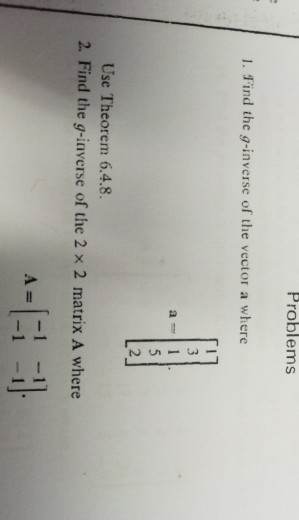
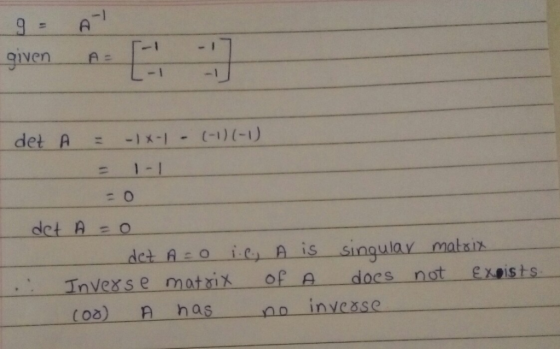
The first one is sorted only left with the second question
Homework Answers
Give an example of a matrix A that has a left inverse but does not have...
 Give an example of a matrix A that has a left inverse but does
not have a right inverse. (If BA = I then B is a left inverse of
A.) 2. Give an example of a matrix A that has a right inverse but
does not have a left inverse. (If AB = I then B is a right inverse
of A.) Let V and W be vector spaces. If T 2 L(V;W) is invertible
then T is called...
Give an example of a matrix A that has a left inverse but does
not have a right inverse. (If BA = I then B is a left inverse of
A.) 2. Give an example of a matrix A that has a right inverse but
does not have a left inverse. (If AB = I then B is a right inverse
of A.) Let V and W be vector spaces. If T 2 L(V;W) is invertible
then T is called...
6. Write a function integerdivision that takes two input numbers and divides the first one with the second one. Question 2 a) Create a vector A with all integers between 5 and 400. 4 Marks ) Give...
 6. Write a function integerdivision that takes two input numbers and divides the first one with the second one. Question 2 a) Create a vector A with all integers between 5 and 400. 4 Marks ) Given a matrix Z, how to access element of the matrix. c) What is the output of this MATLAB code? A [2,4,10,13;16,3,7,18, 8,4,9,25:3,12,15,17); length(A) size(A) Ans) Ans)
6. Write a function integerdivision that takes two input numbers and divides the first one with the...
6. Write a function integerdivision that takes two input numbers and divides the first one with the second one. Question 2 a) Create a vector A with all integers between 5 and 400. 4 Marks ) Given a matrix Z, how to access element of the matrix. c) What is the output of this MATLAB code? A [2,4,10,13;16,3,7,18, 8,4,9,25:3,12,15,17); length(A) size(A) Ans) Ans)
6. Write a function integerdivision that takes two input numbers and divides the first one with the...
Please help step by step with problem 20. Thanks. The Second Shifting Theorem Replacing g() by...
 Please help step by step with problem 20. Thanks.
The Second Shifting Theorem Replacing g() by g(1 – t) in Theorem 8.4.1 yields the next theorem. Theorem 8.4.2 (Second Shifting Theorem Ift > 0 and L(8) exists for s > So then L (ult – t)g(1 – t)) exists for s > 50 and Luſt - t)g(t – t)) = e-"L()). or, equivalently, ifgt) G(s), then uſt - t):(t – t) e "G(s). (8.4.12) REMARK: Recall that the First Shifting...
Please help step by step with problem 20. Thanks.
The Second Shifting Theorem Replacing g() by g(1 – t) in Theorem 8.4.1 yields the next theorem. Theorem 8.4.2 (Second Shifting Theorem Ift > 0 and L(8) exists for s > So then L (ult – t)g(1 – t)) exists for s > 50 and Luſt - t)g(t – t)) = e-"L()). or, equivalently, ifgt) G(s), then uſt - t):(t – t) e "G(s). (8.4.12) REMARK: Recall that the First Shifting...
Problem 3. A connection to second-onter ODE Recall the second-order ODE ay" + by' cy g(t), where ...
 Problem 3. A connection to second-onter ODE Recall the second-order ODE ay" + by' cy g(t), where a 0, b, and c are all constant and g(t) is the non-homogenous term. (a) Use a substitution to show that this ODE can be written as a vector equation их for a constant, 2 × 2 matrix A and vector functions x(t) and G(t) (b) Compute the characteristic equation of the matrix A, and relate this to the original second-order ODE.
Problem...
Problem 3. A connection to second-onter ODE Recall the second-order ODE ay" + by' cy g(t), where a 0, b, and c are all constant and g(t) is the non-homogenous term. (a) Use a substitution to show that this ODE can be written as a vector equation их for a constant, 2 × 2 matrix A and vector functions x(t) and G(t) (b) Compute the characteristic equation of the matrix A, and relate this to the original second-order ODE.
Problem...
Just answer the first one, second one is to get an idea of what answer must...
 Just answer the first one, second one is to get an idea of what
answer must look like.
Question 5 [3 points] Find the point of the way from (-6, -1, 0) to (0, 9, -3). P= 0 Question 5 [3 points] Find the point of the way from (-7, -9, 2) to (6,6, -7). P= 10 30 Marking: The correct answer is: آ | ذرا نم ! Your point has 3 incorrect entries. To find the point some fraction...
Just answer the first one, second one is to get an idea of what
answer must look like.
Question 5 [3 points] Find the point of the way from (-6, -1, 0) to (0, 9, -3). P= 0 Question 5 [3 points] Find the point of the way from (-7, -9, 2) to (6,6, -7). P= 10 30 Marking: The correct answer is: آ | ذرا نم ! Your point has 3 incorrect entries. To find the point some fraction...
3. (10 points) Simultaneous left inverse The two matrices 3 2] and both left-invertible, and have multiple left inverses. Do they have a common left inverse? Explain how to find a 2 × 4 matrix C that...
 3. (10 points) Simultaneous left inverse The two matrices 3 2] and both left-invertible, and have multiple left inverses. Do they have a common left inverse? Explain how to find a 2 × 4 matrix C that satisfies CA-CB-1, or determine that no such matrix exists. (You can use numerical computing to find C.) Hint. Set up a set of linear equations for the entries of C. Remark. There is nothing special about the particular entries of the two matrices...
(a) Show that if the matrix B is invertible, then the only solution of the equation...
 (a) Show that if the matrix B is invertible, then the only solution of the equation BX = 0 (where is the zero square matrix of the same size as B) is X-0. (b) Consider a matrix partitioned in blocks, of the form A 0 ( BC where A and C are invertible, not necessarily of the same size. Find its inverse, itself partitioned in blocks of the same size, in terms of A, B, C. Hint: one of the...
general relativity question. Instructions The first problem is just a test of how well one knows...
 general relativity question.
Instructions The first problem is just a test of how well one knows the methods of averaging over directions. This is a standard tool which is used in many areas of classical electrodynamics and general relativity. e.g, in the context of the radiation problem and in the context of particle motion in inhomogeneous electromagnetic fields. The second problem is just a test of how well one understood the content of the present lecture. Solve the problems and...
general relativity question.
Instructions The first problem is just a test of how well one knows the methods of averaging over directions. This is a standard tool which is used in many areas of classical electrodynamics and general relativity. e.g, in the context of the radiation problem and in the context of particle motion in inhomogeneous electromagnetic fields. The second problem is just a test of how well one understood the content of the present lecture. Solve the problems and...
(a) Show that if the matrix B is invertible, then the only solution of the equation...
 (a) Show that if the matrix B is invertible, then the only solution of the equation BX = 0 (where 0 is the zero square matrix of the same size as B) is X-0. (b) Consider a matrix partitioned in blocks, of the form (Α (в ο). с) where A and C are invertible, not necessarily of the same size. Find its inverse, itself partitioned in blocks of the same size, in terms of A, B, C. Hint: one of...
1. Consider a smooth function f(t) defined on 0 t
 Applied Mathematics Laplace Transforms
1. Consider a smooth function f(t) defined on 0 t<o, with Laplace transform F(s) (a) Prove the First Shift Theorem, which states that Lfeatf(t)) = F(s-a), where a is a constant. Use the First Shift Theorem to find the inverse trans- form of s2 -6s 12 6 marks (b) Prove the Second Shift Theorem, which states that L{f(t-a)H(t-a))-e-as F(s), where H is the Heaviside step function and a is a positive constant. Use the First and...
Applied Mathematics Laplace Transforms
1. Consider a smooth function f(t) defined on 0 t<o, with Laplace transform F(s) (a) Prove the First Shift Theorem, which states that Lfeatf(t)) = F(s-a), where a is a constant. Use the First Shift Theorem to find the inverse trans- form of s2 -6s 12 6 marks (b) Prove the Second Shift Theorem, which states that L{f(t-a)H(t-a))-e-as F(s), where H is the Heaviside step function and a is a positive constant. Use the First and...
 Give an example of a matrix A that has a left inverse but does
not have a right inverse. (If BA = I then B is a left inverse of
A.) 2. Give an example of a matrix A that has a right inverse but
does not have a left inverse. (If AB = I then B is a right inverse
of A.) Let V and W be vector spaces. If T 2 L(V;W) is invertible
then T is called...
Give an example of a matrix A that has a left inverse but does
not have a right inverse. (If BA = I then B is a left inverse of
A.) 2. Give an example of a matrix A that has a right inverse but
does not have a left inverse. (If AB = I then B is a right inverse
of A.) Let V and W be vector spaces. If T 2 L(V;W) is invertible
then T is called...
 6. Write a function integerdivision that takes two input numbers and divides the first one with the second one. Question 2 a) Create a vector A with all integers between 5 and 400. 4 Marks ) Given a matrix Z, how to access element of the matrix. c) What is the output of this MATLAB code? A [2,4,10,13;16,3,7,18, 8,4,9,25:3,12,15,17); length(A) size(A) Ans) Ans)
6. Write a function integerdivision that takes two input numbers and divides the first one with the...
6. Write a function integerdivision that takes two input numbers and divides the first one with the second one. Question 2 a) Create a vector A with all integers between 5 and 400. 4 Marks ) Given a matrix Z, how to access element of the matrix. c) What is the output of this MATLAB code? A [2,4,10,13;16,3,7,18, 8,4,9,25:3,12,15,17); length(A) size(A) Ans) Ans)
6. Write a function integerdivision that takes two input numbers and divides the first one with the...
 Please help step by step with problem 20. Thanks.
The Second Shifting Theorem Replacing g() by g(1 – t) in Theorem 8.4.1 yields the next theorem. Theorem 8.4.2 (Second Shifting Theorem Ift > 0 and L(8) exists for s > So then L (ult – t)g(1 – t)) exists for s > 50 and Luſt - t)g(t – t)) = e-"L()). or, equivalently, ifgt) G(s), then uſt - t):(t – t) e "G(s). (8.4.12) REMARK: Recall that the First Shifting...
Please help step by step with problem 20. Thanks.
The Second Shifting Theorem Replacing g() by g(1 – t) in Theorem 8.4.1 yields the next theorem. Theorem 8.4.2 (Second Shifting Theorem Ift > 0 and L(8) exists for s > So then L (ult – t)g(1 – t)) exists for s > 50 and Luſt - t)g(t – t)) = e-"L()). or, equivalently, ifgt) G(s), then uſt - t):(t – t) e "G(s). (8.4.12) REMARK: Recall that the First Shifting...
 Problem 3. A connection to second-onter ODE Recall the second-order ODE ay" + by' cy g(t), where a 0, b, and c are all constant and g(t) is the non-homogenous term. (a) Use a substitution to show that this ODE can be written as a vector equation их for a constant, 2 × 2 matrix A and vector functions x(t) and G(t) (b) Compute the characteristic equation of the matrix A, and relate this to the original second-order ODE.
Problem...
Problem 3. A connection to second-onter ODE Recall the second-order ODE ay" + by' cy g(t), where a 0, b, and c are all constant and g(t) is the non-homogenous term. (a) Use a substitution to show that this ODE can be written as a vector equation их for a constant, 2 × 2 matrix A and vector functions x(t) and G(t) (b) Compute the characteristic equation of the matrix A, and relate this to the original second-order ODE.
Problem...
 Just answer the first one, second one is to get an idea of what
answer must look like.
Question 5 [3 points] Find the point of the way from (-6, -1, 0) to (0, 9, -3). P= 0 Question 5 [3 points] Find the point of the way from (-7, -9, 2) to (6,6, -7). P= 10 30 Marking: The correct answer is: آ | ذرا نم ! Your point has 3 incorrect entries. To find the point some fraction...
Just answer the first one, second one is to get an idea of what
answer must look like.
Question 5 [3 points] Find the point of the way from (-6, -1, 0) to (0, 9, -3). P= 0 Question 5 [3 points] Find the point of the way from (-7, -9, 2) to (6,6, -7). P= 10 30 Marking: The correct answer is: آ | ذرا نم ! Your point has 3 incorrect entries. To find the point some fraction...
 3. (10 points) Simultaneous left inverse The two matrices 3 2] and both left-invertible, and have multiple left inverses. Do they have a common left inverse? Explain how to find a 2 × 4 matrix C that satisfies CA-CB-1, or determine that no such matrix exists. (You can use numerical computing to find C.) Hint. Set up a set of linear equations for the entries of C. Remark. There is nothing special about the particular entries of the two matrices...
 (a) Show that if the matrix B is invertible, then the only solution of the equation BX = 0 (where is the zero square matrix of the same size as B) is X-0. (b) Consider a matrix partitioned in blocks, of the form A 0 ( BC where A and C are invertible, not necessarily of the same size. Find its inverse, itself partitioned in blocks of the same size, in terms of A, B, C. Hint: one of the...
 general relativity question.
Instructions The first problem is just a test of how well one knows the methods of averaging over directions. This is a standard tool which is used in many areas of classical electrodynamics and general relativity. e.g, in the context of the radiation problem and in the context of particle motion in inhomogeneous electromagnetic fields. The second problem is just a test of how well one understood the content of the present lecture. Solve the problems and...
general relativity question.
Instructions The first problem is just a test of how well one knows the methods of averaging over directions. This is a standard tool which is used in many areas of classical electrodynamics and general relativity. e.g, in the context of the radiation problem and in the context of particle motion in inhomogeneous electromagnetic fields. The second problem is just a test of how well one understood the content of the present lecture. Solve the problems and...
 (a) Show that if the matrix B is invertible, then the only solution of the equation BX = 0 (where 0 is the zero square matrix of the same size as B) is X-0. (b) Consider a matrix partitioned in blocks, of the form (Α (в ο). с) where A and C are invertible, not necessarily of the same size. Find its inverse, itself partitioned in blocks of the same size, in terms of A, B, C. Hint: one of...
 Applied Mathematics Laplace Transforms
1. Consider a smooth function f(t) defined on 0 t<o, with Laplace transform F(s) (a) Prove the First Shift Theorem, which states that Lfeatf(t)) = F(s-a), where a is a constant. Use the First Shift Theorem to find the inverse trans- form of s2 -6s 12 6 marks (b) Prove the Second Shift Theorem, which states that L{f(t-a)H(t-a))-e-as F(s), where H is the Heaviside step function and a is a positive constant. Use the First and...
Applied Mathematics Laplace Transforms
1. Consider a smooth function f(t) defined on 0 t<o, with Laplace transform F(s) (a) Prove the First Shift Theorem, which states that Lfeatf(t)) = F(s-a), where a is a constant. Use the First Shift Theorem to find the inverse trans- form of s2 -6s 12 6 marks (b) Prove the Second Shift Theorem, which states that L{f(t-a)H(t-a))-e-as F(s), where H is the Heaviside step function and a is a positive constant. Use the First and...
Most questions answered within 3 hours.
-
Where is the error in this code sequence?
String s1 = "Hello";
String s2 = "ello";...
asked 11 months ago -
Financial data for Joel de Paris, Inc., for last year
follow:
Joel de Paris, Inc.
Balance...
asked 11 months ago -
Consider this reaction:
Al2(SO4)3 (aq)+ BaCl3
(aq) Al2Cl6 (aq)- +
3BaSO4(s) . What is the...
asked 11 months ago -
Suppose that Savneet is considering increasing her
recent random sample from 20 car rentals to 40...
asked 11 months ago -
Trucks arrive at an unloading terminal at an average rate of 120
per hour.
Trucks arrive...
asked 11 months ago -
Why are methanol and ethanol completely soluble in water while
octanol is not very little soluble....
asked 11 months ago -
A facilities manager at a university reads in a research report
that the mean amount of...
asked 11 months ago -
When the CuSO4 is rehydrated by adding water to the anhydrous
compound, is this an endothermic...
asked 11 months ago -
A ray of sunlight is passing from diamond into crown glass; the
angle of incidence is...
asked 11 months ago -
A block of mass 0.249 kg is placed on top of a light, vertical
spring of...
asked 11 months ago -
how do the kidneys compensate in the presences of acidosis
a) trigger hyperventilate
b) reserve acid...
asked 11 months ago -
Question 501 pts
The rental rate of capital to the firm increases. Which of the
following...
asked 11 months ago