
Homework Answers
Add Answer to:
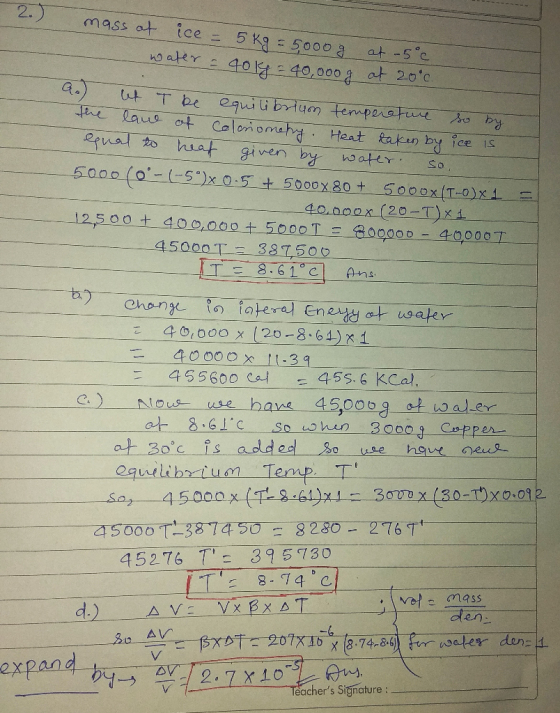
Of ice at -S °C is added to 40 kg of water initially at 20 °C. Assume that the container is well ...
Three 110.0-g ice cubes initially at 0°C are added to 0.860 kg of water initially at 21.0°C in an insulated container....
 Three 110.0-g ice cubes initially at 0°C are added to 0.860 kg of water initially at 21.0°C in an insulated container. (a) What is the equilibrium temperature of the system? °C (b) What is the mass of unmelted ice, if any, when the system is at equilibrium? 1 kg
A chunk of ice (T = -20 degree C) is added to a thermally insulated container...
 A chunk of ice (T = -20 degree C) is added to a thermally insulated container of cold water (T = 0 degree C). What happens in the container? The ice melts until thermal equilibrium is established. Some of the water freezes and the chunk of ice gets larger. The water cools down until thermal equilibrium is established. None of the above things happen.
Three 101.0-g ice cubes initially at 0°C are added to 0.820 kg of water initially at...
Three 101.0-g ice cubes initially at 0°C are added to 0.820 kg of water initially at 19.5°C in an insulated container. (a) What is the equilibrium temperature of the system? °C (b) What is the mass of unmelted ice, if any, when the system is at equilibrium? kg
200 gr of water in a thermally insulated container. 200 gr of water is initially at...
200 gr of water in a thermally insulated container. 200 gr of water is initially at 25 o C in a thermally insulated calorimeter. a) If 50 gr of ice at –15 o C is dropped into this calorimeter what is the final temperature after thermal equilibrium is established. b) If Instead 300 gr of ice at –30 o C is added how much ice will remain when equilibrium is reached? c) In part (a) what is the change in...
Three 110.0-g ice cubes initially at 0°C are added to 0.900 kg of water initially at...
 Three 110.0-g ice cubes initially at 0°C are added to 0.900 kg of water initially at 21.0°C in an insulated container. (a) What is the equilibrium temperature of the system? 9.13 Your response differs significantly from the correct answer. Rework your solution from the beginning and check each step carefully.°C (b) What is the mass of unmelted ice, if any, when the system is at equilibrium? The correct answer is not zero. kg
Ice with a mass of 0.15 kg at 0.0 degrees Celsius is added to 0.25 kg...
 Ice with a mass of 0.15 kg at 0.0 degrees Celsius is added to 0.25 kg of water at 20 degrees Celsius in a thermally insulated cup at atmospheric pressure. This approximates to a thermally insulated system of ice and water. Where no heat enters of leaves the system, what is the final (equilibrium) temperature of the system? Give your value in degrees Celsius.
Problem 5 20 points You place into an insulated container a 1.5 kg of copper initially...
 Problem 5 20 points You place into an insulated container a 1.5 kg of copper initially at 70°C. You add to the insulated container water, initially at 20°C to obtain a final temperature of the system equal to 50°C. The specific heat of some materials are given in the table below: Aluminum Copper Material J/g/°C Glass Gold Ice Iron Rubber Silver Water zinc 0.79 0.13 2.1 0.46 0.24 4.2 0.39 0.89 0.38 2 a) [5 points) What is the variation...
5.45 kg block of ice at 0°C is added to an insulated container partially filled with...
 5.45 kg block of ice at 0°C is added to an insulated container partially filled with 11.9 kg of water at 15.0°C (a) Find the final temperature, neglecting the heat capacity of the container (b) Find the mass of the ice that was melted. 3.21 Your response differs from the correct answer by more than 10%. Double check your calculations. kg GETTING STARTED | I'M STUCK! EXERCISE HINTS: If 9.00 kg of ice at -5.00°C is added to 12.0 kg...
A 0.040-kg ice cube at -10°C is placed in an insulated box that contains a fixed...
A 0.040-kg ice cube at -10°C is placed in an insulated box that contains a fixed quantity of steam at 100°C. When thermal equilibrium of this closed system is established, its temperature is found to be 23 °C. Determine the original mass of the steam at 100 °C.
Initially you have mW = 3.4 kg of water at TW = 54°C in an insulated container. You add ice at TI = -21°C to the contain...
 Initially you have mW = 3.4 kg of water at
TW = 54°C in an insulated container. You add
ice at TI = -21°C to the container and the mix
reaches a final, equilibrium temperature of Tf
= 25°C. The specific heats of ice and water are
cI = 2.10×10³J/(kg⋅°C) and
cW = 4.19×10³ J/(kg⋅°C),
respectively, and the latent heat of fusion for water is
Lf = 3.34×10⁵ J/kg.
(11%) Problem 7: Initially you have mw = 3.4 kg of...
Initially you have mW = 3.4 kg of water at
TW = 54°C in an insulated container. You add
ice at TI = -21°C to the container and the mix
reaches a final, equilibrium temperature of Tf
= 25°C. The specific heats of ice and water are
cI = 2.10×10³J/(kg⋅°C) and
cW = 4.19×10³ J/(kg⋅°C),
respectively, and the latent heat of fusion for water is
Lf = 3.34×10⁵ J/kg.
(11%) Problem 7: Initially you have mw = 3.4 kg of...
 Three 110.0-g ice cubes initially at 0°C are added to 0.860 kg of water initially at 21.0°C in an insulated container. (a) What is the equilibrium temperature of the system? °C (b) What is the mass of unmelted ice, if any, when the system is at equilibrium? 1 kg
 A chunk of ice (T = -20 degree C) is added to a thermally insulated container of cold water (T = 0 degree C). What happens in the container? The ice melts until thermal equilibrium is established. Some of the water freezes and the chunk of ice gets larger. The water cools down until thermal equilibrium is established. None of the above things happen.
 Three 110.0-g ice cubes initially at 0°C are added to 0.900 kg of water initially at 21.0°C in an insulated container. (a) What is the equilibrium temperature of the system? 9.13 Your response differs significantly from the correct answer. Rework your solution from the beginning and check each step carefully.°C (b) What is the mass of unmelted ice, if any, when the system is at equilibrium? The correct answer is not zero. kg
 Ice with a mass of 0.15 kg at 0.0 degrees Celsius is added to 0.25 kg of water at 20 degrees Celsius in a thermally insulated cup at atmospheric pressure. This approximates to a thermally insulated system of ice and water. Where no heat enters of leaves the system, what is the final (equilibrium) temperature of the system? Give your value in degrees Celsius.
 Problem 5 20 points You place into an insulated container a 1.5 kg of copper initially at 70°C. You add to the insulated container water, initially at 20°C to obtain a final temperature of the system equal to 50°C. The specific heat of some materials are given in the table below: Aluminum Copper Material J/g/°C Glass Gold Ice Iron Rubber Silver Water zinc 0.79 0.13 2.1 0.46 0.24 4.2 0.39 0.89 0.38 2 a) [5 points) What is the variation...
 5.45 kg block of ice at 0°C is added to an insulated container partially filled with 11.9 kg of water at 15.0°C (a) Find the final temperature, neglecting the heat capacity of the container (b) Find the mass of the ice that was melted. 3.21 Your response differs from the correct answer by more than 10%. Double check your calculations. kg GETTING STARTED | I'M STUCK! EXERCISE HINTS: If 9.00 kg of ice at -5.00°C is added to 12.0 kg...
 Initially you have mW = 3.4 kg of water at
TW = 54°C in an insulated container. You add
ice at TI = -21°C to the container and the mix
reaches a final, equilibrium temperature of Tf
= 25°C. The specific heats of ice and water are
cI = 2.10×10³J/(kg⋅°C) and
cW = 4.19×10³ J/(kg⋅°C),
respectively, and the latent heat of fusion for water is
Lf = 3.34×10⁵ J/kg.
(11%) Problem 7: Initially you have mw = 3.4 kg of...
Initially you have mW = 3.4 kg of water at
TW = 54°C in an insulated container. You add
ice at TI = -21°C to the container and the mix
reaches a final, equilibrium temperature of Tf
= 25°C. The specific heats of ice and water are
cI = 2.10×10³J/(kg⋅°C) and
cW = 4.19×10³ J/(kg⋅°C),
respectively, and the latent heat of fusion for water is
Lf = 3.34×10⁵ J/kg.
(11%) Problem 7: Initially you have mw = 3.4 kg of...
Most questions answered within 3 hours.
-
Where is the error in this code sequence?
String s1 = "Hello";
String s2 = "ello";...
asked 11 months ago -
Financial data for Joel de Paris, Inc., for last year
follow:
Joel de Paris, Inc.
Balance...
asked 11 months ago -
Consider this reaction:
Al2(SO4)3 (aq)+ BaCl3
(aq) Al2Cl6 (aq)- +
3BaSO4(s) . What is the...
asked 11 months ago -
Suppose that Savneet is considering increasing her
recent random sample from 20 car rentals to 40...
asked 11 months ago -
Trucks arrive at an unloading terminal at an average rate of 120
per hour.
Trucks arrive...
asked 11 months ago -
Why are methanol and ethanol completely soluble in water while
octanol is not very little soluble....
asked 11 months ago -
A facilities manager at a university reads in a research report
that the mean amount of...
asked 11 months ago -
When the CuSO4 is rehydrated by adding water to the anhydrous
compound, is this an endothermic...
asked 11 months ago -
A ray of sunlight is passing from diamond into crown glass; the
angle of incidence is...
asked 11 months ago -
A block of mass 0.249 kg is placed on top of a light, vertical
spring of...
asked 11 months ago -
how do the kidneys compensate in the presences of acidosis
a) trigger hyperventilate
b) reserve acid...
asked 11 months ago -
Question 501 pts
The rental rate of capital to the firm increases. Which of the
following...
asked 11 months ago