
Homework Answers
Add Answer to:
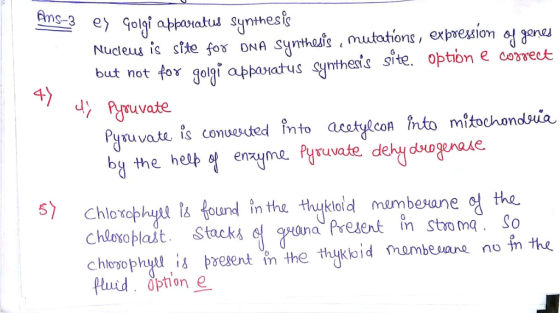
Of: a) NA as the site s eukaryotic cells become more specialized, the nucleus is NOT important sy...
42. Which statement is NOT true about DNA? a) DNA acts like an enzyme by binding...
 42. Which statement is NOT true about DNA? a) DNA acts like an enzyme by binding amino acids together using dehydration synthesis. b) Before cells divide both strands must be copied and one is provided for each new cell cm RNA is copied from a piece of DNA termed a gene. d) DNA is not always copied perfectly. Mistakes, mutations, occur and result in changed proteins, e) DNA functions as code for the synthesis of proteins. 43. A section of...
1. Transcription occurs in the a. Nucleus. b. Ribosomes of the Rough Endoplasmic Reticulum. c. Mitochondrion....
1. Transcription occurs in the a. Nucleus. b. Ribosomes of the Rough Endoplasmic Reticulum. c. Mitochondrion. d. Cell membrane. e. Smooth Endoplasmic Reticulum. 2. The monomers of DNA and RNA are a. amino acids. b. monosaccharides. c. nucleotides. d. fatty acids. e. nucleic acids. 3. Which of the following statements regarding DNA is false? a. DNA uses the nitrogenous base uracil. b. DNA is a nucleic acid. c. One DNA molecule can include four different nucleotides in its structure. d....
Match each molecule to its description. Answers may be used more than once. a. DNA b....
Match each molecule to its description. Answers may be used more than once. a. DNA b. mRNA c. tRNA d. ribosomes 1. Chromosomes 2. Carries specific amino acids into the cytoplasm. 3. Carried protein synthesis instructions out of the nucleus. 4. Site of protein synthesis. 5. Serves as a blueprint for mRNA
Which of the following are characteristic of both prokaryotic and eukaryotic cells? Cytoplasm and a well-defined...
 Which of the following are characteristic of both prokaryotic and eukaryotic cells? Cytoplasm and a well-defined nucleus surrounded by a membrane Membranous sites of ATP synthesis, Golgi complex, and ribosomes Mitochondria, nucleus, and ribosomes D) Cell wall, several chromosomes, and cytoplasm Cell membrane, ribosomes, DNA, and RNA
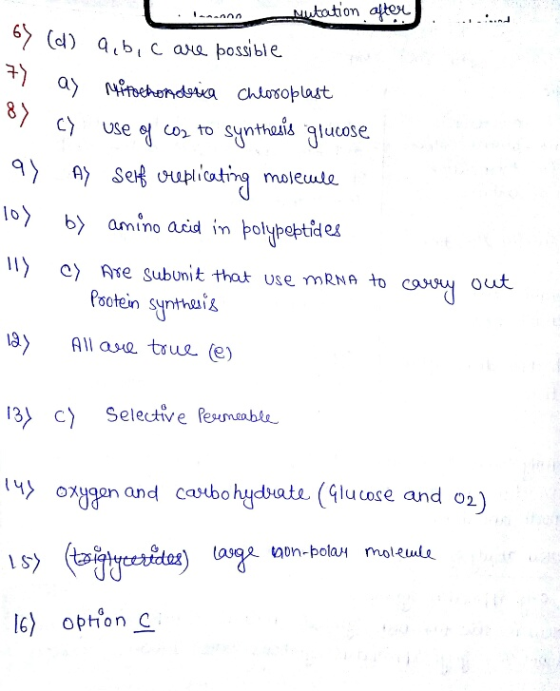
36. Which of the following is true for the ribosomes (rRNA) found in Prokaryotic cells? They are: a) made of DNA and protejn, b) the active site in carbohydrate synthesis, c) subunits that use m...
 36. Which of the following is true for the ribosomes (rRNA) found in Prokaryotic cells? They are: a) made of DNA and protejn, b) the active site in carbohydrate synthesis, c) subunits that use mRNA as the directions for primary structure of protein attached to the endoplasmic reticulum, e) used to synthesize DNA by dehydration synthesis. answer the question and give a why the circled answer wasn't correct
36. Which of the following is true for the ribosomes (rRNA) found...
36. Which of the following is true for the ribosomes (rRNA) found in Prokaryotic cells? They are: a) made of DNA and protejn, b) the active site in carbohydrate synthesis, c) subunits that use mRNA as the directions for primary structure of protein attached to the endoplasmic reticulum, e) used to synthesize DNA by dehydration synthesis. answer the question and give a why the circled answer wasn't correct
36. Which of the following is true for the ribosomes (rRNA) found...
Prokaryotic mRNA usually encodes for more than one protein while eukaryotic mRNA a single protein. Eukaryotic...
 Prokaryotic mRNA usually encodes for more than one protein while eukaryotic mRNA a single protein. Eukaryotic DNA is linear and bacterial and archaeal DNA is-linear. In prokaryotes, ribosomes attach to the mRNA and start protein synthesis even before transcription is completed. Eukaryotic mRNA, rRNA, and tRNA are all highway processed. Nuclear pore complexes control the entry and exit to and from the nucleus. They will not let mRNA exit the nucleus before it is full processed. Eukaryotic and archaeal DNA...
the several other 10.4 to show t 3. The base uracil substitutes for the base thymine in RNA. Complete Table ways...
 the several other 10.4 to show t 3. The base uracil substitutes for the base thymine in RNA. Complete Table ways RNA differs from DNA Table 10.4 DNA Structure Compared with RNA Structure RNA Sugar Bases Strands Helix DNA Deoxyribose Adenine, guanine, thymine, cytosine Double stranded with base pairing Yes Complementary Base Pairing Complementary base pairing occurs between DNA and RNA. The RNA base uracil pairs with the DNA base adenine; the other bases pair as shown previously. Complete Table...
24. Of all the evidence that the mitochondria of eukaryotic cells is derived from endosymbiosis which...
 24. Of all the evidence that the mitochondria of eukaryotic cells is derived from endosymbiosis which it the most important? Select one: a. Their inner membrane resembles the composition of those found in many bacteria b. They have two membranes c. Single circular chromosome d. Their ribosomes are the 70S form that are found in all bacteria e. Their DNA has sequences unique to bacteria 25. Which of the following pairs is mismatched? Select one: a. 70S and 50S b....
Complete a concept map of translation, indicate where it takes place, and describe what will happen...
Complete a concept map of translation, indicate where it takes place, and describe what will happen if the anticodon is not attached to transfer RNA. A)DNA unzips ?transcription of mRNA ? mRNA leaves nucleus ? mRNA binds to ?ribosome ? tRNA brings in amino acid? tRNA anticodon binds to codon on mRNA ? peptide bond binds amino acids to form protein ? transport of the amino acids to the mRNA by tRNA continues until the mRNA translation is completed. This...
9. Which of these organelles contains an inner membrane folded inward to form cristae? a. nucleus...
 9. Which of these organelles contains an inner membrane folded inward to form cristae? a. nucleus b. chloroplast c. rough ER d. mitochondrion e. smooth ER 10. Which reaction requires an enzyme? a. ATP -ADP Pi ADP +Pi >ATP C. Sucrose->glucose+fructose d. glyceraldehyde 3-phosphate (G3P)> 1,3-diphosphoglyceric acid e. all of these 11. What would happen to human red blood cells placed in a solution of sucrose that is hypertonic to their cytoplasm? a. b. C. d. e. They would take...
 42. Which statement is NOT true about DNA? a) DNA acts like an enzyme by binding amino acids together using dehydration synthesis. b) Before cells divide both strands must be copied and one is provided for each new cell cm RNA is copied from a piece of DNA termed a gene. d) DNA is not always copied perfectly. Mistakes, mutations, occur and result in changed proteins, e) DNA functions as code for the synthesis of proteins. 43. A section of...
 Which of the following are characteristic of both prokaryotic and eukaryotic cells? Cytoplasm and a well-defined nucleus surrounded by a membrane Membranous sites of ATP synthesis, Golgi complex, and ribosomes Mitochondria, nucleus, and ribosomes D) Cell wall, several chromosomes, and cytoplasm Cell membrane, ribosomes, DNA, and RNA
 36. Which of the following is true for the ribosomes (rRNA) found in Prokaryotic cells? They are: a) made of DNA and protejn, b) the active site in carbohydrate synthesis, c) subunits that use mRNA as the directions for primary structure of protein attached to the endoplasmic reticulum, e) used to synthesize DNA by dehydration synthesis. answer the question and give a why the circled answer wasn't correct
36. Which of the following is true for the ribosomes (rRNA) found...
36. Which of the following is true for the ribosomes (rRNA) found in Prokaryotic cells? They are: a) made of DNA and protejn, b) the active site in carbohydrate synthesis, c) subunits that use mRNA as the directions for primary structure of protein attached to the endoplasmic reticulum, e) used to synthesize DNA by dehydration synthesis. answer the question and give a why the circled answer wasn't correct
36. Which of the following is true for the ribosomes (rRNA) found...
 Prokaryotic mRNA usually encodes for more than one protein while eukaryotic mRNA a single protein. Eukaryotic DNA is linear and bacterial and archaeal DNA is-linear. In prokaryotes, ribosomes attach to the mRNA and start protein synthesis even before transcription is completed. Eukaryotic mRNA, rRNA, and tRNA are all highway processed. Nuclear pore complexes control the entry and exit to and from the nucleus. They will not let mRNA exit the nucleus before it is full processed. Eukaryotic and archaeal DNA...
 the several other 10.4 to show t 3. The base uracil substitutes for the base thymine in RNA. Complete Table ways RNA differs from DNA Table 10.4 DNA Structure Compared with RNA Structure RNA Sugar Bases Strands Helix DNA Deoxyribose Adenine, guanine, thymine, cytosine Double stranded with base pairing Yes Complementary Base Pairing Complementary base pairing occurs between DNA and RNA. The RNA base uracil pairs with the DNA base adenine; the other bases pair as shown previously. Complete Table...
 24. Of all the evidence that the mitochondria of eukaryotic cells is derived from endosymbiosis which it the most important? Select one: a. Their inner membrane resembles the composition of those found in many bacteria b. They have two membranes c. Single circular chromosome d. Their ribosomes are the 70S form that are found in all bacteria e. Their DNA has sequences unique to bacteria 25. Which of the following pairs is mismatched? Select one: a. 70S and 50S b....
 9. Which of these organelles contains an inner membrane folded inward to form cristae? a. nucleus b. chloroplast c. rough ER d. mitochondrion e. smooth ER 10. Which reaction requires an enzyme? a. ATP -ADP Pi ADP +Pi >ATP C. Sucrose->glucose+fructose d. glyceraldehyde 3-phosphate (G3P)> 1,3-diphosphoglyceric acid e. all of these 11. What would happen to human red blood cells placed in a solution of sucrose that is hypertonic to their cytoplasm? a. b. C. d. e. They would take...
Most questions answered within 3 hours.
-
Where is the error in this code sequence?
String s1 = "Hello";
String s2 = "ello";...
asked 11 months ago -
Financial data for Joel de Paris, Inc., for last year
follow:
Joel de Paris, Inc.
Balance...
asked 11 months ago -
Consider this reaction:
Al2(SO4)3 (aq)+ BaCl3
(aq) Al2Cl6 (aq)- +
3BaSO4(s) . What is the...
asked 11 months ago -
Suppose that Savneet is considering increasing her
recent random sample from 20 car rentals to 40...
asked 11 months ago -
Trucks arrive at an unloading terminal at an average rate of 120
per hour.
Trucks arrive...
asked 11 months ago -
Why are methanol and ethanol completely soluble in water while
octanol is not very little soluble....
asked 11 months ago -
A facilities manager at a university reads in a research report
that the mean amount of...
asked 11 months ago -
When the CuSO4 is rehydrated by adding water to the anhydrous
compound, is this an endothermic...
asked 11 months ago -
A ray of sunlight is passing from diamond into crown glass; the
angle of incidence is...
asked 11 months ago -
A block of mass 0.249 kg is placed on top of a light, vertical
spring of...
asked 11 months ago -
how do the kidneys compensate in the presences of acidosis
a) trigger hyperventilate
b) reserve acid...
asked 11 months ago -
Question 501 pts
The rental rate of capital to the firm increases. Which of the
following...
asked 11 months ago