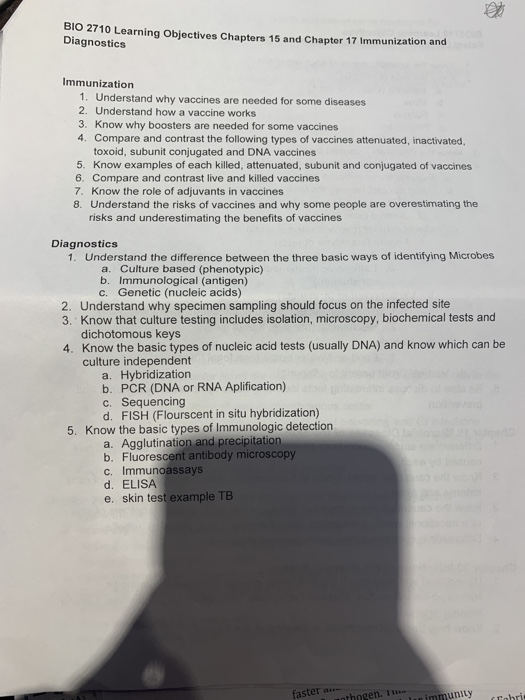
Question
answer immunization and diagnositics.
Homework Answers
Answer #1
Hi, as per our regulation the first question is solved. In this case the questions in the immunisation section are solved.
- Vaccines are needed as preventive measure for future possible infections. Some of the disease ar caused by bacteria or viruses. Vaccines can be generated against these pathogens and given toteh patients. All disease cannot be cured by vaccines due to difference in pathogens characters, location inside the body...etc.
- vaccines work by increasing the immunity of the body. Usually vaccines are weakened pathogens. They can stimulate the body immune cells thus activity as immunogens. They cannot cause full blown diseases. The immune cells produce antibodies against the weakened pathogens in the vaccine and these antibodies are stored and used in future possible infection by the same pathogen.
- Boosted are given to patients after the initial immunisation. Boosted doses help to increase the antibodies to protective level. It helps to counter the decline in immune cell preparedness with time.
- Type fo vaccine: A). Attenuated: it is a weakened form of the pathogen. Patients do not show full blown symptoms but some immunocompromised pertinent may catch the diseases. The patients must be kept under surveillance after the live attenuated vaccine injection. B) Inactivated : these are the killed version of the pathogen. Several boosters are needed to increase the immunity. C) toxoid: here, the vaccine uses a toxin produced by the pathogen, instead of the whole pathogen. The immunity is developed specifically avians the toxoid. D) Conjugate: these vaccines use a specific piece of the pathogen. Subunit can be capsid, proteins, sugar component .etc. It is highly effective and strong immune response can be generated. E) DNA vaccine: genetically modified vector containing specific gene of the pathogen. It is highly targeted and long lasting immune response can be generated. Direct nucleic acid is invested rather than protein or capsid.
- Examples: live attenuated- measles, rotavirus... inactivated- hepatitisA, flu. Subunit conjugate- hiparitisB, HPV, pneumonia. Toxoid- diphtheria, tetanus.
- Live and killed vaccines: comparison- live and killed vaccine both contain the pathogens. Oath can trigger immune response and can show some symptoms. Both are obtained from naturally occurring pathogens and no genetic modifications are done. Contrast- live vaccine contains live but weaker pathogens, the killed vaccine contained dead pathogens. The live vaccine produces stronger immune response than the dead vaccine. Live vaccine needs medicinal supervision after the injection since live pathogen is given to the patient. Dead vaccines need several boosters to increase the immune response.
- Adjuvants: It is a component of vaccine which is formulated to enhance net ability of vaccine to produce strong immune response. most common adjuvants are aluminium hydroxide and paraffin oil.
- Risks of vaccine: vaccine can induce symptoms of disease which can be painful and require medial assistance. Vaccines given to immunonocompromised patients will result in over stimulation of immune response. If vaccine dose is not enough, it may result in understimulatoin defeating the purpose of vaccination.
Know the answer?
Add Answer to:
BIO 2710 Learning Objectives Chapters 15 and Chapter 17 1mmunization and Diagnostics Immunization...
Not the answer you're looking for?
Ask your own homework help question.
Our experts will answer your question WITHIN MINUTES for Free.
Similar Homework Help Questions
ADVERTISEMENT
Need Online Homework Help?
Ask
a QuestionGet Answers For Free
Most questions answered within 3 hours.
Most questions answered within 3 hours.
ADVERTISEMENT
Active Questions
-
Where is the error in this code sequence?
String s1 = "Hello";
String s2 = "ello";...
asked 10 months ago -
Financial data for Joel de Paris, Inc., for last year
follow:
Joel de Paris, Inc.
Balance...
asked 10 months ago -
Consider this reaction:
Al2(SO4)3 (aq)+ BaCl3
(aq) Al2Cl6 (aq)- +
3BaSO4(s) . What is the...
asked 10 months ago -
Suppose that Savneet is considering increasing her
recent random sample from 20 car rentals to 40...
asked 10 months ago -
Trucks arrive at an unloading terminal at an average rate of 120
per hour.
Trucks arrive...
asked 10 months ago -
Why are methanol and ethanol completely soluble in water while
octanol is not very little soluble....
asked 10 months ago -
A facilities manager at a university reads in a research report
that the mean amount of...
asked 10 months ago -
When the CuSO4 is rehydrated by adding water to the anhydrous
compound, is this an endothermic...
asked 10 months ago -
A ray of sunlight is passing from diamond into crown glass; the
angle of incidence is...
asked 10 months ago -
A block of mass 0.249 kg is placed on top of a light, vertical
spring of...
asked 10 months ago -
how do the kidneys compensate in the presences of acidosis
a) trigger hyperventilate
b) reserve acid...
asked 10 months ago -
Question 501 pts
The rental rate of capital to the firm increases. Which of the
following...
asked 10 months ago
ADVERTISEMENT