
Homework Answers
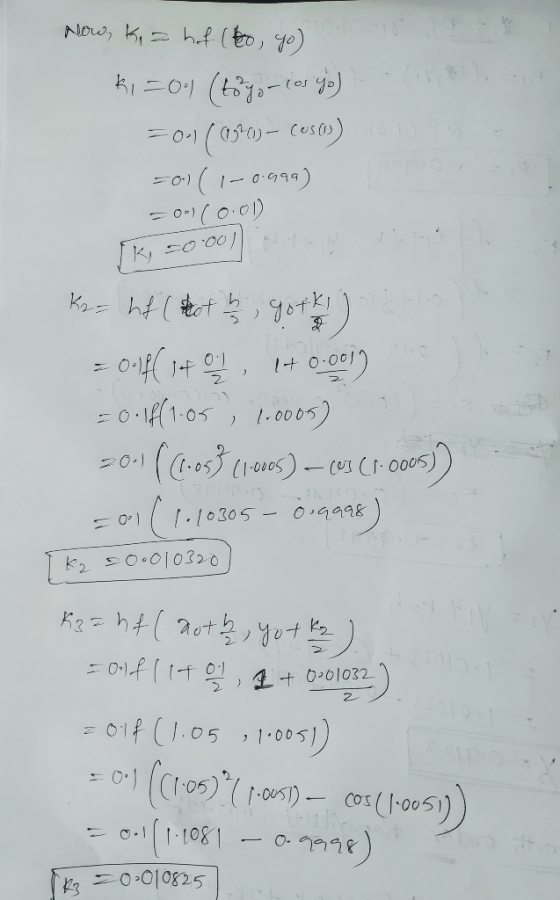
 If any doubt just comment .
Thanks
If any doubt just comment .
Thanks
Add Answer to:
Exercise 1. We are solving the ODE yycos)1) 1, with a time step h 0.1. Calculate y at t-1.1 using...
Exercise 1. We are solving the ODE y'=t2y + cos(y), y(1-1, with a time step h 0.1. Calculate y at...
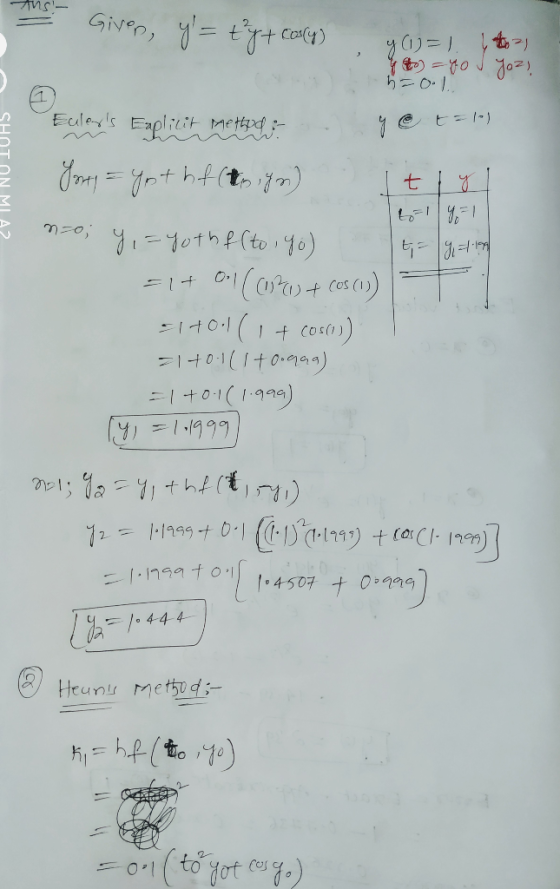
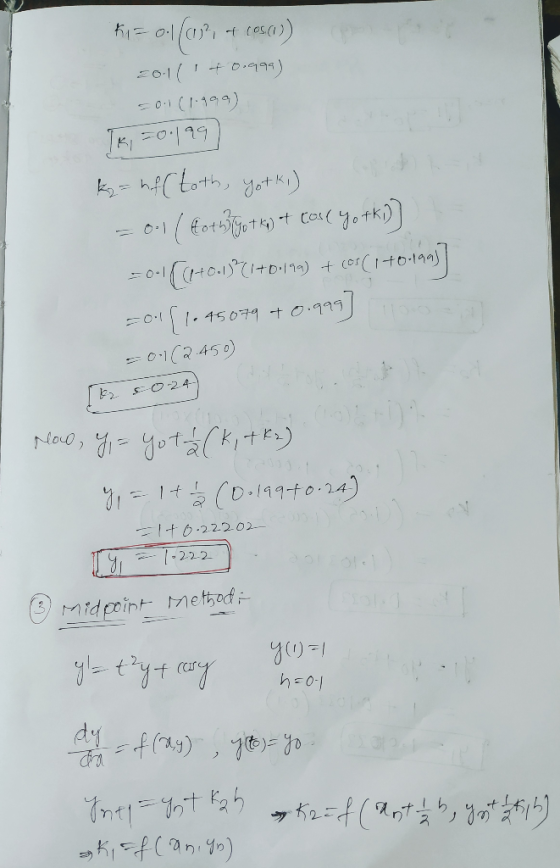
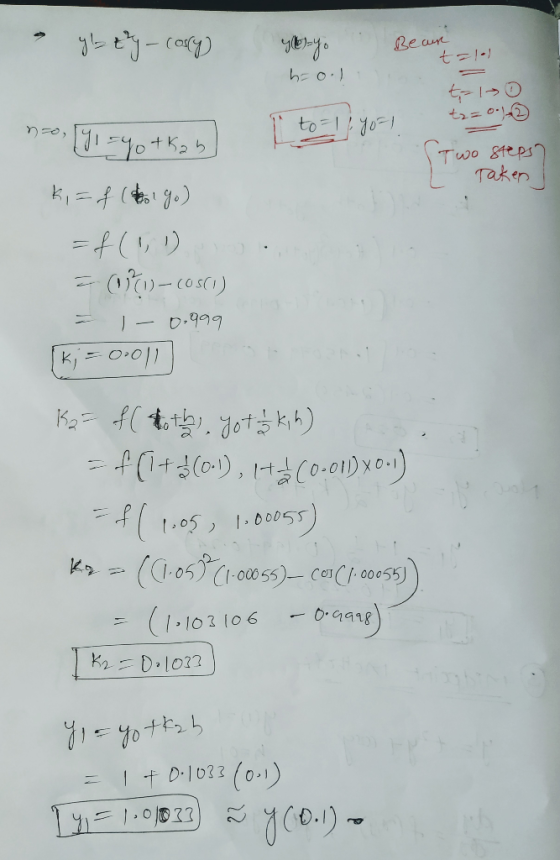
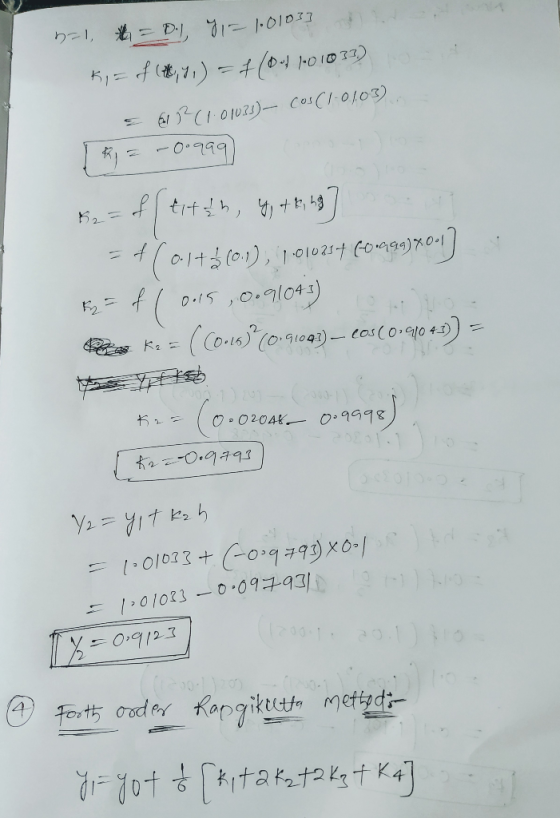
 Exercise 1. We are solving the ODE y'=t2y + cos(y), y(1-1, with a time step h 0.1. Calculate y at t-1.1 using (1) Euler's explicit method; (2) Heun's method; (3) the midpoint method (4) RK4. Detail all calculations; present results in a table; show four significant digits
Exercise 1. We are solving the ODE y'=t2y + cos(y), y(1-1, with a time step h 0.1. Calculate y at t-1.1 using (1) Euler's explicit method; (2) Heun's method; (3) the midpoint method...
Exercise 1. We are solving the ODE y'=t2y + cos(y), y(1-1, with a time step h 0.1. Calculate y at t-1.1 using (1) Euler's explicit method; (2) Heun's method; (3) the midpoint method (4) RK4. Detail all calculations; present results in a table; show four significant digits
Exercise 1. We are solving the ODE y'=t2y + cos(y), y(1-1, with a time step h 0.1. Calculate y at t-1.1 using (1) Euler's explicit method; (2) Heun's method; (3) the midpoint method...
di 2 y(0) = 1 Matlab. Apply Eulers method with step size h = 0.1 on...
 di 2 y(0) = 1 Matlab. Apply Eulers method with step size h = 0.1 on [0, 1] to the initial value problem listed above, in #3. a Print a table of the t values, Euler approximations, and error at each step. Deduce the order of convergence of Euler's method in this case.
MATLAB CODE: Task 2 8y dt Solve the above ordinary differential equation (ODE) using Euler's method with step sizes of: 2. h 0.75 3. h 0.5 4. h 0.001 a) For each step size, plot the results at eac...
 MATLAB CODE:
Task 2 8y dt Solve the above ordinary differential equation (ODE) using Euler's method with step sizes of: 2. h 0.75 3. h 0.5 4. h 0.001 a) For each step size, plot the results at each step starting from y(0) 3 to y(3). b) Plot on the same figure as part a) the analytical solution which is given by: 9 24 -8t c) Calculate and print the percentage error between the Euler's method and the analytical result...
MATLAB CODE:
Task 2 8y dt Solve the above ordinary differential equation (ODE) using Euler's method with step sizes of: 2. h 0.75 3. h 0.5 4. h 0.001 a) For each step size, plot the results at each step starting from y(0) 3 to y(3). b) Plot on the same figure as part a) the analytical solution which is given by: 9 24 -8t c) Calculate and print the percentage error between the Euler's method and the analytical result...
(e) Consider the Runge-Kutta method in solving the following first order ODE: dy First, using Taylor series expansion, we have the following approximation of y evaluated at the time step n+1 as a...
 (e) Consider the Runge-Kutta method in solving the following first order ODE: dy First, using Taylor series expansion, we have the following approximation of y evaluated at the time step n+1 as a function of y at the time step n: where h is the size of the time step. The fourth order Runge-Kutta method assumes the following form where the following approximations can be made at various iterations: )sh+รู้: ,f(t.ta, ),. Note that the first term is evaluated at...
I. Use Euler's method with step size h = 0.1 to numerically solve the initial value problem y,--2ty+y2, y(0) 1 on the interval 0 < t 2. Compare your approximations with the exact solution....
 I. Use Euler's method with step size h = 0.1 to numerically solve the initial value problem y,--2ty+y2, y(0) 1 on the interval 0 < t 2. Compare your approximations with the exact solution.
I. Use Euler's method with step size h = 0.1 to numerically solve the initial value problem y,--2ty+y2, y(0) 1 on the interval 0
I. Use Euler's method with step size h = 0.1 to numerically solve the initial value problem y,--2ty+y2, y(0) 1 on the interval 0 < t 2. Compare your approximations with the exact solution.
I. Use Euler's method with step size h = 0.1 to numerically solve the initial value problem y,--2ty+y2, y(0) 1 on the interval 0
Numerical methods for engineers (30%) ORDINARY DIFFERENTIAL EQUATIONS Solve ODE dy/dx-3xy, where xo-1; yo-2, with step...
 Numerical methods for engineers
(30%) ORDINARY DIFFERENTIAL EQUATIONS Solve ODE dy/dx-3xy, where xo-1; yo-2, with step size h-0.1, (calculate only the first point, ie at x,-1.1 yiz?, )using (a) Euler's method (b) Heun's method (b) Fourth-order RK's method 4"
Numerical methods for engineers
(30%) ORDINARY DIFFERENTIAL EQUATIONS Solve ODE dy/dx-3xy, where xo-1; yo-2, with step size h-0.1, (calculate only the first point, ie at x,-1.1 yiz?, )using (a) Euler's method (b) Heun's method (b) Fourth-order RK's method 4"
(a) Use Euler's Method with a step size h = 0.1 to approximate y(0.0), y(0.1), y(0.2),...
 (a) Use Euler's Method with a step size h = 0.1 to approximate y(0.0), y(0.1), y(0.2), y(0.3), y(0.4), y(0.5) where y(x) is the solution of the initial-value problem ay = - y2 cos x, y(0) = 1. (b) Find and compute the exact value of y(0.5). dx
Use 6 decimal places in your calculations Consider the following IVP: 5 x a) Compute y(0.4) using Euler's method with step size h 0.1. b) If the exact solution is y - ex+ ex, then find the true e...
 Use 6 decimal places in your calculations Consider the following IVP: 5 x a) Compute y(0.4) using Euler's method with step size h 0.1. b) If the exact solution is y - ex+ ex, then find the true error at each case
Use 6 decimal places in your calculations Consider the following IVP: 5 x a) Compute y(0.4) using Euler's method with step size h 0.1. b) If the exact solution is y - ex+ ex, then find the true...
Use 6 decimal places in your calculations Consider the following IVP: 5 x a) Compute y(0.4) using Euler's method with step size h 0.1. b) If the exact solution is y - ex+ ex, then find the true error at each case
Use 6 decimal places in your calculations Consider the following IVP: 5 x a) Compute y(0.4) using Euler's method with step size h 0.1. b) If the exact solution is y - ex+ ex, then find the true...
WE L L. ew 2 0VISUWURSU3121/WW.Apter Section 8//usersmisegaye BellectiveUseramtegekey=MUORAJM69GZ29FnHyxZR794HHcym (1 point) Euler's method for a first...
 WE L L. ew 2 0VISUWURSU3121/WW.Apter Section 8//usersmisegaye BellectiveUseramtegekey=MUORAJM69GZ29FnHyxZR794HHcym (1 point) Euler's method for a first order IVPy a ,), V(o) is the the following algorithm. From (0.10) we define a sequence of approximations to the solution of the differential equation so that at the nth stage, we have In=In-1 +h, Wen-1th fan-1,-1). In this exercise we consider the IVP y = 1+ y with y(0) 2. This equation is first order with exact solution y tan(+ tan (2)). Use...
Given the ODE and initial condition 3. y(0) = 1 dt=yi-y Use the explicit predictor-corrector (Heun's)...
 Given the ODE and initial condition 3. y(0) = 1 dt=yi-y Use the explicit predictor-corrector (Heun's) method to manually (i.e. on paper, by hand use Matlab as a calculator, however) integrate this from t -0 to t 1.5 using h 0.5. Describe technique in words and/or equations and fill out the table below with this solution att -[0.0,0.s -you may you i Ss Step 1 Step 2 Step 3 y'(0.0) = y'(0.5) = (0.5)
 Exercise 1. We are solving the ODE y'=t2y + cos(y), y(1-1, with a time step h 0.1. Calculate y at t-1.1 using (1) Euler's explicit method; (2) Heun's method; (3) the midpoint method (4) RK4. Detail all calculations; present results in a table; show four significant digits
Exercise 1. We are solving the ODE y'=t2y + cos(y), y(1-1, with a time step h 0.1. Calculate y at t-1.1 using (1) Euler's explicit method; (2) Heun's method; (3) the midpoint method...
Exercise 1. We are solving the ODE y'=t2y + cos(y), y(1-1, with a time step h 0.1. Calculate y at t-1.1 using (1) Euler's explicit method; (2) Heun's method; (3) the midpoint method (4) RK4. Detail all calculations; present results in a table; show four significant digits
Exercise 1. We are solving the ODE y'=t2y + cos(y), y(1-1, with a time step h 0.1. Calculate y at t-1.1 using (1) Euler's explicit method; (2) Heun's method; (3) the midpoint method...
 di 2 y(0) = 1 Matlab. Apply Eulers method with step size h = 0.1 on [0, 1] to the initial value problem listed above, in #3. a Print a table of the t values, Euler approximations, and error at each step. Deduce the order of convergence of Euler's method in this case.
 MATLAB CODE:
Task 2 8y dt Solve the above ordinary differential equation (ODE) using Euler's method with step sizes of: 2. h 0.75 3. h 0.5 4. h 0.001 a) For each step size, plot the results at each step starting from y(0) 3 to y(3). b) Plot on the same figure as part a) the analytical solution which is given by: 9 24 -8t c) Calculate and print the percentage error between the Euler's method and the analytical result...
MATLAB CODE:
Task 2 8y dt Solve the above ordinary differential equation (ODE) using Euler's method with step sizes of: 2. h 0.75 3. h 0.5 4. h 0.001 a) For each step size, plot the results at each step starting from y(0) 3 to y(3). b) Plot on the same figure as part a) the analytical solution which is given by: 9 24 -8t c) Calculate and print the percentage error between the Euler's method and the analytical result...
 (e) Consider the Runge-Kutta method in solving the following first order ODE: dy First, using Taylor series expansion, we have the following approximation of y evaluated at the time step n+1 as a function of y at the time step n: where h is the size of the time step. The fourth order Runge-Kutta method assumes the following form where the following approximations can be made at various iterations: )sh+รู้: ,f(t.ta, ),. Note that the first term is evaluated at...
 I. Use Euler's method with step size h = 0.1 to numerically solve the initial value problem y,--2ty+y2, y(0) 1 on the interval 0 < t 2. Compare your approximations with the exact solution.
I. Use Euler's method with step size h = 0.1 to numerically solve the initial value problem y,--2ty+y2, y(0) 1 on the interval 0
I. Use Euler's method with step size h = 0.1 to numerically solve the initial value problem y,--2ty+y2, y(0) 1 on the interval 0 < t 2. Compare your approximations with the exact solution.
I. Use Euler's method with step size h = 0.1 to numerically solve the initial value problem y,--2ty+y2, y(0) 1 on the interval 0
 Numerical methods for engineers
(30%) ORDINARY DIFFERENTIAL EQUATIONS Solve ODE dy/dx-3xy, where xo-1; yo-2, with step size h-0.1, (calculate only the first point, ie at x,-1.1 yiz?, )using (a) Euler's method (b) Heun's method (b) Fourth-order RK's method 4"
Numerical methods for engineers
(30%) ORDINARY DIFFERENTIAL EQUATIONS Solve ODE dy/dx-3xy, where xo-1; yo-2, with step size h-0.1, (calculate only the first point, ie at x,-1.1 yiz?, )using (a) Euler's method (b) Heun's method (b) Fourth-order RK's method 4"
 (a) Use Euler's Method with a step size h = 0.1 to approximate y(0.0), y(0.1), y(0.2), y(0.3), y(0.4), y(0.5) where y(x) is the solution of the initial-value problem ay = - y2 cos x, y(0) = 1. (b) Find and compute the exact value of y(0.5). dx
 Use 6 decimal places in your calculations Consider the following IVP: 5 x a) Compute y(0.4) using Euler's method with step size h 0.1. b) If the exact solution is y - ex+ ex, then find the true error at each case
Use 6 decimal places in your calculations Consider the following IVP: 5 x a) Compute y(0.4) using Euler's method with step size h 0.1. b) If the exact solution is y - ex+ ex, then find the true...
Use 6 decimal places in your calculations Consider the following IVP: 5 x a) Compute y(0.4) using Euler's method with step size h 0.1. b) If the exact solution is y - ex+ ex, then find the true error at each case
Use 6 decimal places in your calculations Consider the following IVP: 5 x a) Compute y(0.4) using Euler's method with step size h 0.1. b) If the exact solution is y - ex+ ex, then find the true...
 WE L L. ew 2 0VISUWURSU3121/WW.Apter Section 8//usersmisegaye BellectiveUseramtegekey=MUORAJM69GZ29FnHyxZR794HHcym (1 point) Euler's method for a first order IVPy a ,), V(o) is the the following algorithm. From (0.10) we define a sequence of approximations to the solution of the differential equation so that at the nth stage, we have In=In-1 +h, Wen-1th fan-1,-1). In this exercise we consider the IVP y = 1+ y with y(0) 2. This equation is first order with exact solution y tan(+ tan (2)). Use...
 Given the ODE and initial condition 3. y(0) = 1 dt=yi-y Use the explicit predictor-corrector (Heun's) method to manually (i.e. on paper, by hand use Matlab as a calculator, however) integrate this from t -0 to t 1.5 using h 0.5. Describe technique in words and/or equations and fill out the table below with this solution att -[0.0,0.s -you may you i Ss Step 1 Step 2 Step 3 y'(0.0) = y'(0.5) = (0.5)
Most questions answered within 3 hours.
-
Where is the error in this code sequence?
String s1 = "Hello";
String s2 = "ello";...
asked 11 months ago -
Financial data for Joel de Paris, Inc., for last year
follow:
Joel de Paris, Inc.
Balance...
asked 11 months ago -
Consider this reaction:
Al2(SO4)3 (aq)+ BaCl3
(aq) Al2Cl6 (aq)- +
3BaSO4(s) . What is the...
asked 11 months ago -
Suppose that Savneet is considering increasing her
recent random sample from 20 car rentals to 40...
asked 11 months ago -
Trucks arrive at an unloading terminal at an average rate of 120
per hour.
Trucks arrive...
asked 11 months ago -
Why are methanol and ethanol completely soluble in water while
octanol is not very little soluble....
asked 11 months ago -
A facilities manager at a university reads in a research report
that the mean amount of...
asked 11 months ago -
When the CuSO4 is rehydrated by adding water to the anhydrous
compound, is this an endothermic...
asked 11 months ago -
A ray of sunlight is passing from diamond into crown glass; the
angle of incidence is...
asked 11 months ago -
A block of mass 0.249 kg is placed on top of a light, vertical
spring of...
asked 11 months ago -
how do the kidneys compensate in the presences of acidosis
a) trigger hyperventilate
b) reserve acid...
asked 11 months ago -
Question 501 pts
The rental rate of capital to the firm increases. Which of the
following...
asked 11 months ago