
Homework Answers
Add Answer to:
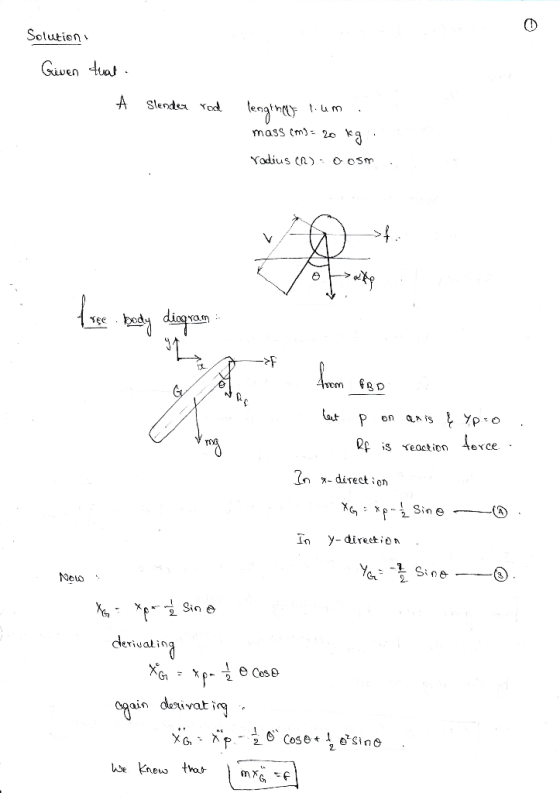
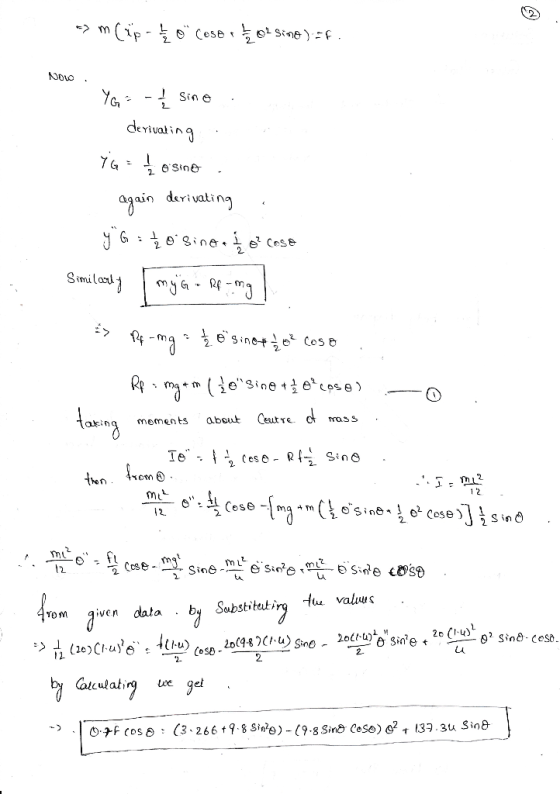
Problem 3.35 (6 points) Figure P3.34 A slender rod 1.4 m long and of mass 20 kg is attached to a ...
Figure P3.34 A slender rod 1.4 m long and of mass 20 kg is attached to...
 Figure P3.34 A slender rod 1.4 m long and of mass 20 kg is attached to a wheel of mass 3 kg and radius 0.05 m, as shown in Figure P3.34. A horizontal force f is applied to the wheel axle. Derive the equations of motion in terms of angular displacement θ of the rod and displacement Xp of the wheel center Assume the wheel does not slip Linearize the resulting equations Extra credit (2 points each) a. If force...
5. A slender rod (mass 1 kg, length L m) is placed vertically on a horizontal rough surface, as shown. The upper end of...
 5. A slender rod (mass 1 kg, length L m) is placed vertically on a horizontal rough surface, as shown. The upper end of the rod is tapped lightly, so that it starts falling. Due to friction, its lower end does not slip. When θ 450 with respect to the vertical, show that the normal force N 3.14 N (pointed up) and that the friction force f0.64 N (pointed to the right). Justify results with appropriate diagrams, equations and calculations....
ke Slender bar of mass m As shown in Figure 1, a uniform slender bar with...
 ke Slender bar of mass m As shown in Figure 1, a uniform slender bar with mass m and length L is supported by a vertical spring at its right end while a mass block 2m suspended from its left end through a spring is supported by another spring. All these three vertical springs have the same stiffness k. If the downward vertical displacement x of the mass block and the clockwise rotation angle 8 of the bar are assumed...
A particle of mass m is attached to one end of a light slender rod which...
 A particle of mass m is attached to one end of a light slender rod which pivots about a horizontal axis through point O. The spring constant k-200 N/m and the distance b-200 mm. If the system is released from rest in the horizontal position shown where the spring is unstretched, the bar is observed to deflect a maximum of 30° clockwise. Determine (a) the particle mass m and (b) the particle speed v after a displacement of 15° from...
The mass of the uniform slender steel rod, shown in Figure 2, is 3 kg. The...
 The mass of the uniform slender steel rod, shown in Figure 2, is 3 kg. The system is set in motion with small oscillations about the horizontal equilibrium position shown. (i) Determine the position x for the slider such that the system period is 1 s. (ii) When the pivot is replaced by a built-in support that restricts any rotation at O and the spring is moved to the right-hand end with the 1.2 kg mass removed, calculate the frequency...
4(12 points) A uniform rod of length L and mass M is attached at one end...
 4(12 points) A uniform rod of length L and mass M is attached at one end to a frictionless pivot and is free to rotate about the pivot in the vertical plane as in Figure. The rod is released from rest in the horizontal position. (a)What are the initial angular acceleration of the rod and the initial translational acceleration of its right end (as shown in Fig.a)? (b)What is its angular speed when the rod reaches its lowest position (as...
A slender, uniform metal rod of mass M and length l is pivoted without friction about an axis through its midpoint and p...
 A slender, uniform metal rod of mass M and length l is pivoted
without friction about an axis through its midpoint and
perpendicular to the rod. A horizontal spring, assumed massless and
with force constant k, is attached to the lower end of the rod,
with the other end of the spring attached to a rigid support.
(Figure 1)
2. Find the torque τ due to the spring. Assume that θ is small
enough that the spring remains effectively horizontal...
A slender, uniform metal rod of mass M and length l is pivoted
without friction about an axis through its midpoint and
perpendicular to the rod. A horizontal spring, assumed massless and
with force constant k, is attached to the lower end of the rod,
with the other end of the spring attached to a rigid support.
(Figure 1)
2. Find the torque τ due to the spring. Assume that θ is small
enough that the spring remains effectively horizontal...
Problem 4.11 A uniform slender rod of mass m, mass center G and length 21 is set against a vertic...
 Problem 4.11 A uniform slender rod of mass m, mass center G and length 21 is set against a vertical wall, with its lower extremity co- inciding with the corner O of the horizon tal support. A small perturbation destroys this unstable equilibrium, and the rod rotates about O. The contact is assumed frictionless. The inclination of the rod with the vertical is described by angle θ. a. Show that the motion of the rod is a rota tion about...
<Homework 8 Problem 18.13 4 of 8 > II Review The 20-kg uniform slender rod is...
 <Homework 8 Problem 18.13 4 of 8 > II Review The 20-kg uniform slender rod is suspended at rest when the force of F = 150 N is applied to its end. The force is always perpendicular to the rod. (Figure 1) Part A Determine the angular velocity of the rod, measured clockwise, when it has rotated 90º clockwise from the position shown. Express your answer using three significant figures. Enter positive value if the angular velocity is clockwise and...
A mass m attached to the end of a massless rod of length L is free...
 A mass m attached to the end of a massless rod of length L is free to swing below the plane of support, as shown in the figure above. The Hamiltonian for this system is given by 2 2 where θ and φ are defined as shown in the figure. On the basis of Hamilton's equations of motion, the gepsralized coordinate or momentum that isa constant in time is (A) 0 (B) ф (C) 0 (D) Pe (E) Po
 Figure P3.34 A slender rod 1.4 m long and of mass 20 kg is attached to a wheel of mass 3 kg and radius 0.05 m, as shown in Figure P3.34. A horizontal force f is applied to the wheel axle. Derive the equations of motion in terms of angular displacement θ of the rod and displacement Xp of the wheel center Assume the wheel does not slip Linearize the resulting equations Extra credit (2 points each) a. If force...
 5. A slender rod (mass 1 kg, length L m) is placed vertically on a horizontal rough surface, as shown. The upper end of the rod is tapped lightly, so that it starts falling. Due to friction, its lower end does not slip. When θ 450 with respect to the vertical, show that the normal force N 3.14 N (pointed up) and that the friction force f0.64 N (pointed to the right). Justify results with appropriate diagrams, equations and calculations....
 ke Slender bar of mass m As shown in Figure 1, a uniform slender bar with mass m and length L is supported by a vertical spring at its right end while a mass block 2m suspended from its left end through a spring is supported by another spring. All these three vertical springs have the same stiffness k. If the downward vertical displacement x of the mass block and the clockwise rotation angle 8 of the bar are assumed...
 A particle of mass m is attached to one end of a light slender rod which pivots about a horizontal axis through point O. The spring constant k-200 N/m and the distance b-200 mm. If the system is released from rest in the horizontal position shown where the spring is unstretched, the bar is observed to deflect a maximum of 30° clockwise. Determine (a) the particle mass m and (b) the particle speed v after a displacement of 15° from...
 The mass of the uniform slender steel rod, shown in Figure 2, is 3 kg. The system is set in motion with small oscillations about the horizontal equilibrium position shown. (i) Determine the position x for the slider such that the system period is 1 s. (ii) When the pivot is replaced by a built-in support that restricts any rotation at O and the spring is moved to the right-hand end with the 1.2 kg mass removed, calculate the frequency...
 4(12 points) A uniform rod of length L and mass M is attached at one end to a frictionless pivot and is free to rotate about the pivot in the vertical plane as in Figure. The rod is released from rest in the horizontal position. (a)What are the initial angular acceleration of the rod and the initial translational acceleration of its right end (as shown in Fig.a)? (b)What is its angular speed when the rod reaches its lowest position (as...
 A slender, uniform metal rod of mass M and length l is pivoted
without friction about an axis through its midpoint and
perpendicular to the rod. A horizontal spring, assumed massless and
with force constant k, is attached to the lower end of the rod,
with the other end of the spring attached to a rigid support.
(Figure 1)
2. Find the torque τ due to the spring. Assume that θ is small
enough that the spring remains effectively horizontal...
A slender, uniform metal rod of mass M and length l is pivoted
without friction about an axis through its midpoint and
perpendicular to the rod. A horizontal spring, assumed massless and
with force constant k, is attached to the lower end of the rod,
with the other end of the spring attached to a rigid support.
(Figure 1)
2. Find the torque τ due to the spring. Assume that θ is small
enough that the spring remains effectively horizontal...
 Problem 4.11 A uniform slender rod of mass m, mass center G and length 21 is set against a vertical wall, with its lower extremity co- inciding with the corner O of the horizon tal support. A small perturbation destroys this unstable equilibrium, and the rod rotates about O. The contact is assumed frictionless. The inclination of the rod with the vertical is described by angle θ. a. Show that the motion of the rod is a rota tion about...
 <Homework 8 Problem 18.13 4 of 8 > II Review The 20-kg uniform slender rod is suspended at rest when the force of F = 150 N is applied to its end. The force is always perpendicular to the rod. (Figure 1) Part A Determine the angular velocity of the rod, measured clockwise, when it has rotated 90º clockwise from the position shown. Express your answer using three significant figures. Enter positive value if the angular velocity is clockwise and...
 A mass m attached to the end of a massless rod of length L is free to swing below the plane of support, as shown in the figure above. The Hamiltonian for this system is given by 2 2 where θ and φ are defined as shown in the figure. On the basis of Hamilton's equations of motion, the gepsralized coordinate or momentum that isa constant in time is (A) 0 (B) ф (C) 0 (D) Pe (E) Po
Most questions answered within 3 hours.
-
Where is the error in this code sequence?
String s1 = "Hello";
String s2 = "ello";...
asked 10 months ago -
Financial data for Joel de Paris, Inc., for last year
follow:
Joel de Paris, Inc.
Balance...
asked 10 months ago -
Consider this reaction:
Al2(SO4)3 (aq)+ BaCl3
(aq) Al2Cl6 (aq)- +
3BaSO4(s) . What is the...
asked 10 months ago -
Suppose that Savneet is considering increasing her
recent random sample from 20 car rentals to 40...
asked 10 months ago -
Trucks arrive at an unloading terminal at an average rate of 120
per hour.
Trucks arrive...
asked 10 months ago -
Why are methanol and ethanol completely soluble in water while
octanol is not very little soluble....
asked 10 months ago -
A facilities manager at a university reads in a research report
that the mean amount of...
asked 10 months ago -
When the CuSO4 is rehydrated by adding water to the anhydrous
compound, is this an endothermic...
asked 10 months ago -
A ray of sunlight is passing from diamond into crown glass; the
angle of incidence is...
asked 10 months ago -
A block of mass 0.249 kg is placed on top of a light, vertical
spring of...
asked 10 months ago -
how do the kidneys compensate in the presences of acidosis
a) trigger hyperventilate
b) reserve acid...
asked 10 months ago -
Question 501 pts
The rental rate of capital to the firm increases. Which of the
following...
asked 10 months ago