![Find the output y[n] using the discrete time domain method by hand: With: A-f ), B-M, c = [O 11, D = [1] and q(0)-A and x[n]](http://img.homeworklib.com/images/8a6cb241-5cc2-4099-bb4b-88c77afab3ca.png?x-oss-process=image/resize,w_560)
Homework Answers
Add Answer to:
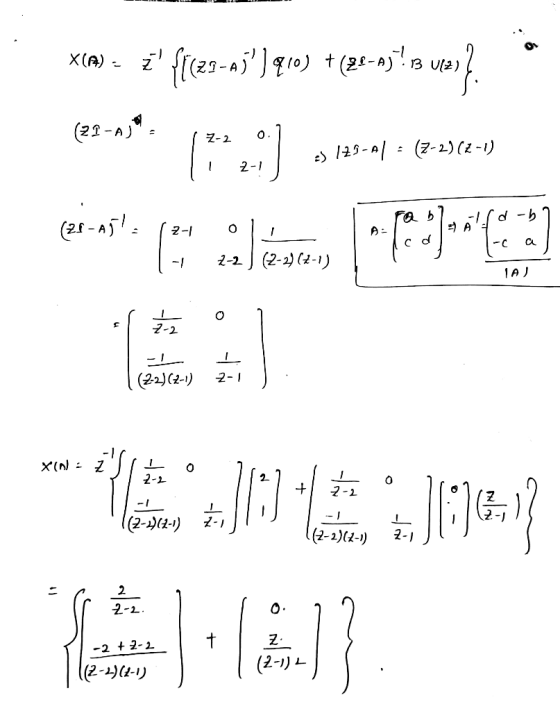
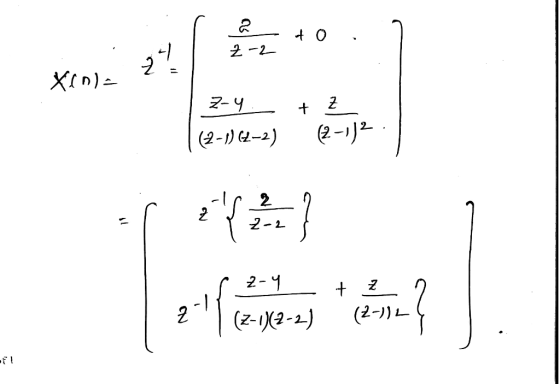
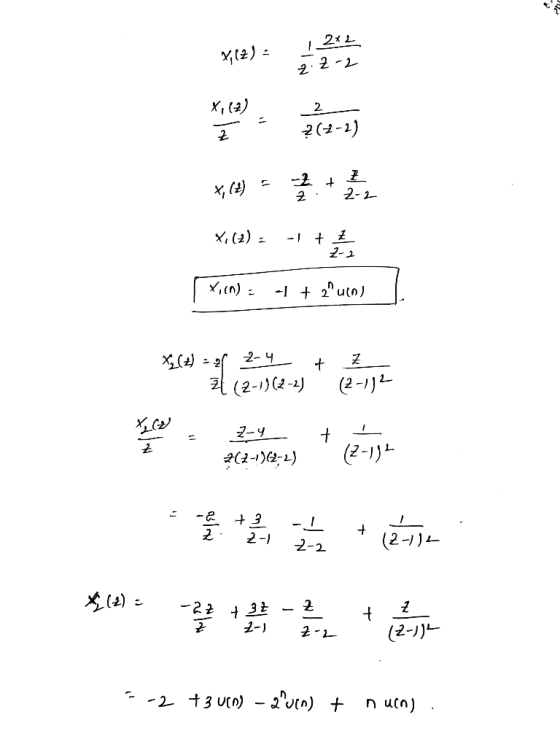
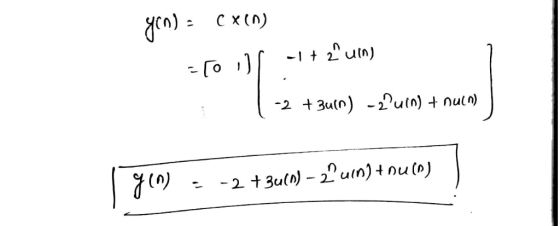
Find the output y[n] using the discrete time domain method by hand: With: A-f ), B-M, c = [O 11, D = [1] and q(0)-A and x[n] = u[n] 2 01 Find the output y[n] using the discrete time domain metho...
Consider the discrete-time system with input x[n] and output y[n] described by : y[n]=x[n]u[2-n] Which of the...
Consider the discrete-time system with input x[n] and output y[n] described by : y[n]=x[n]u[2-n] Which of the following properties does this system possess? Justify your answer in each case. Do not use Laplace transforms a) Memoryless b)Time-invariant c) Linear d)Casual e) Stable
The output of a discrete-time system is related to the input by Y(n) x(n is 1...
 The output of a discrete-time system is related to the input by Y(n) x(n is 1 1) = - a. Find the transfer function of the system. b. If the input X(n) is stationary with E(X(n)) = 0 Rxx(k) = { 1, for k = 0 for k 0 0 find Sy(f) and EfY'(n) γγ
11 Q-Consider the discrete tim system 1-1 x(k+1)= 1-5 1-2 0 1 0 11 3 x(k)...
 11 Q-Consider the discrete tim system 1-1 x(k+1)= 1-5 1-2 0 1 0 11 3 x(k) + 1 2 u(k), y(k)= (-3 1 1] x(k) NW 0 Given u(O)=u(1)=0, y(O)=1 , y(1)=2 Find x(2), and x(0) if possible
Part 1 (Calculation): The Z-transform (ZT) converts a discrete time-domain signal, which is a sequence of...
Part 1 (Calculation): The Z-transform (ZT) converts a discrete time-domain signal, which is a sequence of real or complex numbers, into a complex frequency-domain representation. It is the equivalent of the Laplace transform for discrete systems. The one-sided ZT, used for causal signals and systems, is defined as follows: Consider the digital system (filter) described by the input/output difference equation and z-domain transfer function Hz: yn-0.88 yn-1=0.52 xn-0.4 xn-1 Hzz=Y(z)X(z)=0.52-0.4 z-11-0.88 z-1=0.52 z-0.4z-0.88 Assuming a unit step function input, i.e.,...
A discrete-time system has a difference equation given by y(n) = y(n-1) - 2y(n-2) + x(n) + 2x(n-1) + x(n-2)
A discrete-time system has a difference equation given by y(n) = y(n-1) - 2y(n-2) + x(n) + 2x(n-1) + x(n-2). (a) Find h(n) using iteration. (b) Find the system's z-transfer function H(z). (c) Assume x(n) = δ(n) - 2δ(n-1) + 3δ(n-2). Find y(3) using any method you like. (d) Is this system a FIR or IRR system? How can you tell?
Find the domain of the function. f(x) = 7(x + 11) What is the domain of...
 Find the domain of the function. f(x) = 7(x + 11) What is the domain of f? O A. (-00,-11)U( - 11,0)U(0,00) O B. (-00,000(0,00) O C. (-00,- 11)U( - 11,00) OD. (-00,00)
using discrete structures 3. Consider the function F(x, y, z) for x, y, z z 0 defined as follows: a. F(x, y, 0)-y+1 b. F(x, 0, 1)-x c, F(x, 0, 2) = 0 d. F(x, 0, z+ 3)-1 e. F(x, y, z)-F(x, F(x, y-1, z...
 using discrete structures
3. Consider the function F(x, y, z) for x, y, z z 0 defined as follows: a. F(x, y, 0)-y+1 b. F(x, 0, 1)-x c, F(x, 0, 2) = 0 d. F(x, 0, z+ 3)-1 e. F(x, y, z)-F(x, F(x, y-1, z), z-1) Using Induction, prove the following a. F(x, y, 1)-x +y b, F(x, y, 2) = xy c. F(x, y, 3)-xy
3. Consider the function F(x, y, z) for x, y, z z 0 defined...
using discrete structures
3. Consider the function F(x, y, z) for x, y, z z 0 defined as follows: a. F(x, y, 0)-y+1 b. F(x, 0, 1)-x c, F(x, 0, 2) = 0 d. F(x, 0, z+ 3)-1 e. F(x, y, z)-F(x, F(x, y-1, z), z-1) Using Induction, prove the following a. F(x, y, 1)-x +y b, F(x, y, 2) = xy c. F(x, y, 3)-xy
3. Consider the function F(x, y, z) for x, y, z z 0 defined...
Consider the finite difference matrix operator for the 1D model problem u(/d2- f(x) on domain [0,...
 Consider the finite difference matrix operator for the 1D model problem u(/d2- f(x) on domain [0, 1] with boundary conditions u(0) = 0 and u(1) = 0, given by [-2 1 1-2 1 E RnXn h2 1 -2 1 This matrix can be considered a discrete version of the continuous operator d/da2 that acts upon a function(r). (a) Show that the n eigenvectors of A are given by the vectors ) (p-1,... , n) with components and with eigenvalues h2...
For a causal LTI discrete-time system described by the difference equation:
For a causal LTI discrete-time system described by the difference equation: y[n] + y[n – 1] = x[n] a) Find the transfer function H(z).b) Find poles and zeros and then mark them on the z-plane (pole-zero plot). Is this system BIBO? c) Find its impulse response h[n]. d) Draw the z-domain block diagram (using the unit delay block z-1) of the discrete-time system. e) Find the output y[n] for input x[n] = 10 u[n] if all initial conditions are 0.
• Solve this difference equation by hand using the classical method. y[n] – 1.5 y[n-1] – y[n-2] =...
• Solve this difference equation by hand using the classical method. y[n] – 1.5 y[n-1] – y[n-2] = x[n], with y[0] = 1 and y[-1] = 0, x[n] = (0.5) n u[n-1].
 The output of a discrete-time system is related to the input by Y(n) x(n is 1 1) = - a. Find the transfer function of the system. b. If the input X(n) is stationary with E(X(n)) = 0 Rxx(k) = { 1, for k = 0 for k 0 0 find Sy(f) and EfY'(n) γγ
 11 Q-Consider the discrete tim system 1-1 x(k+1)= 1-5 1-2 0 1 0 11 3 x(k) + 1 2 u(k), y(k)= (-3 1 1] x(k) NW 0 Given u(O)=u(1)=0, y(O)=1 , y(1)=2 Find x(2), and x(0) if possible
 Find the domain of the function. f(x) = 7(x + 11) What is the domain of f? O A. (-00,-11)U( - 11,0)U(0,00) O B. (-00,000(0,00) O C. (-00,- 11)U( - 11,00) OD. (-00,00)
 using discrete structures
3. Consider the function F(x, y, z) for x, y, z z 0 defined as follows: a. F(x, y, 0)-y+1 b. F(x, 0, 1)-x c, F(x, 0, 2) = 0 d. F(x, 0, z+ 3)-1 e. F(x, y, z)-F(x, F(x, y-1, z), z-1) Using Induction, prove the following a. F(x, y, 1)-x +y b, F(x, y, 2) = xy c. F(x, y, 3)-xy
3. Consider the function F(x, y, z) for x, y, z z 0 defined...
using discrete structures
3. Consider the function F(x, y, z) for x, y, z z 0 defined as follows: a. F(x, y, 0)-y+1 b. F(x, 0, 1)-x c, F(x, 0, 2) = 0 d. F(x, 0, z+ 3)-1 e. F(x, y, z)-F(x, F(x, y-1, z), z-1) Using Induction, prove the following a. F(x, y, 1)-x +y b, F(x, y, 2) = xy c. F(x, y, 3)-xy
3. Consider the function F(x, y, z) for x, y, z z 0 defined...
 Consider the finite difference matrix operator for the 1D model problem u(/d2- f(x) on domain [0, 1] with boundary conditions u(0) = 0 and u(1) = 0, given by [-2 1 1-2 1 E RnXn h2 1 -2 1 This matrix can be considered a discrete version of the continuous operator d/da2 that acts upon a function(r). (a) Show that the n eigenvectors of A are given by the vectors ) (p-1,... , n) with components and with eigenvalues h2...
Most questions answered within 3 hours.
-
Where is the error in this code sequence?
String s1 = "Hello";
String s2 = "ello";...
asked 11 months ago -
Financial data for Joel de Paris, Inc., for last year
follow:
Joel de Paris, Inc.
Balance...
asked 11 months ago -
Consider this reaction:
Al2(SO4)3 (aq)+ BaCl3
(aq) Al2Cl6 (aq)- +
3BaSO4(s) . What is the...
asked 11 months ago -
Suppose that Savneet is considering increasing her
recent random sample from 20 car rentals to 40...
asked 11 months ago -
Trucks arrive at an unloading terminal at an average rate of 120
per hour.
Trucks arrive...
asked 11 months ago -
Why are methanol and ethanol completely soluble in water while
octanol is not very little soluble....
asked 11 months ago -
A facilities manager at a university reads in a research report
that the mean amount of...
asked 11 months ago -
When the CuSO4 is rehydrated by adding water to the anhydrous
compound, is this an endothermic...
asked 11 months ago -
A ray of sunlight is passing from diamond into crown glass; the
angle of incidence is...
asked 11 months ago -
A block of mass 0.249 kg is placed on top of a light, vertical
spring of...
asked 11 months ago -
how do the kidneys compensate in the presences of acidosis
a) trigger hyperventilate
b) reserve acid...
asked 11 months ago -
Question 501 pts
The rental rate of capital to the firm increases. Which of the
following...
asked 11 months ago