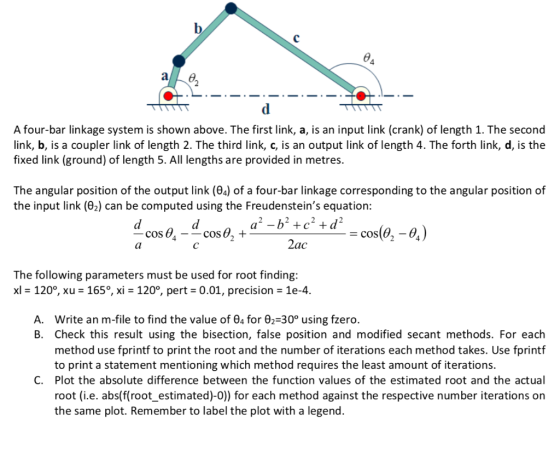
[MATLAB Coding] A four-bar linkage system is shown above. The first link, a, is an input link (crank) of length 1. The second link, b, is a coupler link of length 2. The third link, c, is an output link of length 4. The forth link, d, is the fixed link (ground) of length 5. All lengths are provided in metres. Please answer the whole question in MATLAB coding.
Homework Answers
function [root,iter,absdiff] = modifiedSecantMethod(f,x0,dx,tol)
iter = 1;
xn = x0;
while true
Xn = xn - dx*f(xn)/(f(xn+dx)-f(xn)); %computing root
absdiff(iter) = abs(f(Xn)-0); % get the absolute difference
%termination
if absdiff(iter)<tol
root = Xn;
root = root*180/pi; % to degrees
break;
end
xn = Xn;
iter = iter+1;
end
end
------------------------------------------------------------------------------
function [root,iter,absdiff] = falsePositionMethod(f,x0,x1,tol)
a = x0;
b = x1;
if ~(f(a)*f(b)<0)
error('ERROR: f(a)*f(b) must be less than 0')
end
iter = 1;
while true
x = (a *f(b) - b*f(a))/(f(b)-f(a)); %computing the root
absdiff(iter) = abs(f(x)-0); %getting absolute difference
if absdiff(iter)<=tol %termination
break;
elseif f(a)*f(x)>=0
a = x;
elseif f(b)*f(x)>=0
b = x;
end
iter = iter+1;
end
root = x;
root = root*180/pi; % to degrees
end
-------------------------------------------------------------------------------
function [root,iter,absdiff] = bisectionMethod(f,x_pos,x_neg,tol)
iter = 1;
while true
x_mid = (x_pos+x_neg)/2; %computing the root
if f(x_mid)<0
x_neg = x_mid;
else
x_pos = x_mid;
end
absdiff(iter) = abs(f(x_mid)-0); %getting absolute
differences
if absdiff(iter)<tol %termination
break;
end
x_mid = (x_pos+x_neg)/2;
iter = iter+1;
end
root = x_mid;
root = root*180/pi; % to degrees
end
-----------------------------------------------------------------------------------------
%driver file
clear
clc
close all
xl = 120; xu = 165; xi = 120; %degrees
xl = xl*pi/180; xu = xu*pi/180; xi = xi*pi/180; %to radians
pert = 0.01; precision = 1e-4;
a = 1; b=2;c=4;d=5; %meters
%let x2 = theta2 and x4 = theta4
x2 = 30;%degrees
x2 = x2*pi/180; %to radians
f = @(x4) (d/a).*cos(x4) - (d/c)*cos(x2) + ((a^2-b^2+c^2+d^2)/(2*a*c)) - cos(x2-x4);
%using fzero
fprintf('\nFZERO')
root = fzero(f,[xl,xu]); %radians
root = root*180/pi; %to degrees
fprintf(['\nRoot: ' num2str(root) ' degrees'])
methods = {'modified secant','false position','bisection'};
%modified secant
fprintf('\n\nMODIFIED SECANT')
[root1,iters1,absdiff1] =
modifiedSecantMethod(f,xi,pert,precision);
fprintf(['\nRoot: ' num2str(root1) ' degrees'])
fprintf(['\niterations: ' num2str(iters1)])
%false position
fprintf('\n\nFALSE POSITION')
[root2,iters2,absdiff2] =
falsePositionMethod(f,xl,xu,precision);
fprintf(['\nRoot: ' num2str(root2) ' degrees'])
fprintf(['\niterations: ' num2str(iters2)])
% bisection
fprintf('\n\nBISECTION')
[root3,iters3,absdiff3] = bisectionMethod(f,xl,xu,precision);
fprintf(['\nRoot: ' num2str(root3) ' degrees'])
fprintf(['\niterations: ' num2str(iters3)])
%method requiring least amount of iterations
iters = [iters1 iters2 iters3];
minIterIndex = find(iters==min(iters));
methodLeastIters = methods{minIterIndex};
fprintf(['\n\nMethod requiring least amount of iterations: '
methodLeastIters '\n\n']);
%plotting convergence
figure
plot(1:iters1,absdiff1,'-o r')
hold on
plot(1:iters2,absdiff2,'-o g')
hold on
plot(1:iters3,absdiff3,'-o b')
title('convergence')
xlabel('iteration')
ylabel('|f(x)-0|')
legend('modified secant','false position','bisection')
%OUTPUT
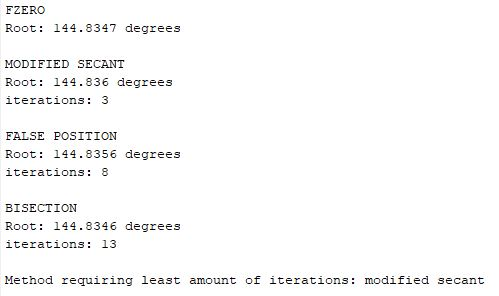
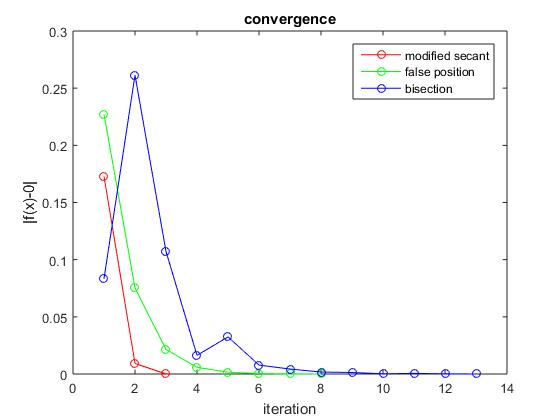
COMMENT DOWN FOR ANY QUERY RELATED TO THIS ANSWER,
IF YOU'RE SATISFIED, GIVE A THUMBS UP
~yc~
Add Answer to:
[MATLAB Coding] A four-bar linkage system is shown above. The first link, a, is an input link (crank) of length 1. The second link, b, is a coupler link of length 2. The third link, c, is an output l...
Pl. (50pts) The four-bar linkage in the posture shown is driven by crank 2 at (02-25rpm cew. Dete...
 Pl. (50pts) The four-bar linkage in the posture shown is driven by crank 2 at (02-25rpm cew. Determine: I) Angular velocities of link 3 2) Angular velocities of link 4 3) Velocity of point P 0.356 0.950 / 0.785 0.544 o: VBA 43 VA 02 04
Pl. (50pts) The four-bar linkage in the posture shown is driven by crank 2 at (02-25rpm cew. Determine: I) Angular velocities of link 3 2) Angular velocities of link 4 3) Velocity of point...
Pl. (50pts) The four-bar linkage in the posture shown is driven by crank 2 at (02-25rpm cew. Determine: I) Angular velocities of link 3 2) Angular velocities of link 4 3) Velocity of point P 0.356 0.950 / 0.785 0.544 o: VBA 43 VA 02 04
Pl. (50pts) The four-bar linkage in the posture shown is driven by crank 2 at (02-25rpm cew. Determine: I) Angular velocities of link 3 2) Angular velocities of link 4 3) Velocity of point...
2. (50 points) The link lengths of a linkage, shown in Figure 2 (not to scale), are L- 5" (ground...
 Kinematics please answer asap with clear work
2. (50 points) The link lengths of a linkage, shown in Figure 2 (not to scale), are L- 5" (ground), and 2-1" (input), L3 3.5" (coupler), L-3" (output or follower), respectively. The location of the coupler point P is given as RPA-4", and δ,-20° When the input link is at 6-55°, we have a-31.251° and θ4-1 18.561° for the open configuration. (a) Find the corresponding transmission angle at this configuration and the corresponding...
Kinematics please answer asap with clear work
2. (50 points) The link lengths of a linkage, shown in Figure 2 (not to scale), are L- 5" (ground), and 2-1" (input), L3 3.5" (coupler), L-3" (output or follower), respectively. The location of the coupler point P is given as RPA-4", and δ,-20° When the input link is at 6-55°, we have a-31.251° and θ4-1 18.561° for the open configuration. (a) Find the corresponding transmission angle at this configuration and the corresponding...
Q3. 1 Figure Q3 For the four bar linkage shown in Figure Q3, assume the diagram...
 Q3. 1 Figure Q3 For the four bar linkage shown in Figure Q3, assume the diagram is drawn to scale and that crank link 2 has a length of 0.2m and an angular velocity of 20rad/s clockwise driven by an input torque of 5Nm. a) Find the positions with respect to the crank origin at A of the instant centre of velocity between the coupler link 3 and the ground link 1 and between the crank link 2 and the...
Find the solution of Problem 2.8 using Newton-Raphson method with the starting value of as 90...
 Find the solution of Problem 2.8 using Newton-Raphson method
with the starting value of
as 90 degrees and
=0.001
Please upload the program using VBA or Matlab
w a stress of o; = 55 x 103 psi, when M = 5 lb-in and d = 0.1 in. 2.8. The angular position of the output link (04) of a four-bar linkage corresponding to any specified angular position of the input link (02) can be computed using the Freudenstein's equation [2.6] kı...
Find the solution of Problem 2.8 using Newton-Raphson method
with the starting value of
as 90 degrees and
=0.001
Please upload the program using VBA or Matlab
w a stress of o; = 55 x 103 psi, when M = 5 lb-in and d = 0.1 in. 2.8. The angular position of the output link (04) of a four-bar linkage corresponding to any specified angular position of the input link (02) can be computed using the Freudenstein's equation [2.6] kı...
 Pl. (50pts) The four-bar linkage in the posture shown is driven by crank 2 at (02-25rpm cew. Determine: I) Angular velocities of link 3 2) Angular velocities of link 4 3) Velocity of point P 0.356 0.950 / 0.785 0.544 o: VBA 43 VA 02 04
Pl. (50pts) The four-bar linkage in the posture shown is driven by crank 2 at (02-25rpm cew. Determine: I) Angular velocities of link 3 2) Angular velocities of link 4 3) Velocity of point...
Pl. (50pts) The four-bar linkage in the posture shown is driven by crank 2 at (02-25rpm cew. Determine: I) Angular velocities of link 3 2) Angular velocities of link 4 3) Velocity of point P 0.356 0.950 / 0.785 0.544 o: VBA 43 VA 02 04
Pl. (50pts) The four-bar linkage in the posture shown is driven by crank 2 at (02-25rpm cew. Determine: I) Angular velocities of link 3 2) Angular velocities of link 4 3) Velocity of point...
 Kinematics please answer asap with clear work
2. (50 points) The link lengths of a linkage, shown in Figure 2 (not to scale), are L- 5" (ground), and 2-1" (input), L3 3.5" (coupler), L-3" (output or follower), respectively. The location of the coupler point P is given as RPA-4", and δ,-20° When the input link is at 6-55°, we have a-31.251° and θ4-1 18.561° for the open configuration. (a) Find the corresponding transmission angle at this configuration and the corresponding...
Kinematics please answer asap with clear work
2. (50 points) The link lengths of a linkage, shown in Figure 2 (not to scale), are L- 5" (ground), and 2-1" (input), L3 3.5" (coupler), L-3" (output or follower), respectively. The location of the coupler point P is given as RPA-4", and δ,-20° When the input link is at 6-55°, we have a-31.251° and θ4-1 18.561° for the open configuration. (a) Find the corresponding transmission angle at this configuration and the corresponding...
 Q3. 1 Figure Q3 For the four bar linkage shown in Figure Q3, assume the diagram is drawn to scale and that crank link 2 has a length of 0.2m and an angular velocity of 20rad/s clockwise driven by an input torque of 5Nm. a) Find the positions with respect to the crank origin at A of the instant centre of velocity between the coupler link 3 and the ground link 1 and between the crank link 2 and the...
 Find the solution of Problem 2.8 using Newton-Raphson method
with the starting value of
as 90 degrees and
=0.001
Please upload the program using VBA or Matlab
w a stress of o; = 55 x 103 psi, when M = 5 lb-in and d = 0.1 in. 2.8. The angular position of the output link (04) of a four-bar linkage corresponding to any specified angular position of the input link (02) can be computed using the Freudenstein's equation [2.6] kı...
Find the solution of Problem 2.8 using Newton-Raphson method
with the starting value of
as 90 degrees and
=0.001
Please upload the program using VBA or Matlab
w a stress of o; = 55 x 103 psi, when M = 5 lb-in and d = 0.1 in. 2.8. The angular position of the output link (04) of a four-bar linkage corresponding to any specified angular position of the input link (02) can be computed using the Freudenstein's equation [2.6] kı...
Most questions answered within 3 hours.
-
Where is the error in this code sequence?
String s1 = "Hello";
String s2 = "ello";...
asked 11 months ago -
Financial data for Joel de Paris, Inc., for last year
follow:
Joel de Paris, Inc.
Balance...
asked 11 months ago -
Consider this reaction:
Al2(SO4)3 (aq)+ BaCl3
(aq) Al2Cl6 (aq)- +
3BaSO4(s) . What is the...
asked 11 months ago -
Suppose that Savneet is considering increasing her
recent random sample from 20 car rentals to 40...
asked 11 months ago -
Trucks arrive at an unloading terminal at an average rate of 120
per hour.
Trucks arrive...
asked 11 months ago -
Why are methanol and ethanol completely soluble in water while
octanol is not very little soluble....
asked 11 months ago -
A facilities manager at a university reads in a research report
that the mean amount of...
asked 11 months ago -
When the CuSO4 is rehydrated by adding water to the anhydrous
compound, is this an endothermic...
asked 11 months ago -
A ray of sunlight is passing from diamond into crown glass; the
angle of incidence is...
asked 11 months ago -
A block of mass 0.249 kg is placed on top of a light, vertical
spring of...
asked 11 months ago -
how do the kidneys compensate in the presences of acidosis
a) trigger hyperventilate
b) reserve acid...
asked 11 months ago -
Question 501 pts
The rental rate of capital to the firm increases. Which of the
following...
asked 11 months ago