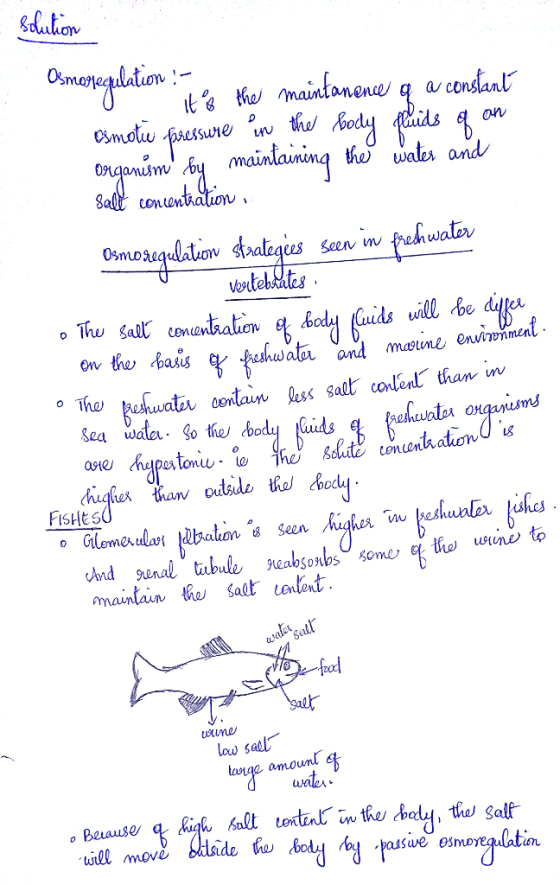
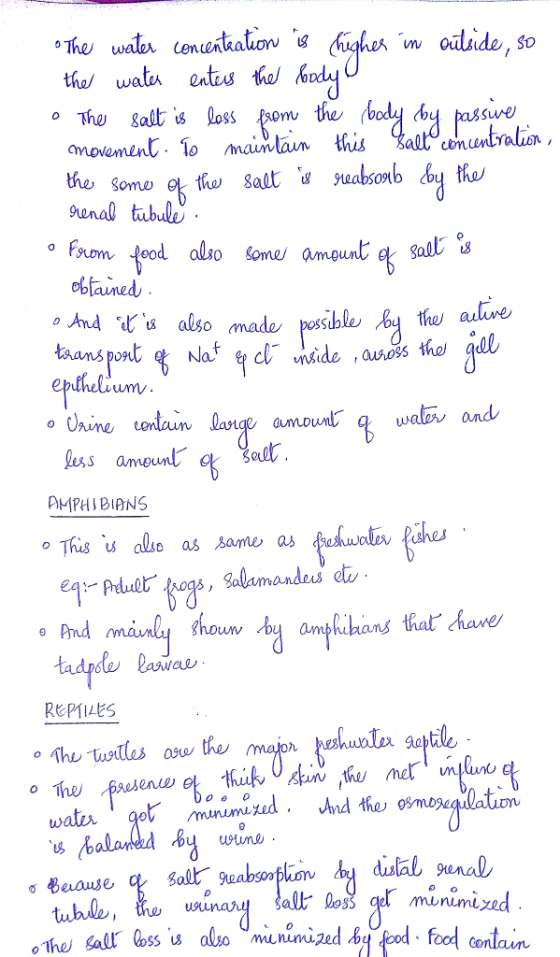
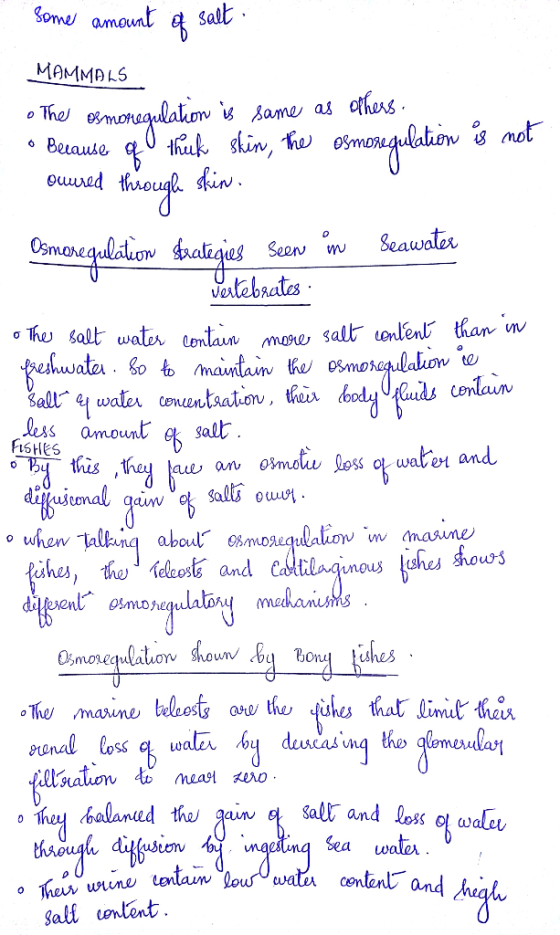
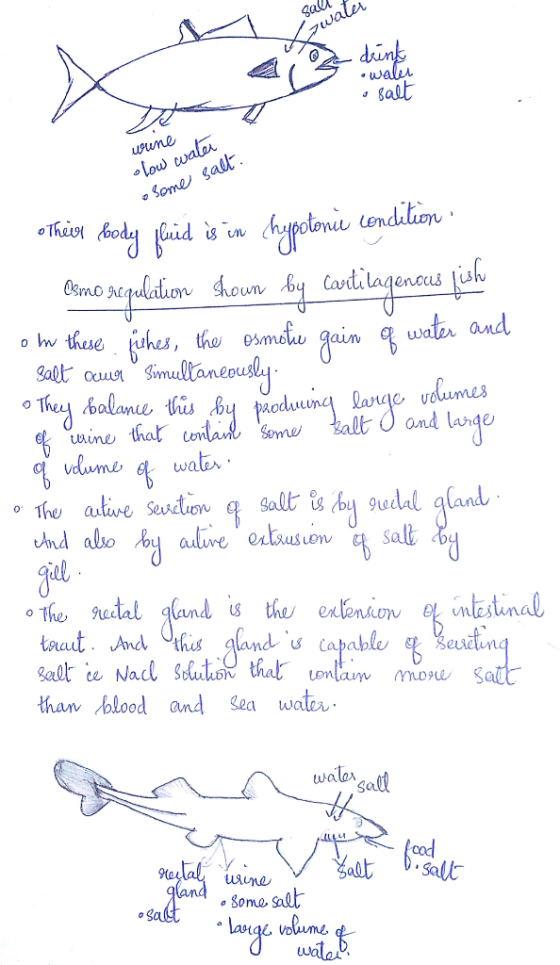
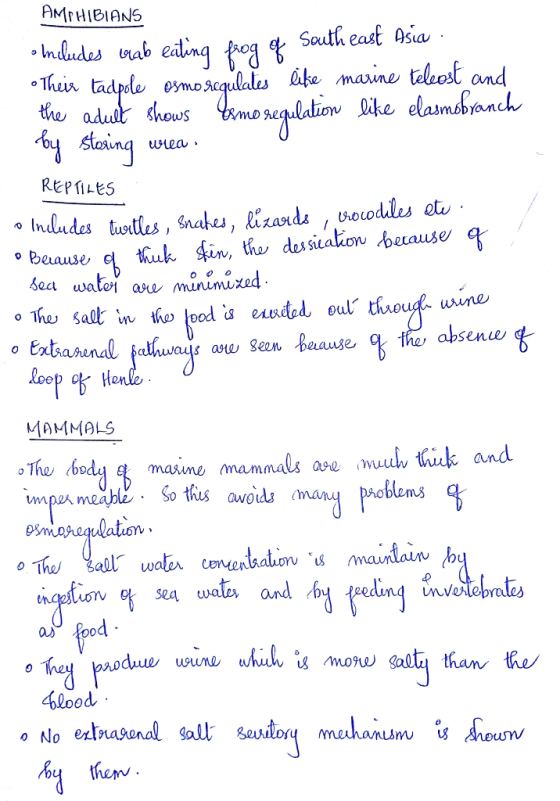
Compare osmoregulation strategies in vertebrates living in freshwater vs. salt water and bony fish vs. cartilaginous fish vs. marine mammals.
-
Compare osmoregulation strategies in vertebrates living in freshwater vs. salt water and bony
fish vs. cartilaginous fish vs. marine mammals.
Homework Answers
Add Answer to:
Compare osmoregulation strategies in vertebrates living in freshwater vs. salt water and bony fish vs. cartilaginous fish vs. marine mammals.
Vertebrates Vertebrates Cartilaginous fish Scales and amniotic egg Land and water Bony fish Finned Finned Transitional...
 Vertebrates Vertebrates Cartilaginous fish Scales and amniotic egg Land and water Bony fish Finned Finned Transitional Fossil Gas exchange via skin Largest extant Group Gill Cover Controls Buoyancy Turtles 13 Mammals Feathered Descendent Egg-laying Place the letter in the appropriate blank a. Operculum k Osteichthyes b. Reptiles Cutaneous respiration c. Placental m. Anura d. Squamata n . Tiktaalik e. Homeothermy 0. Monotreme f. Swim bladder p Aves g Chelonia 4. Sarcopterygii h. Chondrichthyes i. Amphibians j. Actinopterygii Shared between both...
Vertebrates Vertebrates Cartilaginous fish Scales and amniotic egg Land and water Bony fish Finned Finned Transitional...
 Vertebrates Vertebrates Cartilaginous fish Scales and amniotic egg Land and water Bony fish Finned Finned Transitional Fossil Gas exchange via skin Largest extant Group Gill Cover Controls Buoyancy Turtles 13 Mammals Feathered Descendent Egg-laying Place the letter in the appropriate blank a. Operculum k Osteichthyes b. Reptiles Cutaneous respiration c. Placental m. Anura d. Squamata n . Tiktaalik e. Homeothermy 0. Monotreme f. Swim bladder p Aves g Chelonia 4. Sarcopterygii h. Chondrichthyes i. Amphibians j. Actinopterygii Shared between both...
Which of the following in freshwater fish helps combat the problem of living in fresh water...
Which of the following in freshwater fish helps combat the problem of living in fresh water (osmoregulation)? Dinking much water Producing concentrated urine Producing large quantities of urine Excretion of salt ions from gills
Evolution of the Vertebrates Exercises 301 Latimeria, a modern sarcopterygian coelacanth living near Madagascar. Note the...
 Evolution of the Vertebrates Exercises 301 Latimeria, a modern sarcopterygian coelacanth living near Madagascar. Note the similarity of the tail to that of Eusthenopteron fossils in the previous figure. The tail is very different from that of the ray-finned fishes. This example is about 2 m long. (From Levin, H., 2013, The Earth Through Time (10 edition), figure 12-75, p. 370. This material is reproduced with permission of John Wiley & Sons, Inc.) 55. Compare the shape of the tail...
 Vertebrates Vertebrates Cartilaginous fish Scales and amniotic egg Land and water Bony fish Finned Finned Transitional Fossil Gas exchange via skin Largest extant Group Gill Cover Controls Buoyancy Turtles 13 Mammals Feathered Descendent Egg-laying Place the letter in the appropriate blank a. Operculum k Osteichthyes b. Reptiles Cutaneous respiration c. Placental m. Anura d. Squamata n . Tiktaalik e. Homeothermy 0. Monotreme f. Swim bladder p Aves g Chelonia 4. Sarcopterygii h. Chondrichthyes i. Amphibians j. Actinopterygii Shared between both...
 Vertebrates Vertebrates Cartilaginous fish Scales and amniotic egg Land and water Bony fish Finned Finned Transitional Fossil Gas exchange via skin Largest extant Group Gill Cover Controls Buoyancy Turtles 13 Mammals Feathered Descendent Egg-laying Place the letter in the appropriate blank a. Operculum k Osteichthyes b. Reptiles Cutaneous respiration c. Placental m. Anura d. Squamata n . Tiktaalik e. Homeothermy 0. Monotreme f. Swim bladder p Aves g Chelonia 4. Sarcopterygii h. Chondrichthyes i. Amphibians j. Actinopterygii Shared between both...
 Evolution of the Vertebrates Exercises 301 Latimeria, a modern sarcopterygian coelacanth living near Madagascar. Note the similarity of the tail to that of Eusthenopteron fossils in the previous figure. The tail is very different from that of the ray-finned fishes. This example is about 2 m long. (From Levin, H., 2013, The Earth Through Time (10 edition), figure 12-75, p. 370. This material is reproduced with permission of John Wiley & Sons, Inc.) 55. Compare the shape of the tail...
Most questions answered within 3 hours.
-
Where is the error in this code sequence?
String s1 = "Hello";
String s2 = "ello";...
asked 10 months ago -
Financial data for Joel de Paris, Inc., for last year
follow:
Joel de Paris, Inc.
Balance...
asked 10 months ago -
Consider this reaction:
Al2(SO4)3 (aq)+ BaCl3
(aq) Al2Cl6 (aq)- +
3BaSO4(s) . What is the...
asked 10 months ago -
Suppose that Savneet is considering increasing her
recent random sample from 20 car rentals to 40...
asked 10 months ago -
Trucks arrive at an unloading terminal at an average rate of 120
per hour.
Trucks arrive...
asked 10 months ago -
Why are methanol and ethanol completely soluble in water while
octanol is not very little soluble....
asked 10 months ago -
A facilities manager at a university reads in a research report
that the mean amount of...
asked 10 months ago -
When the CuSO4 is rehydrated by adding water to the anhydrous
compound, is this an endothermic...
asked 10 months ago -
A ray of sunlight is passing from diamond into crown glass; the
angle of incidence is...
asked 10 months ago -
A block of mass 0.249 kg is placed on top of a light, vertical
spring of...
asked 10 months ago -
how do the kidneys compensate in the presences of acidosis
a) trigger hyperventilate
b) reserve acid...
asked 10 months ago -
Question 501 pts
The rental rate of capital to the firm increases. Which of the
following...
asked 10 months ago