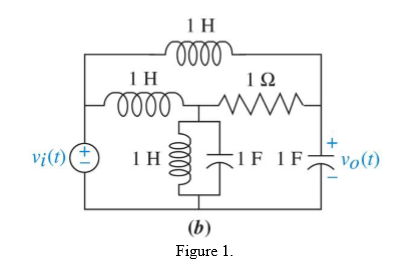
Write the state space equation for Figure 1
Homework Answers
Add Answer to:
Write the state space equation for Figure 1 1 H ΙΩ 1 H HVot) viI Figure 1 1 H ΙΩ 1 H HVot) viI Figure 1
write the state space equation using the following states also write the CCRs , ssrs ,...
 write the state space equation using the following
states
also write the CCRs , ssrs , free body diagram
and finally state space equation
Figure 1: Cart-pendulum system. 7. Bonus Marks: Verify that the ODEs given in (1) and (2) model the cart pendulum. The following hints may be useful: (a) You want to largely follow the procedure taught in class. (b) Select a, e, i and 6 as states. List your inputs, CCRs and SSRs. Make sure to write...
write the state space equation using the following
states
also write the CCRs , ssrs , free body diagram
and finally state space equation
Figure 1: Cart-pendulum system. 7. Bonus Marks: Verify that the ODEs given in (1) and (2) model the cart pendulum. The following hints may be useful: (a) You want to largely follow the procedure taught in class. (b) Select a, e, i and 6 as states. List your inputs, CCRs and SSRs. Make sure to write...
Assignment: Let us consider the same network of HW3, Figure 1, with the parameter reported in Tab...
 Assignment: Let us consider the same network of HW3, Figure 1, with the parameter reported in Table 1. 10 V 1 2 ΙΩ R2 1 H Figure l Table l 1. Which is the order of the system How many input it has? Comment your answer. 2. Obtain (manually) a state space representation of the circuit in the form x(t) - Ax(t) + Bu(t) 3. Assuming that you variable of interest is the current is resistor R1, write an output...
please write clearly so I can read answer Derive the state-space model (state equation and output...
 please write clearly so I can read answer
Derive the state-space model (state equation and output equation) in vector form for the following system. The system output is the angular velocity of the motor's shaft. Assume that the motor shaft is massless. 1.
please write clearly so I can read answer
Derive the state-space model (state equation and output equation) in vector form for the following system. The system output is the angular velocity of the motor's shaft. Assume that the motor shaft is massless. 1.
8. Write down the state space equation for the system shown below US) + 2 y(s)...
 8. Write down the state space equation for the system shown below US) + 2 y(s) $+3 2 s(s+1) 9. Derive the state space equation for the system shown where the coefficients of the system matrix are in diagonal form and the elements of the control matrix are unity. U(S) 1 X2 $+2 X 3+1 X = y $+3 $+4 S
1. Write the state-space equations for the system shown below ri (t) +2 (t) u (t) Figure 1: Syste...
 1. Write the state-space equations for the system shown below ri (t) +2 (t) u (t) Figure 1: System of Problem#1 2. Evaluate the state transition matrix eA for the matrix below and find the homogenous solution given x (0) 1 1 ] A=10-21 3. Find the power lution in powers of x. Show the details of your work. s (b) y" +4y=0 4. Determine if either the Frobenus or regular power series could be the method of your choice...
Write a state-space representation for the system in the figure below. Assume that the system's output is vo(t).
 Write a state-space representation for the system in the figure below. Assume that the system's output isvo(t).
10.Represent the translational mechanical system shown in the Figure in state- space, where xX3(t) is the...
 10.Represent the translational mechanical system shown in the Figure in state- space, where xX3(t) is the output IN- 11.Find the state equations and output equation for the phase-variable representation of the transfer function G(s) 2s+1/(s2+7s+ 9) 12. Convert the state and output equations shown to a transfer function. -1.5 2 u(t) X = X 4 0 Y [1.5 0.625]x 13. For each system shown, write the state equations and the output equation for the phase- variable representation 8s10 sh25 t26...
a) Consider the electrical circuit in Figure 1. Determine the state space representation of the circuit...
 a) Consider the electrical circuit in Figure 1. Determine the state space representation of the circuit where the output is voltage across the capacitor. (6 marks) b) From result obtained in (a), predict the transfer function. (4 marks) [10 MARKS] 1 Ω 192 112 W vi(t) 1 H elle 1 H Illl 1 F volt) Figure 1
Question 1 a) Consider the electrical circuit in Figure 1. Determine the state space representation of...
 Question 1 a) Consider the electrical circuit in Figure 1. Determine the state space representation of the circuit where the output is voltage across the capacitor. (6 marks) b) From result obtained in (a), predict the transfer function. (4 marks) [10 MARKS] 192 192 112 M M w + + Vilt) 1 H sooo 1 H nooo 1F vo(t) Figure 1
Question 1 a) Consider the electrical circuit in Figure 1. Determine the state space representation of...
 Question 1 a) Consider the electrical circuit in Figure 1. Determine the state space representation of the circuit where the output is voltage across the capacitor. (6 marks) b) From result obtained in (a), predict the transfer function. (4 marks) [10 MARKS] 112 192 112 VAD 1 H 1F Figure 1
 write the state space equation using the following
states
also write the CCRs , ssrs , free body diagram
and finally state space equation
Figure 1: Cart-pendulum system. 7. Bonus Marks: Verify that the ODEs given in (1) and (2) model the cart pendulum. The following hints may be useful: (a) You want to largely follow the procedure taught in class. (b) Select a, e, i and 6 as states. List your inputs, CCRs and SSRs. Make sure to write...
write the state space equation using the following
states
also write the CCRs , ssrs , free body diagram
and finally state space equation
Figure 1: Cart-pendulum system. 7. Bonus Marks: Verify that the ODEs given in (1) and (2) model the cart pendulum. The following hints may be useful: (a) You want to largely follow the procedure taught in class. (b) Select a, e, i and 6 as states. List your inputs, CCRs and SSRs. Make sure to write...
 Assignment: Let us consider the same network of HW3, Figure 1, with the parameter reported in Table 1. 10 V 1 2 ΙΩ R2 1 H Figure l Table l 1. Which is the order of the system How many input it has? Comment your answer. 2. Obtain (manually) a state space representation of the circuit in the form x(t) - Ax(t) + Bu(t) 3. Assuming that you variable of interest is the current is resistor R1, write an output...
 please write clearly so I can read answer
Derive the state-space model (state equation and output equation) in vector form for the following system. The system output is the angular velocity of the motor's shaft. Assume that the motor shaft is massless. 1.
please write clearly so I can read answer
Derive the state-space model (state equation and output equation) in vector form for the following system. The system output is the angular velocity of the motor's shaft. Assume that the motor shaft is massless. 1.
 8. Write down the state space equation for the system shown below US) + 2 y(s) $+3 2 s(s+1) 9. Derive the state space equation for the system shown where the coefficients of the system matrix are in diagonal form and the elements of the control matrix are unity. U(S) 1 X2 $+2 X 3+1 X = y $+3 $+4 S
 1. Write the state-space equations for the system shown below ri (t) +2 (t) u (t) Figure 1: System of Problem#1 2. Evaluate the state transition matrix eA for the matrix below and find the homogenous solution given x (0) 1 1 ] A=10-21 3. Find the power lution in powers of x. Show the details of your work. s (b) y" +4y=0 4. Determine if either the Frobenus or regular power series could be the method of your choice...
 10.Represent the translational mechanical system shown in the Figure in state- space, where xX3(t) is the output IN- 11.Find the state equations and output equation for the phase-variable representation of the transfer function G(s) 2s+1/(s2+7s+ 9) 12. Convert the state and output equations shown to a transfer function. -1.5 2 u(t) X = X 4 0 Y [1.5 0.625]x 13. For each system shown, write the state equations and the output equation for the phase- variable representation 8s10 sh25 t26...
 a) Consider the electrical circuit in Figure 1. Determine the state space representation of the circuit where the output is voltage across the capacitor. (6 marks) b) From result obtained in (a), predict the transfer function. (4 marks) [10 MARKS] 1 Ω 192 112 W vi(t) 1 H elle 1 H Illl 1 F volt) Figure 1
 Question 1 a) Consider the electrical circuit in Figure 1. Determine the state space representation of the circuit where the output is voltage across the capacitor. (6 marks) b) From result obtained in (a), predict the transfer function. (4 marks) [10 MARKS] 192 192 112 M M w + + Vilt) 1 H sooo 1 H nooo 1F vo(t) Figure 1
 Question 1 a) Consider the electrical circuit in Figure 1. Determine the state space representation of the circuit where the output is voltage across the capacitor. (6 marks) b) From result obtained in (a), predict the transfer function. (4 marks) [10 MARKS] 112 192 112 VAD 1 H 1F Figure 1
Most questions answered within 3 hours.
-
Where is the error in this code sequence?
String s1 = "Hello";
String s2 = "ello";...
asked 10 months ago -
Financial data for Joel de Paris, Inc., for last year
follow:
Joel de Paris, Inc.
Balance...
asked 10 months ago -
Consider this reaction:
Al2(SO4)3 (aq)+ BaCl3
(aq) Al2Cl6 (aq)- +
3BaSO4(s) . What is the...
asked 10 months ago -
Suppose that Savneet is considering increasing her
recent random sample from 20 car rentals to 40...
asked 10 months ago -
Trucks arrive at an unloading terminal at an average rate of 120
per hour.
Trucks arrive...
asked 10 months ago -
Why are methanol and ethanol completely soluble in water while
octanol is not very little soluble....
asked 10 months ago -
A facilities manager at a university reads in a research report
that the mean amount of...
asked 10 months ago -
When the CuSO4 is rehydrated by adding water to the anhydrous
compound, is this an endothermic...
asked 10 months ago -
A ray of sunlight is passing from diamond into crown glass; the
angle of incidence is...
asked 10 months ago -
A block of mass 0.249 kg is placed on top of a light, vertical
spring of...
asked 10 months ago -
how do the kidneys compensate in the presences of acidosis
a) trigger hyperventilate
b) reserve acid...
asked 10 months ago -
Question 501 pts
The rental rate of capital to the firm increases. Which of the
following...
asked 10 months ago