
Homework Answers
Aeroacoustics What is the phase relationship between: a) F(t) = eiat and G(t)-ei(at-π/2) b) F(t)-ieo and...
 Aeroacoustics
What is the phase relationship between: a) F(t) = eiat and G(t)-ei(at-π/2) b) F(t)-ieo and G(t) c) F(t)--ieior and G(i)=(1+W3)eiat d) F(t)-(3-4)eat and G(t)=(-3+4i)eiat e) F(t)--i(i + V3)ei(or+ π /6) and G(t)--dat 3. iot
Aeroacoustics
What is the phase relationship between: a) F(t) = eiat and G(t)-ei(at-π/2) b) F(t)-ieo and G(t) c) F(t)--ieior and G(i)=(1+W3)eiat d) F(t)-(3-4)eat and G(t)=(-3+4i)eiat e) F(t)--i(i + V3)ei(or+ π /6) and G(t)--dat 3. iot
just show a few to understand the concept t, n -0, 1, 2, -, and Ei(-)...
 just show a few to understand the concept
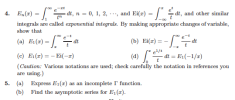
t, n -0, 1, 2, -, and Ei(-) - dt, and other similar integrals are called show that exponential integrals. By making appropriate changes of variable 00 t (c) E(T)Ei(-r) (Caution: Various notations are used; check carefully the notation in references you are using. (a) (b) Express E1(z) as an incomplete Find the asymptotic series for E1(T) 5. function.
just show a few to understand the concept
t, n -0, 1, 2, -, and Ei(-) - dt, and other similar integrals are called show that exponential integrals. By making appropriate changes of variable 00 t (c) E(T)Ei(-r) (Caution: Various notations are used; check carefully the notation in references you are using. (a) (b) Express E1(z) as an incomplete Find the asymptotic series for E1(T) 5. function.
A free particle moving in one dimension has wave function Ψ(x,t)=A[ei(kx−ωt)−ei(2kx−4ωt)] where k and ω are...
A free particle moving in one dimension has wave function Ψ(x,t)=A[ei(kx−ωt)−ei(2kx−4ωt)] where k and ω are positive real constants. At t = π/(6ω) what are the two smallest positive values of x for which the probability function |Ψ(x,t)|2 is a maximum? Express your answer in terms of k.
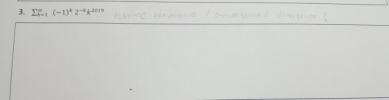
real analysis 3. ei (-1)#2-kk2019 3. ei (-1)#2-kk2019
 real analysis
3. ei (-1)#2-kk2019
3. ei (-1)#2-kk2019
real analysis
3. ei (-1)#2-kk2019
3. ei (-1)#2-kk2019
2. Let Y(t) = ei(x(0)+o)(\pi) where X(t) is a Poisson process with autocorrelation function Rxx(t1, tz)...
 2. Let Y(t) = ei(x(0)+o)(\pi) where X(t) is a Poisson process with autocorrelation function Rxx(t1, tz) = tīta + min(tı, tz), and 6 ~ U(0,2") is independent of X(t). a. Is Y(t) W.S.S.? b. If so, find its power spectral density. [25]
2) Consider a random variable with the following probability distribution: P(X-0)-0., Px-1)-0.2, PX-2)-0.3, PX-3) -0.3, and PX-4)-0.1 A. Generate 400 values of this random variable with the given pro...
 2) Consider a random variable with the following probability distribution: P(X-0)-0., Px-1)-0.2, PX-2)-0.3, PX-3) -0.3, and PX-4)-0.1 A. Generate 400 values of this random variable with the given probability distribution using simulation. B. Compare the distribution of simulated values to the given probability distribution. Is the simulated distribution indicative of the given probability distribution? Explain why or why not. C. Compute the mean and standard deviation of the distribution of simulated values. How do these summary measures compare to the...
Problem 6 A bilinear pairing on R2 is given on basis vectors by <ei, ei >=...
 Problem 6 A bilinear pairing on R2 is given on basis vectors by <ei, ei >= 13; <ei, e2 >=< e2, ej >= 7; <e2,e2 >= 26 a) [3 pts) Find the matrix representation of the pairing. b) (4 pts) Explain why the bilinear pairing defines an inner product. c) [3 pts) If v = [5 – 3]T, find a non-zero vector w with < v, w >= 0
Consider the following individual (indirect) expenditure function: E(px, py, U) = 2(px py U)1/2. At price...
Consider the following individual (indirect) expenditure function: E(px, py, U) = 2(px py U)1/2. At price px = 20, py = 40 and U = 200, the quantity demand xc (on this individual compensated demand curve) is [xc]. Hint: Use the Shephard lemma to derive this individual compensated demand function.
2. Given the following two equations, ei- 125 sin377t and e, -180 sin(377t + T/3). Calculate...
 2. Given the following two equations, ei- 125 sin377t and e, -180 sin(377t + T/3). Calculate the following: a. b. c. d. the resultant RMS Value (187.8v) the phase angle the frequency of the resultant the equation of the resultant in degręes and radians (eR ??? sin 377t + ??) (eR ?? sin 377t+???)
2. Prove that for any fixed real numbers p and g, the equation 2xr + px+q + log2(x2 + px + q) + x2 + px = 2019 has at most two real number solutions. 2. Prove that for any fixed real numbers...
 2. Prove that for any fixed real numbers p and g, the equation 2xr + px+q + log2(x2 + px + q) + x2 + px = 2019 has at most two real number solutions.
2. Prove that for any fixed real numbers p and g, the equation 2xr + px+q + log2(x2 + px + q) + x2 + px = 2019 has at most two real number solutions.
2. Prove that for any fixed real numbers p and g, the equation 2xr + px+q + log2(x2 + px + q) + x2 + px = 2019 has at most two real number solutions.
 Aeroacoustics
What is the phase relationship between: a) F(t) = eiat and G(t)-ei(at-π/2) b) F(t)-ieo and G(t) c) F(t)--ieior and G(i)=(1+W3)eiat d) F(t)-(3-4)eat and G(t)=(-3+4i)eiat e) F(t)--i(i + V3)ei(or+ π /6) and G(t)--dat 3. iot
Aeroacoustics
What is the phase relationship between: a) F(t) = eiat and G(t)-ei(at-π/2) b) F(t)-ieo and G(t) c) F(t)--ieior and G(i)=(1+W3)eiat d) F(t)-(3-4)eat and G(t)=(-3+4i)eiat e) F(t)--i(i + V3)ei(or+ π /6) and G(t)--dat 3. iot
 just show a few to understand the concept
t, n -0, 1, 2, -, and Ei(-) - dt, and other similar integrals are called show that exponential integrals. By making appropriate changes of variable 00 t (c) E(T)Ei(-r) (Caution: Various notations are used; check carefully the notation in references you are using. (a) (b) Express E1(z) as an incomplete Find the asymptotic series for E1(T) 5. function.
just show a few to understand the concept
t, n -0, 1, 2, -, and Ei(-) - dt, and other similar integrals are called show that exponential integrals. By making appropriate changes of variable 00 t (c) E(T)Ei(-r) (Caution: Various notations are used; check carefully the notation in references you are using. (a) (b) Express E1(z) as an incomplete Find the asymptotic series for E1(T) 5. function.
 real analysis
3. ei (-1)#2-kk2019
3. ei (-1)#2-kk2019
real analysis
3. ei (-1)#2-kk2019
3. ei (-1)#2-kk2019
 2. Let Y(t) = ei(x(0)+o)(\pi) where X(t) is a Poisson process with autocorrelation function Rxx(t1, tz) = tīta + min(tı, tz), and 6 ~ U(0,2") is independent of X(t). a. Is Y(t) W.S.S.? b. If so, find its power spectral density. [25]
 2) Consider a random variable with the following probability distribution: P(X-0)-0., Px-1)-0.2, PX-2)-0.3, PX-3) -0.3, and PX-4)-0.1 A. Generate 400 values of this random variable with the given probability distribution using simulation. B. Compare the distribution of simulated values to the given probability distribution. Is the simulated distribution indicative of the given probability distribution? Explain why or why not. C. Compute the mean and standard deviation of the distribution of simulated values. How do these summary measures compare to the...
 Problem 6 A bilinear pairing on R2 is given on basis vectors by <ei, ei >= 13; <ei, e2 >=< e2, ej >= 7; <e2,e2 >= 26 a) [3 pts) Find the matrix representation of the pairing. b) (4 pts) Explain why the bilinear pairing defines an inner product. c) [3 pts) If v = [5 – 3]T, find a non-zero vector w with < v, w >= 0
 2. Given the following two equations, ei- 125 sin377t and e, -180 sin(377t + T/3). Calculate the following: a. b. c. d. the resultant RMS Value (187.8v) the phase angle the frequency of the resultant the equation of the resultant in degręes and radians (eR ??? sin 377t + ??) (eR ?? sin 377t+???)
 2. Prove that for any fixed real numbers p and g, the equation 2xr + px+q + log2(x2 + px + q) + x2 + px = 2019 has at most two real number solutions.
2. Prove that for any fixed real numbers p and g, the equation 2xr + px+q + log2(x2 + px + q) + x2 + px = 2019 has at most two real number solutions.
2. Prove that for any fixed real numbers p and g, the equation 2xr + px+q + log2(x2 + px + q) + x2 + px = 2019 has at most two real number solutions.
Most questions answered within 3 hours.
-
Where is the error in this code sequence?
String s1 = "Hello";
String s2 = "ello";...
asked 11 months ago -
Financial data for Joel de Paris, Inc., for last year
follow:
Joel de Paris, Inc.
Balance...
asked 11 months ago -
Consider this reaction:
Al2(SO4)3 (aq)+ BaCl3
(aq) Al2Cl6 (aq)- +
3BaSO4(s) . What is the...
asked 11 months ago -
Suppose that Savneet is considering increasing her
recent random sample from 20 car rentals to 40...
asked 11 months ago -
Trucks arrive at an unloading terminal at an average rate of 120
per hour.
Trucks arrive...
asked 11 months ago -
Why are methanol and ethanol completely soluble in water while
octanol is not very little soluble....
asked 11 months ago -
A facilities manager at a university reads in a research report
that the mean amount of...
asked 11 months ago -
When the CuSO4 is rehydrated by adding water to the anhydrous
compound, is this an endothermic...
asked 11 months ago -
A ray of sunlight is passing from diamond into crown glass; the
angle of incidence is...
asked 11 months ago -
A block of mass 0.249 kg is placed on top of a light, vertical
spring of...
asked 11 months ago -
how do the kidneys compensate in the presences of acidosis
a) trigger hyperventilate
b) reserve acid...
asked 11 months ago -
Question 501 pts
The rental rate of capital to the firm increases. Which of the
following...
asked 11 months ago