
Homework Answers
s=0:0.01:10;
w=0:0.01:10;
P=zeros(length(s),length(w));
for m=1:length(s)
for n=1:length(w)
P(m,n)=((1e-7.*(s(m).^3))./(s(m)+w(n)))+(1e7.*((s(m).^2)./w(n)))+3.28e-7+(6.5e-7.*(w(n)./s(m)));
end
end
A=min(min(P));
disp(['minimum value of P_{loss density} is ' num2str(A)]);
------------------------------
>> m1
minimum value of P_{loss density} is 100.0007
>>
Add Answer to:
If 0<S<10 and 0<w, K 10 Using Matlab to find the minimum value of Ploss Density f PLoss Densitystw ifPLoss Density = (10+ws') + (16 * 106 * wr) + (3.25 * 10-8 + 6.5 * 10-7 sr) I...
8. For a semi-infinite solid buried in soil (a=0.15 x 10⁶ m²/s and k=0.4 W/m." minimum...
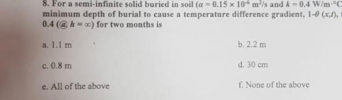 8. For a semi-infinite solid buried in soil (a=0.15 x 10⁶ m²/s and k=0.4 W/m." minimum depth of burial to cause a temperature difference gradient, 1-8 (x,1), 0.4 @ h = o) for two months is a. 1.1 m b. 2.2 m c. 0.8 m d. 30 cm e. All of the above f. None of the above
Please show answer using MATLAB Time, t(s) 0 2 4 6 8 10 12 14 16...
Please show answer using MATLAB Time, t(s) 0 2 4 6 8 10 12 14 16 Position, x(m) 0 0.7 1.8 3.4 5.1 6.3 7.3 8.0 8.4 To find the velocity at all times using the two-point differencing formula (and where appropriate the three-point forward or backward differencing formulae), these should yield the results correct to O(h2) To find the acceleration at all times using the three-point central differencing formula (and where appropriate the four-point forward or backward differencing formulae),...
Consider the graph 12 10 6, 9) y-f(x 8 (2, 7) (4, 5) (0, 3) (8, 0) 10 (a) Using the indicated subintervals, approximate the shaded area by using lower sums s (rectangles that lie below the graph of f...
 Consider the graph 12 10 6, 9) y-f(x 8 (2, 7) (4, 5) (0, 3) (8, 0) 10 (a) Using the indicated subintervals, approximate the shaded area by using lower sums s (rectangles that lie below the graph of f) (b) Using the indicated subintervals, approximate the shaded area by using upper sums S (rectangles that extend above the graph of f) +-14 points SullivanCalc1 5.1.019 Approximate the area A under the graph of function f from a to b...
using matlab 3. [1:2] Find a root (value of x for which f(x)-0) of f(x) =...
 using matlab
3. [1:2] Find a root (value of x for which f(x)-0) of f(x) = a x^3 + bx^2 + c x + d using Newton's interation: xnew = x -f(x)/(x). Note that f'(x) is the first derivative off with respect to x. Then x=xnew. Start with x=0 and iterate until f(xnew) < 1.0-4. Use values (a,b,c,d]=[-0.02, 0.09, -1.1, 3.2). Plot the polynomial vs x in the range (-10 10). Mark the zero point.
using matlab
3. [1:2] Find a root (value of x for which f(x)-0) of f(x) = a x^3 + bx^2 + c x + d using Newton's interation: xnew = x -f(x)/(x). Note that f'(x) is the first derivative off with respect to x. Then x=xnew. Start with x=0 and iterate until f(xnew) < 1.0-4. Use values (a,b,c,d]=[-0.02, 0.09, -1.1, 3.2). Plot the polynomial vs x in the range (-10 10). Mark the zero point.
The joint probability density function for random variables S and T is given by 20,0s 3 10 fk(2s+ for 0 0 otherwis (a) [5 pts] Determine the value of k (b) [5 pts] Find the probability that P(S +...
 The joint probability density function for random variables S and T is given by 20,0s 3 10 fk(2s+ for 0 0 otherwis (a) [5 pts] Determine the value of k (b) [5 pts] Find the probability that P(S +T20). Warning: Sketch the integration region.]
The joint probability density function for random variables S and T is given by 20,0s 3 10 fk(2s+ for 0 0 otherwis (a) [5 pts] Determine the value of k (b) [5 pts] Find the probability...
The joint probability density function for random variables S and T is given by 20,0s 3 10 fk(2s+ for 0 0 otherwis (a) [5 pts] Determine the value of k (b) [5 pts] Find the probability that P(S +T20). Warning: Sketch the integration region.]
The joint probability density function for random variables S and T is given by 20,0s 3 10 fk(2s+ for 0 0 otherwis (a) [5 pts] Determine the value of k (b) [5 pts] Find the probability...
Simplify the following function expressions using K-map in both standard forms: F(w,x,y,z) = Σ(1, 7, 8,...
Simplify the following function expressions using K-map in both standard forms: F(w,x,y,z) = Σ(1, 7, 8, 9, 10) F(A,B,C, D) = Π(1, 2, 7, 9). F(x, y, z) = [(x+y)(x’+z)]’
7. Find the surface area of the surface r(u, u) = u ui + (u + u)j + (u-u) k, u2 +02-1 V/16-x2-y2 with upward orientation and let 8. Let S be the hemisphere 2 F(x, y,z)-yitj+3z k. Calculate JJs F d...
 7. Find the surface area of the surface r(u, u) = u ui + (u + u)j + (u-u) k, u2 +02-1 V/16-x2-y2 with upward orientation and let 8. Let S be the hemisphere 2 F(x, y,z)-yitj+3z k. Calculate JJs F dS, the flux of F across S
7. Find the surface area of the surface r(u, u) = u ui + (u + u)j + (u-u) k, u2 +02-1 V/16-x2-y2 with upward orientation and let 8. Let S be...
7. Find the surface area of the surface r(u, u) = u ui + (u + u)j + (u-u) k, u2 +02-1 V/16-x2-y2 with upward orientation and let 8. Let S be the hemisphere 2 F(x, y,z)-yitj+3z k. Calculate JJs F dS, the flux of F across S
7. Find the surface area of the surface r(u, u) = u ui + (u + u)j + (u-u) k, u2 +02-1 V/16-x2-y2 with upward orientation and let 8. Let S be...
Exercise 10 (8 Marks) Given the open loop transfer function of a system: KH(S) = K...
 Exercise 10 (8 Marks) Given the open loop transfer function of a system: KH(S) = K s(s +3Xs? +2s +2) Draw manually the root locus plot for the system and determine: a) The number of branches. b) The starting and ending points of all the branches. c) The location of the centroid d) The range of K to keep this and angles of asymplotes. e) The intersections of the root loci with the imaginary axis and the corresponding value of...
(1 point 16 18 I W AB has length 18 and AC has length 16, find:...
 (1 point 16 18 I W AB has length 18 and AC has length 16, find: • The length of MC . The measure of angle B in degrees): . The measure of angle in degrees): If you use a calculator to find a decimal approximation, your answer must be accurate to at least 3 decimal places If you're using a calculator, be sure that your calculator is set to degrees, not radians You are also allowed to use the...
2. Nise (9.3) For a unity feedback system with 10% OS: KG(s) Ts)- 1+ KGS) G(s) (s +2)(s +3) (s +7) NOTE: the 10% overshoot line is 126.16" with a 7-59. a. Find the K value of the system at 10...
 2. Nise (9.3) For a unity feedback system with 10% OS: KG(s) Ts)- 1+ KGS) G(s) (s +2)(s +3) (s +7) NOTE: the 10% overshoot line is 126.16" with a 7-59. a. Find the K value of the system at 10% OS if this corresponds to a point on the root locus of s-1.87+j2.56 NOTE: use the fact that 1 + KG(6) -0 at all points on the root locus,so K -() convert your G(s) to a exponential magnitude to...
 8. For a semi-infinite solid buried in soil (a=0.15 x 10⁶ m²/s and k=0.4 W/m." minimum depth of burial to cause a temperature difference gradient, 1-8 (x,1), 0.4 @ h = o) for two months is a. 1.1 m b. 2.2 m c. 0.8 m d. 30 cm e. All of the above f. None of the above
 Consider the graph 12 10 6, 9) y-f(x 8 (2, 7) (4, 5) (0, 3) (8, 0) 10 (a) Using the indicated subintervals, approximate the shaded area by using lower sums s (rectangles that lie below the graph of f) (b) Using the indicated subintervals, approximate the shaded area by using upper sums S (rectangles that extend above the graph of f) +-14 points SullivanCalc1 5.1.019 Approximate the area A under the graph of function f from a to b...
 using matlab
3. [1:2] Find a root (value of x for which f(x)-0) of f(x) = a x^3 + bx^2 + c x + d using Newton's interation: xnew = x -f(x)/(x). Note that f'(x) is the first derivative off with respect to x. Then x=xnew. Start with x=0 and iterate until f(xnew) < 1.0-4. Use values (a,b,c,d]=[-0.02, 0.09, -1.1, 3.2). Plot the polynomial vs x in the range (-10 10). Mark the zero point.
using matlab
3. [1:2] Find a root (value of x for which f(x)-0) of f(x) = a x^3 + bx^2 + c x + d using Newton's interation: xnew = x -f(x)/(x). Note that f'(x) is the first derivative off with respect to x. Then x=xnew. Start with x=0 and iterate until f(xnew) < 1.0-4. Use values (a,b,c,d]=[-0.02, 0.09, -1.1, 3.2). Plot the polynomial vs x in the range (-10 10). Mark the zero point.
 The joint probability density function for random variables S and T is given by 20,0s 3 10 fk(2s+ for 0 0 otherwis (a) [5 pts] Determine the value of k (b) [5 pts] Find the probability that P(S +T20). Warning: Sketch the integration region.]
The joint probability density function for random variables S and T is given by 20,0s 3 10 fk(2s+ for 0 0 otherwis (a) [5 pts] Determine the value of k (b) [5 pts] Find the probability...
The joint probability density function for random variables S and T is given by 20,0s 3 10 fk(2s+ for 0 0 otherwis (a) [5 pts] Determine the value of k (b) [5 pts] Find the probability that P(S +T20). Warning: Sketch the integration region.]
The joint probability density function for random variables S and T is given by 20,0s 3 10 fk(2s+ for 0 0 otherwis (a) [5 pts] Determine the value of k (b) [5 pts] Find the probability...
 7. Find the surface area of the surface r(u, u) = u ui + (u + u)j + (u-u) k, u2 +02-1 V/16-x2-y2 with upward orientation and let 8. Let S be the hemisphere 2 F(x, y,z)-yitj+3z k. Calculate JJs F dS, the flux of F across S
7. Find the surface area of the surface r(u, u) = u ui + (u + u)j + (u-u) k, u2 +02-1 V/16-x2-y2 with upward orientation and let 8. Let S be...
7. Find the surface area of the surface r(u, u) = u ui + (u + u)j + (u-u) k, u2 +02-1 V/16-x2-y2 with upward orientation and let 8. Let S be the hemisphere 2 F(x, y,z)-yitj+3z k. Calculate JJs F dS, the flux of F across S
7. Find the surface area of the surface r(u, u) = u ui + (u + u)j + (u-u) k, u2 +02-1 V/16-x2-y2 with upward orientation and let 8. Let S be...
 Exercise 10 (8 Marks) Given the open loop transfer function of a system: KH(S) = K s(s +3Xs? +2s +2) Draw manually the root locus plot for the system and determine: a) The number of branches. b) The starting and ending points of all the branches. c) The location of the centroid d) The range of K to keep this and angles of asymplotes. e) The intersections of the root loci with the imaginary axis and the corresponding value of...
 (1 point 16 18 I W AB has length 18 and AC has length 16, find: • The length of MC . The measure of angle B in degrees): . The measure of angle in degrees): If you use a calculator to find a decimal approximation, your answer must be accurate to at least 3 decimal places If you're using a calculator, be sure that your calculator is set to degrees, not radians You are also allowed to use the...
 2. Nise (9.3) For a unity feedback system with 10% OS: KG(s) Ts)- 1+ KGS) G(s) (s +2)(s +3) (s +7) NOTE: the 10% overshoot line is 126.16" with a 7-59. a. Find the K value of the system at 10% OS if this corresponds to a point on the root locus of s-1.87+j2.56 NOTE: use the fact that 1 + KG(6) -0 at all points on the root locus,so K -() convert your G(s) to a exponential magnitude to...
Most questions answered within 3 hours.
-
Where is the error in this code sequence?
String s1 = "Hello";
String s2 = "ello";...
asked 11 months ago -
Financial data for Joel de Paris, Inc., for last year
follow:
Joel de Paris, Inc.
Balance...
asked 11 months ago -
Consider this reaction:
Al2(SO4)3 (aq)+ BaCl3
(aq) Al2Cl6 (aq)- +
3BaSO4(s) . What is the...
asked 11 months ago -
Suppose that Savneet is considering increasing her
recent random sample from 20 car rentals to 40...
asked 11 months ago -
Trucks arrive at an unloading terminal at an average rate of 120
per hour.
Trucks arrive...
asked 11 months ago -
Why are methanol and ethanol completely soluble in water while
octanol is not very little soluble....
asked 11 months ago -
A facilities manager at a university reads in a research report
that the mean amount of...
asked 11 months ago -
When the CuSO4 is rehydrated by adding water to the anhydrous
compound, is this an endothermic...
asked 11 months ago -
A ray of sunlight is passing from diamond into crown glass; the
angle of incidence is...
asked 11 months ago -
A block of mass 0.249 kg is placed on top of a light, vertical
spring of...
asked 11 months ago -
how do the kidneys compensate in the presences of acidosis
a) trigger hyperventilate
b) reserve acid...
asked 11 months ago -
Question 501 pts
The rental rate of capital to the firm increases. Which of the
following...
asked 11 months ago