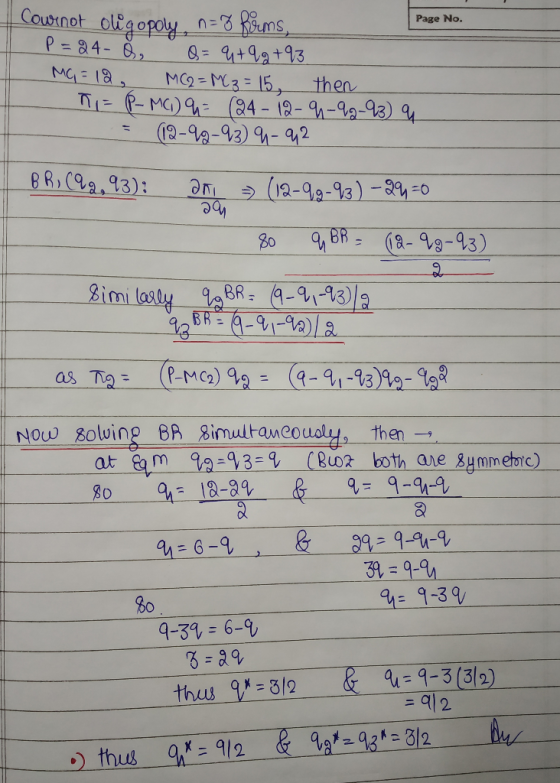
1. Consider a three firm (n = 3) Cournot oligopoly. The market inverse demand function is p (Q) = 24 Q. Firm 1 has constant average and marginal costs of $12 per unit, while firms 2 and 3 have constan...
1. Consider a three firm (n = 3) Cournot oligopoly. The market inverse demand function is
p (Q) = 24 Q.
Firm 1 has constant average and marginal costs of $12 per unit, while firms 2 and 3 have constant average and marginal costs of $15 per unit.
a)Verify that the following are Nash equilibrium quantities for this market: q1 = 9 / 2 and q2 = q3 = 3 / 2 .
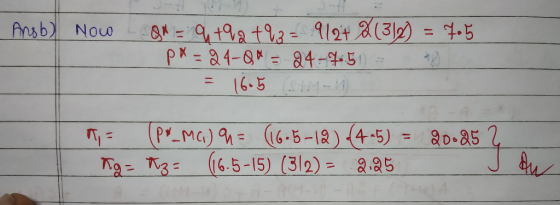
b)How much profit does each firm earn in equilibrium?
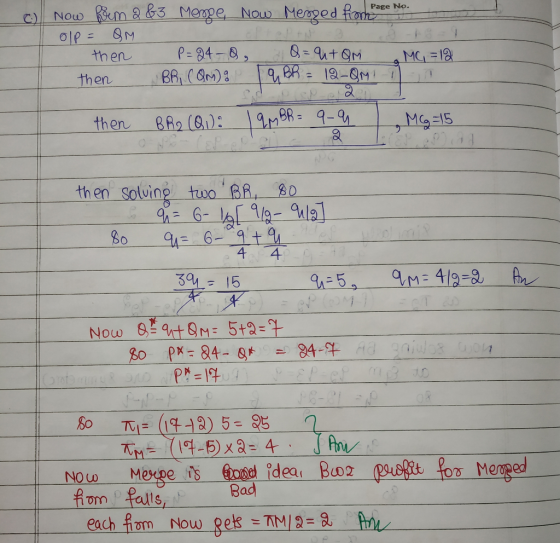
(c) Suppose firms 2 and 3 merge. We now have a duopoly in which firm 1 has costs of $12 per unit and firm 2 (the merged entity) has costs of $15 per unit.
i. Nash equilibrium quantities for each firm in this duopoly: q1 = 9 and q2= 6, and calculate each firm's equilibrium profit. Was the merger a good idea for the two merging firms? Be sure to explain your answer.
ii. Calculate the consumer surplus for the pre-merger market (i.e., the one with 3 firms) and for the post-merger market (i.e., the one with 2 firms).
[Hint: In each case, you need to draw the market demand curve, identify the market price based on the equilibrium quantities, and then calculate the area of the consumer surplus triangle.]
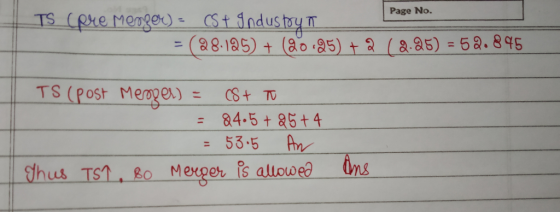
ii. Suppose the Commerce Commission allows a merger to take place if it increases total surplus, where total surplus is the sum of industry profit plus consumer surplus. (" Industry profits " is the total profit of all firms in the industry - the sum of the individual firms' profits.) It will not allow the merger if total surplus falls or stays the same. Will the Commerce Commission approve the merger in this case? Be sure to explain your answer.
Homework Answers
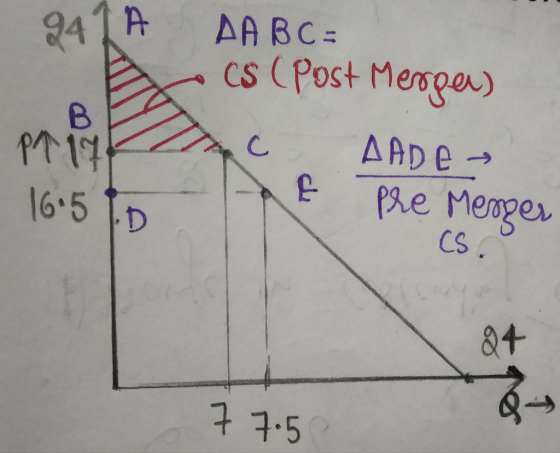
So CS( pre merger) = .5*(24-16.5)*7.5 = 28.125
CS (post merger)= .5*(24-17)*7= 24.5
Thus CS falls post merger
Add Answer to:
1. Consider a three firm (n = 3) Cournot oligopoly. The market inverse demand function is p (Q) = 24 Q. Firm 1 has constant average and marginal costs of $12 per unit, while firms 2 and 3 have constan...
I. Consider a three firm (n = 3) Cournot oligopoly. The market inverse demand function is...
 I. Consider a three firm (n = 3) Cournot oligopoly. The market inverse demand function is P()-24 Q. Firm 1 has constant average and marginal costs of $12 per unit, while firms 2 and 3 have constant average and marginal costs of $15 per unit. p (Q) (a) Verify that the following are Nash equilibrium quantities for this market: q,-. and g2 = g3 We were unable to transcribe this image
2. Suppose the market demand curve is P = 40 − 3Q and all firms in...
2. Suppose the market demand curve is P = 40 − 3Q and all firms in the industry face M C = 4 and have no fixed costs. For each of the following situations, calculate the five items: Market Price , Quantity per firm ,Profits per firm ,Consumer Surplus ,Deadweight Loss (a) Uniform pricing monopolist P = Q = π = CS = DWL = (b) Cournot Duopoly P= Q1 = Q2 = π 1 = π2...
Consider two symmetric Cournot duopolists who face inverse market demand of p = 140−Q. Suppose that...
Consider two symmetric Cournot duopolists who face inverse market demand of p = 140−Q. Suppose that they each have long-run cost functions Ci(qi) = 20qi for i = 1, 2. (a) Draw a graph containing the demand and marginal cost curves. (b) What are the efficient quantity and price, QC and pC? How much total surplus is generated at this quantity and price? (c) What are the monopoly quantity and price, QM and pM ? How much profit would a...
2. (Cournot Model) Consider a Cournot duopoly. The market demand is p=160 - q2. Firm 1's...
 2. (Cournot Model) Consider a Cournot duopoly. The market demand is p=160 - q2. Firm 1's marginal cost is 10, and firm 2's marginal cost is also 10. There are no fixed costs. A. Derive each firm's best response function B. What is the Nash equilibrium of this model? Find the equilibrium market price. C. Find the equilibrium profit for each firm D. Find the equilibrium consumer surplus in this market. 3. (Bertrand Model) Consider a Bertrand duopoly. The market...
The market demand function is Q = 10000 - 1000p Each firm has a marginal cost...
The market demand function is Q = 10000 - 1000p Each firm has a marginal cost of m=$0.28. Firm 1, the leader, acts before Firm 2, the follower. Solve for the Stackelberg-Nash equilibrium quantities, prices, and profits. Compare your solution to the Cournot-Nash equilibrium. The Stackelberg-Nash equilibrium quantities are q1 = ____ units and q2= ____ units. (Enter your responses as whole numbers.) The Stackelberg-Nash equilibrium price is: p=$_____________ Profits for the firms are profit1=$_______________ and profit2=$_______________ The Cournot-Nash equilibrium...
EC202-5-FY 10 9Answer both parts of this question. (a) Firm A and Firm B produce a homogenous good and are Cournot duopolists. The firms face an inverse market demand curve given by P 10-Q. where...
 EC202-5-FY 10 9Answer both parts of this question. (a) Firm A and Firm B produce a homogenous good and are Cournot duopolists. The firms face an inverse market demand curve given by P 10-Q. where P is the market price and Q is the market quantity demanded. The marginal and average cost of each firm is 4 i. 10 marks] Show that if the firms compete as Cournot duopolists that the total in- dustry output is 4 and that if...
2. Consider a market with inverse demand P (Q) = 100 - Q. Assume there are...
2. Consider a market with inverse demand P (Q) = 100 - Q. Assume there are two different duopolies serving it. Duopoly D1 has two firms having unit costs c1 = 6 and c2 = 2, and duopoly D2 has two (symmetric) firms both having unit cost c = 4. (a) Find the Cournot equilibrium in each duopoly. (b) Compare the equilibrium total outputs and market prices in the two duopolies. (c) Compare the equilibrium consumer surplus, total firm revenue,...
15.2 where a, b > 0 a. Suppose that firms' marginal and average costs are constant...
 15.2 where a, b > 0 a. Suppose that firms' marginal and average costs are constant and equal to c and that inverse market demand is given by P = a - bQ. Calculate the profit-maximizing price-quantity combination for a monopolist. Also calculate the monopolist's profit. b. Calculate the Nash equilibrium quantities for Cournot duopolists, which choose quantities for their identical products simultaneously. Also compute market output, market price, and firm and industry profits. c. Calculate the Nash equilibrium prices...
Question 5 Demand in a market dominated by two firms (a Cournot duopoly) is determined according...
Question 5 Demand in a market dominated by two firms (a Cournot duopoly) is determined according to: P = 200 – 2(Q1 + Q2), where P is the market price, Q1 is the quantity demanded by Firm 1, and Q2 is the quantity demanded by Firm 2. The marginal cost and average cost for each firm is constant; AC=MC = $60. The cournot-duopoly equilibrium profit for each firm is _____. Hint: Write your answer to two decimal places. QUESTION 6...
Duopoly quantity-setting firms face the market demand p=210-Q. Each firm has a marginal cost of $15...
Duopoly quantity-setting firms face the market demand p=210-Q. Each firm has a marginal cost of $15 per unit. What is the Cournot equilibrium? The Cournot Equilibrium quantities for Firm 1 (q1) and Firm 2 (q2) are: q1= __ units and q2 =__ units . (Enter numeric responses using real numbers rounded to two decimal places.) The Cournot equilibrium price is p=$__ (two decimal places)
 I. Consider a three firm (n = 3) Cournot oligopoly. The market inverse demand function is P()-24 Q. Firm 1 has constant average and marginal costs of $12 per unit, while firms 2 and 3 have constant average and marginal costs of $15 per unit. p (Q) (a) Verify that the following are Nash equilibrium quantities for this market: q,-. and g2 = g3 We were unable to transcribe this image
 2. (Cournot Model) Consider a Cournot duopoly. The market demand is p=160 - q2. Firm 1's marginal cost is 10, and firm 2's marginal cost is also 10. There are no fixed costs. A. Derive each firm's best response function B. What is the Nash equilibrium of this model? Find the equilibrium market price. C. Find the equilibrium profit for each firm D. Find the equilibrium consumer surplus in this market. 3. (Bertrand Model) Consider a Bertrand duopoly. The market...
 EC202-5-FY 10 9Answer both parts of this question. (a) Firm A and Firm B produce a homogenous good and are Cournot duopolists. The firms face an inverse market demand curve given by P 10-Q. where P is the market price and Q is the market quantity demanded. The marginal and average cost of each firm is 4 i. 10 marks] Show that if the firms compete as Cournot duopolists that the total in- dustry output is 4 and that if...
 15.2 where a, b > 0 a. Suppose that firms' marginal and average costs are constant and equal to c and that inverse market demand is given by P = a - bQ. Calculate the profit-maximizing price-quantity combination for a monopolist. Also calculate the monopolist's profit. b. Calculate the Nash equilibrium quantities for Cournot duopolists, which choose quantities for their identical products simultaneously. Also compute market output, market price, and firm and industry profits. c. Calculate the Nash equilibrium prices...
Most questions answered within 3 hours.
-
Where is the error in this code sequence?
String s1 = "Hello";
String s2 = "ello";...
asked 11 months ago -
Financial data for Joel de Paris, Inc., for last year
follow:
Joel de Paris, Inc.
Balance...
asked 11 months ago -
Consider this reaction:
Al2(SO4)3 (aq)+ BaCl3
(aq) Al2Cl6 (aq)- +
3BaSO4(s) . What is the...
asked 11 months ago -
Suppose that Savneet is considering increasing her
recent random sample from 20 car rentals to 40...
asked 11 months ago -
Trucks arrive at an unloading terminal at an average rate of 120
per hour.
Trucks arrive...
asked 11 months ago -
Why are methanol and ethanol completely soluble in water while
octanol is not very little soluble....
asked 11 months ago -
A facilities manager at a university reads in a research report
that the mean amount of...
asked 11 months ago -
When the CuSO4 is rehydrated by adding water to the anhydrous
compound, is this an endothermic...
asked 11 months ago -
A ray of sunlight is passing from diamond into crown glass; the
angle of incidence is...
asked 11 months ago -
A block of mass 0.249 kg is placed on top of a light, vertical
spring of...
asked 11 months ago -
how do the kidneys compensate in the presences of acidosis
a) trigger hyperventilate
b) reserve acid...
asked 11 months ago -
Question 501 pts
The rental rate of capital to the firm increases. Which of the
following...
asked 11 months ago