
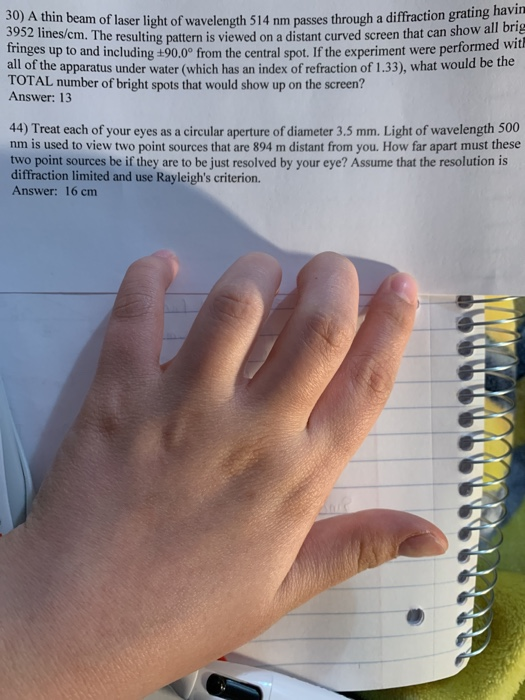
30) A thin beam of laser light of wavelength 514 nm passes through a diffraction grating havin 3952 lines/cm. The resulting pattern is viewed on a distant curved screen that can fringes up to and including +90.0° from the central spot. If the experiment were perform all of the apparatus under water (which has an index of refraction of 1.33), what would be the TOTAL number of bright spot Answer: 13 s that would show up on the screen 44) Treat each of your eyes as a circular aperture of diameter 3.5 mm. Light of wavelength 500 nm is used to view two point sources that are 894 m distant from you. How far apart must these two point sources be if they are to be just resolved by your eye? Assume that the resolution is diffraction limited and use Rayleigh's criterion. Answer: 16 cm
Homework Answers
answer 1) we know the formula slit diffraction
sin


we have ,
tan
y=L*tan
the distance between first minima=2y=2*0.004=0.008 m=8.00 mm
so the answer is 8.0 mm
Add Answer to:
) In the figure, a slit 0.30 mm wide is illuminated by light of wavelength 426 nm. A diffraction attern is seen on a screen 2.8 m from the slit. What is the linear distance on the screen betw...
A thin beam of laser light of wavelength 514 nm passes through a diffraction grating having...
A thin beam of laser light of wavelength 514 nm passes through a diffraction grating having 3952 lines/cm. The resulting pattern is viewed on a distant curved screen that can show all bright fringes up to and including ?90.0? from the central spot. If the experiment were performed with all of the apparatus under water (which has an index of refraction of 1.33), what would be the TOTAL number of bright spots that would show up on the screen?
Light of wavelength 429 nm (in vacuum) is incident on a diffraction grating that has a...
Light of wavelength 429 nm (in vacuum) is incident on a diffraction grating that has a slit separation of 1.2 × 10⁻⁵ m. The distance between the grating and the viewing screen is 0.10 m. A diffraction pattern is produced on the screen that consists of a central bright fringe and higher-order bright fringes (see the drawing). (a) Determine the distance y from the central bright fringe to the second-order bright fringe. (Hint: The diffraction angles are small enough that...
Light of wavelength 385 nm (in vacuum) is incident on a diffraction grating that has a...
Light of wavelength 385 nm (in vacuum) is incident on a diffraction grating that has a slit separation of 1.2 × 10⁻⁵ m. The distance between the grating and the viewing screen is 0.18 m. A diffraction pattern is produced on the screen that consists of a central bright fringe and higher-order bright fringes (see the drawing). (a) Determine the distance y from the central bright fringe to the second-order bright fringe. (Hint: The diffraction angles are small enough that...
Light of wavelength 575 nm falls on a slit 0.0774 mm wide. (a) On a very...
Light of wavelength 575 nm falls on a slit 0.0774 mm wide. (a) On a very large distant screen, how many totally dark fringes (indicating complete cancellation) will there be, including both sides of the central bright spot? Solve this problem withoutcalculating all the angles! (Hint: What is the largest that sin? can be? What does this tell you is the largest that m can be?) _____dark fringes (b) At what angle will the dark fringe that is most distant...
Light of wavelength 620 nm falls on a slit that is 3.8x10⁻³ mm wide. Calculate how...
Light of wavelength 620 nm falls on a slit that is 3.8x10⁻³ mm wide. Calculate how far the first, second and third bright diffraction fringes are from the strong central maximum if the screen is 10 cm away
A diffraction grating with 600 lines/mm is illuminated with light of wavelength 510 nm. A very...
A diffraction grating with 600 lines/mm is illuminated with light of wavelength 510 nm. A very wide viewing screen is 4.2 m behind the grating. Part A What is the distance between the two m = 1 bright fringes? Express your answer with the appropriate units. Δy = SubmitMy AnswersGive Up Part B How many bright fringes can be seen on the screen? N = SubmitMy AnswersGive Up
A 480 lines/mm diffraction grating is illuminated by light of wavelength 510 nm . How many...
A 480 lines/mm diffraction grating is illuminated by light of wavelength 510 nm . How many bright fringes are seen on a 4.0-m-wide screen located 2.1 m behind the grating?
Light of wavelength 700 nm falls on a 0.44 mm wide slit and forms a diffraction...
 Light of wavelength 700 nm falls on a 0.44 mm wide slit and forms a diffraction pattern on a screen 1.2 m wway. (a) Find the position of the first dark band on each side of the central maximum. mm (b) Find the width of the central maximum. 3. [-/10 Points] DETAILS SERCP7 24.P.031. MY NOTES PRACTICE ANOTHER Light of wavelength 587.9 nm illuminates a siit, of width 0.74 mm. (a) At what distance from the slit should a screen...
A diffraction grating with 610 lines per mm is illuminated with light of wavelength 520 nm...
A diffraction grating with 610 lines per mm is illuminated with light of wavelength 520 nm . A very wide viewing screen is 2.0 m behind the grating. Part A What is the distance between the two m=1 fringes? Express your answer in meters. ΔyΔ y = nothing m Request Answer Part B How many bright fringes can be seen on the screen? Express your answer as an integer.
A beam of light of wavelength 600 nm from a distant source falls on a single...
A beam of light of wavelength 600 nm from a distant source falls on a single slit 1.00 mm wide and resulting diffraction pattern is observed on a screen 2 m away. The distance between the first dark fringes on either side of the central bright fringe is 1.2 cm 1.2 mm 6x10⁻⁴ m 2.4 mm
 Light of wavelength 700 nm falls on a 0.44 mm wide slit and forms a diffraction pattern on a screen 1.2 m wway. (a) Find the position of the first dark band on each side of the central maximum. mm (b) Find the width of the central maximum. 3. [-/10 Points] DETAILS SERCP7 24.P.031. MY NOTES PRACTICE ANOTHER Light of wavelength 587.9 nm illuminates a siit, of width 0.74 mm. (a) At what distance from the slit should a screen...
Most questions answered within 3 hours.
-
Where is the error in this code sequence?
String s1 = "Hello";
String s2 = "ello";...
asked 11 months ago -
Financial data for Joel de Paris, Inc., for last year
follow:
Joel de Paris, Inc.
Balance...
asked 11 months ago -
Consider this reaction:
Al2(SO4)3 (aq)+ BaCl3
(aq) Al2Cl6 (aq)- +
3BaSO4(s) . What is the...
asked 11 months ago -
Suppose that Savneet is considering increasing her
recent random sample from 20 car rentals to 40...
asked 11 months ago -
Trucks arrive at an unloading terminal at an average rate of 120
per hour.
Trucks arrive...
asked 11 months ago -
Why are methanol and ethanol completely soluble in water while
octanol is not very little soluble....
asked 11 months ago -
A facilities manager at a university reads in a research report
that the mean amount of...
asked 11 months ago -
When the CuSO4 is rehydrated by adding water to the anhydrous
compound, is this an endothermic...
asked 11 months ago -
A ray of sunlight is passing from diamond into crown glass; the
angle of incidence is...
asked 11 months ago -
A block of mass 0.249 kg is placed on top of a light, vertical
spring of...
asked 11 months ago -
how do the kidneys compensate in the presences of acidosis
a) trigger hyperventilate
b) reserve acid...
asked 11 months ago -
Question 501 pts
The rental rate of capital to the firm increases. Which of the
following...
asked 11 months ago