![3. 12+2-4 points] We are comparing the two caches in Problem 1 and Problem 2. Suppose both caphes have a hit time of 2 cycles](http://img.homeworklib.com/images/3c87d5b2-64bb-434b-a9ff-fc003933ec05.png?x-oss-process=image/resize,w_560)
![3. 12+2-4 points] We are comparing the two caches in Problem 1 and Problem 2. Suppose both caphes have a hit time of 2 cycles](http://img.homeworklib.com/images/eb0a04c2-e002-42d6-9152-c7f8af471215.png?x-oss-process=image/resize,w_560)
![- 10 points 1. [3 +2+5 ] Suppose we have a 2KB direct-mapped data cache with 4-byte blocks. (a) Show how a 32-bit memory addr](http://img.homeworklib.com/images/65f75c7c-6d18-4213-889c-aaac8c06d7dc.png?x-oss-process=image/resize,w_560)
![2. 13+2+5-10 points] Suppose we have a 2KB 8-way set-associative data cache with 32-byte blocks. a) Show how a 32-bit memory](http://img.homeworklib.com/images/dbbc11a0-16ee-4000-9140-d1e9c19e2f8a.png?x-oss-process=image/resize,w_560)
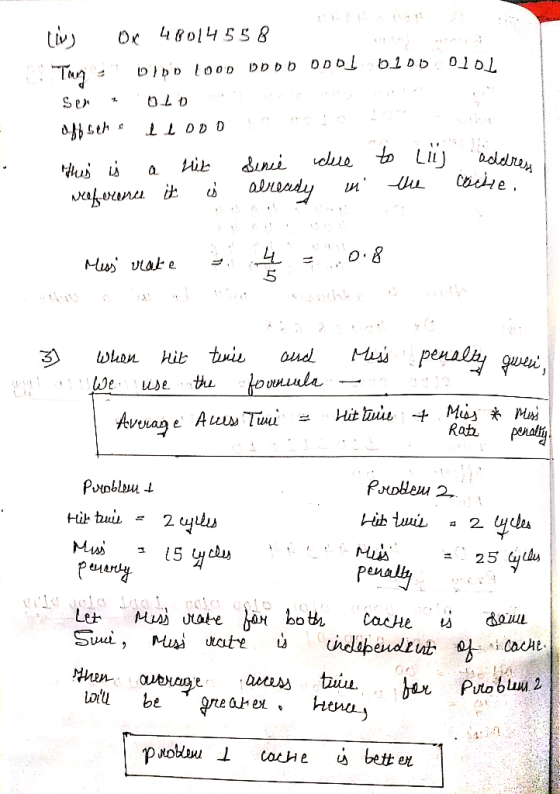
3. 12+2-4 points] We are comparing the two caches in Problem 1 and Problem 2. Suppose both caphes have a hit time of 2 cycles. The cache in Problem 1 has a miss penalty of 15 cycles. The one in Problem 2 has a miss penalty of 25 cycles. Calculate the total time taken (in cycles) for all accesses, for each cache. Which cache is better- the one in Problem 1 or Problem 2?
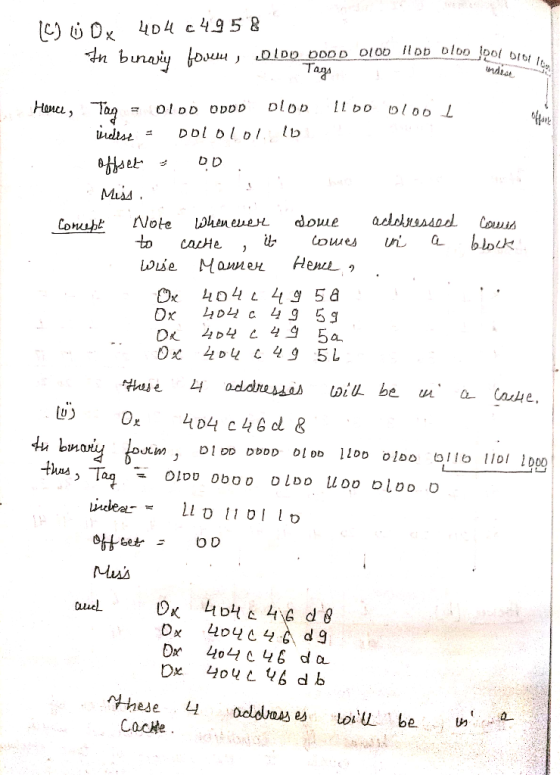
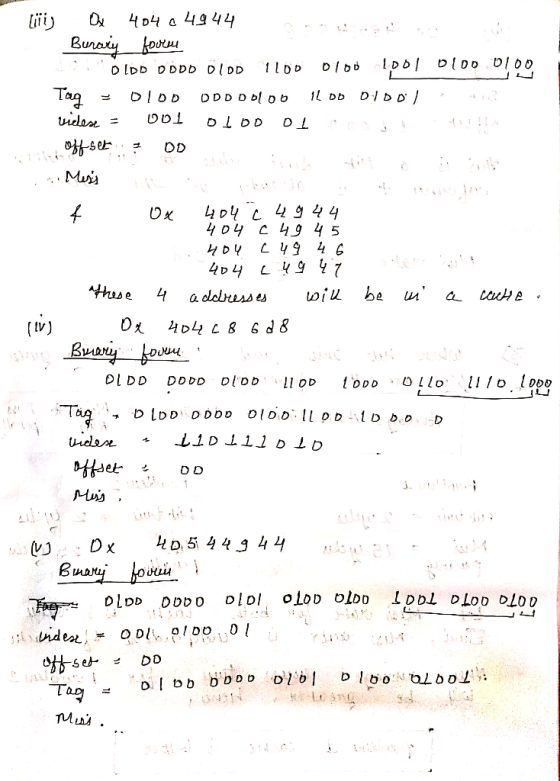
- 10 points 1. [3 +2+5 ] Suppose we have a 2KB direct-mapped data cache with 4-byte blocks. (a) Show how a 32-bit memory address is divided into tag, index and offset. Show clearly how many bits are in each field. (b) How many total bits are there in this cache? (c) Consider this address trace: 0x404c4958 0x404c46d8 0x404c4944 0x404c86d8 0x40544944 For this cache, for each address in the above trace, show the tag, index and offset in binary. Indicate whether each reference is a hit or a miss. What is the miss rate?
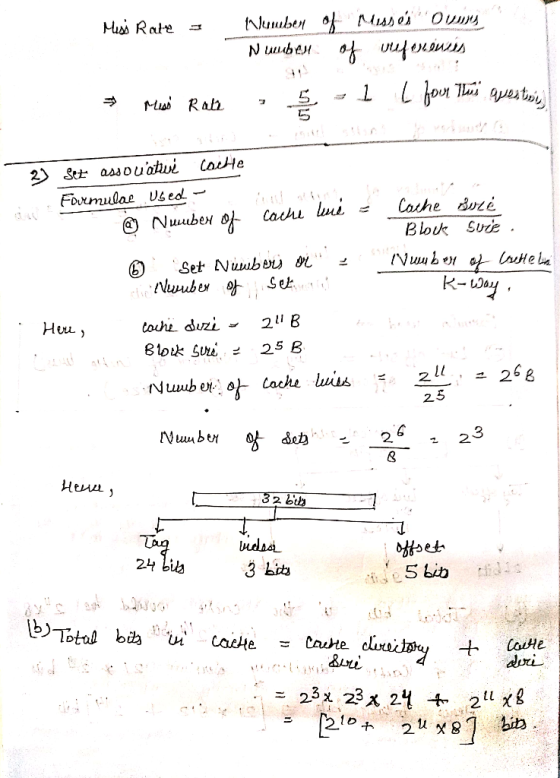
2. 13+2+5-10 points] Suppose we have a 2KB 8-way set-associative data cache with 32-byte blocks. a) Show how a 32-bit memory address is divided into tag, index and offset. Show clearly how many bits are in each field. (8 points) b) How many total bits are there in this cache? c) Consider this address trace: 0x48034760 0x48014554 0x48014560 0x48014760 0x48014558 For this cache, for each address in the above trace, show the tag, index and offset in binary. Indicate whether each reference is a hit or a miss. What is the miss rate? Doblem 2 Sunpose bo
Homework Answers


Add Answer to:
3. 12+2-4 points] We are comparing the two caches in Problem 1 and Problem 2. Suppose both caphes have a hit time of 2 cycles. The cache in Problem 1 has a miss penalty of 15 cycles. The o...
We have a 4 KB direct-mapped data cache with 4-byte blocks. Consider this address trace: 0x48014554 0x48014548 0x48014754 0x48034760 0x48014554 0x48014560 0x48014760 0x48014554 For this cache, for eac...
We have a 4 KB direct-mapped data cache with 4-byte blocks. Consider this address trace: 0x48014554 0x48014548 0x48014754 0x48034760 0x48014554 0x48014560 0x48014760 0x48014554 For this cache, for each address in the above trace, show the tag, index and offset in binary (or hex). Indicate whether each reference is a hit or a miss. What is the miss rate?
a) Suppose we have a 64 KB, direct-mapped cache with 8-word blocks. Determine how many bits...
a) Suppose we have a 64 KB, direct-mapped cache with 8-word blocks. Determine how many bits are required for the tag, index, and offset fields for a 32-bit memory address. b) If instead, we use a 64 KB, 4-way set-associative cache with 8-word blocks, how many bits will be required for the tag, index, and offset fields for a 32-bit address? c) What type of cache is shown in problem 2? How many bits are required for this cache’s tag,...
3- for a direct mapped cache design with a 32 bit address, the following bits of address are used...
 Please answer all parts correctly and show your work
3- for a direct mapped cache design with a 32 bit address, the following bits of address are used to access the cache Tag Index Offset 31-10 9-5 4-0 Starting from power on, the following byte addressed cache reference are recorded. Address 0 16 132 232 160 1024 30 140 3100180 2180 d. How many blocks are replaced e. What is the hit ratio f. List final state of the cache,...
Please answer all parts correctly and show your work
3- for a direct mapped cache design with a 32 bit address, the following bits of address are used to access the cache Tag Index Offset 31-10 9-5 4-0 Starting from power on, the following byte addressed cache reference are recorded. Address 0 16 132 232 160 1024 30 140 3100180 2180 d. How many blocks are replaced e. What is the hit ratio f. List final state of the cache,...
Question 33 10 pts For a direct mapped cache of 4 blocks with a cache block...
 Question 33 10 pts For a direct mapped cache of 4 blocks with a cache block size of 1 byte, in which cache block will each memory location map to? The order of accesses if given by the operation number. Indicate if each access is a hit or a miss, and what the tag value is for each entry. Assume that the cache is initially empty, and the accesses are in order of appearance. REDRAW AND COMPLETE THE CACHE TABLE...
Suppose we have a byte-addressable computer with a cache that holds 8 blocks of 4 bytes...
Suppose we have a byte-addressable computer with a cache that holds 8 blocks of 4 bytes each. Assuming that each memory address has 8 bits and cache is originally empty, for the cache mapping technique, two-way set associative, trace how cache is used when a program accesses the following series of addresses in order: 0x01, 0x04, 0x09, 0x05, 0x14, 0x21, and 0x01.
Problem 6. Suppose we have a computer with 32 megabytes of main memory, 256 bytes of...
 Problem 6. Suppose we have a computer with 32 megabytes of main memory, 256 bytes of cache, and a block size of 16 bytes. For each configuration below, determine the memory address format, indicating the number of bits needed for each appropriate field (i.e. tag, block, set, offset). Show any relevant calculations. Direct cache mapping and memory is byte-addressable a) Direct cache mapping and memory is word-addressable with a word size of 16 bits b) c) 2-way set associative cache...
Given the following cache specifications: (S, E, B, m) = (4, 2, 2, 6) Construct a...
Given the following cache specifications: (S, E, B, m) = (4, 2, 2, 6) Construct a block diagram of a two-way set-associative cache. Each block is 1 byte deep. Identify the tag bits, set bits and block offset bits for the address field. The cache replacement policy is: Last-in First-out. Step 1: Initial State Define the initial structure and state of the cache as done in class. The # of rows in the table below must be changed to fit...
You have a 2-way set associative L1 cache that is 8KB, with 4-word cache lines. You get the follo...
 You have a 2-way set associative L1 cache that is 8KB, with 4-word cache lines. You get the following sequence of writes to the cache --each is a 32-bit address in hexadecimal 0x32E4 0x8000 0x1F50 0x8004 0x72EC OxDOOC 0x800C 0x72E8 0x4008 OxD000 0x82E0 a) [7 Pts] How many cache misses occur with an LFU (Least Frequently Used) policy? Give a detailed answer and fill in the table below for each address reference Set Index (in hex) Memory address(in hex) 0x32E4...
Exercise l: Suppose that we have a virtual memory space of 28 bytes for a given process and physical memory of 4 page frames. There is no cache. Suppose that pages are 32 bytes in length. 1) How...
 Exercise l: Suppose that we have a virtual memory space of 28 bytes for a given process and physical memory of 4 page frames. There is no cache. Suppose that pages are 32 bytes in length. 1) How many bits the virtual address contain? How many bits the physical address contain? bs Suppose now that some pages from the process have been brought into main memory as shown in the following figure: Virtual memory Physical memory Page table Frame #...
The Pentium 4 microprocessor have two 8 Kbyte, Level 1 caches – one for data and...
The Pentium 4 microprocessor have two 8 Kbyte, Level 1 caches – one for data and one for instructions. However, a design team is considering another option – a single, 16 Kbyte cache that holds both instructions and data. Additional specs for the 16 Kbyte cache include: - Each block will hold 32 bytes of data (not including tag, valid bit, etc.) - The cache would be 2-way set associative - Physical addresses are 32 bits - Data is...
 Please answer all parts correctly and show your work
3- for a direct mapped cache design with a 32 bit address, the following bits of address are used to access the cache Tag Index Offset 31-10 9-5 4-0 Starting from power on, the following byte addressed cache reference are recorded. Address 0 16 132 232 160 1024 30 140 3100180 2180 d. How many blocks are replaced e. What is the hit ratio f. List final state of the cache,...
Please answer all parts correctly and show your work
3- for a direct mapped cache design with a 32 bit address, the following bits of address are used to access the cache Tag Index Offset 31-10 9-5 4-0 Starting from power on, the following byte addressed cache reference are recorded. Address 0 16 132 232 160 1024 30 140 3100180 2180 d. How many blocks are replaced e. What is the hit ratio f. List final state of the cache,...
 Question 33 10 pts For a direct mapped cache of 4 blocks with a cache block size of 1 byte, in which cache block will each memory location map to? The order of accesses if given by the operation number. Indicate if each access is a hit or a miss, and what the tag value is for each entry. Assume that the cache is initially empty, and the accesses are in order of appearance. REDRAW AND COMPLETE THE CACHE TABLE...
 Problem 6. Suppose we have a computer with 32 megabytes of main memory, 256 bytes of cache, and a block size of 16 bytes. For each configuration below, determine the memory address format, indicating the number of bits needed for each appropriate field (i.e. tag, block, set, offset). Show any relevant calculations. Direct cache mapping and memory is byte-addressable a) Direct cache mapping and memory is word-addressable with a word size of 16 bits b) c) 2-way set associative cache...
 You have a 2-way set associative L1 cache that is 8KB, with 4-word cache lines. You get the following sequence of writes to the cache --each is a 32-bit address in hexadecimal 0x32E4 0x8000 0x1F50 0x8004 0x72EC OxDOOC 0x800C 0x72E8 0x4008 OxD000 0x82E0 a) [7 Pts] How many cache misses occur with an LFU (Least Frequently Used) policy? Give a detailed answer and fill in the table below for each address reference Set Index (in hex) Memory address(in hex) 0x32E4...
 Exercise l: Suppose that we have a virtual memory space of 28 bytes for a given process and physical memory of 4 page frames. There is no cache. Suppose that pages are 32 bytes in length. 1) How many bits the virtual address contain? How many bits the physical address contain? bs Suppose now that some pages from the process have been brought into main memory as shown in the following figure: Virtual memory Physical memory Page table Frame #...
Most questions answered within 3 hours.
-
Where is the error in this code sequence?
String s1 = "Hello";
String s2 = "ello";...
asked 10 months ago -
Financial data for Joel de Paris, Inc., for last year
follow:
Joel de Paris, Inc.
Balance...
asked 10 months ago -
Consider this reaction:
Al2(SO4)3 (aq)+ BaCl3
(aq) Al2Cl6 (aq)- +
3BaSO4(s) . What is the...
asked 10 months ago -
Suppose that Savneet is considering increasing her
recent random sample from 20 car rentals to 40...
asked 10 months ago -
Trucks arrive at an unloading terminal at an average rate of 120
per hour.
Trucks arrive...
asked 10 months ago -
Why are methanol and ethanol completely soluble in water while
octanol is not very little soluble....
asked 10 months ago -
A facilities manager at a university reads in a research report
that the mean amount of...
asked 10 months ago -
When the CuSO4 is rehydrated by adding water to the anhydrous
compound, is this an endothermic...
asked 10 months ago -
A ray of sunlight is passing from diamond into crown glass; the
angle of incidence is...
asked 10 months ago -
A block of mass 0.249 kg is placed on top of a light, vertical
spring of...
asked 10 months ago -
how do the kidneys compensate in the presences of acidosis
a) trigger hyperventilate
b) reserve acid...
asked 10 months ago -
Question 501 pts
The rental rate of capital to the firm increases. Which of the
following...
asked 10 months ago