-
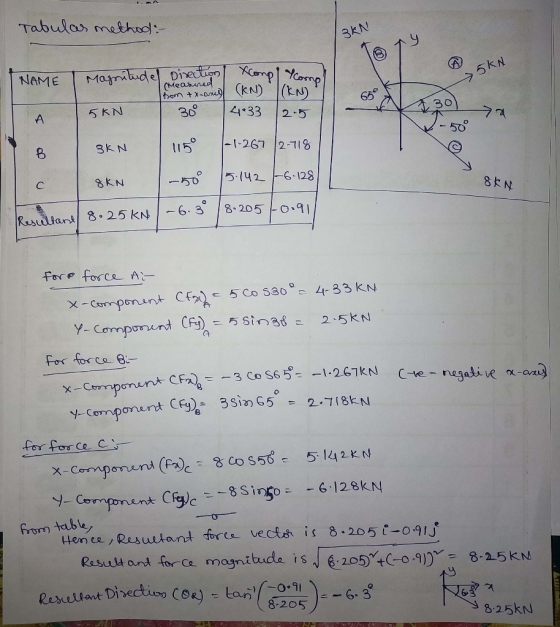
Determine the resultant R of the forces below. Solve using the tabular methodor using the graphical method showing magnitude (2 dec. places) and resultant angle (1 dec. place).

Homework Answers
Add Answer to:
Determine the resultant R of the forces below. Solve using the tabular methodor using the graphical method showing magnitude (2 dec. places) and resultant angle (1 dec. place). 1.) Determine...
1. Determine the magnitude R of the resultant and the angle between the line of action...
 1. Determine the magnitude R of the resultant and the angle between the line of action of the resultant and the x-axis for the two forces shown F1 =400 N 6 60° F2 300 N 2. Determine the magnitude R of the resultant and the angle between the line of action of the resultant and the x axis for the four forces shown 12 F4 10 kN 12 3. Three forces are applied to a bracket mounted on a post...
1.2 Determine the resultant (magnitude and direction) of the three forces shown using the graphical method....
 1.2 Determine the resultant (magnitude and direction) of the three forces shown using the graphical method. Scale: 14"-100# FF450# F-300# 4 70° F3-550#
a. using the graphical/semi-graphical (parallelogram law) to determine the magnitude of F1 and inclination theta of...
 a. using the graphical/semi-graphical (parallelogram law) to
determine the magnitude of F1 and inclination theta of F2
b. use the algebraic method to determine the magnitude of F1 and
the inclination theta of F2
HW (2-2) The two forces shown act in the x-y plane of the T-beam cross section. If it is known that the resultant R of the two forces has a magnitude of 3.5 kN and a line of action that lies 15° above the negative x-axis,...
a. using the graphical/semi-graphical (parallelogram law) to
determine the magnitude of F1 and inclination theta of F2
b. use the algebraic method to determine the magnitude of F1 and
the inclination theta of F2
HW (2-2) The two forces shown act in the x-y plane of the T-beam cross section. If it is known that the resultant R of the two forces has a magnitude of 3.5 kN and a line of action that lies 15° above the negative x-axis,...
Use and identify the steps of the graphical/semi-graphical method (parallelogram law) to find: i. The vector...
 Use and identify the steps of the graphical/semi-graphical
method
(parallelogram law) to find:
i. The vector expression of the
resultant
ii. The magnitude and angle (with
respect to the x axis) of the resultant
b. Use and identify the steps (from
problem 1b) of the algebraic method to find:
i. The vector expression of the
resultant
ii. The magnitude and angle (with
respect to the x axis) of the resultant
34 Chapter 2 Force Systems Representative Problems 2/11 The two...
Use and identify the steps of the graphical/semi-graphical
method
(parallelogram law) to find:
i. The vector expression of the
resultant
ii. The magnitude and angle (with
respect to the x axis) of the resultant
b. Use and identify the steps (from
problem 1b) of the algebraic method to find:
i. The vector expression of the
resultant
ii. The magnitude and angle (with
respect to the x axis) of the resultant
34 Chapter 2 Force Systems Representative Problems 2/11 The two...
Q/1 For the force system shown below and by using both graphical and algebra solutions, determine:...
 Q/1 For the force system shown below and by using both graphical and algebra solutions, determine: (a) The required tension force F3, if the resultant (R) of the three forces directed as shown below. (b) The corresponding magnitude of the resultant (R). F,? 65 35° 250 R F-75 kN W=5 kg
Determine the resultant R of the force system shown below. Compute the magnitude, sense, and angle...
 Determine the resultant R of the force system shown below. Compute the magnitude, sense, and angle of inclination of the resultant R with the X axis. Use the method of components.
3. (Point 32) Using the Graphical Method (Head-Tail), Try the Resultant Vector and Equivalent Vector. Vectors,...
 3. (Point 32) Using the Graphical Method (Head-Tail), Try the Resultant Vector and Equivalent Vector. Vectors, A-(3.00 N, 1809), B-(3.00 N, 30%), and C-(8.00 N, 330%) are given. a) Starting from Vector A, draw the Resultant Vector and Equivalent Vector by using H-T method. R-A +B+C, R+E-0. Vector, A is given. From starting point A, draw B, C, R, and E vector. 0 T b) Find the magnitude of Rusing graphical method. c) Find the angle of R using protractor....
3. Determine the magnitude of the resultant vector uti using the Parallelogram method. Verify with the...
 3. Determine the magnitude of the resultant vector uti using the Parallelogram method. Verify with the Head-to-Tail Method v=60N 38 u = 40N MCTAC: Mathematics for College Technology Module 4: Vectors and Geometry Lesson 18: Adding Vectors Using the Head-to-Tail and the Parallelogram Methods Vector ü has magnitude 30 M and vector i has magnitude 40N.. When placed tail-to-tail, the angle between i and V is 50° a) Determine the magnitude of the resultant vector ü + b) Determine the...
ASSIGNMENT 1 1. Determine the resultant of the forces using the component method. P 20N 42...
 ASSIGNMENT 1 1. Determine the resultant of the forces using the component method. P 20N 42 2. Determine the resultant of the applied forces using the component method. P-30N 40° 34° 37 Q = 54N S 27N 8s
Can you solve step by step in clear handwriting. Thanks. Problem#5 Determine the resultant R of...
 Can
you solve step by step in clear handwriting. Thanks.
Problem#5 Determine the resultant R of the force system shown below. Compute the magnitude, sense, and angle of inclination of the resultant R with the X axis. Use the method of components. F50 N 20 F420 N io F2-70 N Fs 60 N
Can
you solve step by step in clear handwriting. Thanks.
Problem#5 Determine the resultant R of the force system shown below. Compute the magnitude, sense, and angle of inclination of the resultant R with the X axis. Use the method of components. F50 N 20 F420 N io F2-70 N Fs 60 N
 1. Determine the magnitude R of the resultant and the angle between the line of action of the resultant and the x-axis for the two forces shown F1 =400 N 6 60° F2 300 N 2. Determine the magnitude R of the resultant and the angle between the line of action of the resultant and the x axis for the four forces shown 12 F4 10 kN 12 3. Three forces are applied to a bracket mounted on a post...
 1.2 Determine the resultant (magnitude and direction) of the three forces shown using the graphical method. Scale: 14"-100# FF450# F-300# 4 70° F3-550#
 a. using the graphical/semi-graphical (parallelogram law) to
determine the magnitude of F1 and inclination theta of F2
b. use the algebraic method to determine the magnitude of F1 and
the inclination theta of F2
HW (2-2) The two forces shown act in the x-y plane of the T-beam cross section. If it is known that the resultant R of the two forces has a magnitude of 3.5 kN and a line of action that lies 15° above the negative x-axis,...
a. using the graphical/semi-graphical (parallelogram law) to
determine the magnitude of F1 and inclination theta of F2
b. use the algebraic method to determine the magnitude of F1 and
the inclination theta of F2
HW (2-2) The two forces shown act in the x-y plane of the T-beam cross section. If it is known that the resultant R of the two forces has a magnitude of 3.5 kN and a line of action that lies 15° above the negative x-axis,...
 Use and identify the steps of the graphical/semi-graphical
method
(parallelogram law) to find:
i. The vector expression of the
resultant
ii. The magnitude and angle (with
respect to the x axis) of the resultant
b. Use and identify the steps (from
problem 1b) of the algebraic method to find:
i. The vector expression of the
resultant
ii. The magnitude and angle (with
respect to the x axis) of the resultant
34 Chapter 2 Force Systems Representative Problems 2/11 The two...
Use and identify the steps of the graphical/semi-graphical
method
(parallelogram law) to find:
i. The vector expression of the
resultant
ii. The magnitude and angle (with
respect to the x axis) of the resultant
b. Use and identify the steps (from
problem 1b) of the algebraic method to find:
i. The vector expression of the
resultant
ii. The magnitude and angle (with
respect to the x axis) of the resultant
34 Chapter 2 Force Systems Representative Problems 2/11 The two...
 Q/1 For the force system shown below and by using both graphical and algebra solutions, determine: (a) The required tension force F3, if the resultant (R) of the three forces directed as shown below. (b) The corresponding magnitude of the resultant (R). F,? 65 35° 250 R F-75 kN W=5 kg
 Determine the resultant R of the force system shown below. Compute the magnitude, sense, and angle of inclination of the resultant R with the X axis. Use the method of components.
 3. (Point 32) Using the Graphical Method (Head-Tail), Try the Resultant Vector and Equivalent Vector. Vectors, A-(3.00 N, 1809), B-(3.00 N, 30%), and C-(8.00 N, 330%) are given. a) Starting from Vector A, draw the Resultant Vector and Equivalent Vector by using H-T method. R-A +B+C, R+E-0. Vector, A is given. From starting point A, draw B, C, R, and E vector. 0 T b) Find the magnitude of Rusing graphical method. c) Find the angle of R using protractor....
 3. Determine the magnitude of the resultant vector uti using the Parallelogram method. Verify with the Head-to-Tail Method v=60N 38 u = 40N MCTAC: Mathematics for College Technology Module 4: Vectors and Geometry Lesson 18: Adding Vectors Using the Head-to-Tail and the Parallelogram Methods Vector ü has magnitude 30 M and vector i has magnitude 40N.. When placed tail-to-tail, the angle between i and V is 50° a) Determine the magnitude of the resultant vector ü + b) Determine the...
 ASSIGNMENT 1 1. Determine the resultant of the forces using the component method. P 20N 42 2. Determine the resultant of the applied forces using the component method. P-30N 40° 34° 37 Q = 54N S 27N 8s
 Can
you solve step by step in clear handwriting. Thanks.
Problem#5 Determine the resultant R of the force system shown below. Compute the magnitude, sense, and angle of inclination of the resultant R with the X axis. Use the method of components. F50 N 20 F420 N io F2-70 N Fs 60 N
Can
you solve step by step in clear handwriting. Thanks.
Problem#5 Determine the resultant R of the force system shown below. Compute the magnitude, sense, and angle of inclination of the resultant R with the X axis. Use the method of components. F50 N 20 F420 N io F2-70 N Fs 60 N
Most questions answered within 3 hours.
-
Where is the error in this code sequence?
String s1 = "Hello";
String s2 = "ello";...
asked 11 months ago -
Financial data for Joel de Paris, Inc., for last year
follow:
Joel de Paris, Inc.
Balance...
asked 11 months ago -
Consider this reaction:
Al2(SO4)3 (aq)+ BaCl3
(aq) Al2Cl6 (aq)- +
3BaSO4(s) . What is the...
asked 11 months ago -
Suppose that Savneet is considering increasing her
recent random sample from 20 car rentals to 40...
asked 11 months ago -
Trucks arrive at an unloading terminal at an average rate of 120
per hour.
Trucks arrive...
asked 11 months ago -
Why are methanol and ethanol completely soluble in water while
octanol is not very little soluble....
asked 11 months ago -
A facilities manager at a university reads in a research report
that the mean amount of...
asked 11 months ago -
When the CuSO4 is rehydrated by adding water to the anhydrous
compound, is this an endothermic...
asked 11 months ago -
A ray of sunlight is passing from diamond into crown glass; the
angle of incidence is...
asked 11 months ago -
A block of mass 0.249 kg is placed on top of a light, vertical
spring of...
asked 11 months ago -
how do the kidneys compensate in the presences of acidosis
a) trigger hyperventilate
b) reserve acid...
asked 11 months ago -
Question 501 pts
The rental rate of capital to the firm increases. Which of the
following...
asked 11 months ago