
Homework Answers


Add Answer to:
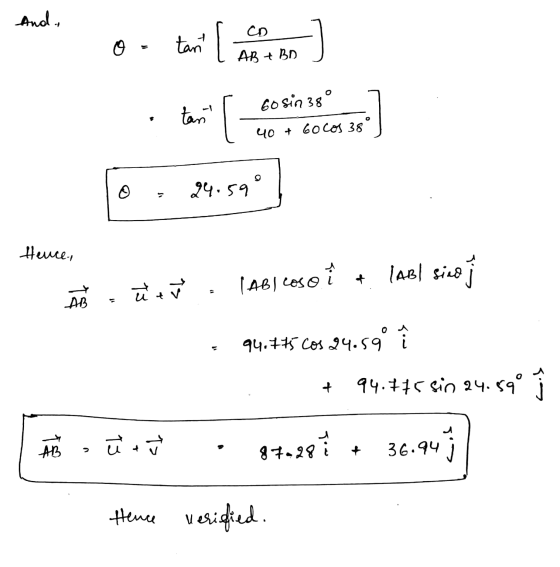
3. Determine the magnitude of the resultant vector uti using the Parallelogram method. Verify with the...
[2] A linear combination of vectors is given. Determine the resultant vector using the tip- to-tail...
 [2] A linear combination of vectors is given. Determine the resultant vector using the tip- to-tail method for adding vectors geometrically. (9,-6) + (-12, -1) – (3, -15) + 5(2, -1)
3. (Point 32) Using the Graphical Method (Head-Tail), Try the Resultant Vector and Equivalent Vector. Vectors,...
 3. (Point 32) Using the Graphical Method (Head-Tail), Try the Resultant Vector and Equivalent Vector. Vectors, A-(3.00 N, 1809), B-(3.00 N, 30%), and C-(8.00 N, 330%) are given. a) Starting from Vector A, draw the Resultant Vector and Equivalent Vector by using H-T method. R-A +B+C, R+E-0. Vector, A is given. From starting point A, draw B, C, R, and E vector. 0 T b) Find the magnitude of Rusing graphical method. c) Find the angle of R using protractor....
[1] In parallelogram WXYZ, if u joins X to Y and v joins X to W,...
 [1] In parallelogram WXYZ, if u joins X to Y and v joins X to W, which connection forms a vector equal to u + v? v + u? u-v? V-u? A. W to Y B. Y to W C. X to Z D. Z to X W z Y [2] A linear combination of vectors is given. Determine the resultant vector using the tip- to-tail method for adding vectors geometrically. (9,-6) + (-12, -1) - (3, -15) + 5(2,...
Use and identify the steps of the graphical/semi-graphical method (parallelogram law) to find: i. The vector...
 Use and identify the steps of the graphical/semi-graphical
method
(parallelogram law) to find:
i. The vector expression of the
resultant
ii. The magnitude and angle (with
respect to the x axis) of the resultant
b. Use and identify the steps (from
problem 1b) of the algebraic method to find:
i. The vector expression of the
resultant
ii. The magnitude and angle (with
respect to the x axis) of the resultant
34 Chapter 2 Force Systems Representative Problems 2/11 The two...
Use and identify the steps of the graphical/semi-graphical
method
(parallelogram law) to find:
i. The vector expression of the
resultant
ii. The magnitude and angle (with
respect to the x axis) of the resultant
b. Use and identify the steps (from
problem 1b) of the algebraic method to find:
i. The vector expression of the
resultant
ii. The magnitude and angle (with
respect to the x axis) of the resultant
34 Chapter 2 Force Systems Representative Problems 2/11 The two...
5. Determine the magnitude and direction of the resultant vector i = a + b +...
 5. Determine the magnitude and direction of the resultant vector i = a + b + c using the component method if al = 5,1b1 = 10, and Cl = 20. Round your answers to one decimal place. 20°
PART II: THE RESULTANT OF ADDING THREE FORCES(VECTORS). In this activity consider vector & as force...
 PART II: THE RESULTANT OF ADDING THREE FORCES(VECTORS). In this activity consider vector & as force (F), vector bas force (F), and vector & as force (). While vector 3 is the resultant vector (FR) 1- Select explore 20" from the option window at the bottom of the graph. 2- Drag the origin of the graph paper to the middle as shown in figure (6) 3- Drag vector a, b, and to the graph paper. 4- Fix the magnitude and...
a. using the graphical/semi-graphical (parallelogram law) to determine the magnitude of F1 and inclination theta of...
 a. using the graphical/semi-graphical (parallelogram law) to
determine the magnitude of F1 and inclination theta of F2
b. use the algebraic method to determine the magnitude of F1 and
the inclination theta of F2
HW (2-2) The two forces shown act in the x-y plane of the T-beam cross section. If it is known that the resultant R of the two forces has a magnitude of 3.5 kN and a line of action that lies 15° above the negative x-axis,...
a. using the graphical/semi-graphical (parallelogram law) to
determine the magnitude of F1 and inclination theta of F2
b. use the algebraic method to determine the magnitude of F1 and
the inclination theta of F2
HW (2-2) The two forces shown act in the x-y plane of the T-beam cross section. If it is known that the resultant R of the two forces has a magnitude of 3.5 kN and a line of action that lies 15° above the negative x-axis,...
using the head to tail method of vector addition, sketch the vector c given by c=3A-0.5B...
using the head to tail method of vector addition, sketch the vector c given by c=3A-0.5B where A= 15lb due north B=40lb @35 degrees south of east.... Determine the magnitude and direction of C using the law of sines and the law of cosines
Determine the resultant R of the forces below. Solve using the tabular methodor using the graphical method showing magnitude (2 dec. places) and resultant angle (1 dec. place). 1.) Determine...
 Determine the resultant R of the forces below. Solve using the
tabular methodor using the graphical method showing magnitude (2
dec. places) and resultant angle (1 dec. place).
1.) Determine the resultant R of the forces below. Solve using the tabular method or using the graphical method showing magnitude (2 dec. places) and resultant angle (1 dec. place). 3 kN 5 kN 30% 507 8 kN
1.) Determine the resultant R of the forces below. Solve using the tabular method...
Determine the resultant R of the forces below. Solve using the
tabular methodor using the graphical method showing magnitude (2
dec. places) and resultant angle (1 dec. place).
1.) Determine the resultant R of the forces below. Solve using the tabular method or using the graphical method showing magnitude (2 dec. places) and resultant angle (1 dec. place). 3 kN 5 kN 30% 507 8 kN
1.) Determine the resultant R of the forces below. Solve using the tabular method...
1. Determine the resultant of the following three vector displacements by using the polygon method: (1)...
 1. Determine the resultant of the following three vector displacements by using the polygon method: (1) 30 m, 30P north of east, (2) 40 m, 45° east of north, and (3) 50 m, 70° west of north. 1 cm: 10m 2 A car is driven 215 km west and then 85 km southwest What is the displacement of the car from the point of origin (magnitude and direction)? Use the law of sines and cosines
 [2] A linear combination of vectors is given. Determine the resultant vector using the tip- to-tail method for adding vectors geometrically. (9,-6) + (-12, -1) – (3, -15) + 5(2, -1)
 3. (Point 32) Using the Graphical Method (Head-Tail), Try the Resultant Vector and Equivalent Vector. Vectors, A-(3.00 N, 1809), B-(3.00 N, 30%), and C-(8.00 N, 330%) are given. a) Starting from Vector A, draw the Resultant Vector and Equivalent Vector by using H-T method. R-A +B+C, R+E-0. Vector, A is given. From starting point A, draw B, C, R, and E vector. 0 T b) Find the magnitude of Rusing graphical method. c) Find the angle of R using protractor....
 [1] In parallelogram WXYZ, if u joins X to Y and v joins X to W, which connection forms a vector equal to u + v? v + u? u-v? V-u? A. W to Y B. Y to W C. X to Z D. Z to X W z Y [2] A linear combination of vectors is given. Determine the resultant vector using the tip- to-tail method for adding vectors geometrically. (9,-6) + (-12, -1) - (3, -15) + 5(2,...
 Use and identify the steps of the graphical/semi-graphical
method
(parallelogram law) to find:
i. The vector expression of the
resultant
ii. The magnitude and angle (with
respect to the x axis) of the resultant
b. Use and identify the steps (from
problem 1b) of the algebraic method to find:
i. The vector expression of the
resultant
ii. The magnitude and angle (with
respect to the x axis) of the resultant
34 Chapter 2 Force Systems Representative Problems 2/11 The two...
Use and identify the steps of the graphical/semi-graphical
method
(parallelogram law) to find:
i. The vector expression of the
resultant
ii. The magnitude and angle (with
respect to the x axis) of the resultant
b. Use and identify the steps (from
problem 1b) of the algebraic method to find:
i. The vector expression of the
resultant
ii. The magnitude and angle (with
respect to the x axis) of the resultant
34 Chapter 2 Force Systems Representative Problems 2/11 The two...
 5. Determine the magnitude and direction of the resultant vector i = a + b + c using the component method if al = 5,1b1 = 10, and Cl = 20. Round your answers to one decimal place. 20°
 PART II: THE RESULTANT OF ADDING THREE FORCES(VECTORS). In this activity consider vector & as force (F), vector bas force (F), and vector & as force (). While vector 3 is the resultant vector (FR) 1- Select explore 20" from the option window at the bottom of the graph. 2- Drag the origin of the graph paper to the middle as shown in figure (6) 3- Drag vector a, b, and to the graph paper. 4- Fix the magnitude and...
 a. using the graphical/semi-graphical (parallelogram law) to
determine the magnitude of F1 and inclination theta of F2
b. use the algebraic method to determine the magnitude of F1 and
the inclination theta of F2
HW (2-2) The two forces shown act in the x-y plane of the T-beam cross section. If it is known that the resultant R of the two forces has a magnitude of 3.5 kN and a line of action that lies 15° above the negative x-axis,...
a. using the graphical/semi-graphical (parallelogram law) to
determine the magnitude of F1 and inclination theta of F2
b. use the algebraic method to determine the magnitude of F1 and
the inclination theta of F2
HW (2-2) The two forces shown act in the x-y plane of the T-beam cross section. If it is known that the resultant R of the two forces has a magnitude of 3.5 kN and a line of action that lies 15° above the negative x-axis,...
 Determine the resultant R of the forces below. Solve using the
tabular methodor using the graphical method showing magnitude (2
dec. places) and resultant angle (1 dec. place).
1.) Determine the resultant R of the forces below. Solve using the tabular method or using the graphical method showing magnitude (2 dec. places) and resultant angle (1 dec. place). 3 kN 5 kN 30% 507 8 kN
1.) Determine the resultant R of the forces below. Solve using the tabular method...
Determine the resultant R of the forces below. Solve using the
tabular methodor using the graphical method showing magnitude (2
dec. places) and resultant angle (1 dec. place).
1.) Determine the resultant R of the forces below. Solve using the tabular method or using the graphical method showing magnitude (2 dec. places) and resultant angle (1 dec. place). 3 kN 5 kN 30% 507 8 kN
1.) Determine the resultant R of the forces below. Solve using the tabular method...
 1. Determine the resultant of the following three vector displacements by using the polygon method: (1) 30 m, 30P north of east, (2) 40 m, 45° east of north, and (3) 50 m, 70° west of north. 1 cm: 10m 2 A car is driven 215 km west and then 85 km southwest What is the displacement of the car from the point of origin (magnitude and direction)? Use the law of sines and cosines
Most questions answered within 3 hours.
-
Where is the error in this code sequence?
String s1 = "Hello";
String s2 = "ello";...
asked 11 months ago -
Financial data for Joel de Paris, Inc., for last year
follow:
Joel de Paris, Inc.
Balance...
asked 11 months ago -
Consider this reaction:
Al2(SO4)3 (aq)+ BaCl3
(aq) Al2Cl6 (aq)- +
3BaSO4(s) . What is the...
asked 11 months ago -
Suppose that Savneet is considering increasing her
recent random sample from 20 car rentals to 40...
asked 11 months ago -
Trucks arrive at an unloading terminal at an average rate of 120
per hour.
Trucks arrive...
asked 11 months ago -
Why are methanol and ethanol completely soluble in water while
octanol is not very little soluble....
asked 11 months ago -
A facilities manager at a university reads in a research report
that the mean amount of...
asked 11 months ago -
When the CuSO4 is rehydrated by adding water to the anhydrous
compound, is this an endothermic...
asked 11 months ago -
A ray of sunlight is passing from diamond into crown glass; the
angle of incidence is...
asked 11 months ago -
A block of mass 0.249 kg is placed on top of a light, vertical
spring of...
asked 11 months ago -
how do the kidneys compensate in the presences of acidosis
a) trigger hyperventilate
b) reserve acid...
asked 11 months ago -
Question 501 pts
The rental rate of capital to the firm increases. Which of the
following...
asked 11 months ago