
Homework Answers
SOLUTION:

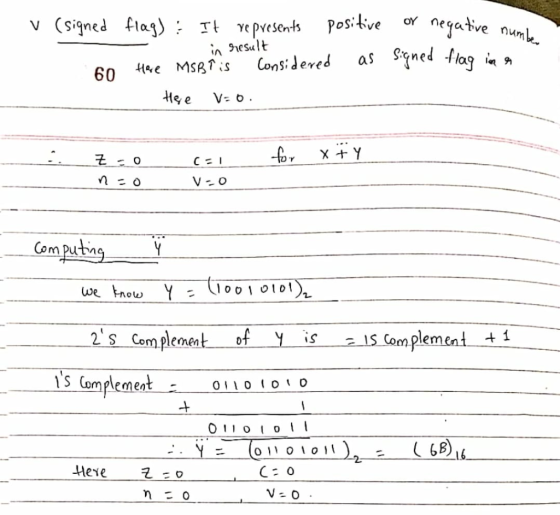
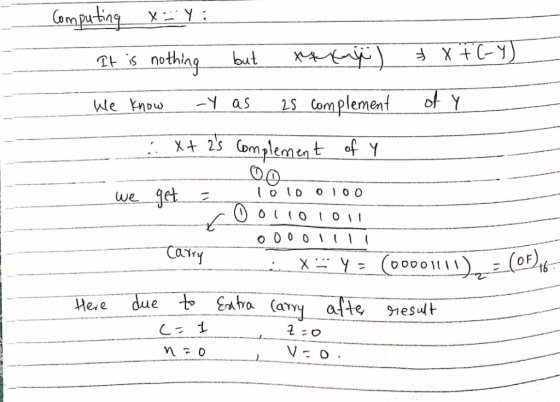


NOTE:
If you are satisfied with my answer please do upvote and
if you have any kind of doubts please post in comment section. i'll
surely help you there.
Thank You:)
Add Answer to:
e,f,g,h,i 1) Given: X 0xA4 and Y 0x95, a) Convert X and Y to 8-bit binary numbers. b) Compute the 8-bit sum X+Y of...
HW 9: N-bit Arithmetic For each of the <X, Y> pairs in the table below: a)...
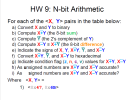 HW 9: N-bit Arithmetic For each of the <X, Y> pairs in the table below: a) Convert X and Y to binary b) Compute X+Y (the 8-bit sum) c) Compute Y (the 2's complement of Y) d) Compute X-Y = X+Y (the 8-bit difference) e) Indicate the signs of X, Y, X+Y, Y, and X-Y f) Convert X+Y, Y, and X-Y to hexadecimal g) Indicate condition flag (z, n, C, v) values for X+Y, X-Y h) As unsigned numbers are...
1. a) Perform the following binary subtractions of unsigned binary numbers. Convert your answer to decimal....
 1. a) Perform the following binary subtractions of unsigned binary numbers. Convert your answer to decimal. i) 101001012 - 01001001, ii) 110110102 - 100100112 b) Repeat the calculations above but for when the binary numbers are in two's complement form. Comment on the results of the two methods used, noting and discrepancies. 2. Find the sums of the following unsigned hexadecimal numbers. Indicate whether or not the sum overflows an equivalent 8-bit binary result. a) 1116 +2216 b) 1716 +3516...
1. 2. Find the decimal value of the following 8-bit numbers for (i) un-signed and (ii)...
 1. 2. Find the decimal value of the following 8-bit numbers for (i) un-signed and (ii) signed number. (a) 11010110, (b) 01011101 Express the following decimal numbers in 6-bit 2's complement representation: (a) -27, (b) 6, (c)-13, (d) -47 - 4. Convert decimal numbers 83 and 101 to 8-bit unsigned binary number. Find the sum and difference (with addition approach) of these two numbers.
8.9 Use FA's to design a device which will calculate 5x +4y where x and y are 4-bit unsigned inpu...
 8.9 Use FA's to design a device which will calculate 5x +4y where x and y are 4-bit unsigned inputs. Use 8-bit arithmetic. 8.10 Use FA's and logic gates to design a device which will multiply a given 4-bit signed input by -2. (Hint: if you think about this for a bit, you should see the answer is actually pretty straightforward. ..) in addition to the normal sum and carry outputs, a third output called overflow does not. 8.11 Use...
(32 pts) Adder/ Subtractor 11. (8 pts) Given a l-bit full adder (you can use the...
 (32 pts) Adder/ Subtractor 11. (8 pts) Given a l-bit full adder (you can use the box representation as below) show the circuitry required to make it into a 4-bit full adder and subtractor. 12. (12 pts) Show the hardware required to compute the 4 primary flags for your 4-bit add sub unit carry (C), zero (Z), overflow (V), and sign (N). 13.(12 pts) Show the results for the addition below. Also show the equivalent decimal numbers for each Ain...
6. Convert .3710 to a binary fraction of 10 binary digits. 7. Use two's compliment arithmetic to perform the following 8 bit binary operations. a. 0010 1110 + 0001 1011 b. 0101 1101 – 0011 1010 c....
6. Convert .3710 to a binary fraction of 10 binary digits. 7. Use two's compliment arithmetic to perform the following 8 bit binary operations. a. 0010 1110 + 0001 1011 b. 0101 1101 – 0011 1010 c. 1011 1000 – 1000 1011 d. 1000 1100 – 1111 0111 8. Convert 150.8476562510 to IEEE Floating Point Standard. 9. Simplify the following Boolean expressions. a. xy + xy + xz b. (w + x)(x + y)(w + x + y + z)...
1. If we had two 4-bit signed 2's complement numbers, X--4 and Y-6 and we wanted to compare them, we might calculate X-Y (a) Show that calculation (b) Explain how the result tells us that Y>IX...
 1. If we had two 4-bit signed 2's complement numbers, X--4 and Y-6 and we wanted to compare them, we might calculate X-Y (a) Show that calculation (b) Explain how the result tells us that Y>IX (c) Now show the calculation for Y. X (d) Explain how this also shows us that Y>X 2. We talked about an ALU that takes two 4-bit inputs, A and B, and then generates a 4-bit result, S, based on a 2-bit command, F1FO....
Edit, compile, and run the following programs on the UNIX shell: Write a program that takes...
Edit, compile, and run the following programs on the UNIX shell: Write a program that takes in six commandline arguments and has four functions (described below) that use bitwise operators. The user should enter six space-separated commandline arguments: four characters (any ASCII character) followed by two integers. Anything else should print an error message telling the user what the correct input is and end the program. Convert the commandline input into "unsigned char" and "unsigned int" datatypes. Be careful with...
why is this wrong for vectors vector<char> decrypt{ {'B', 'C', 'D', 'E', 'F', 'G', 'H', 'I',...
why is this wrong for vectors vector<char> decrypt{ {'B', 'C', 'D', 'E', 'F', 'G', 'H', 'I', 'J', 'K', 'L', 'M', 'N', 'O', 'P', 'Q', 'R', 'S', 'T', 'U', 'V', 'W', 'X', 'Y', 'Z', '1', '2', '3', '4', '5', '6', '7', '8', '9', 'A'}, {'C', 'D', 'E', 'F', 'G', 'H', 'I', 'J', 'K', 'L', 'M', 'N', 'O', 'P', 'Q', 'R', 'S', 'T', 'U', 'V', 'W', 'X', 'Y', 'Z', '1', '2', '3', '4', '5', '6', '7', '8', '9', 'A', 'B'}, }; for(int...
I need help on this question Thanks 1. Let g(x) = x2 and h(x, y, z) =x+ y + z, and let f(x, y) be the function defined...
 I need help on this question Thanks
1. Let g(x) = x2 and h(x, y, z) =x+ y + z, and let f(x, y) be the function defined from g and f by primitive recursion. Compute the values f(1, 0), f(1, 1), f(1, 2) and f(5, 0). f(5, ). f(5, 2)
1. Let g(x) = x2 and h(x, y, z) =x+ y + z, and let f(x, y) be the function defined from g and f by primitive recursion. Compute...
I need help on this question Thanks
1. Let g(x) = x2 and h(x, y, z) =x+ y + z, and let f(x, y) be the function defined from g and f by primitive recursion. Compute the values f(1, 0), f(1, 1), f(1, 2) and f(5, 0). f(5, ). f(5, 2)
1. Let g(x) = x2 and h(x, y, z) =x+ y + z, and let f(x, y) be the function defined from g and f by primitive recursion. Compute...
 HW 9: N-bit Arithmetic For each of the <X, Y> pairs in the table below: a) Convert X and Y to binary b) Compute X+Y (the 8-bit sum) c) Compute Y (the 2's complement of Y) d) Compute X-Y = X+Y (the 8-bit difference) e) Indicate the signs of X, Y, X+Y, Y, and X-Y f) Convert X+Y, Y, and X-Y to hexadecimal g) Indicate condition flag (z, n, C, v) values for X+Y, X-Y h) As unsigned numbers are...
 1. a) Perform the following binary subtractions of unsigned binary numbers. Convert your answer to decimal. i) 101001012 - 01001001, ii) 110110102 - 100100112 b) Repeat the calculations above but for when the binary numbers are in two's complement form. Comment on the results of the two methods used, noting and discrepancies. 2. Find the sums of the following unsigned hexadecimal numbers. Indicate whether or not the sum overflows an equivalent 8-bit binary result. a) 1116 +2216 b) 1716 +3516...
 1. 2. Find the decimal value of the following 8-bit numbers for (i) un-signed and (ii) signed number. (a) 11010110, (b) 01011101 Express the following decimal numbers in 6-bit 2's complement representation: (a) -27, (b) 6, (c)-13, (d) -47 - 4. Convert decimal numbers 83 and 101 to 8-bit unsigned binary number. Find the sum and difference (with addition approach) of these two numbers.
 8.9 Use FA's to design a device which will calculate 5x +4y where x and y are 4-bit unsigned inputs. Use 8-bit arithmetic. 8.10 Use FA's and logic gates to design a device which will multiply a given 4-bit signed input by -2. (Hint: if you think about this for a bit, you should see the answer is actually pretty straightforward. ..) in addition to the normal sum and carry outputs, a third output called overflow does not. 8.11 Use...
 (32 pts) Adder/ Subtractor 11. (8 pts) Given a l-bit full adder (you can use the box representation as below) show the circuitry required to make it into a 4-bit full adder and subtractor. 12. (12 pts) Show the hardware required to compute the 4 primary flags for your 4-bit add sub unit carry (C), zero (Z), overflow (V), and sign (N). 13.(12 pts) Show the results for the addition below. Also show the equivalent decimal numbers for each Ain...
 1. If we had two 4-bit signed 2's complement numbers, X--4 and Y-6 and we wanted to compare them, we might calculate X-Y (a) Show that calculation (b) Explain how the result tells us that Y>IX (c) Now show the calculation for Y. X (d) Explain how this also shows us that Y>X 2. We talked about an ALU that takes two 4-bit inputs, A and B, and then generates a 4-bit result, S, based on a 2-bit command, F1FO....
 I need help on this question Thanks
1. Let g(x) = x2 and h(x, y, z) =x+ y + z, and let f(x, y) be the function defined from g and f by primitive recursion. Compute the values f(1, 0), f(1, 1), f(1, 2) and f(5, 0). f(5, ). f(5, 2)
1. Let g(x) = x2 and h(x, y, z) =x+ y + z, and let f(x, y) be the function defined from g and f by primitive recursion. Compute...
I need help on this question Thanks
1. Let g(x) = x2 and h(x, y, z) =x+ y + z, and let f(x, y) be the function defined from g and f by primitive recursion. Compute the values f(1, 0), f(1, 1), f(1, 2) and f(5, 0). f(5, ). f(5, 2)
1. Let g(x) = x2 and h(x, y, z) =x+ y + z, and let f(x, y) be the function defined from g and f by primitive recursion. Compute...
Most questions answered within 3 hours.
-
Where is the error in this code sequence?
String s1 = "Hello";
String s2 = "ello";...
asked 11 months ago -
Financial data for Joel de Paris, Inc., for last year
follow:
Joel de Paris, Inc.
Balance...
asked 11 months ago -
Consider this reaction:
Al2(SO4)3 (aq)+ BaCl3
(aq) Al2Cl6 (aq)- +
3BaSO4(s) . What is the...
asked 11 months ago -
Suppose that Savneet is considering increasing her
recent random sample from 20 car rentals to 40...
asked 11 months ago -
Trucks arrive at an unloading terminal at an average rate of 120
per hour.
Trucks arrive...
asked 11 months ago -
Why are methanol and ethanol completely soluble in water while
octanol is not very little soluble....
asked 11 months ago -
A facilities manager at a university reads in a research report
that the mean amount of...
asked 11 months ago -
When the CuSO4 is rehydrated by adding water to the anhydrous
compound, is this an endothermic...
asked 11 months ago -
A ray of sunlight is passing from diamond into crown glass; the
angle of incidence is...
asked 11 months ago -
A block of mass 0.249 kg is placed on top of a light, vertical
spring of...
asked 11 months ago -
how do the kidneys compensate in the presences of acidosis
a) trigger hyperventilate
b) reserve acid...
asked 11 months ago -
Question 501 pts
The rental rate of capital to the firm increases. Which of the
following...
asked 11 months ago