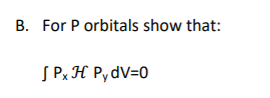
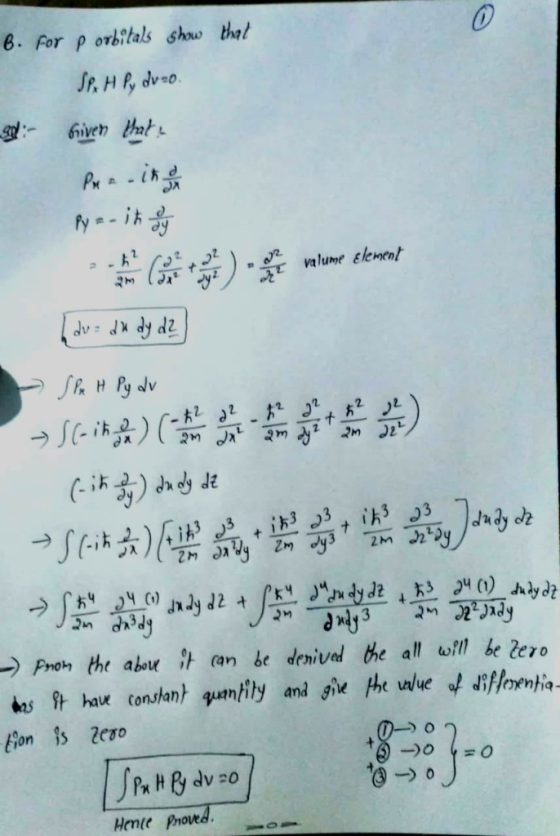
Where Px is the wave function for a Px orbital and Py is the wave function for a Py orbital and ℋ is the Hamiltonian.
Homework Answers
Add Answer to:
Where Px is the wave function for a Px orbital and Py is the wave function for a Py orbital and ℋ is the Hamiltonian. B...
Normalize the sphybrid orbital: h = s + Px + Py + Pz S, Px Py...
 Normalize the sphybrid orbital: h = s + Px + Py + Pz S, Px Py and pz represent n = 2 atomic orbitals on the same carbon atom. Assume all four AO's are normalized and orthogonal to each other. (2 pts)
Normalize the sp3 hybrid orbital: h1 spxt Py + pz s, px, Py and pz representn...
 Normalize the sp3 hybrid orbital: h1 spxt Py + pz s, px, Py and pz representn = 2 atomic orbitals on the same carbon atom. Assume all four AO's are normalized and orthogonal to each other. (2 pts)
Part B Each principal level with n= 2 or greater contains three p orbitals (pz, Py,...
 Part B Each principal level with n= 2 or greater contains three p orbitals (pz, Py, and p:). The three 2p orbitals are shown below. The p orbitals are not spherically symmetric like the sorbitals, but rather have two lobes of electron density on either side of the nucleus. The three 2p orbitals differ only in their orientation, and they are perpendicular to one another. ti P. P, orbital Py orbital P orbital The 2p orbital is not spherically symmetric...
Question 11 (1 point) Saved Identify the orbital. Px orbital Pz orbital dxy orbital Py orbital...
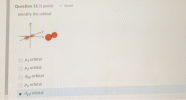 Question 11 (1 point) Saved Identify the orbital. Px orbital Pz orbital dxy orbital Py orbital e dyz orbital
Given the antisymmetrized orbital wave function: Y = C[97(1)42(2) – 9/11)41(2)] where 41 and 42 are...
 Given the antisymmetrized orbital wave function: Y = C[97(1)42(2) – 9/11)41(2)] where 41 and 42 are any two different space orbitals. Show that the wave function vanishes if both electrons are at the same location.
e) CN, V,1) remairis constant and e Hamiltonian H (x, y, px, Py) of a classical...
 e) CN, V,1) remairis constant and e Hamiltonian H (x, y, px, Py) of a classical two dimensional harmonic 3. Th oscillator of mass m and spring constant k is given by e) m nm Calculate the average energy < E-
Suppose Qxd = 10,000 - 2 Px + 3 Py - 4.5M, where Px = $100,...
Suppose Qxd = 10,000 - 2 Px + 3 Py - 4.5M, where Px = $100, Py = $50, and M = $2,000. (Note that Qdx is the quantity demanded of Good X, Px is the price of Good X, Py is the price of another product called Good Y, and M stands for income available.) Use this information to answer the following three parts of question 6. a. For this demand equation, what is the P intercept? b. For...
Consider the following individual (indirect) expenditure function: E(px, py, U) = 2(px py U)1/2. At price...
Consider the following individual (indirect) expenditure function: E(px, py, U) = 2(px py U)1/2. At price px = 20, py = 40 and U = 200, the quantity demand xc (on this individual compensated demand curve) is [xc]. Hint: Use the Shephard lemma to derive this individual compensated demand function.
1.2 (10 mks each). In parts a) and b) below, assume px = $1, py =...
 1.2 (10 mks each). In parts a) and b) below, assume px = $1, py = $5, I = income = $21. Solve the U-max problem for each of the following two utility functions: (a) U = xy?, x, y = 0; (b) U=x1/3y2/3, x, y 2 0; (c) now, let px = p, Py = $5, 1 = $21, find the u-max solution for U = xy?, x, y = 0; (d) let px = 1, Py = p,...
(a) 1.2 (10 mks each). In parts a) and b) below, assume px = $1, Py...
 (a) 1.2 (10 mks each). In parts a) and b) below, assume px = $1, Py = $5, I = income = $21. Solve the U-max problem for each of the following two utility functions: U= xy?, x, y 2 0; (b) U = x1/3y2/3, x, y = 0; now, let px = P, Py = $5, I = $21, find the u-max solution for U = xy?, x, y 2 0; let px = 1, Py =p, I =...
 Normalize the sphybrid orbital: h = s + Px + Py + Pz S, Px Py and pz represent n = 2 atomic orbitals on the same carbon atom. Assume all four AO's are normalized and orthogonal to each other. (2 pts)
 Normalize the sp3 hybrid orbital: h1 spxt Py + pz s, px, Py and pz representn = 2 atomic orbitals on the same carbon atom. Assume all four AO's are normalized and orthogonal to each other. (2 pts)
 Part B Each principal level with n= 2 or greater contains three p orbitals (pz, Py, and p:). The three 2p orbitals are shown below. The p orbitals are not spherically symmetric like the sorbitals, but rather have two lobes of electron density on either side of the nucleus. The three 2p orbitals differ only in their orientation, and they are perpendicular to one another. ti P. P, orbital Py orbital P orbital The 2p orbital is not spherically symmetric...
 Question 11 (1 point) Saved Identify the orbital. Px orbital Pz orbital dxy orbital Py orbital e dyz orbital
 Given the antisymmetrized orbital wave function: Y = C[97(1)42(2) – 9/11)41(2)] where 41 and 42 are any two different space orbitals. Show that the wave function vanishes if both electrons are at the same location.
 e) CN, V,1) remairis constant and e Hamiltonian H (x, y, px, Py) of a classical two dimensional harmonic 3. Th oscillator of mass m and spring constant k is given by e) m nm Calculate the average energy < E-
 1.2 (10 mks each). In parts a) and b) below, assume px = $1, py = $5, I = income = $21. Solve the U-max problem for each of the following two utility functions: (a) U = xy?, x, y = 0; (b) U=x1/3y2/3, x, y 2 0; (c) now, let px = p, Py = $5, 1 = $21, find the u-max solution for U = xy?, x, y = 0; (d) let px = 1, Py = p,...
 (a) 1.2 (10 mks each). In parts a) and b) below, assume px = $1, Py = $5, I = income = $21. Solve the U-max problem for each of the following two utility functions: U= xy?, x, y 2 0; (b) U = x1/3y2/3, x, y = 0; now, let px = P, Py = $5, I = $21, find the u-max solution for U = xy?, x, y 2 0; let px = 1, Py =p, I =...
Most questions answered within 3 hours.
-
Where is the error in this code sequence?
String s1 = "Hello";
String s2 = "ello";...
asked 10 months ago -
Financial data for Joel de Paris, Inc., for last year
follow:
Joel de Paris, Inc.
Balance...
asked 10 months ago -
Consider this reaction:
Al2(SO4)3 (aq)+ BaCl3
(aq) Al2Cl6 (aq)- +
3BaSO4(s) . What is the...
asked 10 months ago -
Suppose that Savneet is considering increasing her
recent random sample from 20 car rentals to 40...
asked 10 months ago -
Trucks arrive at an unloading terminal at an average rate of 120
per hour.
Trucks arrive...
asked 10 months ago -
Why are methanol and ethanol completely soluble in water while
octanol is not very little soluble....
asked 10 months ago -
A facilities manager at a university reads in a research report
that the mean amount of...
asked 10 months ago -
When the CuSO4 is rehydrated by adding water to the anhydrous
compound, is this an endothermic...
asked 10 months ago -
A ray of sunlight is passing from diamond into crown glass; the
angle of incidence is...
asked 10 months ago -
A block of mass 0.249 kg is placed on top of a light, vertical
spring of...
asked 10 months ago -
how do the kidneys compensate in the presences of acidosis
a) trigger hyperventilate
b) reserve acid...
asked 10 months ago -
Question 501 pts
The rental rate of capital to the firm increases. Which of the
following...
asked 10 months ago