
Homework Answers
In this solution some basic concepts and formulas of Vibration Mechanics are used. For more information, refer to any standard textbook or drop a comment below. Please give a Thumbs Up, if solution is helpful.
Solution :
NOTE : Feel free to ask further queries. Your positive rating would be appreciated and motivate me !
Add Answer to:
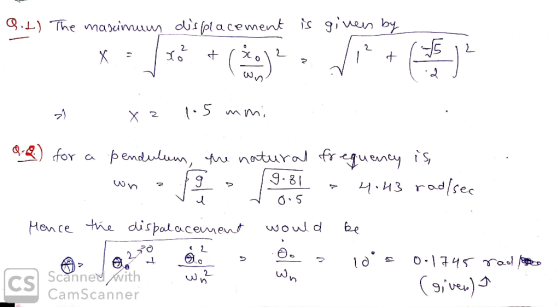
Exercises 1. (introduction) Sketch or plot the displacement of the mass in a mass-spring system for at least two per...
This document consists of 04 printed pages [Turn over Question 1 (CLO 1, PLO 2, C3)...
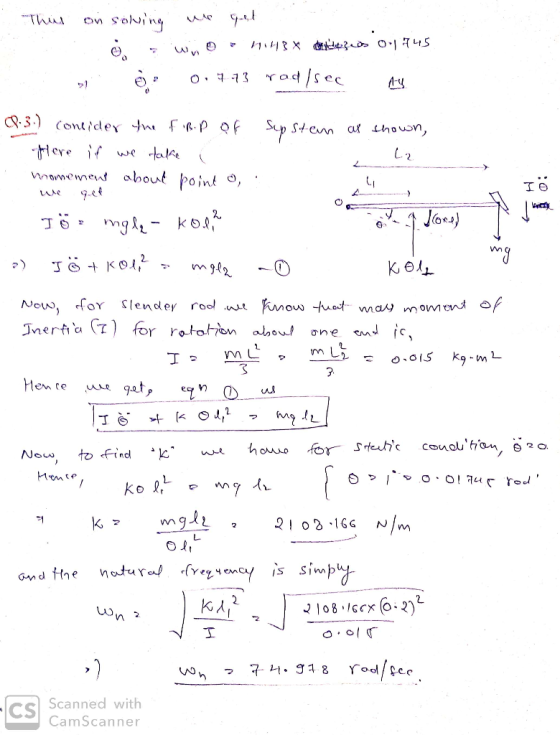
 This document consists of 04 printed pages [Turn over Question 1 (CLO 1, PLO 2, C3) Calculate the total energy in a damped system with frequency 2 rad's and damping ratio ( = 0.01 with mass 10 kg for the case xo = 0.1 m and vp=0. [25] I Rocker arm Follower Valve spring Oil Question 2 (CLO 1, PLO 2, C3) A rough sketch of a valve-and-rocker arm system for an internal combustion engine is given in Figure OHT...
A rough sketch of a valve-and-rocker-arm system for an internal combustion engine is give in Figure...
 A rough sketch of a valve-and-rocker-arm system for an internal
combustion engine is give in Figure shown . We want to model the
system as a beam pined at one end and attached to a spring at
another end as shown for ?, angular displacement of the rocker arm.
Find Ieq and Keq and determine the equations of motion and
calculate an expression for the natural frequency. Here J is the
rotational inertia of the rocker arm about its pivot...
A rough sketch of a valve-and-rocker-arm system for an internal
combustion engine is give in Figure shown . We want to model the
system as a beam pined at one end and attached to a spring at
another end as shown for ?, angular displacement of the rocker arm.
Find Ieq and Keq and determine the equations of motion and
calculate an expression for the natural frequency. Here J is the
rotational inertia of the rocker arm about its pivot...
A vibratory system can be modeled as a mass spring dashpot system as shown in Figure. In a free vibration test, the mas...
 A vibratory system can be modeled as a mass spring dashpot system as shown in Figure. In a free vibration test, the mass is disturbed from its equilibrium position. The corresponding time history plot is given as shown by the plot. Determine the following characteristics of the system: a) The natural frequency of the system b) The effective spring stifness c) The viscous damping coefficient c E 2 20kg 1.5 time (s)
A vibratory system can be modeled as a...
A vibratory system can be modeled as a mass spring dashpot system as shown in Figure. In a free vibration test, the mass is disturbed from its equilibrium position. The corresponding time history plot is given as shown by the plot. Determine the following characteristics of the system: a) The natural frequency of the system b) The effective spring stifness c) The viscous damping coefficient c E 2 20kg 1.5 time (s)
A vibratory system can be modeled as a...
A second order mechanical system of a mass connected to a spring and a damper is subjected to a s...
 A second order mechanical system of a mass connected to a spring and a damper is subjected to a sinusoidal input force mi+ci +kx- Asin(ot) The mass is m-5 kg, the damping constant is c = 1 N-sec/m, the spring stiffness is 2 N/m, and the amplitude of the input force is A- 3 N. For this system give explicit numerical values for the damping factor un-damped natural frequency on a. and the
A second order mechanical system of a...
A second order mechanical system of a mass connected to a spring and a damper is subjected to a sinusoidal input force mi+ci +kx- Asin(ot) The mass is m-5 kg, the damping constant is c = 1 N-sec/m, the spring stiffness is 2 N/m, and the amplitude of the input force is A- 3 N. For this system give explicit numerical values for the damping factor un-damped natural frequency on a. and the
A second order mechanical system of a...
3. The motion of a 1DOF mass-spring-damper system (see Figure 1) is modeled by the following seco...
 3. The motion of a 1DOF mass-spring-damper system (see Figure 1) is modeled by the following second order linear ODE: dx,2 dt n dt2 (0) C dt where is the damping ratio an wn is the natural frequency, both related to k, b, and m (the spring constant, damping coefficient, and mass, respectively) (a) Use the forward difference approximations of (b) Using Δt andd to obtain a finite difference formula for x(t+ 2Δ) (like we did in class for the...
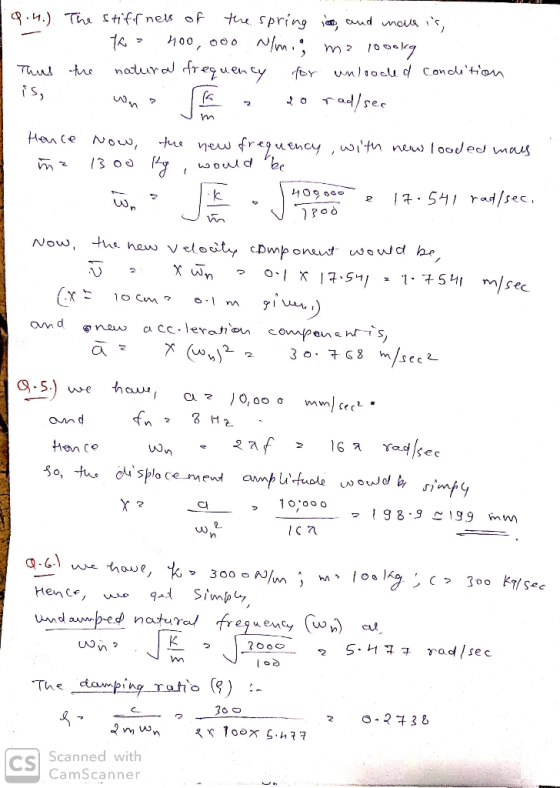
Exercise 11: Simple Harmonic Motion 1. A spring-mass system oscillates with a frequency of 10 Hz...
 Exercise 11: Simple Harmonic Motion 1. A spring-mass system oscillates with a frequency of 10 Hz when the mass is equal to 0.50 kg. What is the stiffness of the spring? With the same spring, what would the mass need to be to double the frequency? 2. A pendulum swings with a period of 1.50 seconds when the acceleration due to gravity is equal to 9.80 m/s? What is the length of the pendulum? How would this period change if...
QUESTION 4 (140 marks) Determine the damped frequency of the spring-mass system schematically illustrated below if...
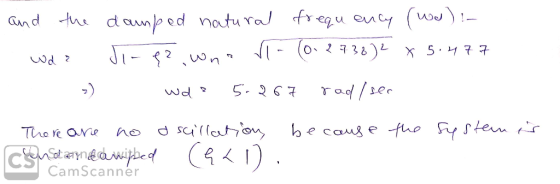
 QUESTION 4 (140 marks) Determine the damped frequency of the spring-mass system schematically illustrated below if the spring stiffness is 3000 N/m and the damping coefficient c is set at 320 Ns/m. If a periodic 260 N force is applied to the mass at a frequency of 2 Hz, determine the amplitude of the forced vibration. Spring Viscous damper 35 kg Figure 4
Consider a single degree of freedom (SDOF) with mass-spring-damper system
 Consider a single degree of freedom (SDOF) with mass-spring-damper system subjected to harmonic excitation having the following characteristics: Mass, m = 850 kg; stiffness, k = 80 kN/m; damping constant, c = 2000 N.s/m, forcing function amplitude, f0 = 5 N; forcing frequency, ωt = 30 rad/s. (a) Calculate the steady-state response of the system and state whether the system is underdamped, critically damped, or overdamped. (b) What happen to the steady-state response when the damping is increased to 18000 N.s/m? (Hint: Determine...
A second order mechanical system of a mass connected to a spring and a damper is subjected to a s...
 A second order mechanical system of a mass connected to a spring and a damper is subjected to a sinusoidal input force mx+cx + kx = A sin(at) The mass is m-5 kg, the damping constant is c = 1 N-sec/m, the spring stiffness is 2 N/m, and the amplitude of the input force is A- 3 N. For this system give explicit numerical values for the damping factor 5 and the un-damped natural frequency Using the given formulas for...
Problem # 4 15 points The base of a damped spring-mass system, with m 25 kg...
 Problem # 4 15 points The base of a damped spring-mass system, with m 25 kg and k 2500 N/m, is subjected to a harmonic excitation y(t) Xo cos ω. The amplitude of the mass is found to be 0.05 m when the base is excited at the natural frequency of the system with Yo 0.0 m. Determine the damping constant of the system.
 This document consists of 04 printed pages [Turn over Question 1 (CLO 1, PLO 2, C3) Calculate the total energy in a damped system with frequency 2 rad's and damping ratio ( = 0.01 with mass 10 kg for the case xo = 0.1 m and vp=0. [25] I Rocker arm Follower Valve spring Oil Question 2 (CLO 1, PLO 2, C3) A rough sketch of a valve-and-rocker arm system for an internal combustion engine is given in Figure OHT...
 A rough sketch of a valve-and-rocker-arm system for an internal
combustion engine is give in Figure shown . We want to model the
system as a beam pined at one end and attached to a spring at
another end as shown for ?, angular displacement of the rocker arm.
Find Ieq and Keq and determine the equations of motion and
calculate an expression for the natural frequency. Here J is the
rotational inertia of the rocker arm about its pivot...
A rough sketch of a valve-and-rocker-arm system for an internal
combustion engine is give in Figure shown . We want to model the
system as a beam pined at one end and attached to a spring at
another end as shown for ?, angular displacement of the rocker arm.
Find Ieq and Keq and determine the equations of motion and
calculate an expression for the natural frequency. Here J is the
rotational inertia of the rocker arm about its pivot...
 A vibratory system can be modeled as a mass spring dashpot system as shown in Figure. In a free vibration test, the mass is disturbed from its equilibrium position. The corresponding time history plot is given as shown by the plot. Determine the following characteristics of the system: a) The natural frequency of the system b) The effective spring stifness c) The viscous damping coefficient c E 2 20kg 1.5 time (s)
A vibratory system can be modeled as a...
A vibratory system can be modeled as a mass spring dashpot system as shown in Figure. In a free vibration test, the mass is disturbed from its equilibrium position. The corresponding time history plot is given as shown by the plot. Determine the following characteristics of the system: a) The natural frequency of the system b) The effective spring stifness c) The viscous damping coefficient c E 2 20kg 1.5 time (s)
A vibratory system can be modeled as a...
 A second order mechanical system of a mass connected to a spring and a damper is subjected to a sinusoidal input force mi+ci +kx- Asin(ot) The mass is m-5 kg, the damping constant is c = 1 N-sec/m, the spring stiffness is 2 N/m, and the amplitude of the input force is A- 3 N. For this system give explicit numerical values for the damping factor un-damped natural frequency on a. and the
A second order mechanical system of a...
A second order mechanical system of a mass connected to a spring and a damper is subjected to a sinusoidal input force mi+ci +kx- Asin(ot) The mass is m-5 kg, the damping constant is c = 1 N-sec/m, the spring stiffness is 2 N/m, and the amplitude of the input force is A- 3 N. For this system give explicit numerical values for the damping factor un-damped natural frequency on a. and the
A second order mechanical system of a...
 3. The motion of a 1DOF mass-spring-damper system (see Figure 1) is modeled by the following second order linear ODE: dx,2 dt n dt2 (0) C dt where is the damping ratio an wn is the natural frequency, both related to k, b, and m (the spring constant, damping coefficient, and mass, respectively) (a) Use the forward difference approximations of (b) Using Δt andd to obtain a finite difference formula for x(t+ 2Δ) (like we did in class for the...
 Exercise 11: Simple Harmonic Motion 1. A spring-mass system oscillates with a frequency of 10 Hz when the mass is equal to 0.50 kg. What is the stiffness of the spring? With the same spring, what would the mass need to be to double the frequency? 2. A pendulum swings with a period of 1.50 seconds when the acceleration due to gravity is equal to 9.80 m/s? What is the length of the pendulum? How would this period change if...
 QUESTION 4 (140 marks) Determine the damped frequency of the spring-mass system schematically illustrated below if the spring stiffness is 3000 N/m and the damping coefficient c is set at 320 Ns/m. If a periodic 260 N force is applied to the mass at a frequency of 2 Hz, determine the amplitude of the forced vibration. Spring Viscous damper 35 kg Figure 4
 A second order mechanical system of a mass connected to a spring and a damper is subjected to a sinusoidal input force mx+cx + kx = A sin(at) The mass is m-5 kg, the damping constant is c = 1 N-sec/m, the spring stiffness is 2 N/m, and the amplitude of the input force is A- 3 N. For this system give explicit numerical values for the damping factor 5 and the un-damped natural frequency Using the given formulas for...
 Problem # 4 15 points The base of a damped spring-mass system, with m 25 kg and k 2500 N/m, is subjected to a harmonic excitation y(t) Xo cos ω. The amplitude of the mass is found to be 0.05 m when the base is excited at the natural frequency of the system with Yo 0.0 m. Determine the damping constant of the system.
Most questions answered within 3 hours.
-
Where is the error in this code sequence?
String s1 = "Hello";
String s2 = "ello";...
asked 11 months ago -
Financial data for Joel de Paris, Inc., for last year
follow:
Joel de Paris, Inc.
Balance...
asked 11 months ago -
Consider this reaction:
Al2(SO4)3 (aq)+ BaCl3
(aq) Al2Cl6 (aq)- +
3BaSO4(s) . What is the...
asked 11 months ago -
Suppose that Savneet is considering increasing her
recent random sample from 20 car rentals to 40...
asked 11 months ago -
Trucks arrive at an unloading terminal at an average rate of 120
per hour.
Trucks arrive...
asked 11 months ago -
Why are methanol and ethanol completely soluble in water while
octanol is not very little soluble....
asked 11 months ago -
A facilities manager at a university reads in a research report
that the mean amount of...
asked 11 months ago -
When the CuSO4 is rehydrated by adding water to the anhydrous
compound, is this an endothermic...
asked 11 months ago -
A ray of sunlight is passing from diamond into crown glass; the
angle of incidence is...
asked 11 months ago -
A block of mass 0.249 kg is placed on top of a light, vertical
spring of...
asked 11 months ago -
how do the kidneys compensate in the presences of acidosis
a) trigger hyperventilate
b) reserve acid...
asked 11 months ago -
Question 501 pts
The rental rate of capital to the firm increases. Which of the
following...
asked 11 months ago