*Coral Language* Write a program that first gets a list of six integers from input. The first five values are the intege...
*Coral Language*
Write a program that first gets a list of six integers from input. The first five values are the integer list. The last value is the upper threshold. Then output all integers less than or equal to the threshold value.
Ex: If the input is 50 60 140 200 75 100, the output is:
50 60 75
For coding simplicity, follow every output value by a space, including the last one.
Such functionality is common on sites like Amazon, where a user can filter results.
Your program should define and use a function:
Function outputIntsLessThanOrEqualToThreshold(integer array(?) userVals, integer upperThreshold) returns nothing
Homework Answers
If you have any doubts, please give me comment...
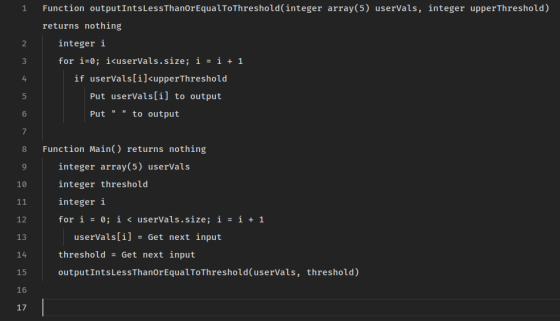
Function outputIntsLessThanOrEqualToThreshold(integer array(5)
userVals, integer upperThreshold) returns nothing
integer i
for i=0; i<userVals.size; i = i + 1
if userVals[i]<upperThreshold
Put userVals[i] to output
Put " " to output
Function Main() returns nothing
integer array(5) userVals
integer threshold
integer i
for i = 0; i < userVals.size; i = i + 1
userVals[i] = Get next input
threshold = Get next input
outputIntsLessThanOrEqualToThreshold(userVals, threshold)
Add Answer to:
*Coral Language* Write a program that first gets a list of six integers from input. The first five values are the intege...
Coral Language Please to thanks Write a program that first gets a list of 5 integers...
Coral Language Please to thanks Write a program that first gets a list of 5 integers from input. Then, get another value from the input, and output all integers less than or equal to that value. Ex: If the input is 50 60 140 200 75 100, the output is: 50 60 75 For coding simplicity, follow every output value by a space, including the last one. Then, output a newline. Such functionality is common on sites like Amazon, where...
IN JAVA Write a program that first gets a list of integers from input. The input...
IN JAVA Write a program that first gets a list of integers from input. The input begins with an integer indicating the number of integers that follow. Then, get the last value from the input, which indicates a threshold. Output all integers less than or equal to that last threshold value. Assume that the list will always contain fewer than 20 integers. Ex: If the input is: 5 50 60 140 200 75 100 the output is: 50 60 75...
Write a program that first gets a list of integers from the input and adds them...
Write a program that first gets a list of integers from the input and adds them to an array. The input begins with an integer indicating the number of integers that follow (Your program should work for any size of the array). Then, get the last value from the input, and output all integers less than or equal to that value by iterating through the array. Ex: If the input is: Enter the number of integers: 5 Enter integer 1:...
Write a program that first gets a list of integers from input. The input begins with...
Write a program that first gets a list of integers from input. The input begins with an integer indicating the number of integers that follow. Then, get the last value from the input, and output all integers less than or equal to that value. Ex: If the input is: 5 50 60 140 200 75 100 the output is: 50 60 75 The 5 indicates that there are five integers in the list, namely 50, 60, 140, 200, and 75....
Please draw a flow chart for each method please and thank you. Write a program that...
 Please draw a flow chart for each method please and thank
you.
Write a program that first gets a list of integers from input. The input begins with an integer indicating the number of integers that follow. Then, get the last value from the input, and output all integers less than or equal to that value. Assume that the list will always contain less than 20 integers. Ex: If the input is: 5 50 60 140 200 75 100 the...
Please draw a flow chart for each method please and thank
you.
Write a program that first gets a list of integers from input. The input begins with an integer indicating the number of integers that follow. Then, get the last value from the input, and output all integers less than or equal to that value. Assume that the list will always contain less than 20 integers. Ex: If the input is: 5 50 60 140 200 75 100 the...
NEED IN CORAL LANGUAGE ONLY When analyzing data sets, such as data for human heights or...
NEED IN CORAL LANGUAGE ONLY When analyzing data sets, such as data for human heights or for human weights, a common step is to adjust the data. This can be done by normalizing to values between 0 and 1, or throwing away outliers. For this program, adjust the values by subtracting the smallest value from all the values. The input consists of five integers. Ex: If the input is 30 50 10 70 65, the output is: 20 40 0...
5.35 LAB: Sort a vector Write a program that gets a list of integers from input,...
5.35 LAB: Sort a vector Write a program that gets a list of integers from input, and outputs the integers in ascending order (lowest to highest). The first integer indicates how many numbers are in the list. Assume that the list will always contain less than 20 integers. Ex: If the input is: 5 10 4 39 12 2 the output is: 2 4 10 12 39 For coding simplicity, follow every output value by a space, including the last...
Write a program whose input is two integers, and whose output is the first integer
5.20 (Ch 5) HW: Output range with increment of 10 Write a program whose input is two integers, and whose output is the first integer and subsequent increments of 10 as long as the value is less than or equal to the second integer Ex: If the input is: -15 30 Then the output is: 15 -5 5 15 25 Ex: If the second integer is less than the first as in 20 5, the output is: Second integer can't be less than the...
[C++] Write a program that reads a list of integers, and outputs those integers in reverse....
[C++] Write a program that reads a list of integers, and outputs those integers in reverse. You must use an array for this lab. The input begins with an integer indicating the number of integers that follow. For coding simplicity, follow each output integer by a space, including the last one. Ex: If the input is: 5 2 4 6 8 10 the output is: 10 8 6 4 2 5 To achieve the above, first read the integers into...
3.16 LAB: Output range with increment of 10 Write a program whose input is two integers,...
3.16 LAB: Output range with increment of 10 Write a program whose input is two integers, and whose output is the first integer and subsequent increments of 10 as long as the value is less than or equal to the second integer. Ex: If the input is: -15 30 the output is: -15 -5 5 15 25 Ex: If the second integer is less than the first as in: 20 5 the output is: Second integer can't be less than...
 Please draw a flow chart for each method please and thank
you.
Write a program that first gets a list of integers from input. The input begins with an integer indicating the number of integers that follow. Then, get the last value from the input, and output all integers less than or equal to that value. Assume that the list will always contain less than 20 integers. Ex: If the input is: 5 50 60 140 200 75 100 the...
Please draw a flow chart for each method please and thank
you.
Write a program that first gets a list of integers from input. The input begins with an integer indicating the number of integers that follow. Then, get the last value from the input, and output all integers less than or equal to that value. Assume that the list will always contain less than 20 integers. Ex: If the input is: 5 50 60 140 200 75 100 the...
Most questions answered within 3 hours.
-
Where is the error in this code sequence?
String s1 = "Hello";
String s2 = "ello";...
asked 11 months ago -
Financial data for Joel de Paris, Inc., for last year
follow:
Joel de Paris, Inc.
Balance...
asked 11 months ago -
Consider this reaction:
Al2(SO4)3 (aq)+ BaCl3
(aq) Al2Cl6 (aq)- +
3BaSO4(s) . What is the...
asked 11 months ago -
Suppose that Savneet is considering increasing her
recent random sample from 20 car rentals to 40...
asked 11 months ago -
Trucks arrive at an unloading terminal at an average rate of 120
per hour.
Trucks arrive...
asked 11 months ago -
Why are methanol and ethanol completely soluble in water while
octanol is not very little soluble....
asked 11 months ago -
A facilities manager at a university reads in a research report
that the mean amount of...
asked 11 months ago -
When the CuSO4 is rehydrated by adding water to the anhydrous
compound, is this an endothermic...
asked 11 months ago -
A ray of sunlight is passing from diamond into crown glass; the
angle of incidence is...
asked 11 months ago -
A block of mass 0.249 kg is placed on top of a light, vertical
spring of...
asked 11 months ago -
how do the kidneys compensate in the presences of acidosis
a) trigger hyperventilate
b) reserve acid...
asked 11 months ago -
Question 501 pts
The rental rate of capital to the firm increases. Which of the
following...
asked 11 months ago