#include <stdio.h> int main(int argc, char *argv[]) { char a, *pc, c[9]; int i, *pk, k[9]; a='...
#include <stdio.h>
int main(int argc, char *argv[])
{
char a, *pc, c[9];
int i, *pk, k[9];
a='z';
pc=&(c[8]);
pk=&(k[0]);
for (i=0; i<9; i++)
{
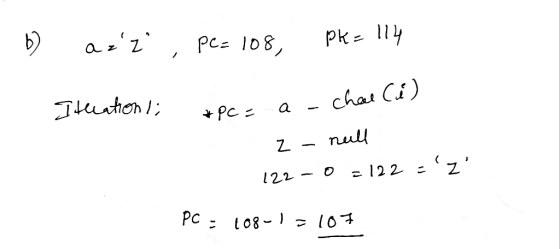
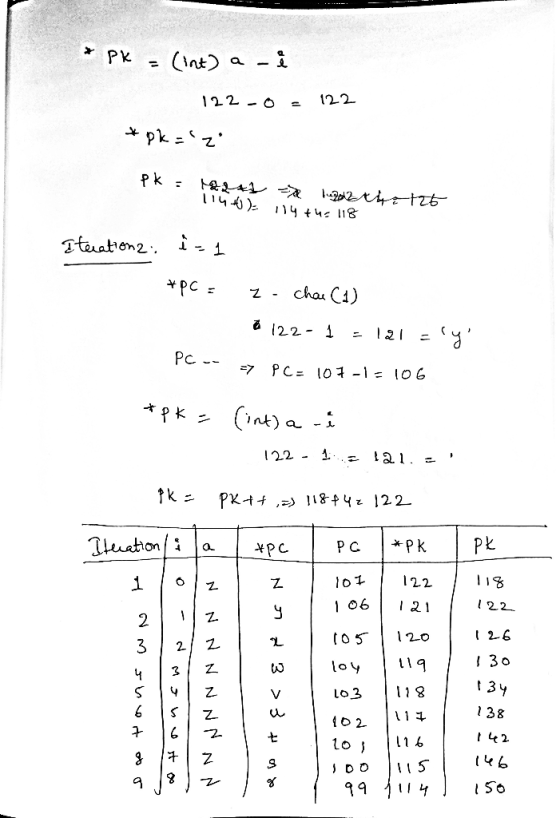
*pc=a-(char)i;
pc--;
*pk=(int)a-i;
pk++;
}
return 0;
}//end of main
Answer the below questions with the above code
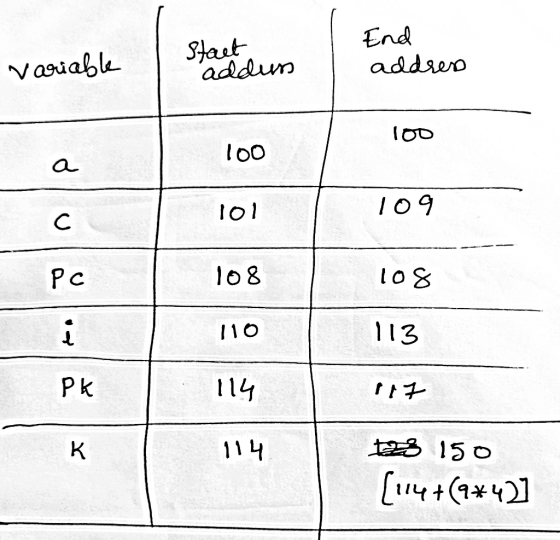
- Write out the memory map for the above C code in the following table. For array variables, list the address range for the entire array. Assume the memory address starts from 100, that is, the address for a is 100. Suppose sizeof(char)=1, sizeof(int)=4 and the size of a memory address (a pointer) is 8 bytes. You may assume there is no gap in memory between the variables. (18 pts)
|
Variable |
Start address |
End address |
|
a |
||
|
Pc |
||
|
c |
||
|
i |
||
|
pk |
||
|
K |
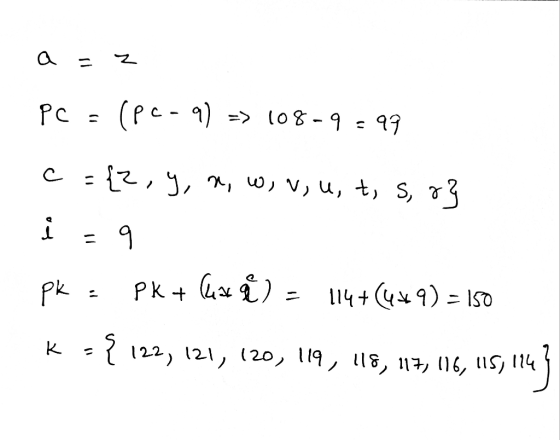
- Additionally, show values of the variables in the following table at the end of execution of the for loop before the main function returns. (For the two array variables c and k, list the contents of all array elements.) (18 pts)
|
Variable |
Value |
|
a |
|
|
pc |
Use an expression involving c to represent pc’s value |
|
c |
list the contents of the entire array |
|
i |
|
|
pk |
Use an expression involving k to represent pk’s value |
|
k |
list the contents of the entire array |
- True or false? pc and pk have the same value just before return. (2 pts)
- True or false? The two array c and k contain the same integral values just before return. (2 pts)
Homework Answers
C.False
D. True
Add Answer to:
#include <stdio.h> int main(int argc, char *argv[]) { char a, *pc, c[9]; int i, *pk, k[9]; a='...
Learn the example C program in Folio consisting of three files (a.c, a.h, main.c) and complete this exercise. You need t...
Learn the example C program in Folio consisting of three files (a.c, a.h, main.c) and complete this exercise. You need to understand function, pointer and the selection sort algorithm. Write a C program that consists of three files mysort.h, mysort.c and myMain.c. Below is the mysort.h prototype #include <stdlib.h> #include <stdio.h> void generateNums(int *myarr, int len); void sortNums(int *myarr, int len); mysort.h must contain only the function declarations (prototypes) listed above generateNums function should generate len random integers in the...
#include <stdio.h> int main(int argc, char *argv[]) { int i; for (i = argc - 1;...
#include <stdio.h> int main(int argc, char *argv[]) { int i; for (i = argc - 1; i > 0; i--) printf("%s ", argv[i]); printf("\n"); return 0; } can you explain this code in c and why use this function
#include <stdlib.h> #include <stdio.h> #include "main.h" #define MAX_NUM_LENGTH 11 void usage(int argc, char** argv) { if(argc...
#include <stdlib.h> #include <stdio.h> #include "main.h" #define MAX_NUM_LENGTH 11 void usage(int argc, char** argv) { if(argc < 4) { fprintf(stderr, "usage: %s <input file 1> <input file 2> <output file>\n", argv[0]); exit(EXIT_FAILURE); } } /* This function takes in the two input file names (stored in argv) and determines the number of integers in each file. If the two files both have N integers, return N, otherwise return -1. If one or both of the files do not exist, it...
The operating system is Ubuntu 18.04 hello.c #include <stdio.h> int main(int argc, char *argv[]) { printf("Hello...
 The operating system is Ubuntu 18.04
hello.c
#include <stdio.h>
int main(int argc, char *argv[]) {
printf("Hello world!\n");
return 0;
}
syscall-hello.c
#include <unistd.h>
#include <sys/syscall.h>
char *buf = "Hello world!\n";
int main(int argc, char *argv) {
size_t result;
/* "man 2 write" to see arguments to write syscall */
result = syscall(SYS_write, 1, buf, 13);
return (int) result;
}Download and compile hello.ce and syscall-hello.com. Compile them statically and dynamically. How do the library and system calls produced by them compare...
The operating system is Ubuntu 18.04
hello.c
#include <stdio.h>
int main(int argc, char *argv[]) {
printf("Hello world!\n");
return 0;
}
syscall-hello.c
#include <unistd.h>
#include <sys/syscall.h>
char *buf = "Hello world!\n";
int main(int argc, char *argv) {
size_t result;
/* "man 2 write" to see arguments to write syscall */
result = syscall(SYS_write, 1, buf, 13);
return (int) result;
}Download and compile hello.ce and syscall-hello.com. Compile them statically and dynamically. How do the library and system calls produced by them compare...
The main(int argc, char *argv[]) function will perform the following: • Evaluate whether value in argc...
The main(int argc, char *argv[]) function will perform the following: • Evaluate whether value in argc is greater or equal to 3. • If it is not, then print the following message: Incorrect number of arguments - please call with assignment min max where assignment is the name of your executable and min/max define the range of numbers for your array. • If argc is ≥ 3 convert the values for min and max into integers and store them in...
#include <stdio.h> int main ( ) { int k; int sum=0; for (k=0; k<6; k++) {...
#include <stdio.h> int main ( ) { int k; int sum=0; for (k=0; k<6; k++) { sum += k; } printf("%d\n", sum); return 0; } (a) [10 pts] Convert the C program to be an assembly code named as lab3_ex7_assembly.s. Please notice that your code must be executable in the Venus simulator. In the assembly code you write, you need to answer the following questions as well: (b) [5 pts] What are the registers in your code to represent the...
sort.c #include <stdlib.h> #include <stdio.h> #include "libsort.h" int main() { int* array; int size,...
 sort.c
#include <stdlib.h>
#include <stdio.h>
#include "libsort.h"
int main()
{
int* array;
int size, c;
float median;
printf("Enter the array size:\n");
scanf("%d", &size);
array = (int*) malloc(size *
sizeof(int));
printf("Enter %d integers:\n", size);
for (c = 0; c < size; c++)
scanf("%d",
&array[c]);
sort(array, size);
printf("Array sorted in ascending
order:\n");
for (c = 0; c < size; c++)
printf("%d ",
array[c]);
printf("\n");
median = find_median(array,...
sort.c
#include <stdlib.h>
#include <stdio.h>
#include "libsort.h"
int main()
{
int* array;
int size, c;
float median;
printf("Enter the array size:\n");
scanf("%d", &size);
array = (int*) malloc(size *
sizeof(int));
printf("Enter %d integers:\n", size);
for (c = 0; c < size; c++)
scanf("%d",
&array[c]);
sort(array, size);
printf("Array sorted in ascending
order:\n");
for (c = 0; c < size; c++)
printf("%d ",
array[c]);
printf("\n");
median = find_median(array,...
#include<stdio.h> #include<stdio.h> int main(){ int i; //initialize array char array[10] = {“Smith”, “Owen”, “Kowalczyk”, “Glass”, “Bierling”,...
#include<stdio.h> #include<stdio.h> int main(){ int i; //initialize array char array[10] = {“Smith”, “Owen”, “Kowalczyk”, “Glass”, “Bierling”, “Hanenburg”, “Rhoderick”, “Pearce”, “Raymond”, “Kamphuis”}; for(int i=0; i<8;i++){ for(int j=0; j<9; j++){ if(strcmp(array[j],array[j+1])>0){ char temp[20]; strcpy(temp,array[j]); strcpy(array[j],array[j+1]); strcpy(array[j+1],temp); } } } printf(“---------File Names---------\n”); for(inti=0; i<9; i++){ printf(“\t%s\n”,array[i]); } printf(-------5 Largest Files according to sorting----\n”); for(int i=0;i>=5;i--) { printf(“\t%s\n”,array[i]); } return0; } Consider the "sort" program (using with void* parameters in the bubblesort function) from the week 10 "sort void" lecture. Modify it as follows...
Homework Part 1 Write a C program that declares and initializes a double, an int, and a char. You...
 Homework Part 1 Write a C program that declares and initializes a double, an int, and a char. You can initialize the variables to any legal value of your choosing. Next, declare and initialize a pointer variable to each of the variables Using printf), output the following: The address of each of the first three variables. Use the "Ox%x" format specifier to print the addresses in hexadecimal notation The value of each variable. They should equal the value you gave...
C Programming // Compile with: clang radio.c -o radio // Run with: ./radio #include <stdio.h> #include...
C Programming // Compile with: clang radio.c -o radio // Run with: ./radio #include <stdio.h> #include <stdlib.h> #include <string.h> #include <time.h> // @Name loadMusicFile // @Brief Load the music database // 'size' is the size of the database. char** loadMusicFile(const char* fileName, int size){ FILE *myFile = fopen(fileName,"r"); // Allocate memory for each character-string pointer char** database = malloc(sizeof(char*)*size); unsigned int song=0; for(song =0; song < size; song++){ // Allocate memory for each individual character string database[song] =...
 The operating system is Ubuntu 18.04
hello.c
#include <stdio.h>
int main(int argc, char *argv[]) {
printf("Hello world!\n");
return 0;
}
syscall-hello.c
#include <unistd.h>
#include <sys/syscall.h>
char *buf = "Hello world!\n";
int main(int argc, char *argv) {
size_t result;
/* "man 2 write" to see arguments to write syscall */
result = syscall(SYS_write, 1, buf, 13);
return (int) result;
}Download and compile hello.ce and syscall-hello.com. Compile them statically and dynamically. How do the library and system calls produced by them compare...
The operating system is Ubuntu 18.04
hello.c
#include <stdio.h>
int main(int argc, char *argv[]) {
printf("Hello world!\n");
return 0;
}
syscall-hello.c
#include <unistd.h>
#include <sys/syscall.h>
char *buf = "Hello world!\n";
int main(int argc, char *argv) {
size_t result;
/* "man 2 write" to see arguments to write syscall */
result = syscall(SYS_write, 1, buf, 13);
return (int) result;
}Download and compile hello.ce and syscall-hello.com. Compile them statically and dynamically. How do the library and system calls produced by them compare...
 sort.c
#include <stdlib.h>
#include <stdio.h>
#include "libsort.h"
int main()
{
int* array;
int size, c;
float median;
printf("Enter the array size:\n");
scanf("%d", &size);
array = (int*) malloc(size *
sizeof(int));
printf("Enter %d integers:\n", size);
for (c = 0; c < size; c++)
scanf("%d",
&array[c]);
sort(array, size);
printf("Array sorted in ascending
order:\n");
for (c = 0; c < size; c++)
printf("%d ",
array[c]);
printf("\n");
median = find_median(array,...
sort.c
#include <stdlib.h>
#include <stdio.h>
#include "libsort.h"
int main()
{
int* array;
int size, c;
float median;
printf("Enter the array size:\n");
scanf("%d", &size);
array = (int*) malloc(size *
sizeof(int));
printf("Enter %d integers:\n", size);
for (c = 0; c < size; c++)
scanf("%d",
&array[c]);
sort(array, size);
printf("Array sorted in ascending
order:\n");
for (c = 0; c < size; c++)
printf("%d ",
array[c]);
printf("\n");
median = find_median(array,...
 Homework Part 1 Write a C program that declares and initializes a double, an int, and a char. You can initialize the variables to any legal value of your choosing. Next, declare and initialize a pointer variable to each of the variables Using printf), output the following: The address of each of the first three variables. Use the "Ox%x" format specifier to print the addresses in hexadecimal notation The value of each variable. They should equal the value you gave...
Most questions answered within 3 hours.
-
Where is the error in this code sequence?
String s1 = "Hello";
String s2 = "ello";...
asked 10 months ago -
Financial data for Joel de Paris, Inc., for last year
follow:
Joel de Paris, Inc.
Balance...
asked 10 months ago -
Consider this reaction:
Al2(SO4)3 (aq)+ BaCl3
(aq) Al2Cl6 (aq)- +
3BaSO4(s) . What is the...
asked 10 months ago -
Suppose that Savneet is considering increasing her
recent random sample from 20 car rentals to 40...
asked 10 months ago -
Trucks arrive at an unloading terminal at an average rate of 120
per hour.
Trucks arrive...
asked 10 months ago -
Why are methanol and ethanol completely soluble in water while
octanol is not very little soluble....
asked 10 months ago -
A facilities manager at a university reads in a research report
that the mean amount of...
asked 10 months ago -
When the CuSO4 is rehydrated by adding water to the anhydrous
compound, is this an endothermic...
asked 10 months ago -
A ray of sunlight is passing from diamond into crown glass; the
angle of incidence is...
asked 10 months ago -
A block of mass 0.249 kg is placed on top of a light, vertical
spring of...
asked 10 months ago -
how do the kidneys compensate in the presences of acidosis
a) trigger hyperventilate
b) reserve acid...
asked 10 months ago -
Question 501 pts
The rental rate of capital to the firm increases. Which of the
following...
asked 10 months ago