(TCO 5) Explain the ventilation cycle and how it relates to the respiratory rate. If a patient breathes at a rate of 14...
(TCO 5) Explain the ventilation cycle and how it relates to the respiratory rate. If a patient breathes at a rate of 14 breaths per minute and has an inspiratory time of 2.5 seconds, what is the expiratory time?
Homework Answers
The change from inspiration to expiration in the mechanically ventilated breath is termed as cycling. Mechanical ventilation optimization and synchronization with patients breathing is very important to maintain efficient respiration. The mechanical ventilator breath can be divided into inspiratory phase and expiratory phase. At the end of inspiration, gas flow ceases, and the breath switches exhalation. This transition of the inspiratory phase to the expiratory phase is termed “cycling.” The cycling depends on four variables : pressure, time, volume and flow.
Total cycle time= 60/respiratory rate = 60/14 = 4.3 sec
Now the inspiratory time given is 2.5 sec
So the expiratiry time = total cycle time - inspiratory time
Expiratory time = 4.3 - 2.5 = 1.8sec
Add Answer to:
(TCO 5) Explain the ventilation cycle and how it relates to the respiratory rate. If a patient breathes at a rate of 14...
11. Patient has an inspiratory time 1.2 sec, tidal volume .u What is the flow? 12....
 11. Patient has an inspiratory time 1.2 sec, tidal volume .u What is the flow? 12. Patient has an inspiratory flow 45 /min, tidal volume 625 What is the inspiratory time? 13. Patient has a set RR 12, tidal volume 1.0 L and flow rate 50 L/min What is the patient's minute volume? What is the total cycle time? What is the inspiratory time? What is the expiratory time? What is the /E ratio? Patient has a set RR 10,...
1 Calculate the total flow delivered to a patient. The patient is wearing a 47% entrainment...
 1 Calculate the total flow delivered to a patient. The patient is wearing a 47% entrainment mask set at 6 LPM 2. If a patient has a total cycle time of 5 seconds, what is the respiratory rate per minute? 3. What is the total cycle time for a patient who has an l:E ratio of 1:4 and inspiratory time of 1 second?
1 Calculate the total flow delivered to a patient. The patient is wearing a 47% entrainment mask...
1 Calculate the total flow delivered to a patient. The patient is wearing a 47% entrainment mask set at 6 LPM 2. If a patient has a total cycle time of 5 seconds, what is the respiratory rate per minute? 3. What is the total cycle time for a patient who has an l:E ratio of 1:4 and inspiratory time of 1 second?
1 Calculate the total flow delivered to a patient. The patient is wearing a 47% entrainment mask...
. atient has ån inspiratory time 1.2 sec, tidal volume 1.OL What is the flow? .Patient...
 . atient has ån inspiratory time 1.2 sec, tidal volume 1.OL What is the flow? .Patient has an inspiratory flow 45 L/min, tidal volume 625 mL What is the inspiratory time? Patient has a set RR 12, tidal volume 1.0 L and flow rate 50 I/min What is the patient's minute volume? What is the total cycle time? What is the inspiratory time? What is the expiratory time? What is the LE ratio? Patient has a set RR 10, set...
10. Match the ventilator terms and settings with their descriptions: 10. Match the ventilator terms and...
 10. Match the ventilator terms and settings with their
descriptions:
10. Match the ventilator terms and settings with their descriptions: a. Assist-Control mode (AC) b. Rate or breath/minute (BPM) c. Continuous positive airway pressure (CPAP) d. Bi-level positive airway pressure (BiPAP) e. Fractionof inspired oxygen (FIO2) f. Peak airway inspiratory pressure (PIP) 1. Pressure needed to deliver a set tidal volume 2. Positive pressure throughout the entire respiratory cycle to prevent alveolar collapse 3. Number of ventilations delivered per minute...
10. Match the ventilator terms and settings with their
descriptions:
10. Match the ventilator terms and settings with their descriptions: a. Assist-Control mode (AC) b. Rate or breath/minute (BPM) c. Continuous positive airway pressure (CPAP) d. Bi-level positive airway pressure (BiPAP) e. Fractionof inspired oxygen (FIO2) f. Peak airway inspiratory pressure (PIP) 1. Pressure needed to deliver a set tidal volume 2. Positive pressure throughout the entire respiratory cycle to prevent alveolar collapse 3. Number of ventilations delivered per minute...
A patient in respiratory distress is admitted to the Intensive care Unit with Pneumococcal Pneumonia. The...
A patient in respiratory distress is admitted to the Intensive care Unit with Pneumococcal Pneumonia. The nurse receives the following report: S Patient admitted to ICU 2 hours ago with pneumococcal pneumonia B History of Chronic Obstructive Lung Disease Lung Cancer Diabetes Type II A Temperature 38.7 Heart rate of 80 beats per minute Respiratory rate of 40 breaths per minute Blood Pressure 80/40 White blood cell count (WBC) of 15,000 cells/mm3 Oxygen saturation 78%. PaCO2 of 60 mmHG Blood...
CASE STUDY: Respiratory Med-Surg. Respiratory Case studies #1 Patient Profile: A 62-year-old female client with a...
CASE STUDY: Respiratory Med-Surg. Respiratory Case studies #1 Patient Profile: A 62-year-old female client with a history of COPD is admitted to the hospital with an acute exacerbation and left-sided pneumonia. The nurse observes increased anterior-posterior diameter of the chest, reddish-blue skin tone, and prolonged expiratory phase when breathing. Admission vital signs: temperature 101.5 F (oral), blood pressure 154/92, heart rate 110, and respiratory rate 26 breaths/minute. Critical Thinking Questions: Answer each question thoroughly and with details: What nursing diagnosis...
For 1 is it Respiratory Zone or Conducting Zone Steve thought he would see how long...
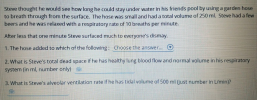 For 1 is it Respiratory Zone
or Conducting Zone
Steve thought he would see how long he could stay under water in his friends pool by using a garden hose to breath through from the surface. The hose was small and had a total volume of 250 ml. Steve had a few beers and he was relaxed with a respiratory rate of 10 breaths per minute After less that one minute Steve surfaced much to everyone's dismay. 1. The hose...
For 1 is it Respiratory Zone
or Conducting Zone
Steve thought he would see how long he could stay under water in his friends pool by using a garden hose to breath through from the surface. The hose was small and had a total volume of 250 ml. Steve had a few beers and he was relaxed with a respiratory rate of 10 breaths per minute After less that one minute Steve surfaced much to everyone's dismay. 1. The hose...
RET1485C Respiratory Therapy Thecry Pretest/Post 9. Which of the tollowing is correct? 14. Sputum culture and...
 RET1485C Respiratory Therapy Thecry Pretest/Post 9. Which of the tollowing is correct? 14. Sputum culture and sensitivity would be ndicated for which of the following conditions? a. Compliances in serios add as a. ST segment elevation b. Pleural eftusion b. Compliance is the physical tendency to return to an initial state ater d. Bronchitis the patient for respiratory distress. After hooking the patient up to a cardiac monitor you observe the following thythm The inssillation of surfactant reduces 15. You...
All of the following may be associated with respiratory distress in the pediatric patient except: Bradycardia...
All of the following may be associated with respiratory distress in the pediatric patient except: Bradycardia Agitation Retractions Nasal flaring Which of these interventions would be the most appropriate during endotracheal intubation of an infant or child with respiratory failure? Any single attempt at intubation should be continued without interruption until tube placement is achieved. Interrupt the attempt and provide bag-mask ventilation with 100% if the heart rate decreases or clinical condition worsens. Always use cuffed tubes. Evaluate tube position...
Case Studies A 28 year old woman presents to the emcrgency department with complaints of difficulty...
 Case Studies A 28 year old woman presents to the emcrgency department with complaints of difficulty breathing, general muscle weakness and dysphagia. Her history of present illness reveals that she was diagnosed wtih infectious mononucleosis 10 days ago and had recently experienced ptosis and weakness in her legs and amis. She weighs 150 pound and is 5 feet, 8 inches tall. ABG on room air: 730502378 S02 91% H maximal inspiratory pressure is 15 1. cmH20 and vital capacity is...
 11. Patient has an inspiratory time 1.2 sec, tidal volume .u What is the flow? 12. Patient has an inspiratory flow 45 /min, tidal volume 625 What is the inspiratory time? 13. Patient has a set RR 12, tidal volume 1.0 L and flow rate 50 L/min What is the patient's minute volume? What is the total cycle time? What is the inspiratory time? What is the expiratory time? What is the /E ratio? Patient has a set RR 10,...
 1 Calculate the total flow delivered to a patient. The patient is wearing a 47% entrainment mask set at 6 LPM 2. If a patient has a total cycle time of 5 seconds, what is the respiratory rate per minute? 3. What is the total cycle time for a patient who has an l:E ratio of 1:4 and inspiratory time of 1 second?
1 Calculate the total flow delivered to a patient. The patient is wearing a 47% entrainment mask...
1 Calculate the total flow delivered to a patient. The patient is wearing a 47% entrainment mask set at 6 LPM 2. If a patient has a total cycle time of 5 seconds, what is the respiratory rate per minute? 3. What is the total cycle time for a patient who has an l:E ratio of 1:4 and inspiratory time of 1 second?
1 Calculate the total flow delivered to a patient. The patient is wearing a 47% entrainment mask...
 . atient has ån inspiratory time 1.2 sec, tidal volume 1.OL What is the flow? .Patient has an inspiratory flow 45 L/min, tidal volume 625 mL What is the inspiratory time? Patient has a set RR 12, tidal volume 1.0 L and flow rate 50 I/min What is the patient's minute volume? What is the total cycle time? What is the inspiratory time? What is the expiratory time? What is the LE ratio? Patient has a set RR 10, set...
 10. Match the ventilator terms and settings with their
descriptions:
10. Match the ventilator terms and settings with their descriptions: a. Assist-Control mode (AC) b. Rate or breath/minute (BPM) c. Continuous positive airway pressure (CPAP) d. Bi-level positive airway pressure (BiPAP) e. Fractionof inspired oxygen (FIO2) f. Peak airway inspiratory pressure (PIP) 1. Pressure needed to deliver a set tidal volume 2. Positive pressure throughout the entire respiratory cycle to prevent alveolar collapse 3. Number of ventilations delivered per minute...
10. Match the ventilator terms and settings with their
descriptions:
10. Match the ventilator terms and settings with their descriptions: a. Assist-Control mode (AC) b. Rate or breath/minute (BPM) c. Continuous positive airway pressure (CPAP) d. Bi-level positive airway pressure (BiPAP) e. Fractionof inspired oxygen (FIO2) f. Peak airway inspiratory pressure (PIP) 1. Pressure needed to deliver a set tidal volume 2. Positive pressure throughout the entire respiratory cycle to prevent alveolar collapse 3. Number of ventilations delivered per minute...
 For 1 is it Respiratory Zone
or Conducting Zone
Steve thought he would see how long he could stay under water in his friends pool by using a garden hose to breath through from the surface. The hose was small and had a total volume of 250 ml. Steve had a few beers and he was relaxed with a respiratory rate of 10 breaths per minute After less that one minute Steve surfaced much to everyone's dismay. 1. The hose...
For 1 is it Respiratory Zone
or Conducting Zone
Steve thought he would see how long he could stay under water in his friends pool by using a garden hose to breath through from the surface. The hose was small and had a total volume of 250 ml. Steve had a few beers and he was relaxed with a respiratory rate of 10 breaths per minute After less that one minute Steve surfaced much to everyone's dismay. 1. The hose...
 RET1485C Respiratory Therapy Thecry Pretest/Post 9. Which of the tollowing is correct? 14. Sputum culture and sensitivity would be ndicated for which of the following conditions? a. Compliances in serios add as a. ST segment elevation b. Pleural eftusion b. Compliance is the physical tendency to return to an initial state ater d. Bronchitis the patient for respiratory distress. After hooking the patient up to a cardiac monitor you observe the following thythm The inssillation of surfactant reduces 15. You...
 Case Studies A 28 year old woman presents to the emcrgency department with complaints of difficulty breathing, general muscle weakness and dysphagia. Her history of present illness reveals that she was diagnosed wtih infectious mononucleosis 10 days ago and had recently experienced ptosis and weakness in her legs and amis. She weighs 150 pound and is 5 feet, 8 inches tall. ABG on room air: 730502378 S02 91% H maximal inspiratory pressure is 15 1. cmH20 and vital capacity is...
Most questions answered within 3 hours.
-
Where is the error in this code sequence?
String s1 = "Hello";
String s2 = "ello";...
asked 10 months ago -
Financial data for Joel de Paris, Inc., for last year
follow:
Joel de Paris, Inc.
Balance...
asked 10 months ago -
Consider this reaction:
Al2(SO4)3 (aq)+ BaCl3
(aq) Al2Cl6 (aq)- +
3BaSO4(s) . What is the...
asked 10 months ago -
Suppose that Savneet is considering increasing her
recent random sample from 20 car rentals to 40...
asked 10 months ago -
Trucks arrive at an unloading terminal at an average rate of 120
per hour.
Trucks arrive...
asked 10 months ago -
Why are methanol and ethanol completely soluble in water while
octanol is not very little soluble....
asked 10 months ago -
A facilities manager at a university reads in a research report
that the mean amount of...
asked 10 months ago -
When the CuSO4 is rehydrated by adding water to the anhydrous
compound, is this an endothermic...
asked 10 months ago -
A ray of sunlight is passing from diamond into crown glass; the
angle of incidence is...
asked 10 months ago -
A block of mass 0.249 kg is placed on top of a light, vertical
spring of...
asked 10 months ago -
how do the kidneys compensate in the presences of acidosis
a) trigger hyperventilate
b) reserve acid...
asked 10 months ago -
Question 501 pts
The rental rate of capital to the firm increases. Which of the
following...
asked 10 months ago