Describe Update No. 2009-02 (omnibuds update) describe each standard update and what it added to the existing authorati...
Homework Answers
Omnibus Update
Amendmends various topics for technical correction.
1. Amend paragraph 810-10-30-4, while retaining the existing link to transition paragraph 805-10-65-1 as follows:
- The excess, if any, of (a) over (b) shall be allocated and reported as a pro rata adjustment of the amounts that would have been assigned to all of the newly consolidated assets as specified in paragraphs 44 and 45 of FASB Statement No. 141, Business Combinations, before that Statement's 2007 revision, as if the initial consolidation had resulted from a business combination:
-
- The fair value of the newly consolidated assets and the reported amount of assets transferred by the primary beneficiary to the VIE
- The sum of all of the following:
- The fair value of the consideration paid
- The reported amount of any previously held interests
- The fair value of the newly consolidated liabilities and non-controlling interests.
Pending Content:
Transition Date: December 15, 2008 Transition Guidance: 805-10-65-1
The primary beneficiary of a VIE that is not a business shall recognize a gain or loss for the difference between (a) and (b):
- The sum of:
- The fair value of any consideration paid
- The fair value of any noncontrolling interests
- The fair valuereported amount of any previously held interests
- The net amount of the VIE's identifiable assets and liabilities
recognized and measured in accordance with Topic 805.
- [Not used]
- [Not used]
- [Not used]
- Amend paragraph 715-10-15-8, with no link to a transition paragraph as follows:
715-10-15-8 This Topic does not change or supersede any of the requirements set forth in Topic 960 for the financial statements of a defined benefit pension plan.
3. Amend master glossary term Business to show the following pending content, with a link to transition paragraph 805-10-65-1.
Business
An integrated set of activities and assets that is capable of being conducted and managed for the purpose of providing a return in the form of dividends, lower costs, or other economic benefits directly to investors or other owners, members, or participants. Additional guidance on what a business consists of is presented in paragraphs 805-10-55-4 through 55-9.
4. Amend paragraphs 810-10-30-6, 810-10-50-3, and 810-10-55-9 by changing the existing glossary links on the term “Business” from the term that appears in 805-10-20 to the term being amended in this Item of this ASUI.
5. 320-10-65-1
-
- The following represents the transition and effective date information related to FSP FAS 115-2 and FAS 124-2, Recognition and Presentation of Other-Than-Temporary Impairments:
-
- The pending content that links to this paragraph shall be effective for interim and annual reporting periods ending after June 15, 2009, with early adoption permitted for periods ending after March 15, 2009.
- Earlier adoption of the pending content that links to this paragraph for periods ending before March 15, 2009, is not permitted.
- An entity shall adopt early the pending content that links to this paragraph if the entity elects to adopt early either of the following:
-
-
- The pending content that links to paragraph 820-10-65-1820-10-65- 4
- The pending content that links to paragraph 825-10-65-1.
- If an entity elects to adopt early the pending content that links to this paragraph, it shall adopt the pending content that links to paragraph 820-10-65-1.820-10-65-1.820-10-65-4.
- This paragraph does not require disclosures for earlier periods presented for comparative purposes at initial adoption.
- In periods after initial adoption, this paragraph requires comparative disclosures only for periods ending after initial adoption.
- The pending content that links to this paragraph shall be applied to existing and new investments held by an entity as of the beginning of the interim period in which that content is adopted (for example, as of April 1, 2009, if an entity adopts that content for periods ending after June 15, 2009).
- For debt securities held at the beginning of the interim period of adoption for which an other-than-temporary impairment was previously recognized, if an entity does not intend to sell and it is not more likely than not that the entity will be required to sell the security before recovery of its amortized cost basis (after considering the guidance in paragraphs 320-10-35-30 and 320-10-35-33A through 33G), the entity shall recognize the cumulative effect of initially applying the pending content that links to this paragraph as an adjustment to the opening balance of retained earnings with a corresponding adjustment to accumulated other comprehensive income. The cumulative effect on retained earnings shall be calculated by comparing the present value of the cash flows expected to be collected determined in accordance with the methodology in paragraphs 320-10-35-33D through 35-33E with the amortized cost basis of the debt security as of the beginning of the interim period in which the pending content that links to this paragraph is adopted. The cumulative-effect adjustment shall include related tax effects. The discount rate used to calculate the present value of the cash flows expected to be collected shall be the rate in effect before recognizing any other-than-temporary impairments and not a rate that has been adjusted to reflect those impairments.
- The amortized cost basis of a security for which an other-than- temporary impairment was previously recognized shall be adjusted by the amount of the cumulative-effect adjustment before taxes. The difference between the new amortized cost basis and the cash flows expected to be collected shall be accreted in accordance with existing guidance as interest income (see paragraph 320-10-35-35).
- In the period of adoption, an entity shall provide the disclosures required by Section 250-10-50 for changes in accounting principles.
-
-
- The following represents the transition and effective date information related to FASB Statement No. 163, Accounting for Financial Guarantee Insurance Contracts—an interpretation of FASB Statement No. 60:
-
- Except as noted in item (b), the pending content that links to this paragraph shall be effective for financial statements issued for fiscal years beginning after December 15, 2008, and interim periods within those fiscal years.
- The disclosure requirements in
paragraphs 944-40-50-9(a)(5) and 944- 40-50-9(b)(1) through (5) are
effective for the first period (including interim periods)
beginning after May 2008, with all of the following clarifications:
- The disclosures shall be provided unless deemed impracticable (as described in paragraph 250-10-45-9).
- The disclosures shall be based on an insurance entity’s existing accounting policies that may or may not be consistent with the principles of the pending content that links to this paragraph at this earlier effective date.
- If the disclosures are deemed impracticable at this earlier effective date, an explanation of why they are impracticable at this time and a description of the insurance entity’s existing accounting policy for claim liabilities shall be provided.
- Except for the disclosures effective for the first period (including interim periods) beginning after issuance of Codification Update 2008- XXMay2008, earlier application is not permitted.
- The pending content that links to this paragraph shall be applied to existing and future financial guarantee insurance contracts issued by an insurance entity as of the beginning of the fiscal year in which that pending content is initially applied.
- An insurance entity shall recognize the cumulative effect of initially applying the pending content that links to this paragraph as an adjustment to the opening balance of retained earnings for that fiscal year.
- An insurance entity also shall disclose the cumulative effect of the change on retained earnings in the statement of financial position in the first interim period of the fiscal year in which the pending content that links to this paragraph is initially applied.
- The cumulative-effect adjustment is the difference between the amounts (if any) recognized in the statement of financial position before the initial application of the pending content that links to this paragraph and the amounts recognized in the statement of financial position at the initial application of that pending content, measured using information that is current at that date. Accordingly, discount rates shall reflect the relevant risk-free rate at the date that pending content is initially applied.
- The pending disclosure requirements that link to this paragraph shall be applied beginning in the first interim period of the fiscal year in which the pending content that links to this paragraph is initially applied with earlier disclosure for information specified in item (b). The pending disclosure requirements that link to this paragraph need not be applied for financial statements for periods presented before initial application of the pending content that links to this paragraph
Add Answer to:
Describe Update No. 2009-02 (omnibuds update) describe each standard update and what it added to the existing authorati...
Describe Update No. 2009-01-Topic 105. describe the update and what it added to the existing authorative accounting lit...
Describe Update No. 2009-01-Topic 105. describe the update and what it added to the existing authorative accounting literature.
QUESTION 3 Select all that apply when I describe a gas as existing in Standard State....
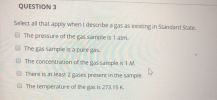 QUESTION 3 Select all that apply when I describe a gas as existing in Standard State. The pressure of the gas sample is 1 atm. The gas sample is a pure gas. The concentration of the gas sample is 1 M. There is at least 2 gases present in the sample. The temperature of the gas is 273.15 K.
Describe the use of existing sources as a sociological research method. What are its advantages? Give...
Describe the use of existing sources as a sociological research method. What are its advantages? Give an example from the Macionis textbook of using existing sources.
Compare CDA, CCD, CCR, describe each of them and who uses these standard for what purpose?
Compare CDA, CCD, CCR, describe each of them and who uses these standard for what purpose?
close some apps. Update now 1. What is sucralfate (Carafate) and what is it used for?...
 close some apps. Update now 1. What is sucralfate (Carafate) and what is it used for? Antacids are different than H2 receptor antagonists. Explain the effect that each has on gastric acid? 2. 3. Describe the differences between hyperosmotic laxatives and stimulant laxatives. 4. What are the long-term dangers of excessive calcium intake? ババババババ1MMMMMM ww、ハハハハハハ,豆、ハハハハ/、ハハハハハハハハハハバババババ( >ハハハハハハ
15. Find the standard deviation of the penny date data, and determine the z-score for the dates of 2012 and 2009. What is the significance of the sign of the z-score of each? Charles has a jar i...
 15. Find the standard deviation of the penny date data, and determine the z-score for the dates of 2012 and 2009. What is the significance of the sign of the z-score of each? Charles has a jar in which he places any pennies that he may obtain during his daily activities. His sister, Oluoma, takes a handful of pennies off the top and records the dates on the pennies: 2013, 23014s 2oos, 212, 2, 2013,2012,2013,.2011.2011, 2010,2003, 212. 2013, 2012, 2010....
1. What are 4 standard terms used to describe morphological characteristics of colonies growing on an...
1. What are 4 standard terms used to describe morphological characteristics of colonies growing on an agar plate? 2. Describe the T-streak method 3. Describe which inoculation tool is the most approproiate to use when transfering bacteria from an agar plate to a stab tube. 4. Why is a buffer added to agar? Explain your answer. 5. Look up a growth curve for bacteria growing on an agar plate. Describe why the lag phase occurs.
a) Differentiate between static and dynamic loading? Provide 02 examples for each. b) Describe the mechanism...
a) Differentiate between static and dynamic loading? Provide 02 examples for each. b) Describe the mechanism of crack propagation for both ductile and brittle modes of fracture. Please benchmark at least 05 different research papers where necking (ductile materials) and fracture (brittle materials) have been captured using a scanning electron microscope.
Describe what happens when 12M HCl is added to saturated NaCl solution
Describe what happens when 12M HCl is added to saturated NaCl solution
What could be added to a standard security survey to limit liability to the organization?
What could be added to a standard security survey to limit liability to the organization?
 QUESTION 3 Select all that apply when I describe a gas as existing in Standard State. The pressure of the gas sample is 1 atm. The gas sample is a pure gas. The concentration of the gas sample is 1 M. There is at least 2 gases present in the sample. The temperature of the gas is 273.15 K.
 close some apps. Update now 1. What is sucralfate (Carafate) and what is it used for? Antacids are different than H2 receptor antagonists. Explain the effect that each has on gastric acid? 2. 3. Describe the differences between hyperosmotic laxatives and stimulant laxatives. 4. What are the long-term dangers of excessive calcium intake? ババババババ1MMMMMM ww、ハハハハハハ,豆、ハハハハ/、ハハハハハハハハハハバババババ( >ハハハハハハ
 15. Find the standard deviation of the penny date data, and determine the z-score for the dates of 2012 and 2009. What is the significance of the sign of the z-score of each? Charles has a jar in which he places any pennies that he may obtain during his daily activities. His sister, Oluoma, takes a handful of pennies off the top and records the dates on the pennies: 2013, 23014s 2oos, 212, 2, 2013,2012,2013,.2011.2011, 2010,2003, 212. 2013, 2012, 2010....
Most questions answered within 3 hours.
-
Where is the error in this code sequence?
String s1 = "Hello";
String s2 = "ello";...
asked 10 months ago -
Financial data for Joel de Paris, Inc., for last year
follow:
Joel de Paris, Inc.
Balance...
asked 10 months ago -
Consider this reaction:
Al2(SO4)3 (aq)+ BaCl3
(aq) Al2Cl6 (aq)- +
3BaSO4(s) . What is the...
asked 10 months ago -
Suppose that Savneet is considering increasing her
recent random sample from 20 car rentals to 40...
asked 10 months ago -
Trucks arrive at an unloading terminal at an average rate of 120
per hour.
Trucks arrive...
asked 10 months ago -
Why are methanol and ethanol completely soluble in water while
octanol is not very little soluble....
asked 10 months ago -
A facilities manager at a university reads in a research report
that the mean amount of...
asked 10 months ago -
When the CuSO4 is rehydrated by adding water to the anhydrous
compound, is this an endothermic...
asked 10 months ago -
A ray of sunlight is passing from diamond into crown glass; the
angle of incidence is...
asked 10 months ago -
A block of mass 0.249 kg is placed on top of a light, vertical
spring of...
asked 10 months ago -
how do the kidneys compensate in the presences of acidosis
a) trigger hyperventilate
b) reserve acid...
asked 10 months ago -
Question 501 pts
The rental rate of capital to the firm increases. Which of the
following...
asked 10 months ago