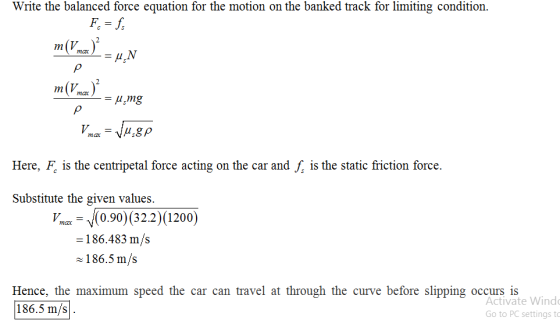
This is a dynamics problem and must be solved with Tangential and normal acceleration the final answer is 344.72 ft/seco...
This is a dynamics problem and must be solved with Tangential and normal acceleration the final answer is 344.72 ft/second. (A racecar travels on a banked track. The radius of curvature of the track is ρ = 1200 ft. The coefficient of static friction is
Homework Answers
Add Answer to:
This is a dynamics problem and must be solved with Tangential and normal acceleration the final answer is 344.72 ft/seco...
use tangential and normal acceleration to find the magnitude Problem 7: A vehicle travels along a...
 use tangential and normal acceleration to find the magnitude
Problem 7: A vehicle travels along a circular track as shown in the diagram with a constant speed of 14 m/s. Just at the point when the vehicle reaches point A it increases its speed according to the following expression, at Determine the magnitudes of the velocity and acceleration of the vehicle when it reaches point B Also, how much time will elapse as it travels from A to B? -(v/3...
use tangential and normal acceleration to find the magnitude
Problem 7: A vehicle travels along a circular track as shown in the diagram with a constant speed of 14 m/s. Just at the point when the vehicle reaches point A it increases its speed according to the following expression, at Determine the magnitudes of the velocity and acceleration of the vehicle when it reaches point B Also, how much time will elapse as it travels from A to B? -(v/3...
To calculate the normal and tangential components of the acceleration of an object along a given...
 To calculate the normal and tangential components of the
acceleration of an object along a given path.
A particle is traveling along the path y(x)=0.2x2y(x)=0.2x2, as
shown in (Figure 1), where yy is in meters when xx is in meters.
When xxx = 7 mm , the particle's velocity is vvv = 10 m/sm/s and
the magnitude of its acceleration is aaam = 4 m/s2m/s2 . Determine
the normal and tangential components of the acceleration.
Item 10 Learning Goal: To...
To calculate the normal and tangential components of the
acceleration of an object along a given path.
A particle is traveling along the path y(x)=0.2x2y(x)=0.2x2, as
shown in (Figure 1), where yy is in meters when xx is in meters.
When xxx = 7 mm , the particle's velocity is vvv = 10 m/sm/s and
the magnitude of its acceleration is aaam = 4 m/s2m/s2 . Determine
the normal and tangential components of the acceleration.
Item 10 Learning Goal: To...
Part A Learning Goal: To calculate the normal and tangential components of the acceleration of an...
 Part A Learning Goal: To calculate the normal and tangential components of the acceleration of an object along a given path. A particle is traveling along the path y(x) = 0.3x2, as shown in (Figure 1), where y is in meters when x is in meters. When 3 = 5 m, the particle's velocity is v = 15 m/s and the magnitude of its acceleration is a = 11 m/s2 Determine the normal and tangential components of the acceleration What...
. 1209%] This is a rigid body kinetic problem. You must solve this problem using the...
 . 1209%] This is a rigid body kinetic problem. You must solve this problem using the Newton's law in the speciied coordinate system. Consider a uniform ball of mass m and radius r rolling down a stationary s1. semi-circular surface of radius R > r. The ball is released from rest at an angle θ= θ。> O. Assume static friction coefficient μ Answer the following questions. (a) 8/20] Let the angle of rotation of the ball be φ and the...
Problem A car travels at a constant speed of 29.5 mi/h (13.2 m/s) on a level...
 Problem A car travels at a constant speed of 29.5 mi/h (13.2 m/s) on a level circular turn of radius 46.0 m, as shown in the bird's-eye view in Figure 7.13a. What minimum coefficient of static friction, Aus, between the tires and the roadway will allow the car to make the circular turn without sliding? Strategy In the car's free-body diagram (Fig. 7.13b) the normal direction is vertical and the tangential direction is into the page (step 2). Use Newton's...
009 (part 1 of 2) 10.0 points A civil engineer is asked to design a curved...
 009 (part 1 of 2) 10.0 points A civil engineer is asked to design a curved section of roadway that meets the following conditions: With ice on the road, when the coefficient of static friction between the road and rubber is 0.24, a car at rest must not slide into the ditch and a car traveling less than 70 km/h must not skid to the outside of the curve. The acceleration of gravity is 9.81 m/s2. At what angle should...
17312332 Consult Interactive Solution 21.51 to see how this problem can be solved The coil in...
 17312332 Consult Interactive Solution 21.51 to see how this problem can be solved The coil in the figure below contains 377 turns and has an area per turn of 3.00 x 10³ m2. The magnetic field is 0.24 T, and the current in the s pressed perpendicularly against the shaft to keep the colil from turning. The coefficient of static friction between the The radius of the shaft is o.013 m. What is the magnitude of the minimum normal force...
Example 7.7 Buckle Up for Safety Goal Calculate the frictional force that causes an object to...
 Example 7.7 Buckle Up for
Safety
Goal Calculate the frictional force that
causes an object to have a centripetal acceleration.
Problem A car travels at a constant speed of 31.5
mi/h (14.1 m/s) on a level circular turn of radius 55.0 m, as shown
in the bird's-eye view in Figure 7.13a. What minimum coefficient of
static friction, µs, between the tires and the
roadway will allow the car to make the circular turn without
sliding?
Strategy In the car's free-body...
Example 7.7 Buckle Up for
Safety
Goal Calculate the frictional force that
causes an object to have a centripetal acceleration.
Problem A car travels at a constant speed of 31.5
mi/h (14.1 m/s) on a level circular turn of radius 55.0 m, as shown
in the bird's-eye view in Figure 7.13a. What minimum coefficient of
static friction, µs, between the tires and the
roadway will allow the car to make the circular turn without
sliding?
Strategy In the car's free-body...
Problem 12.141 < 1 of 7 > Review A package is dropped from the plane which...
 Problem 12.141 < 1 of 7 > Review A package is dropped from the plane which is flying with a constant horizontal velocity of VA = 200 ft/s. Suppose that h = 1950 ft. (Figure 1) Part A Determine the normal component of acceleration at the moment the package is released at A, where it has a horizontal velocity of A = 200 ft/s. Express your answer to three significant figures and include the appropriate units. (an)A = 32.25 Submit...
Problem 5.08 Part A How large must the coefficient of static friction be between the tires...
 Problem 5.08 Part A How large must the coefficient of static friction be between the tires and the road if a car is to round a level curve of radius 110 m at a speed of 100 km/h? Express your answer using two significant figures.
 use tangential and normal acceleration to find the magnitude
Problem 7: A vehicle travels along a circular track as shown in the diagram with a constant speed of 14 m/s. Just at the point when the vehicle reaches point A it increases its speed according to the following expression, at Determine the magnitudes of the velocity and acceleration of the vehicle when it reaches point B Also, how much time will elapse as it travels from A to B? -(v/3...
use tangential and normal acceleration to find the magnitude
Problem 7: A vehicle travels along a circular track as shown in the diagram with a constant speed of 14 m/s. Just at the point when the vehicle reaches point A it increases its speed according to the following expression, at Determine the magnitudes of the velocity and acceleration of the vehicle when it reaches point B Also, how much time will elapse as it travels from A to B? -(v/3...
 To calculate the normal and tangential components of the
acceleration of an object along a given path.
A particle is traveling along the path y(x)=0.2x2y(x)=0.2x2, as
shown in (Figure 1), where yy is in meters when xx is in meters.
When xxx = 7 mm , the particle's velocity is vvv = 10 m/sm/s and
the magnitude of its acceleration is aaam = 4 m/s2m/s2 . Determine
the normal and tangential components of the acceleration.
Item 10 Learning Goal: To...
To calculate the normal and tangential components of the
acceleration of an object along a given path.
A particle is traveling along the path y(x)=0.2x2y(x)=0.2x2, as
shown in (Figure 1), where yy is in meters when xx is in meters.
When xxx = 7 mm , the particle's velocity is vvv = 10 m/sm/s and
the magnitude of its acceleration is aaam = 4 m/s2m/s2 . Determine
the normal and tangential components of the acceleration.
Item 10 Learning Goal: To...
 Part A Learning Goal: To calculate the normal and tangential components of the acceleration of an object along a given path. A particle is traveling along the path y(x) = 0.3x2, as shown in (Figure 1), where y is in meters when x is in meters. When 3 = 5 m, the particle's velocity is v = 15 m/s and the magnitude of its acceleration is a = 11 m/s2 Determine the normal and tangential components of the acceleration What...
 . 1209%] This is a rigid body kinetic problem. You must solve this problem using the Newton's law in the speciied coordinate system. Consider a uniform ball of mass m and radius r rolling down a stationary s1. semi-circular surface of radius R > r. The ball is released from rest at an angle θ= θ。> O. Assume static friction coefficient μ Answer the following questions. (a) 8/20] Let the angle of rotation of the ball be φ and the...
 Problem A car travels at a constant speed of 29.5 mi/h (13.2 m/s) on a level circular turn of radius 46.0 m, as shown in the bird's-eye view in Figure 7.13a. What minimum coefficient of static friction, Aus, between the tires and the roadway will allow the car to make the circular turn without sliding? Strategy In the car's free-body diagram (Fig. 7.13b) the normal direction is vertical and the tangential direction is into the page (step 2). Use Newton's...
 009 (part 1 of 2) 10.0 points A civil engineer is asked to design a curved section of roadway that meets the following conditions: With ice on the road, when the coefficient of static friction between the road and rubber is 0.24, a car at rest must not slide into the ditch and a car traveling less than 70 km/h must not skid to the outside of the curve. The acceleration of gravity is 9.81 m/s2. At what angle should...
 17312332 Consult Interactive Solution 21.51 to see how this problem can be solved The coil in the figure below contains 377 turns and has an area per turn of 3.00 x 10³ m2. The magnetic field is 0.24 T, and the current in the s pressed perpendicularly against the shaft to keep the colil from turning. The coefficient of static friction between the The radius of the shaft is o.013 m. What is the magnitude of the minimum normal force...
 Example 7.7 Buckle Up for
Safety
Goal Calculate the frictional force that
causes an object to have a centripetal acceleration.
Problem A car travels at a constant speed of 31.5
mi/h (14.1 m/s) on a level circular turn of radius 55.0 m, as shown
in the bird's-eye view in Figure 7.13a. What minimum coefficient of
static friction, µs, between the tires and the
roadway will allow the car to make the circular turn without
sliding?
Strategy In the car's free-body...
Example 7.7 Buckle Up for
Safety
Goal Calculate the frictional force that
causes an object to have a centripetal acceleration.
Problem A car travels at a constant speed of 31.5
mi/h (14.1 m/s) on a level circular turn of radius 55.0 m, as shown
in the bird's-eye view in Figure 7.13a. What minimum coefficient of
static friction, µs, between the tires and the
roadway will allow the car to make the circular turn without
sliding?
Strategy In the car's free-body...
 Problem 12.141 < 1 of 7 > Review A package is dropped from the plane which is flying with a constant horizontal velocity of VA = 200 ft/s. Suppose that h = 1950 ft. (Figure 1) Part A Determine the normal component of acceleration at the moment the package is released at A, where it has a horizontal velocity of A = 200 ft/s. Express your answer to three significant figures and include the appropriate units. (an)A = 32.25 Submit...
 Problem 5.08 Part A How large must the coefficient of static friction be between the tires and the road if a car is to round a level curve of radius 110 m at a speed of 100 km/h? Express your answer using two significant figures.
Most questions answered within 3 hours.
-
Where is the error in this code sequence?
String s1 = "Hello";
String s2 = "ello";...
asked 10 months ago -
Financial data for Joel de Paris, Inc., for last year
follow:
Joel de Paris, Inc.
Balance...
asked 10 months ago -
Consider this reaction:
Al2(SO4)3 (aq)+ BaCl3
(aq) Al2Cl6 (aq)- +
3BaSO4(s) . What is the...
asked 10 months ago -
Suppose that Savneet is considering increasing her
recent random sample from 20 car rentals to 40...
asked 10 months ago -
Trucks arrive at an unloading terminal at an average rate of 120
per hour.
Trucks arrive...
asked 10 months ago -
Why are methanol and ethanol completely soluble in water while
octanol is not very little soluble....
asked 10 months ago -
A facilities manager at a university reads in a research report
that the mean amount of...
asked 10 months ago -
When the CuSO4 is rehydrated by adding water to the anhydrous
compound, is this an endothermic...
asked 10 months ago -
A ray of sunlight is passing from diamond into crown glass; the
angle of incidence is...
asked 10 months ago -
A block of mass 0.249 kg is placed on top of a light, vertical
spring of...
asked 10 months ago -
how do the kidneys compensate in the presences of acidosis
a) trigger hyperventilate
b) reserve acid...
asked 10 months ago -
Question 501 pts
The rental rate of capital to the firm increases. Which of the
following...
asked 10 months ago