
![Figure 2. Pumping strategy for a standing rider (2) over to,to At] gives an tand auat- to Since isin ф1S €, the integral on t](http://img.homeworklib.com/images/b40650d8-7fc6-472d-8071-511c073987e1.png?x-oss-process=image/resize,w_560)
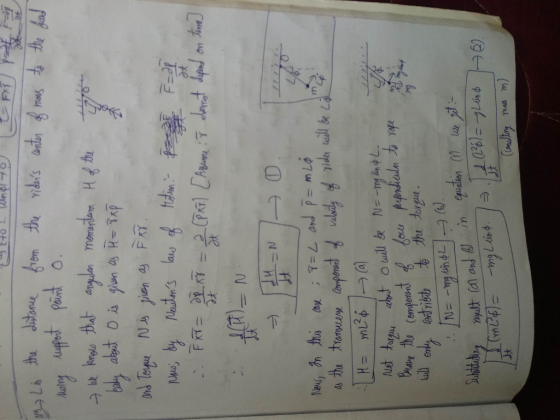
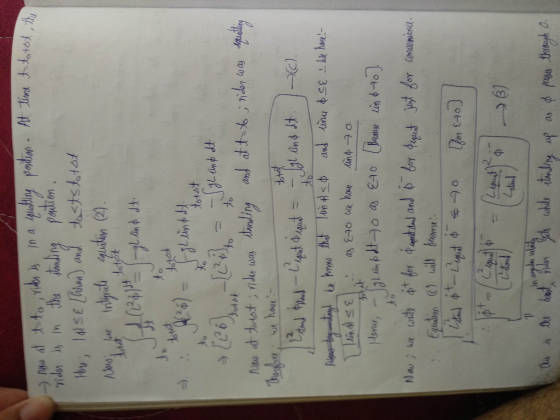
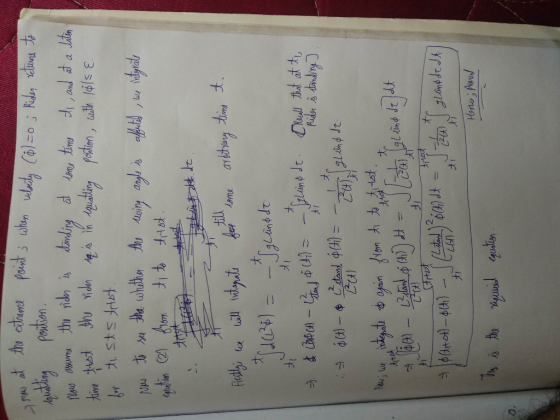
Figure 2. Pumping strategy for a standing rider (2) over to,to At] gives an tand auat- to Since isin ф1S €, the integral on the right-hand side is O(e), so as €-+0 we have To simplify the notation for the angular velocities just before and just after the de- crease in L caused by the rider's suddenly standing up, we write ф_ for aquat-d(to) and φ+ for atand d(to + Δt). Thus the rider's standing up as φ passes through 0 produces the following boost in the angular velocity -(논), What is the effect of the increase in L caused by returning to a squat when φ ~ 0 at the high points in the motion? Assume the rider is standing at some time fı, and a bit later at time t-+ Δt the rider is fully crouched, with Ιφ1S e for t1S t S t1 + Δ Then the values of ф before and after the rider returns to a crouch differ by no more than 2e. In the limit, therefore, ase → 0, returning to the squatting position produces no increase or decrease in the angular velocity, and hence in the kinetic energy, of the pendulum. To see whether the swing angle is affected, we integrate equation (2) from ti to some time tti At and obtain Dividing by L(t) and integrating again, this time from ti to ti + At, gives at- Lstand 268 THE COLLEGE MATHEMATICS JOURNAL This content dounloaded from 132.23627.111 on Tue, 07 Mar 2017 08:36:52 UTC All use subjoct to bpWabout jstoronglerms
Homework Answers
Add Answer to:
Please derive these equations and break them down into steps . thank you very muvj Pumping from a Standing Position...
Please all all parts with correct numbers and neatly show work. Thank you .) We consider...
 Please all all parts with correct numbers and neatly show
work. Thank you
.) We consider a mathematical pendulum with mass 2.6kg attached to s string of unknown length L suspended from a (very high) ng The graph shows the angular displacement 1with respect to the vertical ф- as a function of time t 03 0.2 03 t Is 02 a) What is the length of the pendulum? b) What are the mechanical energy and the maximum speed of the...
Please all all parts with correct numbers and neatly show
work. Thank you
.) We consider a mathematical pendulum with mass 2.6kg attached to s string of unknown length L suspended from a (very high) ng The graph shows the angular displacement 1with respect to the vertical ф- as a function of time t 03 0.2 03 t Is 02 a) What is the length of the pendulum? b) What are the mechanical energy and the maximum speed of the...
Lagrangian Mechanics: A pendulum of mass m and length l hangs from the rear view mirror...
Lagrangian Mechanics: A pendulum of mass m and length l hangs from the rear view mirror in a car traveling with horizontal acceleration a. Assume the car starts from rest at time t=0. (Solve using Lagrangian Mechanics.) a) Draw a diagram of the situation. Write out the x and y coordinates of the position of the pendulum in the in terms of the angle of the pendulum, Φ, and the time t. b) Write out T, U, and L in terms...
P4. A clock keeps time using the periodic motion of a simple pendulum. The pendulum consists...
 P4. A clock keeps time using the periodic motion of a simple pendulum. The pendulum consists of a string of length L and a bob of mass m-5.00 kg attached to the end of the string. The pendulum has a period T-1.00 s. The initial angle (0) at 0 is equal to 0.175 rad. The bob is released from rest (i.e. -0) at -0. The angle between the string and the vertical is given by the equation: e-a cos (or...
Use Reaction forces and Energy methods. Please show all working. Thank you very much. A pendulum...
 Use Reaction forces and Energy methods. Please show all working.
Thank you very much.
A pendulum consisting of a uniform rod and concentrated mass at its free end is pivoted to the inertial frame through a revolute joint. The rod has length L=1.2m and mass m=3 kg. The concentrated mass has magnitude M=5 kg. The system starts from rest with the rod making an angle 0=60° to the horizontal. A moment T=100 Nm acts on the rod. When the rod...
Use Reaction forces and Energy methods. Please show all working.
Thank you very much.
A pendulum consisting of a uniform rod and concentrated mass at its free end is pivoted to the inertial frame through a revolute joint. The rod has length L=1.2m and mass m=3 kg. The concentrated mass has magnitude M=5 kg. The system starts from rest with the rod making an angle 0=60° to the horizontal. A moment T=100 Nm acts on the rod. When the rod...
Part E : Find the magnitude of the angular acceleration. Please and thank you. The seesaw is pivoted in the middle,...
 Torque and Angular Acceleration Learning Goal: To understand and apply the formula τ= Iα to rigid objects rotating about a fixed axis. To find the acceleration a of a particle of mass m, we use Newton's second law. Fnet =ma, where Fnet is the net force acting on the particle. To find the angular acceleration a of a rigid object rotating about a fixed axis, we can use a similar formula: Tnet = Ia, where Tnet=∑T is the net torque acting on the object...
PLEASE ONLY SOLVE THE LAST WHICH ARE d and e FOR ME. THANKS! P4, A clock...
 PLEASE ONLY SOLVE THE LAST WHICH ARE d and e FOR ME.
THANKS!
P4, A clock keeps time using the periodic motion of a simple pendulum. The pendulum consists of a string of length L and a bob of mass m 5.00kg attached to the end of the string. The pendulum has a period T-1.00s. The initial angle o(o) at 0 is equal to 0.175 rad. The bob is released from rest (ie. do at 0.The angle O between the...
PLEASE ONLY SOLVE THE LAST WHICH ARE d and e FOR ME.
THANKS!
P4, A clock keeps time using the periodic motion of a simple pendulum. The pendulum consists of a string of length L and a bob of mass m 5.00kg attached to the end of the string. The pendulum has a period T-1.00s. The initial angle o(o) at 0 is equal to 0.175 rad. The bob is released from rest (ie. do at 0.The angle O between the...
Problem 2: The inverted pendulum, illustrated in Figure 1, is one of the most studied models...
 Problem 2: The inverted pendulum, illustrated in Figure 1, is one of the most studied models in dynamic and control courses given its simplicity despite its complex nonlinear behavior. It can be used to model tall buildings under seismic and wind motion, moving rockets, and satellites. The linearized (ie., approximated) equation of motion is given by: mg ml?.(t)- mgl.0(t) = T(t) where m, L, and g are constants representing the mass, length, and gravity: o denotes the angular position of...
please give me the answer to all of them thank you 8. -0 points My Notes...
 please give me the answer
to all of them
thank you
8. -0 points My Notes Ask Your Teacher A particle with a mass of 0.340 kg is attached to a horizontal spring with a force constant of 3.0ō N m At the moment t moving to the left. (Assume that the positive direction is to the right.) 0 the partice has s maximum speed of 75ms and s (a) Determine the particle's equation of motion, specifying its position as...
please give me the answer
to all of them
thank you
8. -0 points My Notes Ask Your Teacher A particle with a mass of 0.340 kg is attached to a horizontal spring with a force constant of 3.0ō N m At the moment t moving to the left. (Assume that the positive direction is to the right.) 0 the partice has s maximum speed of 75ms and s (a) Determine the particle's equation of motion, specifying its position as...
show all steps please (1 point) Suppose a pendulum with length L (meters) has angle 0...
 show all steps please
(1 point) Suppose a pendulum with length L (meters) has angle 0 (radians) from the vertical. It can be shown that 0 as a function of time satisfies the differential equation: d20 +sin0 0 dt2 where g 9.8 m/sec/sec is the acceleration due to gravity. For small values of 0 we can use the approximation sin(0)~0, and with that substitution, the differential equation becomes linear. A. Determine the equation of motion of a pendulum with length...
show all steps please
(1 point) Suppose a pendulum with length L (meters) has angle 0 (radians) from the vertical. It can be shown that 0 as a function of time satisfies the differential equation: d20 +sin0 0 dt2 where g 9.8 m/sec/sec is the acceleration due to gravity. For small values of 0 we can use the approximation sin(0)~0, and with that substitution, the differential equation becomes linear. A. Determine the equation of motion of a pendulum with length...
Please show all steps and provide any explanations through either text or definitions/equations. GENERAL HOOKE Somewhere...
 Please show all steps and provide any explanations through
either text or definitions/equations.
GENERAL HOOKE Somewhere DEEP BELOW THE EARTH's surface, at an UNKNOWN displacement from the Earth's center, a particle of mass m is dangled from a long string, length L; the particle oscillates along a small arc according to the differential equation dt -0 Here, 0 refers to an angular displacement measured from the vertical and t refers to time. The particle's mass is given by m =...
Please show all steps and provide any explanations through
either text or definitions/equations.
GENERAL HOOKE Somewhere DEEP BELOW THE EARTH's surface, at an UNKNOWN displacement from the Earth's center, a particle of mass m is dangled from a long string, length L; the particle oscillates along a small arc according to the differential equation dt -0 Here, 0 refers to an angular displacement measured from the vertical and t refers to time. The particle's mass is given by m =...
 Please all all parts with correct numbers and neatly show
work. Thank you
.) We consider a mathematical pendulum with mass 2.6kg attached to s string of unknown length L suspended from a (very high) ng The graph shows the angular displacement 1with respect to the vertical ф- as a function of time t 03 0.2 03 t Is 02 a) What is the length of the pendulum? b) What are the mechanical energy and the maximum speed of the...
Please all all parts with correct numbers and neatly show
work. Thank you
.) We consider a mathematical pendulum with mass 2.6kg attached to s string of unknown length L suspended from a (very high) ng The graph shows the angular displacement 1with respect to the vertical ф- as a function of time t 03 0.2 03 t Is 02 a) What is the length of the pendulum? b) What are the mechanical energy and the maximum speed of the...
 P4. A clock keeps time using the periodic motion of a simple pendulum. The pendulum consists of a string of length L and a bob of mass m-5.00 kg attached to the end of the string. The pendulum has a period T-1.00 s. The initial angle (0) at 0 is equal to 0.175 rad. The bob is released from rest (i.e. -0) at -0. The angle between the string and the vertical is given by the equation: e-a cos (or...
 Use Reaction forces and Energy methods. Please show all working.
Thank you very much.
A pendulum consisting of a uniform rod and concentrated mass at its free end is pivoted to the inertial frame through a revolute joint. The rod has length L=1.2m and mass m=3 kg. The concentrated mass has magnitude M=5 kg. The system starts from rest with the rod making an angle 0=60° to the horizontal. A moment T=100 Nm acts on the rod. When the rod...
Use Reaction forces and Energy methods. Please show all working.
Thank you very much.
A pendulum consisting of a uniform rod and concentrated mass at its free end is pivoted to the inertial frame through a revolute joint. The rod has length L=1.2m and mass m=3 kg. The concentrated mass has magnitude M=5 kg. The system starts from rest with the rod making an angle 0=60° to the horizontal. A moment T=100 Nm acts on the rod. When the rod...
 PLEASE ONLY SOLVE THE LAST WHICH ARE d and e FOR ME.
THANKS!
P4, A clock keeps time using the periodic motion of a simple pendulum. The pendulum consists of a string of length L and a bob of mass m 5.00kg attached to the end of the string. The pendulum has a period T-1.00s. The initial angle o(o) at 0 is equal to 0.175 rad. The bob is released from rest (ie. do at 0.The angle O between the...
PLEASE ONLY SOLVE THE LAST WHICH ARE d and e FOR ME.
THANKS!
P4, A clock keeps time using the periodic motion of a simple pendulum. The pendulum consists of a string of length L and a bob of mass m 5.00kg attached to the end of the string. The pendulum has a period T-1.00s. The initial angle o(o) at 0 is equal to 0.175 rad. The bob is released from rest (ie. do at 0.The angle O between the...
 Problem 2: The inverted pendulum, illustrated in Figure 1, is one of the most studied models in dynamic and control courses given its simplicity despite its complex nonlinear behavior. It can be used to model tall buildings under seismic and wind motion, moving rockets, and satellites. The linearized (ie., approximated) equation of motion is given by: mg ml?.(t)- mgl.0(t) = T(t) where m, L, and g are constants representing the mass, length, and gravity: o denotes the angular position of...
 please give me the answer
to all of them
thank you
8. -0 points My Notes Ask Your Teacher A particle with a mass of 0.340 kg is attached to a horizontal spring with a force constant of 3.0ō N m At the moment t moving to the left. (Assume that the positive direction is to the right.) 0 the partice has s maximum speed of 75ms and s (a) Determine the particle's equation of motion, specifying its position as...
please give me the answer
to all of them
thank you
8. -0 points My Notes Ask Your Teacher A particle with a mass of 0.340 kg is attached to a horizontal spring with a force constant of 3.0ō N m At the moment t moving to the left. (Assume that the positive direction is to the right.) 0 the partice has s maximum speed of 75ms and s (a) Determine the particle's equation of motion, specifying its position as...
 show all steps please
(1 point) Suppose a pendulum with length L (meters) has angle 0 (radians) from the vertical. It can be shown that 0 as a function of time satisfies the differential equation: d20 +sin0 0 dt2 where g 9.8 m/sec/sec is the acceleration due to gravity. For small values of 0 we can use the approximation sin(0)~0, and with that substitution, the differential equation becomes linear. A. Determine the equation of motion of a pendulum with length...
show all steps please
(1 point) Suppose a pendulum with length L (meters) has angle 0 (radians) from the vertical. It can be shown that 0 as a function of time satisfies the differential equation: d20 +sin0 0 dt2 where g 9.8 m/sec/sec is the acceleration due to gravity. For small values of 0 we can use the approximation sin(0)~0, and with that substitution, the differential equation becomes linear. A. Determine the equation of motion of a pendulum with length...
 Please show all steps and provide any explanations through
either text or definitions/equations.
GENERAL HOOKE Somewhere DEEP BELOW THE EARTH's surface, at an UNKNOWN displacement from the Earth's center, a particle of mass m is dangled from a long string, length L; the particle oscillates along a small arc according to the differential equation dt -0 Here, 0 refers to an angular displacement measured from the vertical and t refers to time. The particle's mass is given by m =...
Please show all steps and provide any explanations through
either text or definitions/equations.
GENERAL HOOKE Somewhere DEEP BELOW THE EARTH's surface, at an UNKNOWN displacement from the Earth's center, a particle of mass m is dangled from a long string, length L; the particle oscillates along a small arc according to the differential equation dt -0 Here, 0 refers to an angular displacement measured from the vertical and t refers to time. The particle's mass is given by m =...
Most questions answered within 3 hours.
-
Where is the error in this code sequence?
String s1 = "Hello";
String s2 = "ello";...
asked 11 months ago -
Financial data for Joel de Paris, Inc., for last year
follow:
Joel de Paris, Inc.
Balance...
asked 11 months ago -
Consider this reaction:
Al2(SO4)3 (aq)+ BaCl3
(aq) Al2Cl6 (aq)- +
3BaSO4(s) . What is the...
asked 11 months ago -
Suppose that Savneet is considering increasing her
recent random sample from 20 car rentals to 40...
asked 11 months ago -
Trucks arrive at an unloading terminal at an average rate of 120
per hour.
Trucks arrive...
asked 11 months ago -
Why are methanol and ethanol completely soluble in water while
octanol is not very little soluble....
asked 11 months ago -
A facilities manager at a university reads in a research report
that the mean amount of...
asked 11 months ago -
When the CuSO4 is rehydrated by adding water to the anhydrous
compound, is this an endothermic...
asked 11 months ago -
A ray of sunlight is passing from diamond into crown glass; the
angle of incidence is...
asked 11 months ago -
A block of mass 0.249 kg is placed on top of a light, vertical
spring of...
asked 11 months ago -
how do the kidneys compensate in the presences of acidosis
a) trigger hyperventilate
b) reserve acid...
asked 11 months ago -
Question 501 pts
The rental rate of capital to the firm increases. Which of the
following...
asked 11 months ago