1. Adaptive Bilateral Filter for Sharpness matlab codes 2. Adding Noise using Adaptive Bilateral Filter matlab codes 3....
1. Adaptive Bilateral Filter for Sharpness matlab codes
2. Adding Noise using Adaptive Bilateral Filter matlab codes
3. Removing the Noise using Adaptive Bilateral Filter matlab codes
Homework Answers
1)
function [ g_hat ] = fastABF( f,rho,sigma_r,theta,N,filtertype
)
%FASTABF Fast adaptive bilateral filter for grayscale images
%
% g_hat = fastABF(f,rho,sigma_r) filters the input image f using
the
% Gaussian spatial kernel parameter rho and pixelwise Gaussian
range kernel
% parameters sigma_r. The centering parameters theta are equal to f
by
% default.
%
% g_hat = fastABF(f,rho,sigma_r,theta) filters the input image f
using the
% Gaussian spatial kernel parameter rho, pixelwise Gaussian range
kernel
% parameters sigma_r, and pixelwise centering parameters theta (see
paper
% for details).
%
% g_hat = fastABF(f,rho,sigma_r,theta,N) performs the same
operation as
% above, with N being the degree of the polynomial (N=5 by
default).
% It is recommended to not set N greater than 6.
%
% g_hat = fastABF(f,rho,sigma_r,theta,N,filtertype) performs the
same
% operation as above with the spatial filter type specified by the
final
% argument, which can be either 'gaussian' (default) or 'box'. All
results
% in the paper are using the Gaussian spatial kernel. If filtertype
is
% 'box', then rho specifies the half-width of the box kernel
% (kernel length = 2*rho+1).
%
% Input arguments:
% f = m-by-n Input image (grayscale, double type)
% rho = Standard deviation of Gaussian spatial kernel
OR radius of box
% kernel
% sigma_r = m-by-n matrix of pixelwise standard
deviations of Gaussian
% range kernels (scale
[0,255])
% theta = m-by-n Centering image (double type)
% N = Degree of polynomial to fit
% filtertype = Spatial filter type, 'gaussian'
(default) or 'box'
% Output arguments:
% g_hat = Output image using the fast algorithm
if(~exist('theta','var') || isempty(theta))
theta = f;
end
if(~exist('N','var') || isempty(N))
N = 5;
end
if(~exist('filtertype','var') || isempty(filtertype))
filtertype = 'gaussian';
end
[rr,cc] = size(f);
f = f/255;
theta = theta/255;
sigma_r = sigma_r/255;
% Compute local histogram range
if(strcmp(filtertype,'gaussian'))
[Alpha,Beta] = MinMaxFilter(f,6*rho+1);
elseif(strcmp(filtertype,'box'))
[Alpha,Beta] = MinMaxFilter(f,2*rho+1);
else
error('Invalid filter type');
end
mask = (Alpha~=Beta); % Mask for pixels with
Alpha~=Beta
a = nan(rr,cc);
a(mask) = 1./(Beta(mask)-Alpha(mask));
% Compute polynomial coefficients at every pixel
C = fitPolynomial(f,rho,N,Alpha,Beta,filtertype);
% Pre-compute integrals at every pixel
zero = 1;
t0 = (theta(mask)-Alpha(mask))./(Beta(mask)-Alpha(mask));
lambda =
1./(2*sigma_r(mask).*sigma_r(mask).*a(mask).*a(mask));
I = compInt(N+1,lambda,t0);
% Compute numerator and denominator
Num = zeros(nnz(mask),1);
Den = Num;
for k = 0:N
Ck = C(:,zero+k);
Num = Num + Ck.*I{zero+k+1};
Den = Den + Ck.*I{zero+k};
end
% Undo shifting & scaling to get output (eq. 29 in
paper)
g_hat = nan(rr,cc);
g_hat(mask) = Alpha(mask) +
(Beta(mask)-Alpha(mask)).*Num./Den;
g_hat(~mask) = f(~mask);
g_hat = 255*g_hat;
end
Add Answer to:
1. Adaptive Bilateral Filter for Sharpness matlab codes 2. Adding Noise using Adaptive Bilateral Filter matlab codes 3....
Design a matlab code that: 1-play sound 2- add noise to the sound 3- filter the...
Design a matlab code that: 1-play sound 2- add noise to the sound 3- filter the noised signal using fir or iir filter Note: FIR: Finite impulse response filter IIR: Infinite impulse response filter Please make code simple. don't copy other from other codes.
Please write python codes to smooth an image by using median filter and Bilateral filter separately....
 Please write python codes to smooth an image by using median filter and Bilateral filter separately. You should give your codes, the input image and its outputs.
using Matlab: 1) Design an FIR notch filter using zero placement to remove power-line noise at...
using Matlab: 1) Design an FIR notch filter using zero placement to remove power-line noise at 60 Hz (use file ecg_60hz_200, fs = 200 Hz). 2) Design a LP Butterworth filter with cut-off frequency of 40 Hz to remove high-frequency noise (use file ecg_hfn.dat, fs = 1000 Hz). 3) Design an Elliptic HP filter with passband ripple of 0.01 dB and stopband attenuation of 50 dB and cut-off frequency of 0.5 Hz to remove low-frequency noise (use file ecg_lfn.dat, fs...
a=our signal b= noise (10kHz) c= a+b using MATLAB please design a FIR LPF filter that...
a=our signal b= noise (10kHz) c= a+b using MATLAB please design a FIR LPF filter that remove the 10 kHz noise signal from the signal c to obtain signal a. please write a clear description next to every command line. Thanks
I need help creating a Mean Filter for Matlab 3 by 3. ( I need the...
I need help creating a Mean Filter for Matlab 3 by 3. ( I need the Actual Matlab WORking code) It's dude tomorrow, final project worth 40% of my grade. It can not use Matlab Function, must be user define fuction. So far what I have is, I am not sure how to start this, I was told it requires 2 for loops A= imread('lena_256.tif'); % Reads the image in matrix M = ones(3,3)/9; % Creates a matrix of 3...
1. a. For music file of suitable format(.mp3,.dat etc.) add a random noise so that the SNR is 10dB with a Matlab pr...
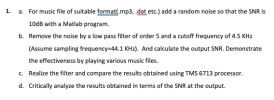 1. a. For music file of suitable format(.mp3,.dat etc.) add a random noise so that the SNR is 10dB with a Matlab program b. Remove the noise by a low pass filter of order 5 and a cutoff frequency of 4.5 KHz (Assume sampling frequency-44.1 KHz). And calculate the output SNR. Demonstrate the effectiveness by playing various music files Realize the filter and compare the results obtained using TMS 6713 processor c. d. Critically analyze the results obtained in terms...
remove noise entire noise from this image using matlab code & get the original image Problem...
 remove noise entire noise from this image using matlab code
& get the original image
Problem 4 (35 points) 1. Describe in details how would you detect and reduce the periodic noise in the input image shown (you should have received a copy of this image via email) and remove it to get an enhanced image. 2. Use MATLAB to show the results of your answer. Include in your submission your code and resulting image. Sinusoldal Nolse Sinusoidal Noise
Problem...
remove noise entire noise from this image using matlab code
& get the original image
Problem 4 (35 points) 1. Describe in details how would you detect and reduce the periodic noise in the input image shown (you should have received a copy of this image via email) and remove it to get an enhanced image. 2. Use MATLAB to show the results of your answer. Include in your submission your code and resulting image. Sinusoldal Nolse Sinusoidal Noise
Problem...
Using MATLAB, not R codes, I repeat, please, not in R, just MATLAB codes, write the complete code for: 1. Assume Y is an exponential random variable with rate parameter λ=2. (1) Generate 1000 samples...
Using MATLAB, not R codes, I repeat, please, not in R, just MATLAB codes, write the complete code for: 1. Assume Y is an exponential random variable with rate parameter λ=2. (1) Generate 1000 samples from this exponential distribution using inverse transform method (2) Compare the histogram of your samples with the true density of Y.
2) One application of Low-pass filter is noise reduction. However, it has adverse effect on the...
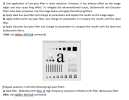 2) One application of Low-pass filter is noise reduction. However, it has adverse effect on the image edges and may cause Ring effect. To mitigate the aforementioned issues, Butterworth and Gaussian filters have been proposed. Use the image below and apply the following filters. a) Apply Ideal low-pass filter and change its parameters and explain the results on the image edges. b) Apply Butterworth low-pass filter and change its parameters to compare the results with the ideal filter. c) Apply...
1. The MATLAB program below uses running averaging to eliminate noise from a sinusoidal signal. %...
 1. The MATLAB program below uses running averaging to eliminate noise from a sinusoidal signal. % Recovering Signal from Noise rng(1234567) M 500; m-1:M; signal-sin(2 * pi * m / M); noise 2 rand(1, M)-1; subplot(2, 1, 1), plot(signal +noise) N 10; b [ones(1, N)l; a [1, zeros(1, N)l; y filter(b, a, noise)/N; subplot(2, 1, 2), plot(signal +y) (a) Change the rng number to the ID number of a student in your group. Enter and run the program. b) Repeat...
 Please write python codes to smooth an image by using median filter and Bilateral filter separately. You should give your codes, the input image and its outputs.
 1. a. For music file of suitable format(.mp3,.dat etc.) add a random noise so that the SNR is 10dB with a Matlab program b. Remove the noise by a low pass filter of order 5 and a cutoff frequency of 4.5 KHz (Assume sampling frequency-44.1 KHz). And calculate the output SNR. Demonstrate the effectiveness by playing various music files Realize the filter and compare the results obtained using TMS 6713 processor c. d. Critically analyze the results obtained in terms...
 remove noise entire noise from this image using matlab code
& get the original image
Problem 4 (35 points) 1. Describe in details how would you detect and reduce the periodic noise in the input image shown (you should have received a copy of this image via email) and remove it to get an enhanced image. 2. Use MATLAB to show the results of your answer. Include in your submission your code and resulting image. Sinusoldal Nolse Sinusoidal Noise
Problem...
remove noise entire noise from this image using matlab code
& get the original image
Problem 4 (35 points) 1. Describe in details how would you detect and reduce the periodic noise in the input image shown (you should have received a copy of this image via email) and remove it to get an enhanced image. 2. Use MATLAB to show the results of your answer. Include in your submission your code and resulting image. Sinusoldal Nolse Sinusoidal Noise
Problem...
 2) One application of Low-pass filter is noise reduction. However, it has adverse effect on the image edges and may cause Ring effect. To mitigate the aforementioned issues, Butterworth and Gaussian filters have been proposed. Use the image below and apply the following filters. a) Apply Ideal low-pass filter and change its parameters and explain the results on the image edges. b) Apply Butterworth low-pass filter and change its parameters to compare the results with the ideal filter. c) Apply...
 1. The MATLAB program below uses running averaging to eliminate noise from a sinusoidal signal. % Recovering Signal from Noise rng(1234567) M 500; m-1:M; signal-sin(2 * pi * m / M); noise 2 rand(1, M)-1; subplot(2, 1, 1), plot(signal +noise) N 10; b [ones(1, N)l; a [1, zeros(1, N)l; y filter(b, a, noise)/N; subplot(2, 1, 2), plot(signal +y) (a) Change the rng number to the ID number of a student in your group. Enter and run the program. b) Repeat...
Most questions answered within 3 hours.
-
Where is the error in this code sequence?
String s1 = "Hello";
String s2 = "ello";...
asked 10 months ago -
Financial data for Joel de Paris, Inc., for last year
follow:
Joel de Paris, Inc.
Balance...
asked 10 months ago -
Consider this reaction:
Al2(SO4)3 (aq)+ BaCl3
(aq) Al2Cl6 (aq)- +
3BaSO4(s) . What is the...
asked 10 months ago -
Suppose that Savneet is considering increasing her
recent random sample from 20 car rentals to 40...
asked 10 months ago -
Trucks arrive at an unloading terminal at an average rate of 120
per hour.
Trucks arrive...
asked 10 months ago -
Why are methanol and ethanol completely soluble in water while
octanol is not very little soluble....
asked 10 months ago -
A facilities manager at a university reads in a research report
that the mean amount of...
asked 10 months ago -
When the CuSO4 is rehydrated by adding water to the anhydrous
compound, is this an endothermic...
asked 10 months ago -
A ray of sunlight is passing from diamond into crown glass; the
angle of incidence is...
asked 10 months ago -
A block of mass 0.249 kg is placed on top of a light, vertical
spring of...
asked 10 months ago -
how do the kidneys compensate in the presences of acidosis
a) trigger hyperventilate
b) reserve acid...
asked 10 months ago -
Question 501 pts
The rental rate of capital to the firm increases. Which of the
following...
asked 10 months ago