
Homework Answers
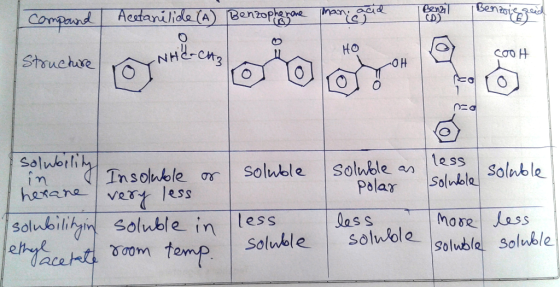
For table of Question 1 find the attached image file.
2. a) The component B is more polar if silica gel is the stationary phase.
Explanation:
Silica gel is polar structure due to presence of high amount of -OH group in its surface. When silica gel interact with polar component present in solvent system it reacts and bind strongly as a result the polar particle moves very slowly in the plate. On the other hand non polar component moves faster due less interaction so A is non polar than B.
b) False
Explanation:
If the solvent system made less polar then the polar component interact more with the polar stationary phase so it will move further in slow fashion. If we made the solvent system more polar then polar component interacts strongly with the solvent and elution will be fast in this case.
c) Rf value calculation
We now the formula of Rf is Distance travelled by solute/distance travelled by solvent.
It is unitless and maximum value is 1.
So Rf of A = (1.8 cm/ 2.6 cm) = 0.69
Rf of B = (0.8cm/ 2.6 cm) = 0.307
Add Answer to:
Pre Lab Questions 1. Complete the following table: Compound Acetanilide (A) Benzophenone (B) Mandelic acid (C) Benzi...
4. Consider the following silica gel TLC plac or compounds A, B, and hexines: developed in...
 4. Consider the following silica gel TLC plac or compounds A, B, and hexines: developed in Fo-o- og a) Determine the Rr values of compounds A, B, and C run on a silica gel TLC plate using hexanes as the solvent b) Which compound, A, B, or C. is the most polar? values if you used acetone instead c) What would you expect to happen to the of hexanes as the eluting solvent? 5) Consider a sample that is a...
TLC Consider the following silica gel TLC plate of compounds A, B, and developed in hexanes:...
 TLC Consider the following silica gel TLC plate of compounds A, B, and developed in hexanes: solvent front 0 D origin A B C 22. Determine the Ry values of compounds A, B, and Crun on a silica gel TLC plate using hexanes as the solvent. 23. Which compound, A, B, or C, is the most polar? 24. What would you expect to happen to the Ry values if you used acetone instead of hexanes as the eluting solvent? 25.TLC...
Post-Laboratory Questions Aspirin adnil tuleno Which compound turned out to be the most polar? The least polar? Do...
 Post-Laboratory Questions Aspirin adnil tuleno Which compound turned out to be the most polar? The least polar? Do experimental results agree with your theoretical predictions? If not, why? 2. What would a chromatogram look like if a less polar developing solvent were used 3. Consider the following TLC plate of compounds A, B, and C developed in hexanes: solvent front starting line a) Determine the R values of compounds A, B, and C run on a silica gel TLC plate...
Hi can someone help me with my pre lab theory questions (1,2,3) on rate of elution...
 Hi can someone help me with my pre lab theory questions (1,2,3)
on rate of elution or Rf? Here is some background below. Please
help explain as many as possible (1-3)! I dont really get the
relation ships in this lab, thank you!
1. What factors affect the rate of elution in organic compounds? 2. Explain what is the relationship between polarities of compounds (polar/non- polar compound) and rate of elution (Rf). 3. Explain what is the relationship between solvent...
Hi can someone help me with my pre lab theory questions (1,2,3)
on rate of elution or Rf? Here is some background below. Please
help explain as many as possible (1-3)! I dont really get the
relation ships in this lab, thank you!
1. What factors affect the rate of elution in organic compounds? 2. Explain what is the relationship between polarities of compounds (polar/non- polar compound) and rate of elution (Rf). 3. Explain what is the relationship between solvent...
Help with the chem question in the picture, 11-15. 230 C at 16 mmHg) at atmospheric...
 Help with the chem question in
the picture, 11-15.
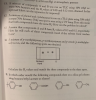
230 C at 16 mmHg) at atmospheric pressure 11. A mixture of compounds A and B was run on TLC using 10% ethyl ac- etate/90% hexanes, and the R, values of 0.05 and 0.12 were obtained. Is this optimal? How can the separation be improved? 12. A mixture ofphenol and cyclohexanol is run on a TLC plate using 30% ethyl sing a UV lamp. Does this mean acetate/70% hexanes. Only one...
Help with the chem question in
the picture, 11-15.
230 C at 16 mmHg) at atmospheric pressure 11. A mixture of compounds A and B was run on TLC using 10% ethyl ac- etate/90% hexanes, and the R, values of 0.05 and 0.12 were obtained. Is this optimal? How can the separation be improved? 12. A mixture ofphenol and cyclohexanol is run on a TLC plate using 30% ethyl sing a UV lamp. Does this mean acetate/70% hexanes. Only one...
2. A solution containing a mixture of naphthalene, benzoic acid, and benzaldehyde is analyzed via TLC...
 2. A solution containing a mixture of naphthalene, benzoic acid, and benzaldehyde is analyzed via TLC and GC. Use the structures and properties of the compounds to aid in answering the following questions. A. In the TLC experiment, the mixture is spotted on a silica TLC plate and eluted with a 1:1 mixture of hexanes and ethyl acetate. Three spots are observed on the plate, with Re values of 0.25, 0.58, and 0.74. Indicate which spot corresponds to which compound....
1. which of the following are not absorbent for TLC? a. magnesium silicate b. polyamides c....
1. which of the following are not absorbent for TLC? a. magnesium silicate b. polyamides c. silica gel-F ( fluorescing indicator added) d. starch e. alumina f. none of the above 2. select the best answer from the statements below about thin layer chromatography A. in normal phase thin layer chromatography the stationary phase is polar silica gel b. in normal phase thin layer chromatography the mobile phase is an organic solvent or a mixture of organic solvents Which is...
can you please answer all 1. When you run a TLC of the reaction in ethyl...
 can
you please answer all
1. When you run a TLC of the reaction in ethyl acetate : hexanes 1:1, the plate below is produced. Give a solvent system that would be expected to produce greater separation and a BRIEF (8 words) justification about your choice. (5 points) 7 6 5 4 3 b. Calculate the R for the bottom spot. (5 points) c. Which compound on the TLC plate is the most polar? (5 points) 2. Why is it...
can
you please answer all
1. When you run a TLC of the reaction in ethyl acetate : hexanes 1:1, the plate below is produced. Give a solvent system that would be expected to produce greater separation and a BRIEF (8 words) justification about your choice. (5 points) 7 6 5 4 3 b. Calculate the R for the bottom spot. (5 points) c. Which compound on the TLC plate is the most polar? (5 points) 2. Why is it...
Results: Distance of the solvent front in mm: 55 mm Compound acetanilide acetylsalicylic acid acetaminophen ibuprofen...
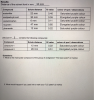 Results: Distance of the solvent front in mm: 55 mm Compound acetanilide acetylsalicylic acid acetaminophen ibuprofen phenacetin Solute distance R value colour of spot / observations Saturated purple colour 0.55 Elongated purple colour 22 mm 30 mm 6 mm 47 mm 12 mm 0.40 Saturated purple colour 0.85 Elongated purple colour Saturated purple colour 0.11 0.22 Unknown #-5 Compound compound 1 compound 2 contains the following compounds: Solute distance Rf value colour of spot / observations 0.22 Saturated purple colour...
1. What is the retention factor for the following TLC plate if the baseline is 1...
1. What is the retention factor for the following TLC plate if the baseline is 1 cm, elute solvent traveled 5cm, and the spot of interest traveled 2.5cm? a) 0.50 b) 1.6 c) 0.63 d) 1.4 10. Column chromatography employs both a stationary and a mobile phase. Which of the compounds listed below is commonly used as the stationary phase in column chromatography? a) decolonizing charcoal b) sodium bicarbonate c) benzoic acid d) silica gel
 4. Consider the following silica gel TLC plac or compounds A, B, and hexines: developed in Fo-o- og a) Determine the Rr values of compounds A, B, and C run on a silica gel TLC plate using hexanes as the solvent b) Which compound, A, B, or C. is the most polar? values if you used acetone instead c) What would you expect to happen to the of hexanes as the eluting solvent? 5) Consider a sample that is a...
 TLC Consider the following silica gel TLC plate of compounds A, B, and developed in hexanes: solvent front 0 D origin A B C 22. Determine the Ry values of compounds A, B, and Crun on a silica gel TLC plate using hexanes as the solvent. 23. Which compound, A, B, or C, is the most polar? 24. What would you expect to happen to the Ry values if you used acetone instead of hexanes as the eluting solvent? 25.TLC...
 Post-Laboratory Questions Aspirin adnil tuleno Which compound turned out to be the most polar? The least polar? Do experimental results agree with your theoretical predictions? If not, why? 2. What would a chromatogram look like if a less polar developing solvent were used 3. Consider the following TLC plate of compounds A, B, and C developed in hexanes: solvent front starting line a) Determine the R values of compounds A, B, and C run on a silica gel TLC plate...
 Hi can someone help me with my pre lab theory questions (1,2,3)
on rate of elution or Rf? Here is some background below. Please
help explain as many as possible (1-3)! I dont really get the
relation ships in this lab, thank you!
1. What factors affect the rate of elution in organic compounds? 2. Explain what is the relationship between polarities of compounds (polar/non- polar compound) and rate of elution (Rf). 3. Explain what is the relationship between solvent...
Hi can someone help me with my pre lab theory questions (1,2,3)
on rate of elution or Rf? Here is some background below. Please
help explain as many as possible (1-3)! I dont really get the
relation ships in this lab, thank you!
1. What factors affect the rate of elution in organic compounds? 2. Explain what is the relationship between polarities of compounds (polar/non- polar compound) and rate of elution (Rf). 3. Explain what is the relationship between solvent...
 Help with the chem question in
the picture, 11-15.
230 C at 16 mmHg) at atmospheric pressure 11. A mixture of compounds A and B was run on TLC using 10% ethyl ac- etate/90% hexanes, and the R, values of 0.05 and 0.12 were obtained. Is this optimal? How can the separation be improved? 12. A mixture ofphenol and cyclohexanol is run on a TLC plate using 30% ethyl sing a UV lamp. Does this mean acetate/70% hexanes. Only one...
Help with the chem question in
the picture, 11-15.
230 C at 16 mmHg) at atmospheric pressure 11. A mixture of compounds A and B was run on TLC using 10% ethyl ac- etate/90% hexanes, and the R, values of 0.05 and 0.12 were obtained. Is this optimal? How can the separation be improved? 12. A mixture ofphenol and cyclohexanol is run on a TLC plate using 30% ethyl sing a UV lamp. Does this mean acetate/70% hexanes. Only one...
 2. A solution containing a mixture of naphthalene, benzoic acid, and benzaldehyde is analyzed via TLC and GC. Use the structures and properties of the compounds to aid in answering the following questions. A. In the TLC experiment, the mixture is spotted on a silica TLC plate and eluted with a 1:1 mixture of hexanes and ethyl acetate. Three spots are observed on the plate, with Re values of 0.25, 0.58, and 0.74. Indicate which spot corresponds to which compound....
 can
you please answer all
1. When you run a TLC of the reaction in ethyl acetate : hexanes 1:1, the plate below is produced. Give a solvent system that would be expected to produce greater separation and a BRIEF (8 words) justification about your choice. (5 points) 7 6 5 4 3 b. Calculate the R for the bottom spot. (5 points) c. Which compound on the TLC plate is the most polar? (5 points) 2. Why is it...
can
you please answer all
1. When you run a TLC of the reaction in ethyl acetate : hexanes 1:1, the plate below is produced. Give a solvent system that would be expected to produce greater separation and a BRIEF (8 words) justification about your choice. (5 points) 7 6 5 4 3 b. Calculate the R for the bottom spot. (5 points) c. Which compound on the TLC plate is the most polar? (5 points) 2. Why is it...
 Results: Distance of the solvent front in mm: 55 mm Compound acetanilide acetylsalicylic acid acetaminophen ibuprofen phenacetin Solute distance R value colour of spot / observations Saturated purple colour 0.55 Elongated purple colour 22 mm 30 mm 6 mm 47 mm 12 mm 0.40 Saturated purple colour 0.85 Elongated purple colour Saturated purple colour 0.11 0.22 Unknown #-5 Compound compound 1 compound 2 contains the following compounds: Solute distance Rf value colour of spot / observations 0.22 Saturated purple colour...
Most questions answered within 3 hours.
-
Where is the error in this code sequence?
String s1 = "Hello";
String s2 = "ello";...
asked 10 months ago -
Financial data for Joel de Paris, Inc., for last year
follow:
Joel de Paris, Inc.
Balance...
asked 10 months ago -
Consider this reaction:
Al2(SO4)3 (aq)+ BaCl3
(aq) Al2Cl6 (aq)- +
3BaSO4(s) . What is the...
asked 10 months ago -
Suppose that Savneet is considering increasing her
recent random sample from 20 car rentals to 40...
asked 10 months ago -
Trucks arrive at an unloading terminal at an average rate of 120
per hour.
Trucks arrive...
asked 10 months ago -
Why are methanol and ethanol completely soluble in water while
octanol is not very little soluble....
asked 10 months ago -
A facilities manager at a university reads in a research report
that the mean amount of...
asked 10 months ago -
When the CuSO4 is rehydrated by adding water to the anhydrous
compound, is this an endothermic...
asked 10 months ago -
A ray of sunlight is passing from diamond into crown glass; the
angle of incidence is...
asked 10 months ago -
A block of mass 0.249 kg is placed on top of a light, vertical
spring of...
asked 10 months ago -
how do the kidneys compensate in the presences of acidosis
a) trigger hyperventilate
b) reserve acid...
asked 10 months ago -
Question 501 pts
The rental rate of capital to the firm increases. Which of the
following...
asked 10 months ago