
Homework Answers

Add Answer to:
Reaction of 3,4,5-trimethyl-4-hexen-1-yne with H2 and Pd/C will produce which of the following compounds? 3,4,5-trimeth...
Reaction of 3,4,5-trimethyl-4-hexen-1-yne with H2 and Pd/C will produce which of the following compounds? 3,4,5-trimeth...
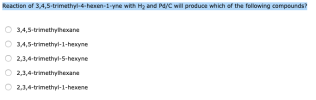 Reaction of 3,4,5-trimethyl-4-hexen-1-yne with H2 and Pd/C will produce which of the following compounds? 3,4,5-trimethylhexane 3,4,5-trimethyl-1-hexyne 2,3,4-trimethyl-5-hexyne 2,3,4-trimethylhexane 2,3,4-trimethyl-1-hexene OOO
What is the correct IUPAC name for the following compound? 4-allyl-5-bromo-1-hexyne O 3-(1-bromopropyl)-5-hexen-1-yne O 4-(1-bromopropyl)-1-hexen-5-yne O...
 What is the correct IUPAC name for the following compound? 4-allyl-5-bromo-1-hexyne O 3-(1-bromopropyl)-5-hexen-1-yne O 4-(1-bromopropyl)-1-hexen-5-yne O 5-bromo-4-ethynyl-1-heptene Submit Request Answer 810
Provide structures for the following: 4,4-dimethyl-2-pentyne 5,5-dimethylnon-3-yne 4,5,5-trimethyl-2-hexyne 1-penten-4-yne 1-cyclohexylethyne propyne 4-isopropyl-2-methyl-1-nonene 6-ethyl-3-nonyne
 Provide structures for the following: 4,4-dimethyl-2-pentyne 5,5-dimethylnon-3-yne 4,5,5-trimethyl-2-hexyne 1-penten-4-yne 1-cyclohexylethyne propyne 4-isopropyl-2-methyl-1-nonene 6-ethyl-3-nonyne
5. When (R)-4-bromohept-2-yne is treated with excess H2 in the presence of Pd/C, the product is...
 5. When (R)-4-bromohept-2-yne is treated with excess H2 in the presence of Pd/C, the product is optically inactive. When (R)-4-bromohex-2-yne is treated in the same conditions, the product is optically active. Explain this observation. 6. Finish the synthesis below. CICI CICI
/2 4. List the following compounds in increasing order of boiling point: oct-1-yne b. 3-ethyl-2-methylbutene c....
 /2 4. List the following compounds in increasing order of boiling point: oct-1-yne b. 3-ethyl-2-methylbutene c. 5,5-dichloropent-1-yne d. hex-2-yne a. 5. List the following compounds in increasing order of density: /2 b. hex-2-yne c. 1,4-dibromopent-1-yne d.1,4-dichloropent-2-yne a. water
7) Write the structures for the following compounds. Which of the compounds are unsaturated? a) 3,5,5-trimethylheptane...
 7) Write the structures for the following compounds. Which of the compounds are unsaturated? a) 3,5,5-trimethylheptane d) 3-ethyl-5-methyloctane CHsCH2CHCH2 CCH3 b) 4-phenyl-2-hexyne e) 3,4-dibromo-2-pentene 0) 3,4- dichforo- 4-methyl-1-pentene f) 2,3,4-tribromohexane
CH3CH2SCH2CH3 can be synthesized by an Sn2 reaction. Draw the structures of the alkyl chloride and...
 CH3CH2SCH2CH3 can be synthesized by an Sn2 reaction. Draw the structures of the alkyl chloride and nucleophile that will give this compound in highest yield. • Use the wedge/hash bond tools to indicate stereochemistry where it exists. • Include all valence lone pairs in your answer. • Separate multiple reactants using the + sign from the drop-down menu. • When a metal counterion is needed, use Na+, but draw it in its own sketcher. Visited Following are two diastereomers of...
2. Predict the product for the following transformations (show proper stereochemistry). Pd/C, H2 Me Me Pd/C,...
 2. Predict the product for the following transformations (show proper stereochemistry). Pd/C, H2 Me Me Pd/C, H2 Me Ph 4. Draw an abbreviated mechanism of the reaction shown below (you can symbolize the Pd/C as a surface, like the one drawn below) Hint. draw an intermediate similar to this: R H MeO H H2 (gas) R MeO metal surface metal surface Pd/C) (Pd/C)
need help with these. thank you in advanced 7) What is the IUPAC name for the...
 need help with these. thank you in advanced
7) What is the IUPAC name for the following compound? CHз CI 5 1 CH3-CH-C-CH= CH 5 CHз CHнз A) 3-chloro-1,3,4-trimethyl-1 - penterte B) 4-chloro-4,5-dimethyl-2-hexene C) 3-chloro-1,3,4,4- tetramethyl -1 -butene 3-chloro-2,3,5-trimethyl-4-pentene E) 3-chloro-2,3-dimethyl-4-hexene 13) Name the following compound. C CH CH,CH2CHCH, A) 3-methyl-4-pentyne 3-ethyl-1-butyne C) 2-ethynebutane D) 1-hexyne E) 3-methyl-1-pentyne 16) Name the following compound. CH3-CH2-C-CH3 A) 3-butenal B) 2-methylbutanone 2-methyl-2-ethylbutanone D) 2-butenal E 2-butanone 18) What is the IUPAC name of...
need help with these. thank you in advanced
7) What is the IUPAC name for the following compound? CHз CI 5 1 CH3-CH-C-CH= CH 5 CHз CHнз A) 3-chloro-1,3,4-trimethyl-1 - penterte B) 4-chloro-4,5-dimethyl-2-hexene C) 3-chloro-1,3,4,4- tetramethyl -1 -butene 3-chloro-2,3,5-trimethyl-4-pentene E) 3-chloro-2,3-dimethyl-4-hexene 13) Name the following compound. C CH CH,CH2CHCH, A) 3-methyl-4-pentyne 3-ethyl-1-butyne C) 2-ethynebutane D) 1-hexyne E) 3-methyl-1-pentyne 16) Name the following compound. CH3-CH2-C-CH3 A) 3-butenal B) 2-methylbutanone 2-methyl-2-ethylbutanone D) 2-butenal E 2-butanone 18) What is the IUPAC name of...
Following are two diastereomers of 3-bromo-3, 4-dimethylhexane. On treatment with sodium ethoxide in ethanol, each gives...
 Following are two diastereomers of 3-bromo-3, 4-dimethylhexane. On treatment with sodium ethoxide in ethanol, each gives 3, 4-dimethyl-3-hexene as the major product. One diastereomer gives the E alkene, and the other gives the Z alkene. Which diastereomer gives the E alkene? Following are two diastereomers of 3-bromo-2, 3, 4-trimethylhexane. On treatment with sodium ethoxide in ethanol, each gives 23, 4-trimethyl-3-hexene as the major product. One diastereomer gives the E alkene, and the other gives the Z alkene. Which diastereomer gives...
 Reaction of 3,4,5-trimethyl-4-hexen-1-yne with H2 and Pd/C will produce which of the following compounds? 3,4,5-trimethylhexane 3,4,5-trimethyl-1-hexyne 2,3,4-trimethyl-5-hexyne 2,3,4-trimethylhexane 2,3,4-trimethyl-1-hexene OOO
 What is the correct IUPAC name for the following compound? 4-allyl-5-bromo-1-hexyne O 3-(1-bromopropyl)-5-hexen-1-yne O 4-(1-bromopropyl)-1-hexen-5-yne O 5-bromo-4-ethynyl-1-heptene Submit Request Answer 810
 Provide structures for the following: 4,4-dimethyl-2-pentyne 5,5-dimethylnon-3-yne 4,5,5-trimethyl-2-hexyne 1-penten-4-yne 1-cyclohexylethyne propyne 4-isopropyl-2-methyl-1-nonene 6-ethyl-3-nonyne
 5. When (R)-4-bromohept-2-yne is treated with excess H2 in the presence of Pd/C, the product is optically inactive. When (R)-4-bromohex-2-yne is treated in the same conditions, the product is optically active. Explain this observation. 6. Finish the synthesis below. CICI CICI
 /2 4. List the following compounds in increasing order of boiling point: oct-1-yne b. 3-ethyl-2-methylbutene c. 5,5-dichloropent-1-yne d. hex-2-yne a. 5. List the following compounds in increasing order of density: /2 b. hex-2-yne c. 1,4-dibromopent-1-yne d.1,4-dichloropent-2-yne a. water
 7) Write the structures for the following compounds. Which of the compounds are unsaturated? a) 3,5,5-trimethylheptane d) 3-ethyl-5-methyloctane CHsCH2CHCH2 CCH3 b) 4-phenyl-2-hexyne e) 3,4-dibromo-2-pentene 0) 3,4- dichforo- 4-methyl-1-pentene f) 2,3,4-tribromohexane
 CH3CH2SCH2CH3 can be synthesized by an Sn2 reaction. Draw the structures of the alkyl chloride and nucleophile that will give this compound in highest yield. • Use the wedge/hash bond tools to indicate stereochemistry where it exists. • Include all valence lone pairs in your answer. • Separate multiple reactants using the + sign from the drop-down menu. • When a metal counterion is needed, use Na+, but draw it in its own sketcher. Visited Following are two diastereomers of...
 2. Predict the product for the following transformations (show proper stereochemistry). Pd/C, H2 Me Me Pd/C, H2 Me Ph 4. Draw an abbreviated mechanism of the reaction shown below (you can symbolize the Pd/C as a surface, like the one drawn below) Hint. draw an intermediate similar to this: R H MeO H H2 (gas) R MeO metal surface metal surface Pd/C) (Pd/C)
 need help with these. thank you in advanced
7) What is the IUPAC name for the following compound? CHз CI 5 1 CH3-CH-C-CH= CH 5 CHз CHнз A) 3-chloro-1,3,4-trimethyl-1 - penterte B) 4-chloro-4,5-dimethyl-2-hexene C) 3-chloro-1,3,4,4- tetramethyl -1 -butene 3-chloro-2,3,5-trimethyl-4-pentene E) 3-chloro-2,3-dimethyl-4-hexene 13) Name the following compound. C CH CH,CH2CHCH, A) 3-methyl-4-pentyne 3-ethyl-1-butyne C) 2-ethynebutane D) 1-hexyne E) 3-methyl-1-pentyne 16) Name the following compound. CH3-CH2-C-CH3 A) 3-butenal B) 2-methylbutanone 2-methyl-2-ethylbutanone D) 2-butenal E 2-butanone 18) What is the IUPAC name of...
need help with these. thank you in advanced
7) What is the IUPAC name for the following compound? CHз CI 5 1 CH3-CH-C-CH= CH 5 CHз CHнз A) 3-chloro-1,3,4-trimethyl-1 - penterte B) 4-chloro-4,5-dimethyl-2-hexene C) 3-chloro-1,3,4,4- tetramethyl -1 -butene 3-chloro-2,3,5-trimethyl-4-pentene E) 3-chloro-2,3-dimethyl-4-hexene 13) Name the following compound. C CH CH,CH2CHCH, A) 3-methyl-4-pentyne 3-ethyl-1-butyne C) 2-ethynebutane D) 1-hexyne E) 3-methyl-1-pentyne 16) Name the following compound. CH3-CH2-C-CH3 A) 3-butenal B) 2-methylbutanone 2-methyl-2-ethylbutanone D) 2-butenal E 2-butanone 18) What is the IUPAC name of...
 Following are two diastereomers of 3-bromo-3, 4-dimethylhexane. On treatment with sodium ethoxide in ethanol, each gives 3, 4-dimethyl-3-hexene as the major product. One diastereomer gives the E alkene, and the other gives the Z alkene. Which diastereomer gives the E alkene? Following are two diastereomers of 3-bromo-2, 3, 4-trimethylhexane. On treatment with sodium ethoxide in ethanol, each gives 23, 4-trimethyl-3-hexene as the major product. One diastereomer gives the E alkene, and the other gives the Z alkene. Which diastereomer gives...
Most questions answered within 3 hours.
-
Where is the error in this code sequence?
String s1 = "Hello";
String s2 = "ello";...
asked 11 months ago -
Financial data for Joel de Paris, Inc., for last year
follow:
Joel de Paris, Inc.
Balance...
asked 11 months ago -
Consider this reaction:
Al2(SO4)3 (aq)+ BaCl3
(aq) Al2Cl6 (aq)- +
3BaSO4(s) . What is the...
asked 11 months ago -
Suppose that Savneet is considering increasing her
recent random sample from 20 car rentals to 40...
asked 11 months ago -
Trucks arrive at an unloading terminal at an average rate of 120
per hour.
Trucks arrive...
asked 11 months ago -
Why are methanol and ethanol completely soluble in water while
octanol is not very little soluble....
asked 11 months ago -
A facilities manager at a university reads in a research report
that the mean amount of...
asked 11 months ago -
When the CuSO4 is rehydrated by adding water to the anhydrous
compound, is this an endothermic...
asked 11 months ago -
A ray of sunlight is passing from diamond into crown glass; the
angle of incidence is...
asked 11 months ago -
A block of mass 0.249 kg is placed on top of a light, vertical
spring of...
asked 11 months ago -
how do the kidneys compensate in the presences of acidosis
a) trigger hyperventilate
b) reserve acid...
asked 11 months ago -
Question 501 pts
The rental rate of capital to the firm increases. Which of the
following...
asked 11 months ago