C12H22O11(s) + 8 KClO3(s) -> 12 CO2(g) + 11 H2O(g) + 8 KCl(s) KClO3 = 122.6 g/mol sucrose = 342.3 g/mol CO2 = 44.01 g...
C12H22O11(s) + 8 KClO3(s) -> 12 CO2(g) + 11 H2O(g) + 8 KCl(s)
KClO3 = 122.6 g/mol
sucrose = 342.3 g/mol
CO2 = 44.01 g/mol
1 skittle = 0.84 grams of sucrose
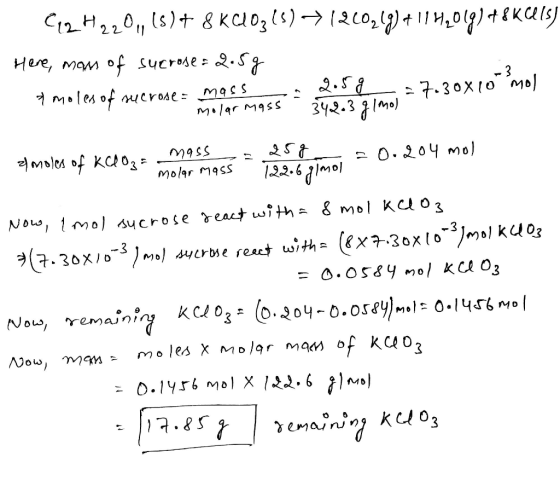
How many grams of reactant remain (excess) after 2.5 g sucrose and 25.0 g KClO3 react?
Homework Answers
Add Answer to:
C12H22O11(s) + 8 KClO3(s) -> 12 CO2(g) + 11 H2O(g) + 8 KCl(s) KClO3 = 122.6 g/mol sucrose = 342.3 g/mol CO2 = 44.01 g...
C12H22O11(s) + 8 KClO3(s) -----> 12 CO2(g) + 11 H2O(g) + 8 KCl(s) KClO3= 122.6 g/mol...
C12H22O11(s) + 8 KClO3(s) -----> 12 CO2(g) + 11 H2O(g) + 8 KCl(s) KClO3= 122.6 g/mol sucrose= 342.3 g/mol CO2= 44.01 g/mol 1 skittle= .84 grams of sucrose 1. If each skittle contains 0.84 g of sucrose (C12H22O11) What is the minimum number of skittles needed to maximize the product if I use 12.0g of KClO3? 2. How many grams of reactant remain (excess) after 2.5g of sucrose and 25.0g KClO3 react? 3. If 2.2 grams of CO2 are produced,...
C12H22O11(s) + 8 KClO3(s) -> 12 CO2(g) + 11 H2O(g) + 8 KCl(s) KClO3 = 122.6...
C12H22O11(s) + 8 KClO3(s) -> 12 CO2(g) + 11 H2O(g) + 8 KCl(s) KClO3 = 122.6 g/mol sucrose = 342.3 g/mol CO2 = 44.01 g/mol 1 skittle = 0.84 grams of sucrose ** 17.85 (g) remaining of KCLO3- reactant ** 5 skittles from sucrose If 2.2 grams of CO2 are produced, what is the percent yield?
C12H22O11(s) + 8 KClO3(s) -> 12 CO2(g) + 11 H2O(g) + 8 KCl(s) KClO3...
C12H22O11(s) + 8 KClO3(s) -> 12 CO2(g) + 11 H2O(g) + 8 KCl(s) KClO3 = 122.6 g/mol sucrose = 342.3 g/mol CO2 = 44.01 g/mol 1 skittle = 0.84 grams of sucrose 1. If each skittle contains 0.84 g of sucrose (C12H22O11) What is the minimum number of skittles needed to maximize the product (no KClO3 remaining) if I use 12.0 g of KClO3?
C12H22O11(s)+8KCLO3(s)=12CO2(g)+11H2O(g)+8KCL(8) 1. If each skittle contains 0.84 g of sucrose (C12H22O11) what is the m...
C12H22O11(s)+8KCLO3(s)=12CO2(g)+11H2O(g)+8KCL(8) 1. If each skittle contains 0.84 g of sucrose (C12H22O11) what is the maximum number of skittles needed to maximize the product (no KCLO3 remaining) if i use 12.0 g of KCLO3? 2. how many grams of reactants remains (excess) after 2.5 g sucrose and 25.0 g KCLO3 react? 3. if 2.2 gram of CO2 are produced what is the precent yield?
C12H22O11 + 8 KClO3 12 CO2 + 11H2O + 8 KCl How many grams of reactant...
C12H22O11 + 8 KClO3 12 CO2 + 11H2O + 8 KCl How many grams of reactant remain in excess after 3 grams of C12H22O11 and 18 grams of KClO3 react? Show all steps and work.
KClO3 + C12H22O11 = KCl + CO2 + H2O If 850.0 g of Potassium Chlorate is...
KClO3 + C12H22O11 = KCl + CO2 + H2O If 850.0 g of Potassium Chlorate is combined with 300.0g sucrose and they react as above, determine the mass of Potassium Chloride that forms
The nonvolatile, nonelectrolyte sucrose , C12H22O11 (342.3 g/mol), is soluble in water H2O. How many grams...
The nonvolatile, nonelectrolyte sucrose , C12H22O11 (342.3 g/mol), is soluble in water H2O. How many grams of sucrose are needed to generate an osmotic pressure of 3.56 atm when dissolved in 227 ml of a water solution at 298 K. grams sucrose
Consider the reaction C12H22O11 (s) + 12 O2 (g) → 12 CO2 (g) + 11 H2O...
Consider the reaction C12H22O11 (s) + 12 O2 (g) → 12 CO2 (g) + 11 H2O (l) in which 10.3 g of sucrose, C12H22O11, was burned in a bomb calorimeter with a heat capacity of 7.50 kJ/oC (including its water). The temperature inside the calorimeter was found to increase by 21.7 oC. Based on this information, what is the heat of this reaction per mole of sucrose? Enter your answer numerically, in terms of kJ/mol and to three significant figures.
A mixture containing KClO3, K2CO3, KHCO3, and KCl was heated, producing CO2,O2, and H2O gases according...
A mixture containing KClO3, K2CO3, KHCO3, and KCl was heated, producing CO2,O2, and H2O gases according to the following equations: 2KClO3(s)2KHCO3(s)K2CO3(s)→→→2KCl(s)+3O2(g)K2O(s)+H2O(g)+2CO2(g)K2O(s)+CO2(g) The KCl does not react under the conditions of the reaction. 100.0 g of the mixture produces 1.70 g of H2O, 12.66 g of CO2, and 4.00 g of O2. (Assume complete decomposition of the mixture.) You may want to reference (Page) Section 3.7 while completing this problem. a. How many grams of KClO3 were in the original mixture?...
Sucrose (table sugar, C12H22O11) can be oxidized to CO2 and H2O, and the enthalpy change for...
Sucrose (table sugar, C12H22O11) can be oxidized to CO2 and H2O, and the enthalpy change for the reaction can be measured. C12H22O11(s) + 12 O2(g) → 12 CO2(g) + 11 H2O(ℓ) ΔHrxn° = -5645 kJ/mol-rxn What is the enthalpy change when 7.00 g of sugar is burned under conditions of constant pressure? kJ
Most questions answered within 3 hours.
-
Where is the error in this code sequence?
String s1 = "Hello";
String s2 = "ello";...
asked 11 months ago -
Financial data for Joel de Paris, Inc., for last year
follow:
Joel de Paris, Inc.
Balance...
asked 11 months ago -
Consider this reaction:
Al2(SO4)3 (aq)+ BaCl3
(aq) Al2Cl6 (aq)- +
3BaSO4(s) . What is the...
asked 11 months ago -
Suppose that Savneet is considering increasing her
recent random sample from 20 car rentals to 40...
asked 11 months ago -
Trucks arrive at an unloading terminal at an average rate of 120
per hour.
Trucks arrive...
asked 11 months ago -
Why are methanol and ethanol completely soluble in water while
octanol is not very little soluble....
asked 11 months ago -
A facilities manager at a university reads in a research report
that the mean amount of...
asked 11 months ago -
When the CuSO4 is rehydrated by adding water to the anhydrous
compound, is this an endothermic...
asked 11 months ago -
A ray of sunlight is passing from diamond into crown glass; the
angle of incidence is...
asked 11 months ago -
A block of mass 0.249 kg is placed on top of a light, vertical
spring of...
asked 11 months ago -
how do the kidneys compensate in the presences of acidosis
a) trigger hyperventilate
b) reserve acid...
asked 11 months ago -
Question 501 pts
The rental rate of capital to the firm increases. Which of the
following...
asked 11 months ago