
Homework Answers
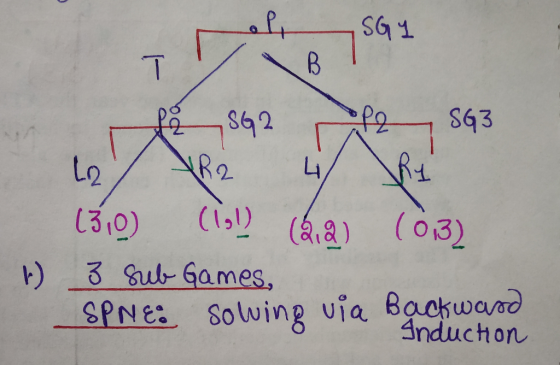

4) with simultaneous game, player 2 has only two actions L & R
Since P2 is indifferent between two nodes, so no distinction between strategies L 1 & L2, R1 & R2
Since both players have dominant strategies, so no mixed strategy NE exists
Add Answer to:
Consider the following extensive form game P1 RP:2 L2 R2 L1 R1 (2,2) (0,3) 1. How many sub-games are there in this game...
Consider the following extensive-form game with two players, 1 and 2. a). Find the pure-strategy Nash...
 Consider the following extensive-form game with two players, 1
and 2.
a). Find the pure-strategy Nash equilibria of the game. [8
Marks]
b). Find the pure-strategy subgame-perfect equilibria of the
game. [6 Marks]
c). Derive the mixed strategy Nash equilibrium of the subgame.
If players play this mixed Nash equilibrium in the subgame, would 1
player In or Out at the initial mode? [6 Marks]
[Hint: Write down the normal-form of the subgame and derive the
mixed Nash equilibrium of...
Consider the following extensive-form game with two players, 1
and 2.
a). Find the pure-strategy Nash equilibria of the game. [8
Marks]
b). Find the pure-strategy subgame-perfect equilibria of the
game. [6 Marks]
c). Derive the mixed strategy Nash equilibrium of the subgame.
If players play this mixed Nash equilibrium in the subgame, would 1
player In or Out at the initial mode? [6 Marks]
[Hint: Write down the normal-form of the subgame and derive the
mixed Nash equilibrium of...
1. Consider the following extensive form game with perfect information: 2 In 0 (a) (Level A)...
 1. Consider the following extensive form game with perfect information: 2 In 0 (a) (Level A) Write down the normal form associated with this extensive formm game (b) (Level A) First suppose = 0. Find a subgame perfect equilibrium for this game. (c) (Level B) Again suppose α-0. Find a pure strategy Nash equilibrium of this extensive form game that is not subgame perfect. (d) (Level B) Now suppose α = 3. Find all pure strategy subgame perfect equi- libria....
3. General Extensive Form Game D Suppose the following general extensive form game 1/2 1/2 (2,...
 3. General Extensive Form Game D Suppose the following general extensive form game 1/2 1/2 (2, 2) (2, 2) (0, 6) (6, 0 (0,0 (6, 4) (a) Represent this game in normal form by using a matrix, and find all pure strategy Bayesian Nash equilibrium (equilibria) b) Find pure strategy subgame perfect equilibrium (or equilibria) of this game. c) Find pure strategy perfect Bayesian equilibrium (or equilibria) of this game.
1. Consider the following extensive form game with perfect information 1 Out 2 2 In 3...
 1. Consider the following extensive form game with perfect information 1 Out 2 2 In 3 3 a) (Level A) Write down the normal form associated with this extensive form game (b) (Level A) First suppose -0. Find a subgame perfect equilibrium for this game (c) (Level B) Again suppose α-0. Find a pure strategy ash equilibrium of this extensive form game that is not subgame perfect (d) (Level B) Now suppose a-3. Find all pure strategy subgame perfect equi-...
4. (General Extensive Form Game ID Suppose the following general extensive-form game. Player 1 Player 2...
 4. (General Extensive Form Game ID Suppose the following general extensive-form game. Player 1 Player 2 (0, 4) (4,0 (4, 0) (0, 4) (a) Represent this game in normal form by using a matrix, and find all pure strategy (Bayesian Nash equilibrium (equilibria) b) Does a pure strategy perfect Bayesian equilibrium exist? If so, show it (or them). If not, prove it.
3. The extensive form of a 2-person game is as follows: 1/ 2 020210 0 0-25-210...
 3. The extensive form of a 2-person game is as follows: 1/ 2 020210 0 0-25-210 (a) What are the pure strategy sets for players I and II. (b) Derive the normal (strategic) form of the game? (c) Find the Nash Equilibrium(a) of the game (d) Is there any sub-game non-perfect equilibrium? Explain.
Problem 1. Consider the following extensive form game. 2 > 2,3 4,1 3,2 1.2 (a) By...
 Problem 1. Consider the following extensive form game. 2 > 2,3 4,1 3,2 1.2 (a) By converting the game into normal form game (by finding the corre- sponding bimatrix game), find all Nash equilibrium in pure strategies. (b) Does player 2 have a strictly dominated strategy?
1. Consider the following normal form game: 112 L CR T 10 102 12 0 13...
 1. Consider the following normal form game: 112 L CR T 10 102 12 0 13 M 12 25 5 0 0 B|13 010 011 a) (Level A) First suppose this game is played only once. What are the pure strategy Nash equilibria? (b) (Level B) Now suppose this game is played twice. Players observe the actions chosen in the first period prior to the second period. Each player's total payoff is the sum of his/her payoff in the two...
Consider the following game. -2,-1 -2,2 8,8 Let a be the probability that P1 plays A...
 Consider the following game. -2,-1 -2,2 8,8 Let a be the probability that P1 plays A (and 1-a be the probability they play B). Let 3 be the probability that P2 plays C (and 1- B be the probability that P2 plays D). Solve for the Mixed Strategy Nash equilibria of this game. Input your answer as a number to two decimal places, for example O.XX. What is the equilibrium value of B?
1. Consider the following normal form game 112 L CR T|10 1012 1210 13 M 12...
 1. Consider the following normal form game 112 L CR T|10 1012 1210 13 M 12 25 5 0 (0 B113 0100 (a) (Level A) First suppose this game is played only once. What are the pure strategy Nash equilibria? (b) (Level B) Now suppose this game is played twice. Players observe the actions chosen in the first period prior to the second period. Each player's total payoff is the sum of his/her payoff in the two periods. Consider the...
 Consider the following extensive-form game with two players, 1
and 2.
a). Find the pure-strategy Nash equilibria of the game. [8
Marks]
b). Find the pure-strategy subgame-perfect equilibria of the
game. [6 Marks]
c). Derive the mixed strategy Nash equilibrium of the subgame.
If players play this mixed Nash equilibrium in the subgame, would 1
player In or Out at the initial mode? [6 Marks]
[Hint: Write down the normal-form of the subgame and derive the
mixed Nash equilibrium of...
Consider the following extensive-form game with two players, 1
and 2.
a). Find the pure-strategy Nash equilibria of the game. [8
Marks]
b). Find the pure-strategy subgame-perfect equilibria of the
game. [6 Marks]
c). Derive the mixed strategy Nash equilibrium of the subgame.
If players play this mixed Nash equilibrium in the subgame, would 1
player In or Out at the initial mode? [6 Marks]
[Hint: Write down the normal-form of the subgame and derive the
mixed Nash equilibrium of...
 1. Consider the following extensive form game with perfect information: 2 In 0 (a) (Level A) Write down the normal form associated with this extensive formm game (b) (Level A) First suppose = 0. Find a subgame perfect equilibrium for this game. (c) (Level B) Again suppose α-0. Find a pure strategy Nash equilibrium of this extensive form game that is not subgame perfect. (d) (Level B) Now suppose α = 3. Find all pure strategy subgame perfect equi- libria....
 3. General Extensive Form Game D Suppose the following general extensive form game 1/2 1/2 (2, 2) (2, 2) (0, 6) (6, 0 (0,0 (6, 4) (a) Represent this game in normal form by using a matrix, and find all pure strategy Bayesian Nash equilibrium (equilibria) b) Find pure strategy subgame perfect equilibrium (or equilibria) of this game. c) Find pure strategy perfect Bayesian equilibrium (or equilibria) of this game.
 1. Consider the following extensive form game with perfect information 1 Out 2 2 In 3 3 a) (Level A) Write down the normal form associated with this extensive form game (b) (Level A) First suppose -0. Find a subgame perfect equilibrium for this game (c) (Level B) Again suppose α-0. Find a pure strategy ash equilibrium of this extensive form game that is not subgame perfect (d) (Level B) Now suppose a-3. Find all pure strategy subgame perfect equi-...
 4. (General Extensive Form Game ID Suppose the following general extensive-form game. Player 1 Player 2 (0, 4) (4,0 (4, 0) (0, 4) (a) Represent this game in normal form by using a matrix, and find all pure strategy (Bayesian Nash equilibrium (equilibria) b) Does a pure strategy perfect Bayesian equilibrium exist? If so, show it (or them). If not, prove it.
 3. The extensive form of a 2-person game is as follows: 1/ 2 020210 0 0-25-210 (a) What are the pure strategy sets for players I and II. (b) Derive the normal (strategic) form of the game? (c) Find the Nash Equilibrium(a) of the game (d) Is there any sub-game non-perfect equilibrium? Explain.
 Problem 1. Consider the following extensive form game. 2 > 2,3 4,1 3,2 1.2 (a) By converting the game into normal form game (by finding the corre- sponding bimatrix game), find all Nash equilibrium in pure strategies. (b) Does player 2 have a strictly dominated strategy?
 1. Consider the following normal form game: 112 L CR T 10 102 12 0 13 M 12 25 5 0 0 B|13 010 011 a) (Level A) First suppose this game is played only once. What are the pure strategy Nash equilibria? (b) (Level B) Now suppose this game is played twice. Players observe the actions chosen in the first period prior to the second period. Each player's total payoff is the sum of his/her payoff in the two...
 Consider the following game. -2,-1 -2,2 8,8 Let a be the probability that P1 plays A (and 1-a be the probability they play B). Let 3 be the probability that P2 plays C (and 1- B be the probability that P2 plays D). Solve for the Mixed Strategy Nash equilibria of this game. Input your answer as a number to two decimal places, for example O.XX. What is the equilibrium value of B?
 1. Consider the following normal form game 112 L CR T|10 1012 1210 13 M 12 25 5 0 (0 B113 0100 (a) (Level A) First suppose this game is played only once. What are the pure strategy Nash equilibria? (b) (Level B) Now suppose this game is played twice. Players observe the actions chosen in the first period prior to the second period. Each player's total payoff is the sum of his/her payoff in the two periods. Consider the...
Most questions answered within 3 hours.
-
Where is the error in this code sequence?
String s1 = "Hello";
String s2 = "ello";...
asked 11 months ago -
Financial data for Joel de Paris, Inc., for last year
follow:
Joel de Paris, Inc.
Balance...
asked 11 months ago -
Consider this reaction:
Al2(SO4)3 (aq)+ BaCl3
(aq) Al2Cl6 (aq)- +
3BaSO4(s) . What is the...
asked 11 months ago -
Suppose that Savneet is considering increasing her
recent random sample from 20 car rentals to 40...
asked 11 months ago -
Trucks arrive at an unloading terminal at an average rate of 120
per hour.
Trucks arrive...
asked 11 months ago -
Why are methanol and ethanol completely soluble in water while
octanol is not very little soluble....
asked 11 months ago -
A facilities manager at a university reads in a research report
that the mean amount of...
asked 11 months ago -
When the CuSO4 is rehydrated by adding water to the anhydrous
compound, is this an endothermic...
asked 11 months ago -
A ray of sunlight is passing from diamond into crown glass; the
angle of incidence is...
asked 11 months ago -
A block of mass 0.249 kg is placed on top of a light, vertical
spring of...
asked 11 months ago -
how do the kidneys compensate in the presences of acidosis
a) trigger hyperventilate
b) reserve acid...
asked 11 months ago -
Question 501 pts
The rental rate of capital to the firm increases. Which of the
following...
asked 11 months ago