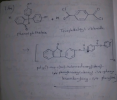
Write the mechanism for the reaction of terephthaloyl chloride with hydroquinone to form polyster?
Write the mechanism for the reaction of terephthaloyl chloride with hydroquinone to form polyster?
Homework Answers
 a
a
Add Answer to:
Write the mechanism for the reaction of terephthaloyl chloride with hydroquinone to form polyster?
What is the theoretical yield of the below reaction: Theoretical Yield: Hydroquinone Terephthaloyl Polymer Product Chlo...
 What is the theoretical yield of the below reaction:
Theoretical Yield: Hydroquinone Terephthaloyl Polymer Product Chloride C14H9O Molecular C$HO2 CsH4O2Cl2 Formula 203.02 g/mol 110.11 g/mol 327.39 g/mol Molecular Weight Quantity 1.01 g 1.59g
What is the theoretical yield of the below reaction:
Theoretical Yield: Hydroquinone Terephthaloyl Polymer Product Chloride C14H9O Molecular C$HO2 CsH4O2Cl2 Formula 203.02 g/mol 110.11 g/mol 327.39 g/mol Molecular Weight Quantity 1.01 g 1.59g
What features should I expect to see in a FTIR spectra of the polyester of Hydroquinone...
 What features should I expect to see in a FTIR spectra of the
polyester of Hydroquinone and Terephthaloyl Chloride?
I have included an image of the spectra as a prompt.
Thanks in advance! :)
FTIR Absorbance Spectra Procedure 3 Absorbance 500 1000 1500 2000 2500 3000 3500 4000 4500 Wavenumber (cm-1)
What features should I expect to see in a FTIR spectra of the
polyester of Hydroquinone and Terephthaloyl Chloride?
I have included an image of the spectra as a prompt.
Thanks in advance! :)
FTIR Absorbance Spectra Procedure 3 Absorbance 500 1000 1500 2000 2500 3000 3500 4000 4500 Wavenumber (cm-1)
n-butyl chloride, sec-butyl chloride, tert_butyl chloride. SN1 reaction Write the mechanism of the reactions with the...
 n-butyl chloride, sec-butyl chloride, tert_butyl chloride.
SN1
reaction
Write the mechanism of the reactions with the actual substrates (one for the primary, one for the secondary etc.)
n-butyl chloride, sec-butyl chloride, tert_butyl chloride.
SN1
reaction
Write the mechanism of the reactions with the actual substrates (one for the primary, one for the secondary etc.)
Write a reaction mechanism for the formation of butylmagnesium chloride and its subsequent reaction with butanal,...
Write a reaction mechanism for the formation of butylmagnesium chloride and its subsequent reaction with butanal, CH3CH2CH2CHO
Please write out full reaction mechanism: Iron (II) chloride tetrahydrate and iron (III) chloride hexahydrate will...
Please write out full reaction mechanism: Iron (II) chloride tetrahydrate and iron (III) chloride hexahydrate will be dissolved in deionized (DI) water to form a homogeneous solution. The solution will then be heated in a water bath at 65°C for 15-20 minutes; followed by the addition of 25% sodium hydroxide. Please write full chemical formula (step by step + explanation) so that I can understand. Please write legibly if handwritten. Thank you so much!
Draw the trimer that forms when 1 4-phenylenediamine reacts with terephthaloyl chloride.
Draw the trimer that forms when 1 4-phenylenediamine reacts with terephthaloyl chloride.
write an equation for the reaction of sodium oxide with potassium chloride to form sodium chloride...
write an equation for the reaction of sodium oxide with potassium chloride to form sodium chloride and potassium oxide. balance the equation.
Show how to determine the theoretical yield of 3.18g of Phenolphthalein combined with 2.03g of terephthaloyl...
 Show how to determine the theoretical yield of 3.18g of
Phenolphthalein combined with 2.03g of terephthaloyl chloride to
form a polyester via the following equation (2 molecules of HCl are
also made in the reaction):
cl Terephtaloyl chloride Phenolphthalein poly (3-oxo-1 (3H)- Isobenzoluranylidene) 14-phenylenexy carbonyl-1,4-phenya lenecarbonyloxy - 1,4 phenylene
Show how to determine the theoretical yield of 3.18g of
Phenolphthalein combined with 2.03g of terephthaloyl chloride to
form a polyester via the following equation (2 molecules of HCl are
also made in the reaction):
cl Terephtaloyl chloride Phenolphthalein poly (3-oxo-1 (3H)- Isobenzoluranylidene) 14-phenylenexy carbonyl-1,4-phenya lenecarbonyloxy - 1,4 phenylene
please explain E. Triterpene 32. The reaction of terephthaloyl chloride with ethylene glycol, shown, forms a...
 please explain
E. Triterpene 32. The reaction of terephthaloyl chloride with ethylene glycol, shown, forms a 35. Reduction of D-xylose (shown) with sodium borohydride yields a product that is CHO H OH NaBHA HH HOH CH2OH HOOH H20 CI A. polyester B. polyamide C. polyether D. polycarbonate E polyurethane A. a racemic mixture B. a single pure enantiomer C. an equal mixture of two diastereomers D. an unequal mixture of two diastereomers E. a meso compound 33. Which of the...
please explain
E. Triterpene 32. The reaction of terephthaloyl chloride with ethylene glycol, shown, forms a 35. Reduction of D-xylose (shown) with sodium borohydride yields a product that is CHO H OH NaBHA HH HOH CH2OH HOOH H20 CI A. polyester B. polyamide C. polyether D. polycarbonate E polyurethane A. a racemic mixture B. a single pure enantiomer C. an equal mixture of two diastereomers D. an unequal mixture of two diastereomers E. a meso compound 33. Which of the...
From my understanding, hydroquinone is oxidized to benzoquinone and vice versa like the picture below. So...
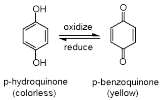 From my understanding, hydroquinone is oxidized to
benzoquinone and vice versa like the picture below.
So I thought the answer for this question would be
oxidized but it was wrong.
Why the answer is reduced???
oxidize reduce OH p-hydroquinone (colorless) p-benzoquinone (yellow) Hydroquinone can react relatively easily and reversibly to form benzoquinone, as shown below in Reaction 1. Coenzyme Q10, a naturally occurring hydroquinone derivative and component of the electron transport chain, carries high-energy electrons: to HO- ОН our —...
From my understanding, hydroquinone is oxidized to
benzoquinone and vice versa like the picture below.
So I thought the answer for this question would be
oxidized but it was wrong.
Why the answer is reduced???
oxidize reduce OH p-hydroquinone (colorless) p-benzoquinone (yellow) Hydroquinone can react relatively easily and reversibly to form benzoquinone, as shown below in Reaction 1. Coenzyme Q10, a naturally occurring hydroquinone derivative and component of the electron transport chain, carries high-energy electrons: to HO- ОН our —...
 What is the theoretical yield of the below reaction:
Theoretical Yield: Hydroquinone Terephthaloyl Polymer Product Chloride C14H9O Molecular C$HO2 CsH4O2Cl2 Formula 203.02 g/mol 110.11 g/mol 327.39 g/mol Molecular Weight Quantity 1.01 g 1.59g
What is the theoretical yield of the below reaction:
Theoretical Yield: Hydroquinone Terephthaloyl Polymer Product Chloride C14H9O Molecular C$HO2 CsH4O2Cl2 Formula 203.02 g/mol 110.11 g/mol 327.39 g/mol Molecular Weight Quantity 1.01 g 1.59g
 What features should I expect to see in a FTIR spectra of the
polyester of Hydroquinone and Terephthaloyl Chloride?
I have included an image of the spectra as a prompt.
Thanks in advance! :)
FTIR Absorbance Spectra Procedure 3 Absorbance 500 1000 1500 2000 2500 3000 3500 4000 4500 Wavenumber (cm-1)
What features should I expect to see in a FTIR spectra of the
polyester of Hydroquinone and Terephthaloyl Chloride?
I have included an image of the spectra as a prompt.
Thanks in advance! :)
FTIR Absorbance Spectra Procedure 3 Absorbance 500 1000 1500 2000 2500 3000 3500 4000 4500 Wavenumber (cm-1)
 n-butyl chloride, sec-butyl chloride, tert_butyl chloride.
SN1
reaction
Write the mechanism of the reactions with the actual substrates (one for the primary, one for the secondary etc.)
n-butyl chloride, sec-butyl chloride, tert_butyl chloride.
SN1
reaction
Write the mechanism of the reactions with the actual substrates (one for the primary, one for the secondary etc.)
 Show how to determine the theoretical yield of 3.18g of
Phenolphthalein combined with 2.03g of terephthaloyl chloride to
form a polyester via the following equation (2 molecules of HCl are
also made in the reaction):
cl Terephtaloyl chloride Phenolphthalein poly (3-oxo-1 (3H)- Isobenzoluranylidene) 14-phenylenexy carbonyl-1,4-phenya lenecarbonyloxy - 1,4 phenylene
Show how to determine the theoretical yield of 3.18g of
Phenolphthalein combined with 2.03g of terephthaloyl chloride to
form a polyester via the following equation (2 molecules of HCl are
also made in the reaction):
cl Terephtaloyl chloride Phenolphthalein poly (3-oxo-1 (3H)- Isobenzoluranylidene) 14-phenylenexy carbonyl-1,4-phenya lenecarbonyloxy - 1,4 phenylene
 please explain
E. Triterpene 32. The reaction of terephthaloyl chloride with ethylene glycol, shown, forms a 35. Reduction of D-xylose (shown) with sodium borohydride yields a product that is CHO H OH NaBHA HH HOH CH2OH HOOH H20 CI A. polyester B. polyamide C. polyether D. polycarbonate E polyurethane A. a racemic mixture B. a single pure enantiomer C. an equal mixture of two diastereomers D. an unequal mixture of two diastereomers E. a meso compound 33. Which of the...
please explain
E. Triterpene 32. The reaction of terephthaloyl chloride with ethylene glycol, shown, forms a 35. Reduction of D-xylose (shown) with sodium borohydride yields a product that is CHO H OH NaBHA HH HOH CH2OH HOOH H20 CI A. polyester B. polyamide C. polyether D. polycarbonate E polyurethane A. a racemic mixture B. a single pure enantiomer C. an equal mixture of two diastereomers D. an unequal mixture of two diastereomers E. a meso compound 33. Which of the...
 From my understanding, hydroquinone is oxidized to
benzoquinone and vice versa like the picture below.
So I thought the answer for this question would be
oxidized but it was wrong.
Why the answer is reduced???
oxidize reduce OH p-hydroquinone (colorless) p-benzoquinone (yellow) Hydroquinone can react relatively easily and reversibly to form benzoquinone, as shown below in Reaction 1. Coenzyme Q10, a naturally occurring hydroquinone derivative and component of the electron transport chain, carries high-energy electrons: to HO- ОН our —...
From my understanding, hydroquinone is oxidized to
benzoquinone and vice versa like the picture below.
So I thought the answer for this question would be
oxidized but it was wrong.
Why the answer is reduced???
oxidize reduce OH p-hydroquinone (colorless) p-benzoquinone (yellow) Hydroquinone can react relatively easily and reversibly to form benzoquinone, as shown below in Reaction 1. Coenzyme Q10, a naturally occurring hydroquinone derivative and component of the electron transport chain, carries high-energy electrons: to HO- ОН our —...
Most questions answered within 3 hours.
-
Where is the error in this code sequence?
String s1 = "Hello";
String s2 = "ello";...
asked 10 months ago -
Financial data for Joel de Paris, Inc., for last year
follow:
Joel de Paris, Inc.
Balance...
asked 10 months ago -
Consider this reaction:
Al2(SO4)3 (aq)+ BaCl3
(aq) Al2Cl6 (aq)- +
3BaSO4(s) . What is the...
asked 10 months ago -
Suppose that Savneet is considering increasing her
recent random sample from 20 car rentals to 40...
asked 10 months ago -
Trucks arrive at an unloading terminal at an average rate of 120
per hour.
Trucks arrive...
asked 10 months ago -
Why are methanol and ethanol completely soluble in water while
octanol is not very little soluble....
asked 10 months ago -
A facilities manager at a university reads in a research report
that the mean amount of...
asked 10 months ago -
When the CuSO4 is rehydrated by adding water to the anhydrous
compound, is this an endothermic...
asked 10 months ago -
A ray of sunlight is passing from diamond into crown glass; the
angle of incidence is...
asked 10 months ago -
A block of mass 0.249 kg is placed on top of a light, vertical
spring of...
asked 10 months ago -
how do the kidneys compensate in the presences of acidosis
a) trigger hyperventilate
b) reserve acid...
asked 10 months ago -
Question 501 pts
The rental rate of capital to the firm increases. Which of the
following...
asked 10 months ago