In the second choice, the support at A is a smooth pin, and a cable connects points B and C. In the third choice, the...
In the second choice, the support at A is a smooth pin, and a cable connects points B and C. In the third choice, the support at A is a single thrust bearing, and a cable connects points B andC. In the fourth choice, the supports at A and B are hinges, and the support at C is a roller.
1)
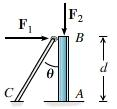
2)
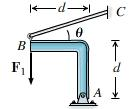
3)
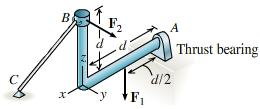
4)
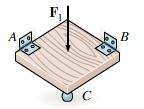
Homework Answers

Add Answer to:
In the second choice, the support at A is a smooth pin,
and a cable connects points B and C. In the third
choice, the...
Part A Which of these bodies has redundant constraints for the given loading conditions? F1 and F2 are applied, known...
 Part A
Which of these bodies has redundant constraints for the given
loading conditions? F1 and F2 are applied, known forces. In the first
choice, the support at A is fixed and a cable connects
points B and C. In the second choice, the support at
A is a smooth pin, and a cable connects points B and
C. In the third choice, the support at A is a single
thrust bearing, and a cable connects points B and C....
Part A
Which of these bodies has redundant constraints for the given
loading conditions? F1 and F2 are applied, known forces. In the first
choice, the support at A is fixed and a cable connects
points B and C. In the second choice, the support at
A is a smooth pin, and a cable connects points B and
C. In the third choice, the support at A is a single
thrust bearing, and a cable connects points B and C....
Problem 1. A pin supports bar AB at A. Another pin supports bar BC at C....
 Problem 1. A pin supports bar AB at A. Another pin supports bar BC at C. A third pin joins the two bars at B. Force F acts on pin B. Determine the force in each bar. Problem 2. Points A, B, and C are situated in the xy plane. Point D lies directly beneath O. Cable segments AD, BD, and CD knot together at D from which the 2 kip weight hangs. Determine the magnitudes of the tensile force...
1. The frame supports the load as shown. The pin at A has a diameter of...
 1. The frame supports the load as shown. The pin at A has a diameter of 0.3 in. If pin at A is subjected to double shear, determine the average shear stress in the pin. Note that support at B is a roller. (25 points) -2 ft 36 in 3 ft 900 O -900 t(품)g0otAc 24i 1. The frame supports the load as shown. The pin at A has a diameter of 0.3 in. If pin at A is subjected...
A loaded beam with a pin support at B and a roller support at C is...
 A loaded beam with a pin support at B and a roller support at C
is shown in Figure 1. The applied loads on the beam are: an
anti-clockwise point moment at A, a variably distributed load
between B and C, and a clockwise point moment at D.
A loaded beam with a pin support at B and a roller support at C is shown in Figure 1. The applied loads on the beam are: an anti-clockwise point moment at...
A loaded beam with a pin support at B and a roller support at C
is shown in Figure 1. The applied loads on the beam are: an
anti-clockwise point moment at A, a variably distributed load
between B and C, and a clockwise point moment at D.
A loaded beam with a pin support at B and a roller support at C is shown in Figure 1. The applied loads on the beam are: an anti-clockwise point moment at...
1) Determine the reactions at the supports for the structures shown. The support at A is...
 1) Determine the reactions at the supports for the structures shown. The support at A is a Roller and the support at B is a Pin. 2.0 k/ft M 10 k- 3.0 k/ft 12 ft 25 k- 25k-Pokift 15 ft B! 1 F20ft- 2) 2 3 k/ft A beam is supported at points A, C, and E, and is loaded as shown. The support at A is fixed. The supports at C and E are rollers. Hinge-B ce Dl Hinge...
1. (60 points) The two-member structure is connected at B by a pin, which is fixed...
 1. (60 points) The two-member structure is connected at B by a pin, which is fixed so RCD and passes through the smooth slot in member AR. Determine the horizontal and vertical components of reaction the supports A, C and D. 4 tt FBD 200 1b/it 3 ft
A loaded beam with a pin support at B and a rller support at C is shown in Figure 1. The applied loads on the bea...
 A loaded beam with a pin support at B and a rller support at C is shown in Figure 1. The applied loads on the beam are: an anti-clockwise point moment at A, a variably distributed load between B and C, and a clockwise point moment at D g kN/m f kNm h kN m A C 4 m 2 m 2 m Figure 1 The magnitude of the anti-clockwise point moment f in units of kN'm can be found...
2.- The beam shown in the figure, has a roller support at A, a fixed support at C and an internal hinge at B. The lengths of segments AB and BC are and b respectively. A uniformly distributed load, q...
 2.- The beam shown in the figure, has a roller support at A, a fixed support at C and an internal hinge at B. The lengths of segments AB and BC are and b respectively. A uniformly distributed load, q, is applied between points B and C, and a concentrated load P acts at a distance 2a/3 from the support A. El is constant. (a) Determine the deflection o at the hinge using superposition. Clearly state the continuity conditions at...
2. (40 points) For the loaded determinate truss with pin reaction at support E and roller...
 2. (40 points) For the loaded determinate truss with pin reaction at support E and roller reaction at support A: (30 pts) fine the forces in members , DC, DG, and HG using the method of sections through section aa. Indicate whether these forces are in compression (C) or tension (T). (10 pts) list any zero-force members that you can determine. 30 k 30k 30k 15 k 12 ft 4 at 16 ft = 64 ft -
2.- The beam shown in the figure, has a roller support at A, a fixed support at C and an internal...
 2.- The beam shown in the figure, has a roller support at A, a fixed support at C and an internal hinge at B. The lengths of segments AB and BC are α and b respectively. A uniformly distributed load, q, is applied between points B and C, and a concentrated load P acts at a distance 2a/3 from the support A. EI is constant. (a) Determine the deflection B at the hinge using superposition. Clearly state the continuity conditions...
 Part A
Which of these bodies has redundant constraints for the given
loading conditions? F1 and F2 are applied, known forces. In the first
choice, the support at A is fixed and a cable connects
points B and C. In the second choice, the support at
A is a smooth pin, and a cable connects points B and
C. In the third choice, the support at A is a single
thrust bearing, and a cable connects points B and C....
Part A
Which of these bodies has redundant constraints for the given
loading conditions? F1 and F2 are applied, known forces. In the first
choice, the support at A is fixed and a cable connects
points B and C. In the second choice, the support at
A is a smooth pin, and a cable connects points B and
C. In the third choice, the support at A is a single
thrust bearing, and a cable connects points B and C....
 Problem 1. A pin supports bar AB at A. Another pin supports bar BC at C. A third pin joins the two bars at B. Force F acts on pin B. Determine the force in each bar. Problem 2. Points A, B, and C are situated in the xy plane. Point D lies directly beneath O. Cable segments AD, BD, and CD knot together at D from which the 2 kip weight hangs. Determine the magnitudes of the tensile force...
 1. The frame supports the load as shown. The pin at A has a diameter of 0.3 in. If pin at A is subjected to double shear, determine the average shear stress in the pin. Note that support at B is a roller. (25 points) -2 ft 36 in 3 ft 900 O -900 t(품)g0otAc 24i 1. The frame supports the load as shown. The pin at A has a diameter of 0.3 in. If pin at A is subjected...
 A loaded beam with a pin support at B and a roller support at C
is shown in Figure 1. The applied loads on the beam are: an
anti-clockwise point moment at A, a variably distributed load
between B and C, and a clockwise point moment at D.
A loaded beam with a pin support at B and a roller support at C is shown in Figure 1. The applied loads on the beam are: an anti-clockwise point moment at...
A loaded beam with a pin support at B and a roller support at C
is shown in Figure 1. The applied loads on the beam are: an
anti-clockwise point moment at A, a variably distributed load
between B and C, and a clockwise point moment at D.
A loaded beam with a pin support at B and a roller support at C is shown in Figure 1. The applied loads on the beam are: an anti-clockwise point moment at...
 1) Determine the reactions at the supports for the structures shown. The support at A is a Roller and the support at B is a Pin. 2.0 k/ft M 10 k- 3.0 k/ft 12 ft 25 k- 25k-Pokift 15 ft B! 1 F20ft- 2) 2 3 k/ft A beam is supported at points A, C, and E, and is loaded as shown. The support at A is fixed. The supports at C and E are rollers. Hinge-B ce Dl Hinge...
 1. (60 points) The two-member structure is connected at B by a pin, which is fixed so RCD and passes through the smooth slot in member AR. Determine the horizontal and vertical components of reaction the supports A, C and D. 4 tt FBD 200 1b/it 3 ft
 A loaded beam with a pin support at B and a rller support at C is shown in Figure 1. The applied loads on the beam are: an anti-clockwise point moment at A, a variably distributed load between B and C, and a clockwise point moment at D g kN/m f kNm h kN m A C 4 m 2 m 2 m Figure 1 The magnitude of the anti-clockwise point moment f in units of kN'm can be found...
 2.- The beam shown in the figure, has a roller support at A, a fixed support at C and an internal hinge at B. The lengths of segments AB and BC are and b respectively. A uniformly distributed load, q, is applied between points B and C, and a concentrated load P acts at a distance 2a/3 from the support A. El is constant. (a) Determine the deflection o at the hinge using superposition. Clearly state the continuity conditions at...
 2. (40 points) For the loaded determinate truss with pin reaction at support E and roller reaction at support A: (30 pts) fine the forces in members , DC, DG, and HG using the method of sections through section aa. Indicate whether these forces are in compression (C) or tension (T). (10 pts) list any zero-force members that you can determine. 30 k 30k 30k 15 k 12 ft 4 at 16 ft = 64 ft -
 2.- The beam shown in the figure, has a roller support at A, a fixed support at C and an internal hinge at B. The lengths of segments AB and BC are α and b respectively. A uniformly distributed load, q, is applied between points B and C, and a concentrated load P acts at a distance 2a/3 from the support A. EI is constant. (a) Determine the deflection B at the hinge using superposition. Clearly state the continuity conditions...
Most questions answered within 3 hours.
-
Where is the error in this code sequence?
String s1 = "Hello";
String s2 = "ello";...
asked 10 months ago -
Financial data for Joel de Paris, Inc., for last year
follow:
Joel de Paris, Inc.
Balance...
asked 10 months ago -
Consider this reaction:
Al2(SO4)3 (aq)+ BaCl3
(aq) Al2Cl6 (aq)- +
3BaSO4(s) . What is the...
asked 10 months ago -
Suppose that Savneet is considering increasing her
recent random sample from 20 car rentals to 40...
asked 10 months ago -
Trucks arrive at an unloading terminal at an average rate of 120
per hour.
Trucks arrive...
asked 10 months ago -
Why are methanol and ethanol completely soluble in water while
octanol is not very little soluble....
asked 10 months ago -
A facilities manager at a university reads in a research report
that the mean amount of...
asked 10 months ago -
When the CuSO4 is rehydrated by adding water to the anhydrous
compound, is this an endothermic...
asked 10 months ago -
A ray of sunlight is passing from diamond into crown glass; the
angle of incidence is...
asked 10 months ago -
A block of mass 0.249 kg is placed on top of a light, vertical
spring of...
asked 10 months ago -
how do the kidneys compensate in the presences of acidosis
a) trigger hyperventilate
b) reserve acid...
asked 10 months ago -
Question 501 pts
The rental rate of capital to the firm increases. Which of the
following...
asked 10 months ago