
Homework Answers

Add Answer to:
Shown below are three models that can be used to represent a molecule of ammonia. H-N-H IZ: Select two of the models. I...
Data Table Two Double Bond Molecular Models Molecule Valence Electrons Lewis Structure Molecular Geometry Polar o...
 Data Table Two Double Bond Molecular Models Molecule Valence Electrons Lewis Structure Molecular Geometry Polar or Nonpolar Model Check САН. (Resonance) NIA NIA CO2 Report Sheet Questions 8 dashes and dots and draw an arrow over the Lewis Find the total number of valence electrons for the following molecules. mensional Lewis structure usine dashes and dots and draw an arrow on structure to show any net dipole moment. w any net dipole moment. Identify the molecular geometry and have Your...
Experiment 10: Modeling Chirality and Cycloalkanes 4. Several compounds are shown below. For each, make two...
 Experiment 10: Modeling Chirality and Cycloalkanes 4. Several compounds are shown below. For each, make two models: one model of the compound as shown, and the other where each tetrahedral stereocenter is inverted. Compare the two models side-by-side to see if the model with the inverted stereocenter(s) is the enantiomer, or if it is identical to the original. Remember, you can rotate around o-bonds to place the molecule in the conformation with the highest symmetry. Is each compound meso or...
3. Diastereomers and Meso Forms. When a molecule has two or more stereogenic centers, stereoisomers that...
 3. Diastereomers and Meso Forms. When a molecule has two or more stereogenic centers, stereoisomers that are not mirror images can exist; these are called diastereoisomers. Within this general class, there are special types of stereoisomers that are always optically inactive and are called meso forms. Construct a model with four different colored balls about a carbon center. Construct another identical to the first and verify this by the superimposition test. Now remove the same colored balls, blue (C from...
In the compound shown below, how can the bond between carbon and chlorine be described? A)...
 In the compound shown below, how can the bond between carbon and chlorine be described? A) intermolecular B) ionic C) nonpolar covalent D) polar covalent E) nonpolar ionic What statement about the ammonia molecule, NH3, is FALSE? A) The molecule contains three polar bonds. B) The molecule itself is not polar. C) The molecule has a trigonal pyramidal shape. D) The nitrogen atom has one nonbonding pair of electrons. E) The pull of the electrons in the N-H bonds is...
3. Diastereomers and Meso Forms. When a molecule has two or more stereogenic centers, stereoisomers that...
 3. Diastereomers and Meso Forms. When a molecule has two or more stereogenic centers, stereoisomers that are not mirror images can exist; these are called diastereoisomers. Within this general class, there are special types of stereoisomers that are always optically inactive and are called meso forms. Construct a model with four different colored balls about a carbon center. Construct another identical to the first and verify this by the superimposition test. Now remove the same colored balls, blue (C from...
2. Malate can be used to make aspartate in two steps as shown below. Find the...
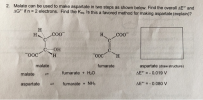 2. Malate can be used to make aspartate in two steps as shown below. Find the overall AE® and AG' if n = 2 electrons. Find the keq. Is this a favored method for making aspartate (explain)? H 000 HC00 COH Cooch 00C malate fumarate aspartate (draw structure) AE = -0.019 V malate fumarate + H2O aspartate = fumarate + NH3 AE" = -0.080 V
Q7.14: Triatomic species can take which two structures? Select all that apply? A tetrahedral B bent...
 Q7.14: Triatomic species can take which two structures? Select all that apply? A tetrahedral B bent linear D octahedral А Q7.15: Which of the following is predicted to be used by the sulfur atom in SO3 based on valence bond theory? А sap B sp2 Csp3 D sp Q 7.15: Both VSEPR theory and valence bond predict the same geometry for XeO3. А True B False Q 7.15: According to valence bond theory, the structure C2H2 the two carbon atoms...
i need help answering these qoustion plz???? Use the short grey sticks for single bonds and...
 i need help answering these qoustion plz????
Use the short grey sticks for single bonds and the long flexible grey sticks for double and triple bonds. Note: In reality, single bonds are longer than double or triple bonds ) Fill in the table below Molecule # of lone pairs on central atom linear or bent? (Circle one) HO lincar benti SO lincar bent CO. bent lincar HCN bent lincar Question: Based on your answers in the table above and the...
i need help answering these qoustion plz????
Use the short grey sticks for single bonds and the long flexible grey sticks for double and triple bonds. Note: In reality, single bonds are longer than double or triple bonds ) Fill in the table below Molecule # of lone pairs on central atom linear or bent? (Circle one) HO lincar benti SO lincar bent CO. bent lincar HCN bent lincar Question: Based on your answers in the table above and the...
Name Section Experiment 13 Advance Study Assignment: The Geometrical Structure Molecules You are asked by your...
 Name Section Experiment 13 Advance Study Assignment: The Geometrical Structure Molecules You are asked by your instructor t nature. you proceed as directed in the section onE. NHCI molecule. Being of a conservative Procedure. 1. First you need to find the number of valence electrons in NH CI. For counting purposes with Lewis struc- e er of valence electrons in an atom of a mam pgToup clement is equal to the last digit in the 1 element in the Periodic...
Questions 7-15 The molecule is ethane 71 2 O ACTIVITY 1.2.1 Biological Macromolecules in 3-D 7....
 Questions 7-15 The molecule is ethane
71 2 O ACTIVITY 1.2.1 Biological Macromolecules in 3-D 7. Orient the two molecules so that portions of the mo lecules that would normally form intermolecular bonds lie next to each other. In this activity, you will build molecular models of biologically important molecules using ball-and-spring molecular model 1) What intermolecular forces help to hold these mo- building kits and then you will view these and other molecules lecules together! of interest using computer-generated...
Questions 7-15 The molecule is ethane
71 2 O ACTIVITY 1.2.1 Biological Macromolecules in 3-D 7. Orient the two molecules so that portions of the mo lecules that would normally form intermolecular bonds lie next to each other. In this activity, you will build molecular models of biologically important molecules using ball-and-spring molecular model 1) What intermolecular forces help to hold these mo- building kits and then you will view these and other molecules lecules together! of interest using computer-generated...
 Data Table Two Double Bond Molecular Models Molecule Valence Electrons Lewis Structure Molecular Geometry Polar or Nonpolar Model Check САН. (Resonance) NIA NIA CO2 Report Sheet Questions 8 dashes and dots and draw an arrow over the Lewis Find the total number of valence electrons for the following molecules. mensional Lewis structure usine dashes and dots and draw an arrow on structure to show any net dipole moment. w any net dipole moment. Identify the molecular geometry and have Your...
 Experiment 10: Modeling Chirality and Cycloalkanes 4. Several compounds are shown below. For each, make two models: one model of the compound as shown, and the other where each tetrahedral stereocenter is inverted. Compare the two models side-by-side to see if the model with the inverted stereocenter(s) is the enantiomer, or if it is identical to the original. Remember, you can rotate around o-bonds to place the molecule in the conformation with the highest symmetry. Is each compound meso or...
 3. Diastereomers and Meso Forms. When a molecule has two or more stereogenic centers, stereoisomers that are not mirror images can exist; these are called diastereoisomers. Within this general class, there are special types of stereoisomers that are always optically inactive and are called meso forms. Construct a model with four different colored balls about a carbon center. Construct another identical to the first and verify this by the superimposition test. Now remove the same colored balls, blue (C from...
 In the compound shown below, how can the bond between carbon and chlorine be described? A) intermolecular B) ionic C) nonpolar covalent D) polar covalent E) nonpolar ionic What statement about the ammonia molecule, NH3, is FALSE? A) The molecule contains three polar bonds. B) The molecule itself is not polar. C) The molecule has a trigonal pyramidal shape. D) The nitrogen atom has one nonbonding pair of electrons. E) The pull of the electrons in the N-H bonds is...
 3. Diastereomers and Meso Forms. When a molecule has two or more stereogenic centers, stereoisomers that are not mirror images can exist; these are called diastereoisomers. Within this general class, there are special types of stereoisomers that are always optically inactive and are called meso forms. Construct a model with four different colored balls about a carbon center. Construct another identical to the first and verify this by the superimposition test. Now remove the same colored balls, blue (C from...
 2. Malate can be used to make aspartate in two steps as shown below. Find the overall AE® and AG' if n = 2 electrons. Find the keq. Is this a favored method for making aspartate (explain)? H 000 HC00 COH Cooch 00C malate fumarate aspartate (draw structure) AE = -0.019 V malate fumarate + H2O aspartate = fumarate + NH3 AE" = -0.080 V
 Q7.14: Triatomic species can take which two structures? Select all that apply? A tetrahedral B bent linear D octahedral А Q7.15: Which of the following is predicted to be used by the sulfur atom in SO3 based on valence bond theory? А sap B sp2 Csp3 D sp Q 7.15: Both VSEPR theory and valence bond predict the same geometry for XeO3. А True B False Q 7.15: According to valence bond theory, the structure C2H2 the two carbon atoms...
 i need help answering these qoustion plz????
Use the short grey sticks for single bonds and the long flexible grey sticks for double and triple bonds. Note: In reality, single bonds are longer than double or triple bonds ) Fill in the table below Molecule # of lone pairs on central atom linear or bent? (Circle one) HO lincar benti SO lincar bent CO. bent lincar HCN bent lincar Question: Based on your answers in the table above and the...
i need help answering these qoustion plz????
Use the short grey sticks for single bonds and the long flexible grey sticks for double and triple bonds. Note: In reality, single bonds are longer than double or triple bonds ) Fill in the table below Molecule # of lone pairs on central atom linear or bent? (Circle one) HO lincar benti SO lincar bent CO. bent lincar HCN bent lincar Question: Based on your answers in the table above and the...
 Name Section Experiment 13 Advance Study Assignment: The Geometrical Structure Molecules You are asked by your instructor t nature. you proceed as directed in the section onE. NHCI molecule. Being of a conservative Procedure. 1. First you need to find the number of valence electrons in NH CI. For counting purposes with Lewis struc- e er of valence electrons in an atom of a mam pgToup clement is equal to the last digit in the 1 element in the Periodic...
 Questions 7-15 The molecule is ethane
71 2 O ACTIVITY 1.2.1 Biological Macromolecules in 3-D 7. Orient the two molecules so that portions of the mo lecules that would normally form intermolecular bonds lie next to each other. In this activity, you will build molecular models of biologically important molecules using ball-and-spring molecular model 1) What intermolecular forces help to hold these mo- building kits and then you will view these and other molecules lecules together! of interest using computer-generated...
Questions 7-15 The molecule is ethane
71 2 O ACTIVITY 1.2.1 Biological Macromolecules in 3-D 7. Orient the two molecules so that portions of the mo lecules that would normally form intermolecular bonds lie next to each other. In this activity, you will build molecular models of biologically important molecules using ball-and-spring molecular model 1) What intermolecular forces help to hold these mo- building kits and then you will view these and other molecules lecules together! of interest using computer-generated...
Most questions answered within 3 hours.
-
Where is the error in this code sequence?
String s1 = "Hello";
String s2 = "ello";...
asked 10 months ago -
Financial data for Joel de Paris, Inc., for last year
follow:
Joel de Paris, Inc.
Balance...
asked 10 months ago -
Consider this reaction:
Al2(SO4)3 (aq)+ BaCl3
(aq) Al2Cl6 (aq)- +
3BaSO4(s) . What is the...
asked 10 months ago -
Suppose that Savneet is considering increasing her
recent random sample from 20 car rentals to 40...
asked 10 months ago -
Trucks arrive at an unloading terminal at an average rate of 120
per hour.
Trucks arrive...
asked 10 months ago -
Why are methanol and ethanol completely soluble in water while
octanol is not very little soluble....
asked 10 months ago -
A facilities manager at a university reads in a research report
that the mean amount of...
asked 10 months ago -
When the CuSO4 is rehydrated by adding water to the anhydrous
compound, is this an endothermic...
asked 10 months ago -
A ray of sunlight is passing from diamond into crown glass; the
angle of incidence is...
asked 10 months ago -
A block of mass 0.249 kg is placed on top of a light, vertical
spring of...
asked 10 months ago -
how do the kidneys compensate in the presences of acidosis
a) trigger hyperventilate
b) reserve acid...
asked 10 months ago -
Question 501 pts
The rental rate of capital to the firm increases. Which of the
following...
asked 10 months ago