
Homework Answers

Add Answer to:
apter 17 Homework Saved 1 attempts left Check my work Enter your answer in the provided box. Even at high temperatu...
#17.10 Enter your answer in the provided box. Even at high temperatures, the formation of NO...
 #17.10
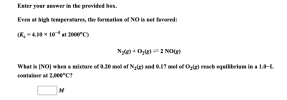
Enter your answer in the provided box. Even at high temperatures, the formation of NO is not favored: (K = 4.10 x 10⁻⁴ at 2000°C) N2(g) + O2(g) = 2 NO(g) What is [NO] when a mixture of 0.20 mol of N2(g) and 0.17 mol of O2(g) reach equilibrium in a 1.0-L container at 2,000°C? M
#17.10
Enter your answer in the provided box. Even at high temperatures, the formation of NO is not favored: (K = 4.10 x 10⁻⁴ at 2000°C) N2(g) + O2(g) = 2 NO(g) What is [NO] when a mixture of 0.20 mol of N2(g) and 0.17 mol of O2(g) reach equilibrium in a 1.0-L container at 2,000°C? M
Even at high temperatures, the formation of NO is not favored: (Kc = 4.10 ×10⁻⁴ at 2000°C) N2(g) + O2(g) ⇌ 2 NO(g) What...
Even at high temperatures, the formation of NO is not favored: (Kc = 4.10 ×10⁻⁴ at 2000°C) N2(g) + O2(g) ⇌ 2 NO(g) What is [NO] when a mixture of 0.20 mol of N2(g) and 0.17 mol of O2(g) reach equilibrium in a 1.0−L container at 2,000°C?
Enter your answer in the provided box. Ammonium hydrogen sulfide decomposes according to the following reaction,...
 Enter your answer in the provided box. Ammonium hydrogen sulfide decomposes according to the following reaction, for which Kp =0.11 at 250°C NH HS(s) H2S() +NH3() If 60.5 g of NH HS(s) is placed in a sealed 5.0-L container, what is the partial pressure of NH3(g) at equilibrium? PN atm Enter your answer in the provided box. Even at high temperatures, the formation of NO is not favored: (K-4.10x 10 at 2000°C) N28)+O2(g)= 2 NO(g) What is (NO] when a...
Need help answering the questions with steps and explanation 1. even at a high temperature, the formation of NO is not f...
 Need help answering the questions with steps and
explanation
1. even at a high temperature, the formation of NO is
not favored.
Compound A decomposes according to the equation A(g) 2 B(g)+ C (g) A sealed 1.00-L container initially contains 1.81 x 10 mol of A(g), 1.35 x 10 mol of B(g), and 6.58 x 10 mol of C(g) at 100°C. At equilibrium, [A] is 2.11 x 10 M. Find [B] and [C] Solve for the equilibrium concentrations of B...
Need help answering the questions with steps and
explanation
1. even at a high temperature, the formation of NO is
not favored.
Compound A decomposes according to the equation A(g) 2 B(g)+ C (g) A sealed 1.00-L container initially contains 1.81 x 10 mol of A(g), 1.35 x 10 mol of B(g), and 6.58 x 10 mol of C(g) at 100°C. At equilibrium, [A] is 2.11 x 10 M. Find [B] and [C] Solve for the equilibrium concentrations of B...
Saved 1 attempts left Check my work Enter your answer in the provided box. Hydrogen sulfide...
 Saved 1 attempts left Check my work Enter your answer in the provided box. Hydrogen sulfide decomposes according to the following reaction, for which K. = 9.30 x 10⁻⁸ at 700°C: 2 H2S(g) = 2 H2(g) + S2(9) If 0.49 mol of H2S is placed in a 3.0-L container, what is the equilibrium concentration of Hz() at 700° C? 0.0056 M
2 attempts left Check my work Enter your answer in the provided box. Hemoglobin is the...
 2 attempts left Check my work Enter your answer in the provided box. Hemoglobin is the protein that transports 02 through the blood from the lungs to the rest of the body. In doing so, each molecule of hemoglobin combines with four molecules of O2. If 1.59 g of hemoglobin combines with 2.47 mL of O2 at 37°C and 731 torr, what is the molar mass of hemoglobin? 1 x10 g/mol
Saved 3 attempts left Check my work Enter your answer in the provided box. When 23.4...
 Saved 3 attempts left Check my work Enter your answer in the provided box. When 23.4 mL of 0.500 M H2SO4 is added to 23.4 mL of 1.00 M KOH in a coffee-cup calorimeter at 23.50°C, the temperature rises to 30.17ºC. Calculate AH of this reaction. (Assume that the total volume is the sum of the individual volumes and that the density and specific heat capacity of the solution are the same as for pure water.) (d for water =...
1 attempts left Check my work Enter your answer in the provided box. Ammonia (NH3) decomposes...
 1 attempts left Check my work Enter your answer in the provided box. Ammonia (NH3) decomposes to hydrogen and nitrogen and 22.0 kcal/mol of energy is absorbed. 2 NHj(g) 3 H2(8) + N2(g) AH +22.0 kcal/mol How much energy is absorbed when 2.63 g of NHj reacts? keal of energy absorbed Report your answer to appropriate number of significant figures.
1. A key step in the extraction of iron from its ore is FeO(s) + CO(g)...
1. A key step in the extraction of iron from its ore is FeO(s) + CO(g) ⇌ Fe(s) + CO2(g) Kp = 0.403 at 1,000°C This step occurs in the 700°C to 1,200°C zone within a blast furnace. What are the equilibrium partial pressures of CO(g) and CO2(g) when 1.1000 atm of CO(g) and excess FeO(s) react in a sealed container at 1000°C? 2. Compound A decomposes according to the equation A(g) ⇌ 2 B(g) + C (g) A...
2 attempts left Check my work Enter your answer in the provided box. Hemoglobin is the...
 2 attempts left Check my work Enter your answer in the provided box. Hemoglobin is the protein that transports 0, through the blood from the lungs to the rest of the body. In doing so, each molecule of hemoglobin combines with four molecules of O2. If 1.87 g of hemoglobin combines with 2.93 mL of O, at 37°C and 723 torr, what is the molar mass of hemoglobin? 10 g/mol (Enter your answer in scientific notation.)
 #17.10
Enter your answer in the provided box. Even at high temperatures, the formation of NO is not favored: (K = 4.10 x 10⁻⁴ at 2000°C) N2(g) + O2(g) = 2 NO(g) What is [NO] when a mixture of 0.20 mol of N2(g) and 0.17 mol of O2(g) reach equilibrium in a 1.0-L container at 2,000°C? M
#17.10
Enter your answer in the provided box. Even at high temperatures, the formation of NO is not favored: (K = 4.10 x 10⁻⁴ at 2000°C) N2(g) + O2(g) = 2 NO(g) What is [NO] when a mixture of 0.20 mol of N2(g) and 0.17 mol of O2(g) reach equilibrium in a 1.0-L container at 2,000°C? M
 Enter your answer in the provided box. Ammonium hydrogen sulfide decomposes according to the following reaction, for which Kp =0.11 at 250°C NH HS(s) H2S() +NH3() If 60.5 g of NH HS(s) is placed in a sealed 5.0-L container, what is the partial pressure of NH3(g) at equilibrium? PN atm Enter your answer in the provided box. Even at high temperatures, the formation of NO is not favored: (K-4.10x 10 at 2000°C) N28)+O2(g)= 2 NO(g) What is (NO] when a...
 Need help answering the questions with steps and
explanation
1. even at a high temperature, the formation of NO is
not favored.
Compound A decomposes according to the equation A(g) 2 B(g)+ C (g) A sealed 1.00-L container initially contains 1.81 x 10 mol of A(g), 1.35 x 10 mol of B(g), and 6.58 x 10 mol of C(g) at 100°C. At equilibrium, [A] is 2.11 x 10 M. Find [B] and [C] Solve for the equilibrium concentrations of B...
Need help answering the questions with steps and
explanation
1. even at a high temperature, the formation of NO is
not favored.
Compound A decomposes according to the equation A(g) 2 B(g)+ C (g) A sealed 1.00-L container initially contains 1.81 x 10 mol of A(g), 1.35 x 10 mol of B(g), and 6.58 x 10 mol of C(g) at 100°C. At equilibrium, [A] is 2.11 x 10 M. Find [B] and [C] Solve for the equilibrium concentrations of B...
 Saved 1 attempts left Check my work Enter your answer in the provided box. Hydrogen sulfide decomposes according to the following reaction, for which K. = 9.30 x 10⁻⁸ at 700°C: 2 H2S(g) = 2 H2(g) + S2(9) If 0.49 mol of H2S is placed in a 3.0-L container, what is the equilibrium concentration of Hz() at 700° C? 0.0056 M
 2 attempts left Check my work Enter your answer in the provided box. Hemoglobin is the protein that transports 02 through the blood from the lungs to the rest of the body. In doing so, each molecule of hemoglobin combines with four molecules of O2. If 1.59 g of hemoglobin combines with 2.47 mL of O2 at 37°C and 731 torr, what is the molar mass of hemoglobin? 1 x10 g/mol
 Saved 3 attempts left Check my work Enter your answer in the provided box. When 23.4 mL of 0.500 M H2SO4 is added to 23.4 mL of 1.00 M KOH in a coffee-cup calorimeter at 23.50°C, the temperature rises to 30.17ºC. Calculate AH of this reaction. (Assume that the total volume is the sum of the individual volumes and that the density and specific heat capacity of the solution are the same as for pure water.) (d for water =...
 1 attempts left Check my work Enter your answer in the provided box. Ammonia (NH3) decomposes to hydrogen and nitrogen and 22.0 kcal/mol of energy is absorbed. 2 NHj(g) 3 H2(8) + N2(g) AH +22.0 kcal/mol How much energy is absorbed when 2.63 g of NHj reacts? keal of energy absorbed Report your answer to appropriate number of significant figures.
 2 attempts left Check my work Enter your answer in the provided box. Hemoglobin is the protein that transports 0, through the blood from the lungs to the rest of the body. In doing so, each molecule of hemoglobin combines with four molecules of O2. If 1.87 g of hemoglobin combines with 2.93 mL of O, at 37°C and 723 torr, what is the molar mass of hemoglobin? 10 g/mol (Enter your answer in scientific notation.)
Most questions answered within 3 hours.
-
Where is the error in this code sequence?
String s1 = "Hello";
String s2 = "ello";...
asked 10 months ago -
Financial data for Joel de Paris, Inc., for last year
follow:
Joel de Paris, Inc.
Balance...
asked 10 months ago -
Consider this reaction:
Al2(SO4)3 (aq)+ BaCl3
(aq) Al2Cl6 (aq)- +
3BaSO4(s) . What is the...
asked 10 months ago -
Suppose that Savneet is considering increasing her
recent random sample from 20 car rentals to 40...
asked 10 months ago -
Trucks arrive at an unloading terminal at an average rate of 120
per hour.
Trucks arrive...
asked 10 months ago -
Why are methanol and ethanol completely soluble in water while
octanol is not very little soluble....
asked 10 months ago -
A facilities manager at a university reads in a research report
that the mean amount of...
asked 10 months ago -
When the CuSO4 is rehydrated by adding water to the anhydrous
compound, is this an endothermic...
asked 10 months ago -
A ray of sunlight is passing from diamond into crown glass; the
angle of incidence is...
asked 10 months ago -
A block of mass 0.249 kg is placed on top of a light, vertical
spring of...
asked 10 months ago -
how do the kidneys compensate in the presences of acidosis
a) trigger hyperventilate
b) reserve acid...
asked 10 months ago -
Question 501 pts
The rental rate of capital to the firm increases. Which of the
following...
asked 10 months ago