
Homework Answers
Add Answer to:
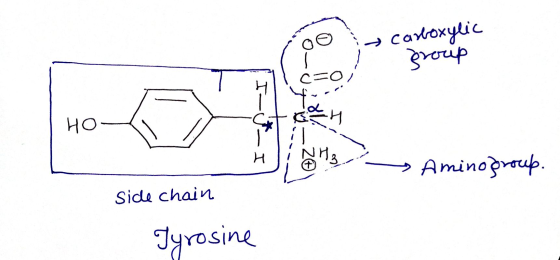
1. An amino acid is shown below. Draw a circle around the carboxylic acid group, a square around the side chain and...
The carboxylic acid group (COOH) in the side chain of Aspartic acid (shown below), one of...
The carboxylic acid group (COOH) in the side chain of Aspartic acid (shown below), one of the 20 naturally occurring amino acids, has a pKa of 4.1. Calculate the percentage of conjugate base (COO- ) for this carboxylic acid group in the side chain of Aspartate at the following pH values: 2.1 , 4.1 and 5.1.
Question 2 1 pts Amino acids are classified by their Rgroup (side chain) carboxylic acid group...
 Question 2 1 pts Amino acids are classified by their Rgroup (side chain) carboxylic acid group peptide bond alpha carbon amine group
1. (a) Draw a zwitterionic amino acid with a side chain, R. (b) What are the...
1. (a) Draw a zwitterionic amino acid with a side chain, R. (b) What are the angles between the Ca bonds? (c) If this is a naturally occurring amino acid, which isomer is it, D or L? (d) Assuming the side chain has no ionizable group, at approximately what pH will the majority of this free amino acid have a net positive charge? A net negative charge?
What is the classification of the side chain R group in the amino acid shown here?...
 What is the classification of the side chain R group in the amino acid shown here? HN CH-C-0 CH-CO A) acidic CH B) basic C) neutral
____ 1. The diagram below represents serine, a polar, uncharged amino acid. Which functional group gives...
 ____ 1. The diagram below represents serine, a polar, uncharged
amino acid. Which functional group gives serine its
distinct property?
a. H3
b. CH2OH
c. –H
d. COO–
____ 2. The monomers shown below are monomers for which of the
following natural polymers?
a. polysaccharides
b. plastics
c. DNA
d. proteins
____ 3. Which of the following processes illustrates the production
of a protein?
a. specific code for amino acids --> amino acid chain -->
gene --> DNA --> specific...
____ 1. The diagram below represents serine, a polar, uncharged
amino acid. Which functional group gives serine its
distinct property?
a. H3
b. CH2OH
c. –H
d. COO–
____ 2. The monomers shown below are monomers for which of the
following natural polymers?
a. polysaccharides
b. plastics
c. DNA
d. proteins
____ 3. Which of the following processes illustrates the production
of a protein?
a. specific code for amino acids --> amino acid chain -->
gene --> DNA --> specific...
What is the classification of the side chain R group in the amino acid shown here?...
 What is the classification of the side chain R group in the amino acid shown here? O A) acidic HN-CH-C-0 CH2 B) basic HN C) neutral -NH
page 2 Chem 102 Work Shot 9.0 Dr.O. Amino Acids NAME_Sheena Thompson For each amino acid:...
 page 2 Chem 102 Work Shot 9.0 Dr.O. Amino Acids NAME_Sheena Thompson For each amino acid: A. Draw a circle around the carboxylic acid group B. Drow a triangle around the c-amino group C. Draw a box (or rectangle or polygon) around the Rgroup in each amino acid D. Use hi-lighters or colored pencils on each name to classify the amino acids as one of the following: 1. Nonpolar 2. Polar neutral 3. Polar acidic 4. Polor basic NH CO_H...
1)Match the name of each amino acid with one of its characteristics. 2)has a hydroxy group...
1)Match the name of each amino acid with one of its characteristics. 2)has a hydroxy group its aromatic side chain 3)has a sulfur atom in its side chain that can form disulfide bonds its side chain is a nonpolar isopropyl group 4)it has the smallest acidic side chain 5)this amino acid has the smallest side chain of all, a hydrogen atom 6)its side chain is a methyl group its side chain of 3 carbons forms a 5-membered ring with the...
Shown below is the partial structural formula for the amino acid L-cysteine, HSCH2(NH2)CHCOOH. Th...
 Shown below is the partial structural formula for the amino acid L-cysteine, HSCH2(NH2)CHCOOH. The dotted lines represent connectivity of the atoms, but the structure does not show the correct bond orders (single, double, etc.). Complete the following activity for L-cysteine. ННО 2 4 H N-H 1. Write the name and chemical formula of the molecule shown above. 2. Determine the total number of valence electrons in the molecule. 3. Use the partial structural formula to draw a Lewis structure for...
4. Shown below is a segment from a polypeptide chain. Which amino acid in this segment...
 4. Shown below is a segment from a polypeptide chain. Which amino acid in this segment is most likely to be found in the hydrophobic interior of the folded protein? ОН OY H ZI IZ ONH2 A. Isoleucine B. Threonine C. Glutamine
 Question 2 1 pts Amino acids are classified by their Rgroup (side chain) carboxylic acid group peptide bond alpha carbon amine group
 What is the classification of the side chain R group in the amino acid shown here? HN CH-C-0 CH-CO A) acidic CH B) basic C) neutral
 ____ 1. The diagram below represents serine, a polar, uncharged
amino acid. Which functional group gives serine its
distinct property?
a. H3
b. CH2OH
c. –H
d. COO–
____ 2. The monomers shown below are monomers for which of the
following natural polymers?
a. polysaccharides
b. plastics
c. DNA
d. proteins
____ 3. Which of the following processes illustrates the production
of a protein?
a. specific code for amino acids --> amino acid chain -->
gene --> DNA --> specific...
____ 1. The diagram below represents serine, a polar, uncharged
amino acid. Which functional group gives serine its
distinct property?
a. H3
b. CH2OH
c. –H
d. COO–
____ 2. The monomers shown below are monomers for which of the
following natural polymers?
a. polysaccharides
b. plastics
c. DNA
d. proteins
____ 3. Which of the following processes illustrates the production
of a protein?
a. specific code for amino acids --> amino acid chain -->
gene --> DNA --> specific...
 What is the classification of the side chain R group in the amino acid shown here? O A) acidic HN-CH-C-0 CH2 B) basic HN C) neutral -NH
 page 2 Chem 102 Work Shot 9.0 Dr.O. Amino Acids NAME_Sheena Thompson For each amino acid: A. Draw a circle around the carboxylic acid group B. Drow a triangle around the c-amino group C. Draw a box (or rectangle or polygon) around the Rgroup in each amino acid D. Use hi-lighters or colored pencils on each name to classify the amino acids as one of the following: 1. Nonpolar 2. Polar neutral 3. Polar acidic 4. Polor basic NH CO_H...
 Shown below is the partial structural formula for the amino acid L-cysteine, HSCH2(NH2)CHCOOH. The dotted lines represent connectivity of the atoms, but the structure does not show the correct bond orders (single, double, etc.). Complete the following activity for L-cysteine. ННО 2 4 H N-H 1. Write the name and chemical formula of the molecule shown above. 2. Determine the total number of valence electrons in the molecule. 3. Use the partial structural formula to draw a Lewis structure for...
 4. Shown below is a segment from a polypeptide chain. Which amino acid in this segment is most likely to be found in the hydrophobic interior of the folded protein? ОН OY H ZI IZ ONH2 A. Isoleucine B. Threonine C. Glutamine
Most questions answered within 3 hours.
-
Where is the error in this code sequence?
String s1 = "Hello";
String s2 = "ello";...
asked 10 months ago -
Financial data for Joel de Paris, Inc., for last year
follow:
Joel de Paris, Inc.
Balance...
asked 10 months ago -
Consider this reaction:
Al2(SO4)3 (aq)+ BaCl3
(aq) Al2Cl6 (aq)- +
3BaSO4(s) . What is the...
asked 10 months ago -
Suppose that Savneet is considering increasing her
recent random sample from 20 car rentals to 40...
asked 10 months ago -
Trucks arrive at an unloading terminal at an average rate of 120
per hour.
Trucks arrive...
asked 10 months ago -
Why are methanol and ethanol completely soluble in water while
octanol is not very little soluble....
asked 10 months ago -
A facilities manager at a university reads in a research report
that the mean amount of...
asked 10 months ago -
When the CuSO4 is rehydrated by adding water to the anhydrous
compound, is this an endothermic...
asked 10 months ago -
A ray of sunlight is passing from diamond into crown glass; the
angle of incidence is...
asked 10 months ago -
A block of mass 0.249 kg is placed on top of a light, vertical
spring of...
asked 10 months ago -
how do the kidneys compensate in the presences of acidosis
a) trigger hyperventilate
b) reserve acid...
asked 10 months ago -
Question 501 pts
The rental rate of capital to the firm increases. Which of the
following...
asked 10 months ago