
Homework Answers
Add Answer to:
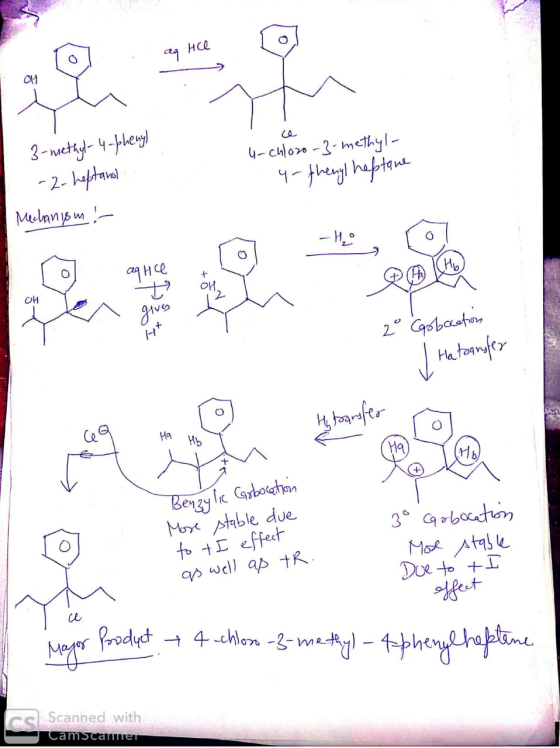
5. Upon reaction of 3-methyl-4-phenyl-2-heptanol with concentrated aqueous hydrochloric acid, the major product 4-c...
5. Upon reaction of 3-methyl-4-phenyl-2-heptanol with concentrated aqueous hydrochloric acid, the major product 4-chloro-3-methyl-4-phenylheptane was found....
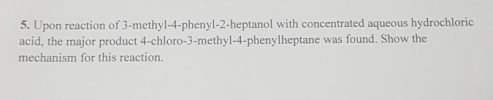 5. Upon reaction of 3-methyl-4-phenyl-2-heptanol with concentrated aqueous hydrochloric acid, the major product 4-chloro-3-methyl-4-phenylheptane was found. Show the mechanism for this reaction.
Just Answer Question 5 Synthesis of 2-chloro-2-methylbutane (literature version) Concentrated aqueous hydrochloric acid (HCI, 3.3 equivalents)...
 Just Answer Question 5
Synthesis of 2-chloro-2-methylbutane (literature version) Concentrated aqueous hydrochloric acid (HCI, 3.3 equivalents) was slowly added to 2-methyl-2-butanol (1.0 equivalents) in a 100 mL round bottom flask with stirring. The reaction was stirred for 15 minutes at room temperature. Upon completion, the reaction mixture was transferred to a 60 mL separatory funnel and the aqueous layer was removed. The organic layer (i.e. the product) was successively washed with: (1) saturated aqueous NaCl (brine), (2) saturated aqueous NaHCO,...
Just Answer Question 5
Synthesis of 2-chloro-2-methylbutane (literature version) Concentrated aqueous hydrochloric acid (HCI, 3.3 equivalents) was slowly added to 2-methyl-2-butanol (1.0 equivalents) in a 100 mL round bottom flask with stirring. The reaction was stirred for 15 minutes at room temperature. Upon completion, the reaction mixture was transferred to a 60 mL separatory funnel and the aqueous layer was removed. The organic layer (i.e. the product) was successively washed with: (1) saturated aqueous NaCl (brine), (2) saturated aqueous NaHCO,...
what is the major product? What is the major product of the following reaction? OH 2...
 what is the major product?
What is the major product of the following reaction? OH 2 de ore 1. SOCI2 2. (CH3)2Culi Product Produc methyl phenyl ketone 1-phenylethanol 2-phenyl-2-propanol 1-chloro-1-phenylethane
what is the major product?
What is the major product of the following reaction? OH 2 de ore 1. SOCI2 2. (CH3)2Culi Product Produc methyl phenyl ketone 1-phenylethanol 2-phenyl-2-propanol 1-chloro-1-phenylethane
A student was planning to synthesize 2-chloro-3-methylbutane from 3-methyl-2-butanol using concentrated HCl, similar to the reaction...
A student was planning to synthesize 2-chloro-3-methylbutane from 3-methyl-2-butanol using concentrated HCl, similar to the reaction you did. When the experiment was carried out, the product isolated was 2-chloro-2-methylbutane. Explain these results by showing a plausible mechanism for the formation of 2-chloro-2-methylbutane under these reaction conditions. (Hint: it is an SN1 reaction, but think about what can happen to the carbocation intermediate that we learned about in lecture to cause that product to form.)
1.The main product of the reaction between p-cresol and Br2 / FeBr3 is: 3-Bromo-4-methyl phenol 2-Bromo-4-methyl...
1.The main product of the reaction between p-cresol and Br2 / FeBr3 is: 3-Bromo-4-methyl phenol 2-Bromo-4-methyl phenol 2-methyl-4-bromine phenol 3-methyl-4-bromine phenol 2.Which of the following compounds is the least reactive in the nucleophilic substitution with NaOH? 2,4-dinitrochlorobenzene m-nitrochlorobenzene o-nitrochlorobenzene 3,5-dinitrochlorobenzene 3.What is the mechanism (s) for the reaction of 4-bromo-1-nitrobenzene with sodium hydroxide to form 4-nitrophenol? bimolecular nucleophilic substitution (Sn2) aromatic nucleophilic substitution by addition-elimination aromatic nucleophilic substitution by elimination-addition aromatic electrophilic substitution 4.which of the following is the correct...
#12 of A,B-unsat Addition What is the major organic product expected from the reaction of methyl...
#12 of A,B-unsat Addition What is the major organic product expected from the reaction of methyl 3-phenyl-2-propynoate with one mole equivalent of benzylamine followed by a mild acid workup? Select one: a. methyl 3-phenyl-2-propenoate b. methyl 3-(N-benzylamino)-3-phenyl-2-propenoate c. methyl 2-(N-benzylamino)-3-phenylpropanoate d. ethyl 2-(N-benzylamino)-3-phenylpropenoate e. benzyl alcohol
4-chloro-2-methyl-2-pentene reacts with acetic acid (solvent), two substitution products are urmea, with the rearranged product predominating...
 4-chloro-2-methyl-2-pentene reacts with acetic acid (solvent), two substitution products are urmea, with the rearranged product predominating as shown in the diagram that follows. When small amounts of acetate ion are added to the reaction mixture, no increase in the rate is observed. Propose a mechanism that accounts for these results. Explain clearly why two products are formed (5 points) Minor Major
Part 1What is the major product of the following reaction? a. 2-ethyl-1-pentene b.(E)-4-methyl-3-hexene c.(E)-3-methyl-2-hexene d. (Z)-3-methyl-2-hexene...
 Part 1What is the major product of the following reaction?
a.
2-ethyl-1-pentene
b.(E)-4-methyl-3-hexene
c.(E)-3-methyl-2-hexene
d.
(Z)-3-methyl-2-hexene
Part 2
What alkyl chloride gives the following as the only product upon
treatment with a strong base?
a.
b.
c.
d.
Part 3
Give the major product for the following E1 reaction.
a.
b.
c.
d.
e.
CH3 CH3CO Br CH3
Part 1What is the major product of the following reaction?
a.
2-ethyl-1-pentene
b.(E)-4-methyl-3-hexene
c.(E)-3-methyl-2-hexene
d.
(Z)-3-methyl-2-hexene
Part 2
What alkyl chloride gives the following as the only product upon
treatment with a strong base?
a.
b.
c.
d.
Part 3
Give the major product for the following E1 reaction.
a.
b.
c.
d.
e.
CH3 CH3CO Br CH3
• Please show the Reaction Mechanism for the formation of 1-Ethyl 1-methyl 1-phenyl methanol (Ethyl methyl...
 • Please show the Reaction Mechanism for the formation of 1-Ethyl 1-methyl 1-phenyl methanol (Ethyl methyl phenyl carbinol) from Ethyl Bromide. Also, discuss the following cases with plausible explanations with the possible reaction schemes. a) Formation of any by-product(s) with excess EtBr b) Formation of any Isomers c) Relative yields of the Major products if EtCl is used instead of EtBr under same reaction condition Just give brief reason(s) for your answers showing structure(s).
What is the product of the following reaction sequence? MgCH CH2CCH3 Ho O 2-heptanol 2-methyl-3-hexanol O...
 What is the product of the following reaction sequence? MgCH CH2CCH3 Ho O 2-heptanol 2-methyl-3-hexanol O 3-methyl-3-hexanol 3-ethyl-2-pentanol
 5. Upon reaction of 3-methyl-4-phenyl-2-heptanol with concentrated aqueous hydrochloric acid, the major product 4-chloro-3-methyl-4-phenylheptane was found. Show the mechanism for this reaction.
 Just Answer Question 5
Synthesis of 2-chloro-2-methylbutane (literature version) Concentrated aqueous hydrochloric acid (HCI, 3.3 equivalents) was slowly added to 2-methyl-2-butanol (1.0 equivalents) in a 100 mL round bottom flask with stirring. The reaction was stirred for 15 minutes at room temperature. Upon completion, the reaction mixture was transferred to a 60 mL separatory funnel and the aqueous layer was removed. The organic layer (i.e. the product) was successively washed with: (1) saturated aqueous NaCl (brine), (2) saturated aqueous NaHCO,...
Just Answer Question 5
Synthesis of 2-chloro-2-methylbutane (literature version) Concentrated aqueous hydrochloric acid (HCI, 3.3 equivalents) was slowly added to 2-methyl-2-butanol (1.0 equivalents) in a 100 mL round bottom flask with stirring. The reaction was stirred for 15 minutes at room temperature. Upon completion, the reaction mixture was transferred to a 60 mL separatory funnel and the aqueous layer was removed. The organic layer (i.e. the product) was successively washed with: (1) saturated aqueous NaCl (brine), (2) saturated aqueous NaHCO,...
 what is the major product?
What is the major product of the following reaction? OH 2 de ore 1. SOCI2 2. (CH3)2Culi Product Produc methyl phenyl ketone 1-phenylethanol 2-phenyl-2-propanol 1-chloro-1-phenylethane
what is the major product?
What is the major product of the following reaction? OH 2 de ore 1. SOCI2 2. (CH3)2Culi Product Produc methyl phenyl ketone 1-phenylethanol 2-phenyl-2-propanol 1-chloro-1-phenylethane
 4-chloro-2-methyl-2-pentene reacts with acetic acid (solvent), two substitution products are urmea, with the rearranged product predominating as shown in the diagram that follows. When small amounts of acetate ion are added to the reaction mixture, no increase in the rate is observed. Propose a mechanism that accounts for these results. Explain clearly why two products are formed (5 points) Minor Major
 Part 1What is the major product of the following reaction?
a.
2-ethyl-1-pentene
b.(E)-4-methyl-3-hexene
c.(E)-3-methyl-2-hexene
d.
(Z)-3-methyl-2-hexene
Part 2
What alkyl chloride gives the following as the only product upon
treatment with a strong base?
a.
b.
c.
d.
Part 3
Give the major product for the following E1 reaction.
a.
b.
c.
d.
e.
CH3 CH3CO Br CH3
Part 1What is the major product of the following reaction?
a.
2-ethyl-1-pentene
b.(E)-4-methyl-3-hexene
c.(E)-3-methyl-2-hexene
d.
(Z)-3-methyl-2-hexene
Part 2
What alkyl chloride gives the following as the only product upon
treatment with a strong base?
a.
b.
c.
d.
Part 3
Give the major product for the following E1 reaction.
a.
b.
c.
d.
e.
CH3 CH3CO Br CH3
 • Please show the Reaction Mechanism for the formation of 1-Ethyl 1-methyl 1-phenyl methanol (Ethyl methyl phenyl carbinol) from Ethyl Bromide. Also, discuss the following cases with plausible explanations with the possible reaction schemes. a) Formation of any by-product(s) with excess EtBr b) Formation of any Isomers c) Relative yields of the Major products if EtCl is used instead of EtBr under same reaction condition Just give brief reason(s) for your answers showing structure(s).
 What is the product of the following reaction sequence? MgCH CH2CCH3 Ho O 2-heptanol 2-methyl-3-hexanol O 3-methyl-3-hexanol 3-ethyl-2-pentanol
Most questions answered within 3 hours.
-
Where is the error in this code sequence?
String s1 = "Hello";
String s2 = "ello";...
asked 11 months ago -
Financial data for Joel de Paris, Inc., for last year
follow:
Joel de Paris, Inc.
Balance...
asked 11 months ago -
Consider this reaction:
Al2(SO4)3 (aq)+ BaCl3
(aq) Al2Cl6 (aq)- +
3BaSO4(s) . What is the...
asked 11 months ago -
Suppose that Savneet is considering increasing her
recent random sample from 20 car rentals to 40...
asked 11 months ago -
Trucks arrive at an unloading terminal at an average rate of 120
per hour.
Trucks arrive...
asked 11 months ago -
Why are methanol and ethanol completely soluble in water while
octanol is not very little soluble....
asked 11 months ago -
A facilities manager at a university reads in a research report
that the mean amount of...
asked 11 months ago -
When the CuSO4 is rehydrated by adding water to the anhydrous
compound, is this an endothermic...
asked 11 months ago -
A ray of sunlight is passing from diamond into crown glass; the
angle of incidence is...
asked 11 months ago -
A block of mass 0.249 kg is placed on top of a light, vertical
spring of...
asked 11 months ago -
how do the kidneys compensate in the presences of acidosis
a) trigger hyperventilate
b) reserve acid...
asked 11 months ago -
Question 501 pts
The rental rate of capital to the firm increases. Which of the
following...
asked 11 months ago