
Homework Answers
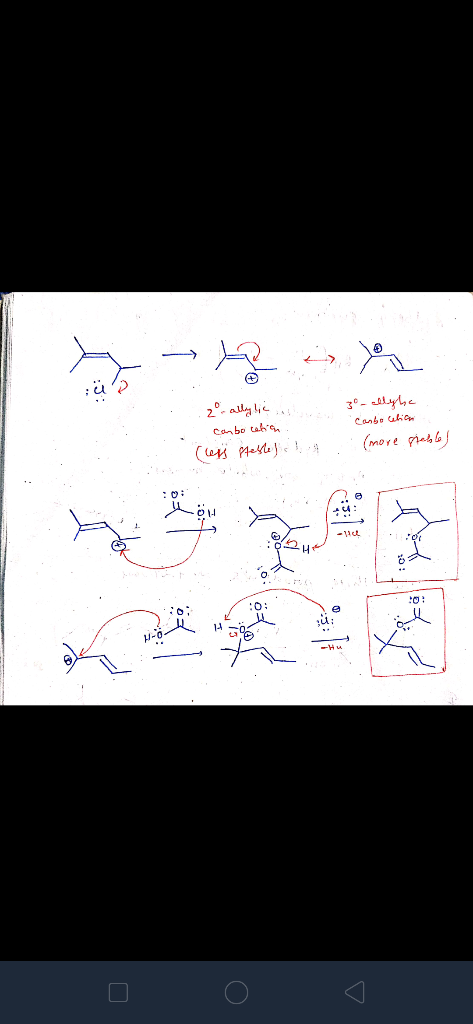
This reaction takes place via SN1 reaction.
Here the formed carbocation under goes resonance to form more stable allylic carbocation. Here, Two intermediates are formed so two products are formed in this reaction.
This is SN1 reaction so the rate of reaction only depends on concentration of alkyl halide.
Because of this reason addition of acetate ion doesn't effect the rate of reaction.
The mechanism of the reaction as follows:
Add Answer to:
4-chloro-2-methyl-2-pentene reacts with acetic acid (solvent), two substitution products are urmea, with the rearranged product predominating...
help please! for 6 and 7. 6) There are a variety of isomeric 1,2,3,4,5,6-hexachlorocyclohexanes, but one...
 help please! for 6 and 7.
6) There are a variety of isomeric 1,2,3,4,5,6-hexachlorocyclohexanes, but one of them does not react with CH CH,O to give an elimination product. Provide the structure of this compound and briefly explain why it does not react (5 points). When 4-chloro-2-methyl-2-pentene reacts with acetic acid (solvent), two substitution products are formed, with the rearranged product predominating as shown in the diagram that follows. When small amounts of acetate ion are added to the reaction...
help please! for 6 and 7.
6) There are a variety of isomeric 1,2,3,4,5,6-hexachlorocyclohexanes, but one of them does not react with CH CH,O to give an elimination product. Provide the structure of this compound and briefly explain why it does not react (5 points). When 4-chloro-2-methyl-2-pentene reacts with acetic acid (solvent), two substitution products are formed, with the rearranged product predominating as shown in the diagram that follows. When small amounts of acetate ion are added to the reaction...
please help with organic chemistry! mechanisms? 5) The reaction of 2-bromo-1,1-dimethylcyclohexane with methanol gives the following...
 please help with organic chemistry! mechanisms?
5) The reaction of 2-bromo-1,1-dimethylcyclohexane with methanol gives the following products. Please provide a detailed explanation to the formation of each product. You should use structures of intermediates in your answer. (8 points). осн, CH,он OCH Br + 6) There are a variety of isomeric 1,2,3,4,5,6-hexachlorocyclohexanes, but one of them does not react with CH3CH20' to give an elimination product. Provide the structure of this compound and briefly explain why it does not react...
please help with organic chemistry! mechanisms?
5) The reaction of 2-bromo-1,1-dimethylcyclohexane with methanol gives the following products. Please provide a detailed explanation to the formation of each product. You should use structures of intermediates in your answer. (8 points). осн, CH,он OCH Br + 6) There are a variety of isomeric 1,2,3,4,5,6-hexachlorocyclohexanes, but one of them does not react with CH3CH20' to give an elimination product. Provide the structure of this compound and briefly explain why it does not react...
give the name of the major product formed shen HCl reacts with 2-pentene Give the name...
 give the name of the major product formed shen HCl reacts with
2-pentene
Give the name of the major product formed when HCl reacts with 2-pentene. O 3-chloropentane O 2,3-dichloropentane O 24hloropentane O There are no major or minor products. There is a 50/50 mixture of both O The reaction doesn't occur.
give the name of the major product formed shen HCl reacts with
2-pentene
Give the name of the major product formed when HCl reacts with 2-pentene. O 3-chloropentane O 2,3-dichloropentane O 24hloropentane O There are no major or minor products. There is a 50/50 mixture of both O The reaction doesn't occur.
1. 3-methyl-1-butene on reaction with H-Cl forms two products, namely 2-chloro-3- methylbutane (minor) and 2-chloro-2-methylbutane (major)....
 1. 3-methyl-1-butene on reaction with H-Cl forms two products, namely 2-chloro-3- methylbutane (minor) and 2-chloro-2-methylbutane (major). Illustrate the mechanism for the formation of these two products. Use curved arrows to illustrate electron movement and all intermediates must be shown. 2. 3,3-dimethyl-1-butene on reaction with HBr forms two products, namely 3-bromo-2,2- dimethylbutane (minor) and 2-bromo-2,3-dimethylbutane (major). Illustrate the mechanism for the formation of these two products. Use curved arrows to illustrate electron movement and all intermediates must be shown. 3. Calculate...
Dehydration of 3-methyl-2-butanol forms one major and two minor organic products. Draw the...
 Acid-catalyzed dehydration of secondary and tertiary alcohols proceeds through an E1 mechanism. The first step is the protonation of alcohol and oxygen to form anoxonium ion.Dehydration of 3-methyl-2-butanol forms one major and two minor organic products. Draw the structures, including hydrogen atoms, of the three organic products ofthis reaction.The 3.) is correct that is the minor product I came up with but I cant get the answer correct for 1.) major product? and 2.) minor product
Dropdown Menus: 1. methyl, primary (unhindered), primary (hindered), secondary, tertiary 2. poor, weakly basic, strongly basic...
 Dropdown Menus:
1. methyl, primary (unhindered), primary (hindered), secondary,
tertiary
2. poor, weakly basic, strongly basic (hindered), strongly basic
(unhindered)
3. protic, aprotic
4. SN2, SN1, E1, E2, SN2 AND E2, SN1 AND E1, No Reaction
5. randomized, inverted, predictable but not inverted,
unchanged
6. a planar carbocation intermediate, backside attack transition
state, anti-periplanar transition state, other
OH Hom 유 용 The Tone The ♡ ♡ Tñ y OH H OH E OH F HO3 G Look at the given...
Dropdown Menus:
1. methyl, primary (unhindered), primary (hindered), secondary,
tertiary
2. poor, weakly basic, strongly basic (hindered), strongly basic
(unhindered)
3. protic, aprotic
4. SN2, SN1, E1, E2, SN2 AND E2, SN1 AND E1, No Reaction
5. randomized, inverted, predictable but not inverted,
unchanged
6. a planar carbocation intermediate, backside attack transition
state, anti-periplanar transition state, other
OH Hom 유 용 The Tone The ♡ ♡ Tñ y OH H OH E OH F HO3 G Look at the given...
the weight if the initial product was 3.4 grams of methyl benzoate. Who |o yald foR 3.91SSg st prodoc...
 the
weight if the initial product was 3.4 grams of methyl
benzoate.
Who |o yald foR 3.91SSg st prodoct nd product 2.14143 EXPERIMENTAL PROCEDURE SAFETY WEAR nitrile gloves for this experiment. The nitrating moture of sulfuric acidnitric acid (1:1) is a very strong acid system. Do not allow it to come in contact with your skin or clothing. It will cause acid burns if it comes in contact with your skin (and holes an your clothes). Wash any affected area...
the
weight if the initial product was 3.4 grams of methyl
benzoate.
Who |o yald foR 3.91SSg st prodoct nd product 2.14143 EXPERIMENTAL PROCEDURE SAFETY WEAR nitrile gloves for this experiment. The nitrating moture of sulfuric acidnitric acid (1:1) is a very strong acid system. Do not allow it to come in contact with your skin or clothing. It will cause acid burns if it comes in contact with your skin (and holes an your clothes). Wash any affected area...
Question 1 The following reaction between 2-methylbut-2-ene and hydrogen bromide (HBr) is best described as what...
 Question 1 The following reaction between 2-methylbut-2-ene and hydrogen bromide (HBr) is best described as what type of reaction? Refer to the Figure A) Addition B) Substitution C) Elimination D) Rearrangement Question 2 For the reaction in question 1, two products are possible- a major product, and a minor product. For the minor product, what is the splitting pattern for the added hydrogen (highlighted in red) that would be observed in the molecules HINMR spectrum? Refer to the Figure HBr...
Give a detailed mechanism for this reaction and give a separation scheme NUCLEOPHILIC ACYL SUBSTITUTION: Synthesis...
 Give a detailed mechanism for this reaction and give a separation
scheme
NUCLEOPHILIC ACYL SUBSTITUTION: Synthesis of an Ester Isoamyl acetate (Banana Oil) Purpose This experiment demonstrat and alcohol. The technique of refluxing the reaction mixture is introduced. es the procedure for the synthesis of an ester from a carboxylic acid Esters are an important functional group in organic chemistry, and esters are found widely distributed in nature. Many lower molecular weight esters are associated with natural fuit flavors and...
Give a detailed mechanism for this reaction and give a separation
scheme
NUCLEOPHILIC ACYL SUBSTITUTION: Synthesis of an Ester Isoamyl acetate (Banana Oil) Purpose This experiment demonstrat and alcohol. The technique of refluxing the reaction mixture is introduced. es the procedure for the synthesis of an ester from a carboxylic acid Esters are an important functional group in organic chemistry, and esters are found widely distributed in nature. Many lower molecular weight esters are associated with natural fuit flavors and...
Calculate the theoretical yield and percent yield for experiments 7, 8, and 9. For experiment 9,...
 Calculate the theoretical yield and percent yield for
experiments 7, 8, and 9. For experiment 9, determine the
theoretical yield based on starting with 0.50g of 3-nitrobenzoic
acid. Show work
Acid I (experiment 7): Weight of methyl 3-nitrobenzoate = 1.9
g
Acid II (experiment 8): Weight of 3-nitrobenzoic acid = 1.75
g
Acid III (experiment 9): Weight of 3-nitrobenzamide = 0.30 g
Experiment 7:
-2.5 mL concentrated H2SO4
-1.75 mL concentrated HNO3 (16M)
-2.1 mL concentrated Methyl Benzoate
Experiment 8:...
Calculate the theoretical yield and percent yield for
experiments 7, 8, and 9. For experiment 9, determine the
theoretical yield based on starting with 0.50g of 3-nitrobenzoic
acid. Show work
Acid I (experiment 7): Weight of methyl 3-nitrobenzoate = 1.9
g
Acid II (experiment 8): Weight of 3-nitrobenzoic acid = 1.75
g
Acid III (experiment 9): Weight of 3-nitrobenzamide = 0.30 g
Experiment 7:
-2.5 mL concentrated H2SO4
-1.75 mL concentrated HNO3 (16M)
-2.1 mL concentrated Methyl Benzoate
Experiment 8:...
 help please! for 6 and 7.
6) There are a variety of isomeric 1,2,3,4,5,6-hexachlorocyclohexanes, but one of them does not react with CH CH,O to give an elimination product. Provide the structure of this compound and briefly explain why it does not react (5 points). When 4-chloro-2-methyl-2-pentene reacts with acetic acid (solvent), two substitution products are formed, with the rearranged product predominating as shown in the diagram that follows. When small amounts of acetate ion are added to the reaction...
help please! for 6 and 7.
6) There are a variety of isomeric 1,2,3,4,5,6-hexachlorocyclohexanes, but one of them does not react with CH CH,O to give an elimination product. Provide the structure of this compound and briefly explain why it does not react (5 points). When 4-chloro-2-methyl-2-pentene reacts with acetic acid (solvent), two substitution products are formed, with the rearranged product predominating as shown in the diagram that follows. When small amounts of acetate ion are added to the reaction...
 please help with organic chemistry! mechanisms?
5) The reaction of 2-bromo-1,1-dimethylcyclohexane with methanol gives the following products. Please provide a detailed explanation to the formation of each product. You should use structures of intermediates in your answer. (8 points). осн, CH,он OCH Br + 6) There are a variety of isomeric 1,2,3,4,5,6-hexachlorocyclohexanes, but one of them does not react with CH3CH20' to give an elimination product. Provide the structure of this compound and briefly explain why it does not react...
please help with organic chemistry! mechanisms?
5) The reaction of 2-bromo-1,1-dimethylcyclohexane with methanol gives the following products. Please provide a detailed explanation to the formation of each product. You should use structures of intermediates in your answer. (8 points). осн, CH,он OCH Br + 6) There are a variety of isomeric 1,2,3,4,5,6-hexachlorocyclohexanes, but one of them does not react with CH3CH20' to give an elimination product. Provide the structure of this compound and briefly explain why it does not react...
 give the name of the major product formed shen HCl reacts with
2-pentene
Give the name of the major product formed when HCl reacts with 2-pentene. O 3-chloropentane O 2,3-dichloropentane O 24hloropentane O There are no major or minor products. There is a 50/50 mixture of both O The reaction doesn't occur.
give the name of the major product formed shen HCl reacts with
2-pentene
Give the name of the major product formed when HCl reacts with 2-pentene. O 3-chloropentane O 2,3-dichloropentane O 24hloropentane O There are no major or minor products. There is a 50/50 mixture of both O The reaction doesn't occur.
 1. 3-methyl-1-butene on reaction with H-Cl forms two products, namely 2-chloro-3- methylbutane (minor) and 2-chloro-2-methylbutane (major). Illustrate the mechanism for the formation of these two products. Use curved arrows to illustrate electron movement and all intermediates must be shown. 2. 3,3-dimethyl-1-butene on reaction with HBr forms two products, namely 3-bromo-2,2- dimethylbutane (minor) and 2-bromo-2,3-dimethylbutane (major). Illustrate the mechanism for the formation of these two products. Use curved arrows to illustrate electron movement and all intermediates must be shown. 3. Calculate...
 Acid-catalyzed dehydration of secondary and tertiary alcohols proceeds through an E1 mechanism. The first step is the protonation of alcohol and oxygen to form anoxonium ion.Dehydration of 3-methyl-2-butanol forms one major and two minor organic products. Draw the structures, including hydrogen atoms, of the three organic products ofthis reaction.The 3.) is correct that is the minor product I came up with but I cant get the answer correct for 1.) major product? and 2.) minor product
 Dropdown Menus:
1. methyl, primary (unhindered), primary (hindered), secondary,
tertiary
2. poor, weakly basic, strongly basic (hindered), strongly basic
(unhindered)
3. protic, aprotic
4. SN2, SN1, E1, E2, SN2 AND E2, SN1 AND E1, No Reaction
5. randomized, inverted, predictable but not inverted,
unchanged
6. a planar carbocation intermediate, backside attack transition
state, anti-periplanar transition state, other
OH Hom 유 용 The Tone The ♡ ♡ Tñ y OH H OH E OH F HO3 G Look at the given...
Dropdown Menus:
1. methyl, primary (unhindered), primary (hindered), secondary,
tertiary
2. poor, weakly basic, strongly basic (hindered), strongly basic
(unhindered)
3. protic, aprotic
4. SN2, SN1, E1, E2, SN2 AND E2, SN1 AND E1, No Reaction
5. randomized, inverted, predictable but not inverted,
unchanged
6. a planar carbocation intermediate, backside attack transition
state, anti-periplanar transition state, other
OH Hom 유 용 The Tone The ♡ ♡ Tñ y OH H OH E OH F HO3 G Look at the given...
 the
weight if the initial product was 3.4 grams of methyl
benzoate.
Who |o yald foR 3.91SSg st prodoct nd product 2.14143 EXPERIMENTAL PROCEDURE SAFETY WEAR nitrile gloves for this experiment. The nitrating moture of sulfuric acidnitric acid (1:1) is a very strong acid system. Do not allow it to come in contact with your skin or clothing. It will cause acid burns if it comes in contact with your skin (and holes an your clothes). Wash any affected area...
the
weight if the initial product was 3.4 grams of methyl
benzoate.
Who |o yald foR 3.91SSg st prodoct nd product 2.14143 EXPERIMENTAL PROCEDURE SAFETY WEAR nitrile gloves for this experiment. The nitrating moture of sulfuric acidnitric acid (1:1) is a very strong acid system. Do not allow it to come in contact with your skin or clothing. It will cause acid burns if it comes in contact with your skin (and holes an your clothes). Wash any affected area...
 Question 1 The following reaction between 2-methylbut-2-ene and hydrogen bromide (HBr) is best described as what type of reaction? Refer to the Figure A) Addition B) Substitution C) Elimination D) Rearrangement Question 2 For the reaction in question 1, two products are possible- a major product, and a minor product. For the minor product, what is the splitting pattern for the added hydrogen (highlighted in red) that would be observed in the molecules HINMR spectrum? Refer to the Figure HBr...
 Give a detailed mechanism for this reaction and give a separation
scheme
NUCLEOPHILIC ACYL SUBSTITUTION: Synthesis of an Ester Isoamyl acetate (Banana Oil) Purpose This experiment demonstrat and alcohol. The technique of refluxing the reaction mixture is introduced. es the procedure for the synthesis of an ester from a carboxylic acid Esters are an important functional group in organic chemistry, and esters are found widely distributed in nature. Many lower molecular weight esters are associated with natural fuit flavors and...
Give a detailed mechanism for this reaction and give a separation
scheme
NUCLEOPHILIC ACYL SUBSTITUTION: Synthesis of an Ester Isoamyl acetate (Banana Oil) Purpose This experiment demonstrat and alcohol. The technique of refluxing the reaction mixture is introduced. es the procedure for the synthesis of an ester from a carboxylic acid Esters are an important functional group in organic chemistry, and esters are found widely distributed in nature. Many lower molecular weight esters are associated with natural fuit flavors and...
 Calculate the theoretical yield and percent yield for
experiments 7, 8, and 9. For experiment 9, determine the
theoretical yield based on starting with 0.50g of 3-nitrobenzoic
acid. Show work
Acid I (experiment 7): Weight of methyl 3-nitrobenzoate = 1.9
g
Acid II (experiment 8): Weight of 3-nitrobenzoic acid = 1.75
g
Acid III (experiment 9): Weight of 3-nitrobenzamide = 0.30 g
Experiment 7:
-2.5 mL concentrated H2SO4
-1.75 mL concentrated HNO3 (16M)
-2.1 mL concentrated Methyl Benzoate
Experiment 8:...
Calculate the theoretical yield and percent yield for
experiments 7, 8, and 9. For experiment 9, determine the
theoretical yield based on starting with 0.50g of 3-nitrobenzoic
acid. Show work
Acid I (experiment 7): Weight of methyl 3-nitrobenzoate = 1.9
g
Acid II (experiment 8): Weight of 3-nitrobenzoic acid = 1.75
g
Acid III (experiment 9): Weight of 3-nitrobenzamide = 0.30 g
Experiment 7:
-2.5 mL concentrated H2SO4
-1.75 mL concentrated HNO3 (16M)
-2.1 mL concentrated Methyl Benzoate
Experiment 8:...
Most questions answered within 3 hours.
-
Where is the error in this code sequence?
String s1 = "Hello";
String s2 = "ello";...
asked 11 months ago -
Financial data for Joel de Paris, Inc., for last year
follow:
Joel de Paris, Inc.
Balance...
asked 11 months ago -
Consider this reaction:
Al2(SO4)3 (aq)+ BaCl3
(aq) Al2Cl6 (aq)- +
3BaSO4(s) . What is the...
asked 11 months ago -
Suppose that Savneet is considering increasing her
recent random sample from 20 car rentals to 40...
asked 11 months ago -
Trucks arrive at an unloading terminal at an average rate of 120
per hour.
Trucks arrive...
asked 11 months ago -
Why are methanol and ethanol completely soluble in water while
octanol is not very little soluble....
asked 11 months ago -
A facilities manager at a university reads in a research report
that the mean amount of...
asked 11 months ago -
When the CuSO4 is rehydrated by adding water to the anhydrous
compound, is this an endothermic...
asked 11 months ago -
A ray of sunlight is passing from diamond into crown glass; the
angle of incidence is...
asked 11 months ago -
A block of mass 0.249 kg is placed on top of a light, vertical
spring of...
asked 11 months ago -
how do the kidneys compensate in the presences of acidosis
a) trigger hyperventilate
b) reserve acid...
asked 11 months ago -
Question 501 pts
The rental rate of capital to the firm increases. Which of the
following...
asked 11 months ago