
Homework Answers
Add Answer to:
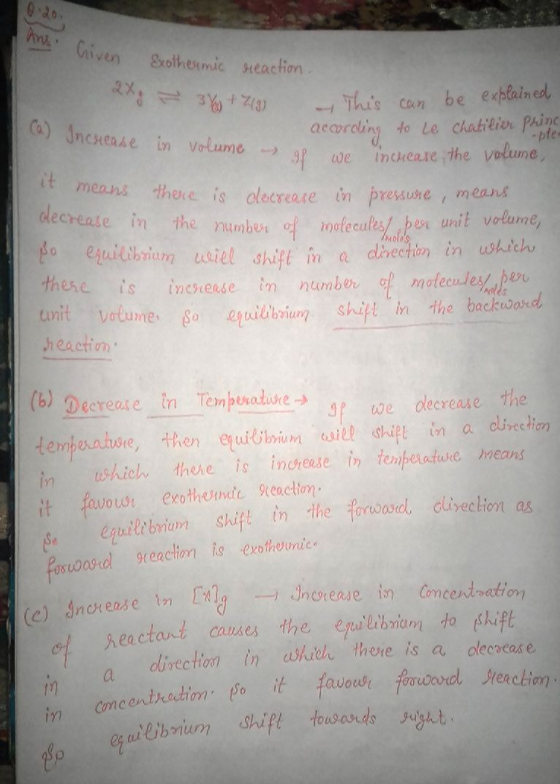
please help with #20 and 21. showing all work 20. (6pts) Consider the exothermic (left to right) reaction: 2X60)...
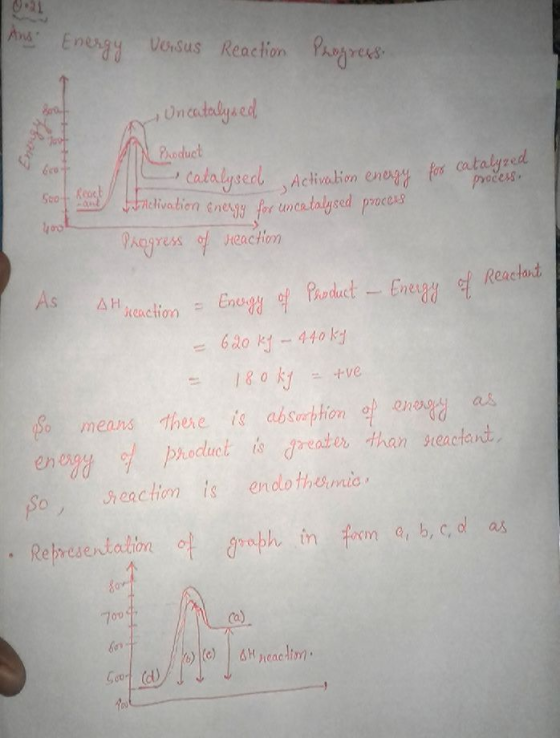
21. The graph of ln A versus time for a reaction: a. allows to determine if the reaction is exothermic b. allows to calc...
21. The graph of ln A versus time for a reaction: a. allows to determine if the reaction is exothermic b. allows to calculate the value of the reaction rate constant C. allows to calculate the activation energy of the reaction d. all of the above
i need help with both , thank you CHEMI21 Quiz #5 Show your work and circle...
 i need help with both , thank you
CHEMI21 Quiz #5 Show your work and circle your answer. Name: 1. The reaction A+B → AB has a AH -130 kJ and an activation energy (E) of 50 kJ. Use this information to complete the following: a. On the back side, sketch the energy vs. progress of reaction graph approximately to scale. For full credit label the axes, reactants, products, activation energy, and AH on your graph. b. Write the reaction...
i need help with both , thank you
CHEMI21 Quiz #5 Show your work and circle your answer. Name: 1. The reaction A+B → AB has a AH -130 kJ and an activation energy (E) of 50 kJ. Use this information to complete the following: a. On the back side, sketch the energy vs. progress of reaction graph approximately to scale. For full credit label the axes, reactants, products, activation energy, and AH on your graph. b. Write the reaction...
When a graph of energy vs, reaction progress was graphed for the reaction A + B...
 When a graph of energy vs, reaction progress was graphed for the reaction A + B rightarrow C + D, the following data was obtained: a) Draw a rough sketch of what this activation energy diagram looks like. Make sure axes and points are labeled appropriately. B) What is the numerical value of the activation energy obtained from the graph? c) Are reactants or products more stable? d) Is the reaction endothermic or exothermic? Explain. d) On the graph you...
Model 1 - Potential Energy Diagrams 1) The energy (enthalpy) change of a reaction can be...
 Model 1 - Potential Energy Diagrams 1) The energy (enthalpy) change of a reaction can be determined by the following expression: Activated Complex Transition State AH = Energy products - Energy reactants Activation Energy, E Reactants Consider the energy change for the reaction in Model 1 (the graph to the left). Potential Energy (kJ/mol) Energy change (AH) Products a) The energy change shown is (positive/negative). b) This reaction is (endothermic / exothermic). c) These (reactants / transition state) has more...
Credit for work. Thank you 14 14) (a) For the reaction of CH) + C&H) -...
 Credit for work. Thank you
14 14) (a) For the reaction of CH) + C&H) - CH10. The activation energy (E.) for the forward readtion is 115 kJ/mol, and the activation for the reverse reaction (decomposition of cyclohexene to ethylene and butadiene) is 287 mol. Draw the energy diagram (potential energy versus progress of the reaction) (b) Calculate the heat of reaction, a H . for the forward reaction Show it on the graph. Is the reaction endothermic or exothermic?...
Credit for work. Thank you
14 14) (a) For the reaction of CH) + C&H) - CH10. The activation energy (E.) for the forward readtion is 115 kJ/mol, and the activation for the reverse reaction (decomposition of cyclohexene to ethylene and butadiene) is 287 mol. Draw the energy diagram (potential energy versus progress of the reaction) (b) Calculate the heat of reaction, a H . for the forward reaction Show it on the graph. Is the reaction endothermic or exothermic?...
Name Wkst #16 CHEM& 162 1. Consider the following proposed reaction mechanism. 12 = 21 1...
 Name Wkst #16 CHEM& 162 1. Consider the following proposed reaction mechanism. 12 = 21 1 + O₂ → 10₂ + 0 0+ 03 - 202 1 +10, -12 + O2 A. What is the overall reaction? B. What are the intermediates and catalysts? Intermediates: Catalysts: C. If the first step is in equilibrium and the second step is slow. what is the overall rate law? Remember, intermediates cannot appear in the final rate law! Rate = D. On the...
suis reaction progress (x axis) for a typical 4. Sketch a plot of energy Swatch a...
 suis reaction progress (x axis) for a typical 4. Sketch a plot of energy Swatch a plot of energy (y axis) versus reaction progress xaxis for on Then, draw another line onto the same plot which shows how the draw when the reaction occurs in the presence of a catalyst. Label each line chemical reaction in terms of the meaning in how a catalyst increases the rate or a chemical reaction in terms of the Explain how a cada of...
4. (22 pts) Consider the following exothermic reaction: H2O2 +2t + 2H' → 12 + 2H20...
 4. (22 pts) Consider the following exothermic reaction: H2O2 +2t + 2H' → 12 + 2H20 Consider the following mechanism for this reaction H,02 + r-* Hol + OH' Hol + r- 12 + он. 20H 2H2 H20 slow fast fast a) What species are intermediates in the above mechanism? Any catalysts? b) Sketch an energy versus reaction progress plot for the three step mechanism and clearly label the rate determining step in your diagram. c) What rate law would...
4Sketch a plot of energy ( ) versus reaction progress avis) for atypical exotherme reaction. Then...
 4Sketch a plot of energy ( ) versus reaction progress avis) for atypical exotherme reaction. Then draw another line onto the same plot which shows how the curve changes when the reaction occurs in the presence of a catalyst Label each line Explain how a catalyst increases the rate of a chemical reaction in terms of the meaning of your plot 5. Consider the reaction in Exercise 4: a. Would this reaction favor formation of mostly products or mostly reactants?...
help with all of these please 19. For a certain reaction, AH -35.4 kJ and AS...
 help with all of these please
19. For a certain reaction, AH -35.4 kJ and AS - 85.5 / a) is the reaction endothermic or exothermic? b) Does the reaction lead to an increase or decrease in the disorder of the system? c) Calculate AGº for the reaction at 298K d) is the reaction spontaneous at 298K? 20. The sublimation of solid carbon dioxide is a spontaneous process. Predict the sign (+,-, or 0) of AG", AH", and As,", respectively....
help with all of these please
19. For a certain reaction, AH -35.4 kJ and AS - 85.5 / a) is the reaction endothermic or exothermic? b) Does the reaction lead to an increase or decrease in the disorder of the system? c) Calculate AGº for the reaction at 298K d) is the reaction spontaneous at 298K? 20. The sublimation of solid carbon dioxide is a spontaneous process. Predict the sign (+,-, or 0) of AG", AH", and As,", respectively....
 i need help with both , thank you
CHEMI21 Quiz #5 Show your work and circle your answer. Name: 1. The reaction A+B → AB has a AH -130 kJ and an activation energy (E) of 50 kJ. Use this information to complete the following: a. On the back side, sketch the energy vs. progress of reaction graph approximately to scale. For full credit label the axes, reactants, products, activation energy, and AH on your graph. b. Write the reaction...
i need help with both , thank you
CHEMI21 Quiz #5 Show your work and circle your answer. Name: 1. The reaction A+B → AB has a AH -130 kJ and an activation energy (E) of 50 kJ. Use this information to complete the following: a. On the back side, sketch the energy vs. progress of reaction graph approximately to scale. For full credit label the axes, reactants, products, activation energy, and AH on your graph. b. Write the reaction...
 When a graph of energy vs, reaction progress was graphed for the reaction A + B rightarrow C + D, the following data was obtained: a) Draw a rough sketch of what this activation energy diagram looks like. Make sure axes and points are labeled appropriately. B) What is the numerical value of the activation energy obtained from the graph? c) Are reactants or products more stable? d) Is the reaction endothermic or exothermic? Explain. d) On the graph you...
 Model 1 - Potential Energy Diagrams 1) The energy (enthalpy) change of a reaction can be determined by the following expression: Activated Complex Transition State AH = Energy products - Energy reactants Activation Energy, E Reactants Consider the energy change for the reaction in Model 1 (the graph to the left). Potential Energy (kJ/mol) Energy change (AH) Products a) The energy change shown is (positive/negative). b) This reaction is (endothermic / exothermic). c) These (reactants / transition state) has more...
 Credit for work. Thank you
14 14) (a) For the reaction of CH) + C&H) - CH10. The activation energy (E.) for the forward readtion is 115 kJ/mol, and the activation for the reverse reaction (decomposition of cyclohexene to ethylene and butadiene) is 287 mol. Draw the energy diagram (potential energy versus progress of the reaction) (b) Calculate the heat of reaction, a H . for the forward reaction Show it on the graph. Is the reaction endothermic or exothermic?...
Credit for work. Thank you
14 14) (a) For the reaction of CH) + C&H) - CH10. The activation energy (E.) for the forward readtion is 115 kJ/mol, and the activation for the reverse reaction (decomposition of cyclohexene to ethylene and butadiene) is 287 mol. Draw the energy diagram (potential energy versus progress of the reaction) (b) Calculate the heat of reaction, a H . for the forward reaction Show it on the graph. Is the reaction endothermic or exothermic?...
 Name Wkst #16 CHEM& 162 1. Consider the following proposed reaction mechanism. 12 = 21 1 + O₂ → 10₂ + 0 0+ 03 - 202 1 +10, -12 + O2 A. What is the overall reaction? B. What are the intermediates and catalysts? Intermediates: Catalysts: C. If the first step is in equilibrium and the second step is slow. what is the overall rate law? Remember, intermediates cannot appear in the final rate law! Rate = D. On the...
 suis reaction progress (x axis) for a typical 4. Sketch a plot of energy Swatch a plot of energy (y axis) versus reaction progress xaxis for on Then, draw another line onto the same plot which shows how the draw when the reaction occurs in the presence of a catalyst. Label each line chemical reaction in terms of the meaning in how a catalyst increases the rate or a chemical reaction in terms of the Explain how a cada of...
 4. (22 pts) Consider the following exothermic reaction: H2O2 +2t + 2H' → 12 + 2H20 Consider the following mechanism for this reaction H,02 + r-* Hol + OH' Hol + r- 12 + он. 20H 2H2 H20 slow fast fast a) What species are intermediates in the above mechanism? Any catalysts? b) Sketch an energy versus reaction progress plot for the three step mechanism and clearly label the rate determining step in your diagram. c) What rate law would...
 4Sketch a plot of energy ( ) versus reaction progress avis) for atypical exotherme reaction. Then draw another line onto the same plot which shows how the curve changes when the reaction occurs in the presence of a catalyst Label each line Explain how a catalyst increases the rate of a chemical reaction in terms of the meaning of your plot 5. Consider the reaction in Exercise 4: a. Would this reaction favor formation of mostly products or mostly reactants?...
 help with all of these please
19. For a certain reaction, AH -35.4 kJ and AS - 85.5 / a) is the reaction endothermic or exothermic? b) Does the reaction lead to an increase or decrease in the disorder of the system? c) Calculate AGº for the reaction at 298K d) is the reaction spontaneous at 298K? 20. The sublimation of solid carbon dioxide is a spontaneous process. Predict the sign (+,-, or 0) of AG", AH", and As,", respectively....
help with all of these please
19. For a certain reaction, AH -35.4 kJ and AS - 85.5 / a) is the reaction endothermic or exothermic? b) Does the reaction lead to an increase or decrease in the disorder of the system? c) Calculate AGº for the reaction at 298K d) is the reaction spontaneous at 298K? 20. The sublimation of solid carbon dioxide is a spontaneous process. Predict the sign (+,-, or 0) of AG", AH", and As,", respectively....
Most questions answered within 3 hours.
-
Where is the error in this code sequence?
String s1 = "Hello";
String s2 = "ello";...
asked 10 months ago -
Financial data for Joel de Paris, Inc., for last year
follow:
Joel de Paris, Inc.
Balance...
asked 10 months ago -
Consider this reaction:
Al2(SO4)3 (aq)+ BaCl3
(aq) Al2Cl6 (aq)- +
3BaSO4(s) . What is the...
asked 10 months ago -
Suppose that Savneet is considering increasing her
recent random sample from 20 car rentals to 40...
asked 10 months ago -
Trucks arrive at an unloading terminal at an average rate of 120
per hour.
Trucks arrive...
asked 10 months ago -
Why are methanol and ethanol completely soluble in water while
octanol is not very little soluble....
asked 10 months ago -
A facilities manager at a university reads in a research report
that the mean amount of...
asked 10 months ago -
When the CuSO4 is rehydrated by adding water to the anhydrous
compound, is this an endothermic...
asked 10 months ago -
A ray of sunlight is passing from diamond into crown glass; the
angle of incidence is...
asked 10 months ago -
A block of mass 0.249 kg is placed on top of a light, vertical
spring of...
asked 10 months ago -
how do the kidneys compensate in the presences of acidosis
a) trigger hyperventilate
b) reserve acid...
asked 10 months ago -
Question 501 pts
The rental rate of capital to the firm increases. Which of the
following...
asked 10 months ago