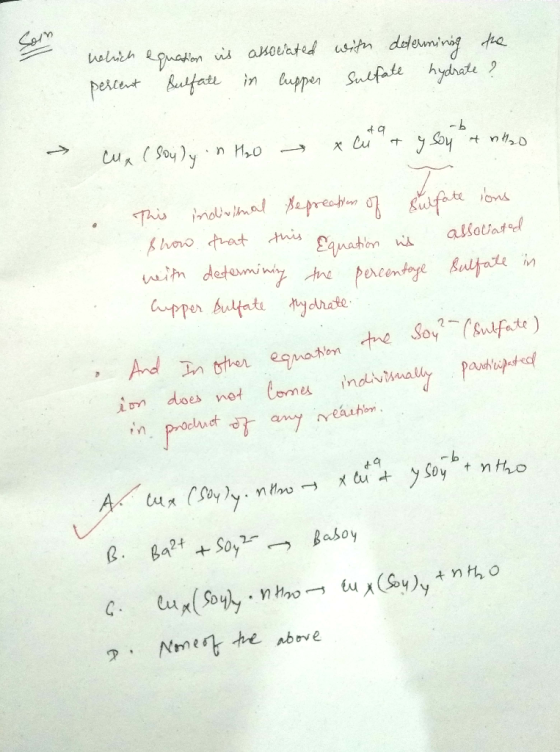
Which equation is associated with determining the percent sulfate in copper sulfate hydrate? A. Cux (SO4)y•nH2O → x...
Which equation is associated with determining the percent sulfate in copper sulfate hydrate?
| A. |
Cux (SO4)y•nH2O → x Cu+a + ySO4-b + nH2O |
|
| B. |
Ba2+ + SO42- → BaSO4 |
|
| C. |
Cux (SO4)y•nH2O → Cux (SO4)y + nH2O |
|
| D. |
None of the above |
Homework Answers
Add Answer to:
Which equation is associated with determining the percent sulfate in copper sulfate hydrate? A. Cux (SO4)y•nH2O → x...
5) The total mass of a crucible and some copper(II) sulfate hydrate in the cruible was...
 5) The total mass of a crucible and some copper(II) sulfate hydrate in the cruible was 34.567 g. The crucible (with copper (II) sulfate hydrate in it was heated at 110 °C for 30 minutes. And the total mass decreased to 33.125 g. How many grams of mass was lost during heating? B) 1.44g A) 1.4420g C) 18 D) 1.4g E) 1.442g 6) Assuming that all are measured quantities, complete the following operation and express the result in the correct...
20) When solutions copper(II) sulti AC utions of sodium sulfide and copper(II) sulfate are mixed, a...
 20) When solutions copper(II) sulti AC utions of sodium sulfide and copper(II) sulfate are mixed, a precipitate of of (11) sulfide is formed. What is the net ionic equation for this reaction? i Cu²+ (aq) + S2-(ag) Curs) + S B) Na2S(aq) + CuSO4(aq) + CuS(s) C) 2Na+ (aq) + (aq) + Cu2+ (aq) + SO42-ag) 2Nat(ag) + SO42-lag) D) Na2S(aq) + CuSO4(aq) - Na2SO4(aq) + Cu(s) E) Cu2+ (aq) + 52-ag) - CuS(s) 40) 41 Choose the best classification...
With which of the following anions will the lithium ion form an insoluble salt? a) sulfate,...
With which of the following anions will the lithium ion form an insoluble salt? a) sulfate, SO42- b) carbonate, CO32- c) sulfate and carbonate d) chloride, Cl- e) none of the above
30. In the following equation which one of the compounds is acting as an acid H2(SO4)...
30. In the following equation which one of the compounds is acting as an acid H2(SO4) + H2O --> HSO4- + H3O+ a. H2O (Incorrect) b. H2SO4 c. H3O+ d. HSO4- e. none of the above
used to titrate a solution of iron(II) ions., with which it reacts according to Cerium(IV) sulfate...
 used to titrate a solution of iron(II) ions., with which it reacts according to Cerium(IV) sulfate Ce4(aq)Fe2 (aq)>Ce3*(aq) + Fe3 (aq) A cerium(IV) sulfate solution is prepared by dissolving 40.47 g of Ce(SO42 in water and diluting to a total volume of 1.000 L. A total of 19.41 mL of this solution is required to reach the endpoint in a titration of a 100.0-mL sample containing Fe(aq). Determine the concentration of Fe2 in the original solution It is desired precipitate,...
(4) Thermodynamic data suggests that copper monohalides (CuX) should exist as polymers in the gas...
 (4) Thermodynamic data suggests that copper monohalides (CuX) should exist as polymers in the gas phaso However, scientists have successfully synthesized CuX monomers and characterized them using microwave spectroscopy For Cu Br the J-13 14,J-1415 and J-1516 transitions occurred at 84421.34 MHz, 90449.25 MHz and 96476.72 MHz, respectively. Assuming Cu Br behaves as a 3D rigid rotor, answer the following questions. Note: Absorption frequency (in units of Hz) of a rotational transition (aka peak position in a microwave spectrum) corresponding...
16) 16. Which of the following represents y as a one-to-one function of x? A) y...
 16) 16. Which of the following represents y as a one-to-one function of x? A) y = x+ B) y = x3 C) {(3,4),(4,5),(5,6), (6,6)} D) x = y2 E) None of the Above x+3 (x-1)(x-3)? 17) 17. Which best describes the intercepts for the graph of g(x) = A) x-intercept at x = -3 and y-intercept at y = 1 B) x-intercepts at x = 1 and x = 3 and y-intercept at y = -3 C) x-intercepts at...
3. Cerium (II) sulfate dissolves in water and releases heat (exothermic reaction). Ce2(SO4)(s)2 Ce (aq) +3...
 3. Cerium (II) sulfate dissolves in water and releases heat (exothermic reaction). Ce2(SO4)(s)2 Ce (aq) +3 SO (aq) a. Write the word "heat" on the appropriate side of the equation above. b. What effect will heating a saturated solution of this salt have? C. What will happen to the equilibrium if more SO ions are added to the solution? d. What will happen if Ba2 ions are added to the solution, causing the SO, to precipitate? 4. Which of the...
Experiment 6 PRE-LABORATORY PROBLEMS NAME 1. Write a purpose statement and a summary of the procedure...
 Experiment 6 PRE-LABORATORY PROBLEMS NAME 1. Write a purpose statement and a summary of the procedure to include special technique equipment, chemicals, and chemical reactions to be performed, an understanding of any calculations that are important to understanding the procedure. 2. Calculate the molar mass of copper (II) Sulfate pentahydrate, Cuso,5H.O. 3. Calculate the mass percent of water present in Copper(II) sulfate pentahydrate. 4. Define the term hydrate and anhydrous. S. A 2.000 gram sample of hydrated barium carbonate was...
40. Concentrated aqueous ammonia is added to a solution of copper(II) sulfate. A white precipitate forms....
 40. Concentrated aqueous ammonia is added to a solution of copper(II) sulfate. A white precipitate forms. The precipitate dissolves as more ammonia is added, generating an intensely blue solution. Which combination of net ionic equations, in the appropriate order, describes this chemistry?! I Cu?* (aq) + 2OH(aq) Cu(OH)2 (19) II Cu?" (aq) + 2OH(aq) = Cu(OH)2 (8) III Cu(OH)(aq) + 4 NH, (aq) Cu(NH3),?* () + 2OH(aq) IV Cu(OH)2 (8) + 4NH, (aq) Cu(NH3)*(14) + 2OH(aq) V NH3(aq) + H20...
 5) The total mass of a crucible and some copper(II) sulfate hydrate in the cruible was 34.567 g. The crucible (with copper (II) sulfate hydrate in it was heated at 110 °C for 30 minutes. And the total mass decreased to 33.125 g. How many grams of mass was lost during heating? B) 1.44g A) 1.4420g C) 18 D) 1.4g E) 1.442g 6) Assuming that all are measured quantities, complete the following operation and express the result in the correct...
 20) When solutions copper(II) sulti AC utions of sodium sulfide and copper(II) sulfate are mixed, a precipitate of of (11) sulfide is formed. What is the net ionic equation for this reaction? i Cu²+ (aq) + S2-(ag) Curs) + S B) Na2S(aq) + CuSO4(aq) + CuS(s) C) 2Na+ (aq) + (aq) + Cu2+ (aq) + SO42-ag) 2Nat(ag) + SO42-lag) D) Na2S(aq) + CuSO4(aq) - Na2SO4(aq) + Cu(s) E) Cu2+ (aq) + 52-ag) - CuS(s) 40) 41 Choose the best classification...
 used to titrate a solution of iron(II) ions., with which it reacts according to Cerium(IV) sulfate Ce4(aq)Fe2 (aq)>Ce3*(aq) + Fe3 (aq) A cerium(IV) sulfate solution is prepared by dissolving 40.47 g of Ce(SO42 in water and diluting to a total volume of 1.000 L. A total of 19.41 mL of this solution is required to reach the endpoint in a titration of a 100.0-mL sample containing Fe(aq). Determine the concentration of Fe2 in the original solution It is desired precipitate,...
 (4) Thermodynamic data suggests that copper monohalides (CuX) should exist as polymers in the gas phaso However, scientists have successfully synthesized CuX monomers and characterized them using microwave spectroscopy For Cu Br the J-13 14,J-1415 and J-1516 transitions occurred at 84421.34 MHz, 90449.25 MHz and 96476.72 MHz, respectively. Assuming Cu Br behaves as a 3D rigid rotor, answer the following questions. Note: Absorption frequency (in units of Hz) of a rotational transition (aka peak position in a microwave spectrum) corresponding...
 16) 16. Which of the following represents y as a one-to-one function of x? A) y = x+ B) y = x3 C) {(3,4),(4,5),(5,6), (6,6)} D) x = y2 E) None of the Above x+3 (x-1)(x-3)? 17) 17. Which best describes the intercepts for the graph of g(x) = A) x-intercept at x = -3 and y-intercept at y = 1 B) x-intercepts at x = 1 and x = 3 and y-intercept at y = -3 C) x-intercepts at...
 3. Cerium (II) sulfate dissolves in water and releases heat (exothermic reaction). Ce2(SO4)(s)2 Ce (aq) +3 SO (aq) a. Write the word "heat" on the appropriate side of the equation above. b. What effect will heating a saturated solution of this salt have? C. What will happen to the equilibrium if more SO ions are added to the solution? d. What will happen if Ba2 ions are added to the solution, causing the SO, to precipitate? 4. Which of the...
 Experiment 6 PRE-LABORATORY PROBLEMS NAME 1. Write a purpose statement and a summary of the procedure to include special technique equipment, chemicals, and chemical reactions to be performed, an understanding of any calculations that are important to understanding the procedure. 2. Calculate the molar mass of copper (II) Sulfate pentahydrate, Cuso,5H.O. 3. Calculate the mass percent of water present in Copper(II) sulfate pentahydrate. 4. Define the term hydrate and anhydrous. S. A 2.000 gram sample of hydrated barium carbonate was...
 40. Concentrated aqueous ammonia is added to a solution of copper(II) sulfate. A white precipitate forms. The precipitate dissolves as more ammonia is added, generating an intensely blue solution. Which combination of net ionic equations, in the appropriate order, describes this chemistry?! I Cu?* (aq) + 2OH(aq) Cu(OH)2 (19) II Cu?" (aq) + 2OH(aq) = Cu(OH)2 (8) III Cu(OH)(aq) + 4 NH, (aq) Cu(NH3),?* () + 2OH(aq) IV Cu(OH)2 (8) + 4NH, (aq) Cu(NH3)*(14) + 2OH(aq) V NH3(aq) + H20...
Most questions answered within 3 hours.
-
Where is the error in this code sequence?
String s1 = "Hello";
String s2 = "ello";...
asked 10 months ago -
Financial data for Joel de Paris, Inc., for last year
follow:
Joel de Paris, Inc.
Balance...
asked 10 months ago -
Consider this reaction:
Al2(SO4)3 (aq)+ BaCl3
(aq) Al2Cl6 (aq)- +
3BaSO4(s) . What is the...
asked 10 months ago -
Suppose that Savneet is considering increasing her
recent random sample from 20 car rentals to 40...
asked 10 months ago -
Trucks arrive at an unloading terminal at an average rate of 120
per hour.
Trucks arrive...
asked 10 months ago -
Why are methanol and ethanol completely soluble in water while
octanol is not very little soluble....
asked 10 months ago -
A facilities manager at a university reads in a research report
that the mean amount of...
asked 10 months ago -
When the CuSO4 is rehydrated by adding water to the anhydrous
compound, is this an endothermic...
asked 10 months ago -
A ray of sunlight is passing from diamond into crown glass; the
angle of incidence is...
asked 10 months ago -
A block of mass 0.249 kg is placed on top of a light, vertical
spring of...
asked 10 months ago -
how do the kidneys compensate in the presences of acidosis
a) trigger hyperventilate
b) reserve acid...
asked 10 months ago -
Question 501 pts
The rental rate of capital to the firm increases. Which of the
following...
asked 10 months ago