
Homework Answers
Add Answer to:
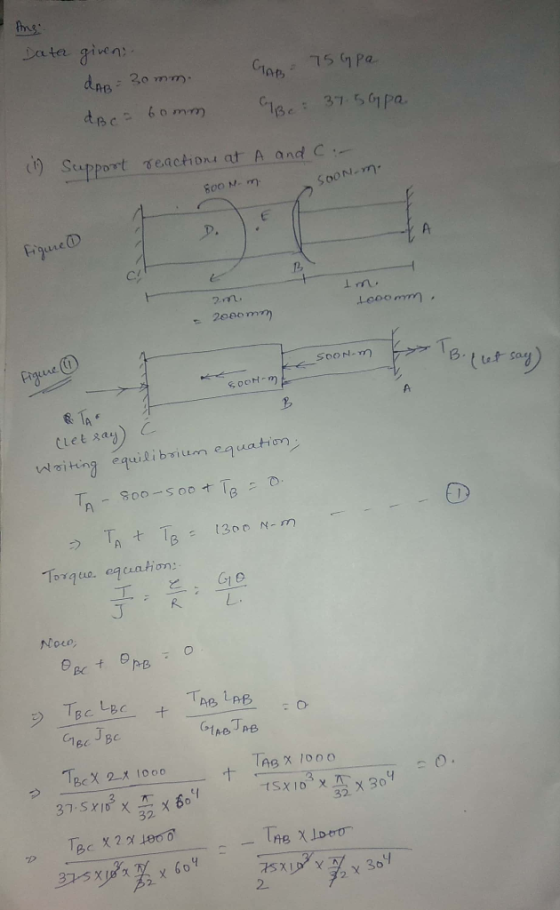
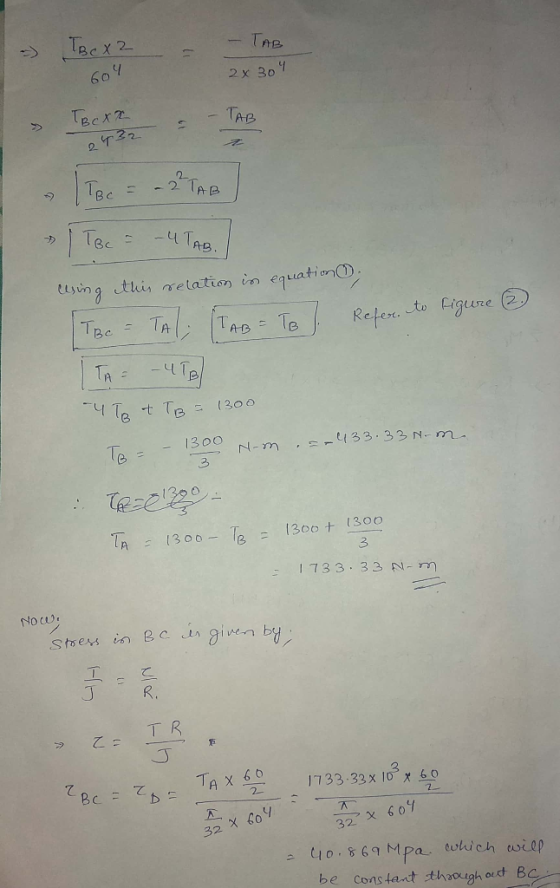
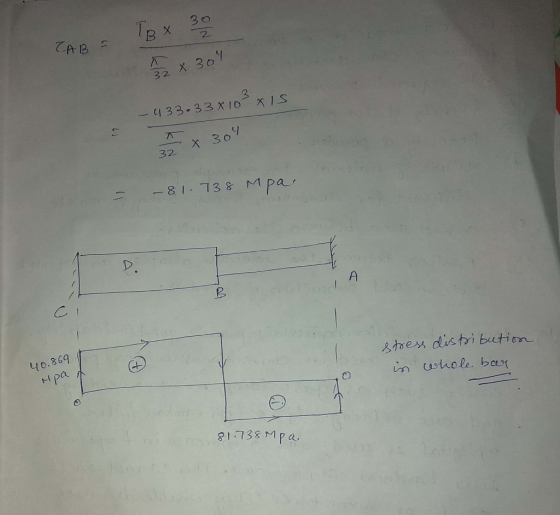
3. A rod is made from two segments: AB is steel and BC is brass. It is fixed at its ends and subjected to two torqu...
A rod is made from two segments: AB is steel and BC is brass. It is...
 A rod is made from two segments: AB is steel and BC is brass. It is fixed at its ends and subjected to a torque of T = 615 Nm. The steel portion has a diameter of 30 mm c B 1.60 m A 0.75 m G t = 75GPa, Gb = 39 GPa Part A Determine the required diameter of the brass portion so the reactions at the walls will be the same. Express your answer to three significant...
Problem 5.88 A rod is made from two segments AB is steel and BC s brass. It is foxed at its ends and subjected to a...
 Problem 5.88 A rod is made from two segments AB is steel and BC s brass. It is foxed at its ends and subjected to a torque of T 680 N-m Ga 75 GPa G 39 GPa (Figure 1) Part A Express your answer to three significant figures and include the appropriate units 因 Figure 1 of 1 ? d Value Units 60 m N-m Provide Feedback .75 m
3. A rod consisting of two cylindrical portions AB and BC is restrained at both ends,...
 3. A rod consisting of two cylindrical portions AB and BC is restrained at both ends, as shown in figure Q3 below. Portion AB is made of brass (E 105 Gpa, and ь-20.9 x 10⁻⁶ per °C) and portion BC is made out of aluminum (Eb 72 Gpa, and otb 23.9 x 10⁶ per °C). The rod is initially unstressed at room temperature of 20 °C. If the temperature changes to 62 °C, find: a) the resulting normal stress in...
A rod consisting of two cylindrical portions AB and BC is restrained at both ends. Portion...
 A rod consisting of two cylindrical portions AB and BC is restrained at both ends. Portion AB is made of steel (E, -200 GPa 17 c)and portion BC is made of brass (E,-105 GPa, b-20.9 x 10⁻⁶/C) Knowing that the rod is initially unstressed, determine the compressive force induced inABC when there is a temperature rise of 53 °C 30-mm diameter 200 mm 56-mm diameter 380 mm
A rod consist of two cylindrical portions AB and BC is restrained at both ends. Portion...
 A rod consist of two cylindrical portions AB and BC is restrained at both ends. Portion AB is made of steel with the following properties (Es 200 GPa, as 11.7 x 10 6/C) and portion BC is made of brass with the following properties (E, 105 GPa, a 20.9 x 10 6/°C). Determine the compressive force induced in ABC when there is a temperature rise of 50°C, knowing that the rod is initially unstressed 2. 30-mm diameter 250 mm
Two brass rods, AB and BC. Find (a) Length of rod AB for which the max. normal stress in ABC is...
Two brass rods AB and BC, each of uniform diameter, will bebrazed together at B to form a nonuniform rod of total length100 m which will be suspended from a support at A as shown.Knowing that the density of brass is 8470 kg/m3, determine (a) thelength of rod AB for which the maximum normal stress in ABC isminimum, (b) the corresponding value of the maximum normalstress.
A rod consisting of two cylindrical portions AB and BC is restrained at both ends. Portion...
A rod consisting of two cylindrical portions AB and BC is restrained at both ends. Portion AB is made of steel (Es = 200 GPa and αs = 11.7 × 10⁻⁶/°C) and portion BC is made of brass (Eb = 105 GPa and αb = 20.9 × 10⁻⁶/°C). Knowing that the rod is initially unstressed, determine the compressive force induced in ABC when there is a temperature rise of 70°C. (Round the final answer to one decimal place.)
PROBLEM 1.6 Two brass rods AB and BC, each of uniform diameter, will be brazed together...
 PROBLEM 1.6 Two brass rods AB and BC, each of uniform diameter, will be brazed together at B to form a nonuniform rod of total length 100 m, which will be suspended from a support at A as shown. Knowing that the density of brass is 8470 kg/m, determine (a) the length of rod AB for which the maximum normal stress in ABC is minimum, (b) the corresponding value of the maximum normal stress. (l 15 mm 100 m
The C83400-red-brass (E=14.6*10^6) rod AB and 2014-T6-aluminum rod BC are joined at the collar B and...
The C83400-red-brass (E=14.6*10^6) rod AB and 2014-T6-aluminum rod BC are joined at the collar B and fixed connected at their ends. The cross-sectional area of each member is 1.75in2 . If there is no load in the members when T1 = 50?F, determine the average normal stress in the member BC when T2 = 150 ?F. Also, how far will the collar be displaced? The C83400-red-brass (E=14.6*10^6) rod AB and 2014-T6-aluminum rod BC are joined at the collar B and...
4.11. A shaft ABC is made of two segments AB and BC (Figure 4. 11). Segment...
 4.11. A shaft ABC is made of two segments AB and BC (Figure 4. 11). Segment 4B is solid with a diameter of 100 mm and BC is hollowed with an outer diameter of 75 mm and wall thickness of 5 mm. The shear modulus is 80 GPa for segment AB and 60 GPa for BC Extemal torques To=25 Nm in the counter-clockwise direction is applied at Cand 1s=10 Nm in the clockwise direction is applied at B. A counter-clockwise...
 A rod is made from two segments: AB is steel and BC is brass. It is fixed at its ends and subjected to a torque of T = 615 Nm. The steel portion has a diameter of 30 mm c B 1.60 m A 0.75 m G t = 75GPa, Gb = 39 GPa Part A Determine the required diameter of the brass portion so the reactions at the walls will be the same. Express your answer to three significant...
 Problem 5.88 A rod is made from two segments AB is steel and BC s brass. It is foxed at its ends and subjected to a torque of T 680 N-m Ga 75 GPa G 39 GPa (Figure 1) Part A Express your answer to three significant figures and include the appropriate units 因 Figure 1 of 1 ? d Value Units 60 m N-m Provide Feedback .75 m
 3. A rod consisting of two cylindrical portions AB and BC is restrained at both ends, as shown in figure Q3 below. Portion AB is made of brass (E 105 Gpa, and ь-20.9 x 10⁻⁶ per °C) and portion BC is made out of aluminum (Eb 72 Gpa, and otb 23.9 x 10⁶ per °C). The rod is initially unstressed at room temperature of 20 °C. If the temperature changes to 62 °C, find: a) the resulting normal stress in...
 A rod consisting of two cylindrical portions AB and BC is restrained at both ends. Portion AB is made of steel (E, -200 GPa 17 c)and portion BC is made of brass (E,-105 GPa, b-20.9 x 10⁻⁶/C) Knowing that the rod is initially unstressed, determine the compressive force induced inABC when there is a temperature rise of 53 °C 30-mm diameter 200 mm 56-mm diameter 380 mm
 A rod consist of two cylindrical portions AB and BC is restrained at both ends. Portion AB is made of steel with the following properties (Es 200 GPa, as 11.7 x 10 6/C) and portion BC is made of brass with the following properties (E, 105 GPa, a 20.9 x 10 6/°C). Determine the compressive force induced in ABC when there is a temperature rise of 50°C, knowing that the rod is initially unstressed 2. 30-mm diameter 250 mm
 PROBLEM 1.6 Two brass rods AB and BC, each of uniform diameter, will be brazed together at B to form a nonuniform rod of total length 100 m, which will be suspended from a support at A as shown. Knowing that the density of brass is 8470 kg/m, determine (a) the length of rod AB for which the maximum normal stress in ABC is minimum, (b) the corresponding value of the maximum normal stress. (l 15 mm 100 m
 4.11. A shaft ABC is made of two segments AB and BC (Figure 4. 11). Segment 4B is solid with a diameter of 100 mm and BC is hollowed with an outer diameter of 75 mm and wall thickness of 5 mm. The shear modulus is 80 GPa for segment AB and 60 GPa for BC Extemal torques To=25 Nm in the counter-clockwise direction is applied at Cand 1s=10 Nm in the clockwise direction is applied at B. A counter-clockwise...
Most questions answered within 3 hours.
-
Where is the error in this code sequence?
String s1 = "Hello";
String s2 = "ello";...
asked 11 months ago -
Financial data for Joel de Paris, Inc., for last year
follow:
Joel de Paris, Inc.
Balance...
asked 11 months ago -
Consider this reaction:
Al2(SO4)3 (aq)+ BaCl3
(aq) Al2Cl6 (aq)- +
3BaSO4(s) . What is the...
asked 11 months ago -
Suppose that Savneet is considering increasing her
recent random sample from 20 car rentals to 40...
asked 11 months ago -
Trucks arrive at an unloading terminal at an average rate of 120
per hour.
Trucks arrive...
asked 11 months ago -
Why are methanol and ethanol completely soluble in water while
octanol is not very little soluble....
asked 11 months ago -
A facilities manager at a university reads in a research report
that the mean amount of...
asked 11 months ago -
When the CuSO4 is rehydrated by adding water to the anhydrous
compound, is this an endothermic...
asked 11 months ago -
A ray of sunlight is passing from diamond into crown glass; the
angle of incidence is...
asked 11 months ago -
A block of mass 0.249 kg is placed on top of a light, vertical
spring of...
asked 11 months ago -
how do the kidneys compensate in the presences of acidosis
a) trigger hyperventilate
b) reserve acid...
asked 11 months ago -
Question 501 pts
The rental rate of capital to the firm increases. Which of the
following...
asked 11 months ago