A centrifuge rotor has a moment of inertia of 3.20 10-2 kg·m2. How much energy is required to bring it from rest to 500...
Please include formulas
Homework Answers
The concept required to solve the given problem is work-energy theorem in rotational kinematics.
Initially, convert the angular speed of centrifuge from rpm to radians per second by using conversion factor. Then, use work-energy theorem to find the work done on the centrifuge.
The rotational kinetic energy K of a rotating object is given by following expression.
Here, I is the moment of inertia, and is the angular speed.
According to work-energy theorem in rotational kinematics, the work done W on a rotating object is equal to change in rotational kinetic energy of the object.
Here, I is the moment of inertia, is the final angular speed, and is the initial angular speed.
The final angular speed of the centrifuge is,
Convert the units for final angular speed from rpm to radians per second.
According to work-energy theorem in rotational kinematics, the work done W on a rotating object is equal to change in rotational kinetic energy of the object.
Substitute 523.59 rad/s for 0 rad/s for and for I in the above equation.
Ans:
The work done is 4386.3 J.
Add Answer to:
A centrifuge rotor has a moment of inertia of 3.20 10-2 kg·m2. How
much energy is required to bring it from rest to 500...
A centrifuge rotor has a moment of inertia of 4.28×10⁻² kg⋅m2 .How much energy is required...
A centrifuge rotor has a moment of inertia of 4.28×10⁻² kg⋅m2 .How much energy is required to bring it from rest to 5520 rpm ?
Course Home 81177843 ome Work10 Problem 8.50 Res Problem 850 Part A A centrituge rotor has...
 Course Home 81177843 ome Work10 Problem 8.50 Res Problem 850 Part A A centrituge rotor has a moment of inertia of 420-10-2 kg·㎡ How much energy is required to bring it from rest to 8170 rpm? Express your answer using three significant figures and include the appropriate units. E- alue Units Submit My Answers Give Up Type here to search 畢。
10-78 A centrifuge of moment of inertia 2.25 x 10² kg.m' rotating at 2.50 X 10...
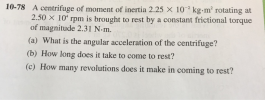 10-78 A centrifuge of moment of inertia 2.25 x 10² kg.m' rotating at 2.50 X 10 rpm is brought to rest by a constant frictional torque of magnitude 2.31 N.m. (a) What is the angular acceleration of the (b) How long does it take to come to rest? (c) How many revolutions does it make in coming to rest? centrifuge?
A.) If each of the three rotor helicopter blades is 3.75 m long and has a mass...
 A.) If each of the three rotor helicopter blades is
3.75
m
long and has a mass of 135
kg,
calculate the moment of inertia of the three rotor blades about the
axis of rotation.
B.)How
much torque must the motor apply to bring the blades from rest up
to a speed of 4.1
rev/s
in 7.6s
?
If each of the three rotor helicopter blades is 3.75 m long and has a mass of 135 kg, calculate the moment of...
A.) If each of the three rotor helicopter blades is
3.75
m
long and has a mass of 135
kg,
calculate the moment of inertia of the three rotor blades about the
axis of rotation.
B.)How
much torque must the motor apply to bring the blades from rest up
to a speed of 4.1
rev/s
in 7.6s
?
If each of the three rotor helicopter blades is 3.75 m long and has a mass of 135 kg, calculate the moment of...
40. (II) Calculate the moment of inertia of the array of point objects shown in Fig. 10-53 about (a) the vertica...
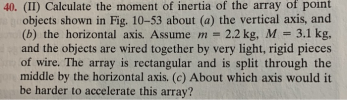 40. (II) Calculate the moment of inertia of the array of point objects shown in Fig. 10-53 about (a) the vertical axis, and (b) the horizontal axis. Assume m = 2.2 kg, M = 3.1 kg, and the objects are wired together by very light, rigid pieces of wire. The array is rectangular and is split through the middle by the horizontal axis. (c) About which axis would it be harder to accelerate this array? 3. (II) A centrifuge rotor...
Let us treat a helicopter rotor blade as a long thin rod, as shown in the...
Let us treat a helicopter rotor blade as a long thin rod, as shown in the figure. (Figure 1) . If each of the three rotor helicopter blades is 3.75 m long and has a mass of 135 kg, calculate the moment of inertia of the three rotor blades about the axis of rotation. b- How much torque must the motor apply to bring the blades from rest up to a speed of 5.9 rev/s in 10 s ?
The flywheel of an engine has a moment of inertia 3.00 kg m^2 about its rotation...
The flywheel of an engine has a moment of inertia 3.00 kg m^2 about its rotation axis. What constant torque is required to bring it up to an angular speed of 370 rev/min in a time of 7.60 s, starting from rest? N?m What is its final kinetic energy? J
How much work is necessary to bring the proton from rest infinetly far away to rest...
How much work is necessary to bring the proton from rest infinetly far away to rest at a distance of 3m from the nucleus? I've know how to get the answer for the first part of the question which asks, " How much (mass) energy is released when a 13C nucleus combines with a proton?" which is 7.5505 MeV, but I'm not sure how to answer the energy question. I think you'd use the equation Wnc= Kf-Ki+ Uf+Ui but I...
Starting from rest, a 10.06-cm-diameter compact disk takes 8.5 s to reach its operating angular velocity...
Starting from rest, a 10.06-cm-diameter compact disk takes 8.5 s to reach its operating angular velocity of 2381 rpm. Assume that the angular acceleration is constant. The disk�s moment of inertia is 1.00×10⁻⁵ kg·m2. How much torque is applied to the disk? 0.0003 N*m How many revolutions does it make before reaching full speed?
A potter's wheel with a moment of inertia of 8.0kg-m^2 has 5.0 N-m applied to it....
A potter's wheel with a moment of inertia of 8.0kg-m^2 has 5.0 N-m applied to it. It starts from rest. 10. seconds later it has gained what kinetic energy? (The answer is 78J, but I don't know how to arrive at the answer.)
 Course Home 81177843 ome Work10 Problem 8.50 Res Problem 850 Part A A centrituge rotor has a moment of inertia of 420-10-2 kg·㎡ How much energy is required to bring it from rest to 8170 rpm? Express your answer using three significant figures and include the appropriate units. E- alue Units Submit My Answers Give Up Type here to search 畢。
 10-78 A centrifuge of moment of inertia 2.25 x 10² kg.m' rotating at 2.50 X 10 rpm is brought to rest by a constant frictional torque of magnitude 2.31 N.m. (a) What is the angular acceleration of the (b) How long does it take to come to rest? (c) How many revolutions does it make in coming to rest? centrifuge?
 A.) If each of the three rotor helicopter blades is
3.75
m
long and has a mass of 135
kg,
calculate the moment of inertia of the three rotor blades about the
axis of rotation.
B.)How
much torque must the motor apply to bring the blades from rest up
to a speed of 4.1
rev/s
in 7.6s
?
If each of the three rotor helicopter blades is 3.75 m long and has a mass of 135 kg, calculate the moment of...
A.) If each of the three rotor helicopter blades is
3.75
m
long and has a mass of 135
kg,
calculate the moment of inertia of the three rotor blades about the
axis of rotation.
B.)How
much torque must the motor apply to bring the blades from rest up
to a speed of 4.1
rev/s
in 7.6s
?
If each of the three rotor helicopter blades is 3.75 m long and has a mass of 135 kg, calculate the moment of...
 40. (II) Calculate the moment of inertia of the array of point objects shown in Fig. 10-53 about (a) the vertical axis, and (b) the horizontal axis. Assume m = 2.2 kg, M = 3.1 kg, and the objects are wired together by very light, rigid pieces of wire. The array is rectangular and is split through the middle by the horizontal axis. (c) About which axis would it be harder to accelerate this array? 3. (II) A centrifuge rotor...
Most questions answered within 3 hours.
-
Where is the error in this code sequence?
String s1 = "Hello";
String s2 = "ello";...
asked 11 months ago -
Financial data for Joel de Paris, Inc., for last year
follow:
Joel de Paris, Inc.
Balance...
asked 11 months ago -
Consider this reaction:
Al2(SO4)3 (aq)+ BaCl3
(aq) Al2Cl6 (aq)- +
3BaSO4(s) . What is the...
asked 11 months ago -
Suppose that Savneet is considering increasing her
recent random sample from 20 car rentals to 40...
asked 11 months ago -
Trucks arrive at an unloading terminal at an average rate of 120
per hour.
Trucks arrive...
asked 11 months ago -
Why are methanol and ethanol completely soluble in water while
octanol is not very little soluble....
asked 11 months ago -
A facilities manager at a university reads in a research report
that the mean amount of...
asked 11 months ago -
When the CuSO4 is rehydrated by adding water to the anhydrous
compound, is this an endothermic...
asked 11 months ago -
A ray of sunlight is passing from diamond into crown glass; the
angle of incidence is...
asked 11 months ago -
A block of mass 0.249 kg is placed on top of a light, vertical
spring of...
asked 11 months ago -
how do the kidneys compensate in the presences of acidosis
a) trigger hyperventilate
b) reserve acid...
asked 11 months ago -
Question 501 pts
The rental rate of capital to the firm increases. Which of the
following...
asked 11 months ago