
Homework Answers


Add Answer to:
10 pointsl Find the gea wlti of te o i t0 10 pointsl Find the gea wlti of te o i t0
thevenin and norton equivalent ECE 231 Final Te Problem #2 Find Thevenin and Norton equivalents of a circuit shown in Fg Extra credit: Verify your solution by finding I. 0,5% 10 20 t0 20 20 io Fi...
 thevenin and norton equivalent
ECE 231 Final Te Problem #2 Find Thevenin and Norton equivalents of a circuit shown in Fg Extra credit: Verify your solution by finding I. 0,5% 10 20 t0 20 20 io Figure 2
ECE 231 Final Te Problem #2 Find Thevenin and Norton equivalents of a circuit shown in Fg Extra credit: Verify your solution by finding I. 0,5% 10 20 t0 20 20 io Figure 2
thevenin and norton equivalent
ECE 231 Final Te Problem #2 Find Thevenin and Norton equivalents of a circuit shown in Fg Extra credit: Verify your solution by finding I. 0,5% 10 20 t0 20 20 io Figure 2
ECE 231 Final Te Problem #2 Find Thevenin and Norton equivalents of a circuit shown in Fg Extra credit: Verify your solution by finding I. 0,5% 10 20 t0 20 20 io Figure 2
EXAMPLE 1 (a) Find the derivative of r(t) = (3 + t4)1+ te-y + sin(40k. (b) Find the unit tangent vector at the point t0...
 EXAMPLE 1 (a) Find the derivative of r(t) = (3 + t4)1+ te-y + sin(40k. (b) Find the unit tangent vector at the point t0. SOLUTION (a) According to this theorem, we differentiate each component of r: t 45 cos (4t) r(t) + 3 (b) Since r(0)= and r(o) j+4k, the unit tangent vector at the point (3, 0, 0) is i+ 4k T(0) = L'(0)--
EXAMPLE 1 (a) Find the derivative of r(t) = (3 + t4)1+ te-y +...
EXAMPLE 1 (a) Find the derivative of r(t) = (3 + t4)1+ te-y + sin(40k. (b) Find the unit tangent vector at the point t0. SOLUTION (a) According to this theorem, we differentiate each component of r: t 45 cos (4t) r(t) + 3 (b) Since r(0)= and r(o) j+4k, the unit tangent vector at the point (3, 0, 0) is i+ 4k T(0) = L'(0)--
EXAMPLE 1 (a) Find the derivative of r(t) = (3 + t4)1+ te-y +...
Find r'(t), r(t0), and r'(t0) for the given value of t0
Find r'(t), r(t0), and r'(t0) for the given value of t0. Then sketch the space curve represented by the vector-valued function, and sketch the vectors r(t0) and r'(t0). r(t) = ti + t2j + 3/2K, t0 = 2
17 pointsl Find an Cauchy-Buler differential equation that has a general solution
 17 pointsl Find an Cauchy-Buler differential equation that has a general solution
17 pointsl Find an Cauchy-Buler differential equation that has a general solution
 17 pointsl Find an Cauchy-Buler differential equation that has a general solution
Given that i(t) -18e- 6e0.4t A for t0 in the network in the accompanying figure, find...
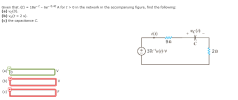 Given that i(t) -18e- 6e0.4t A for t0 in the network in the accompanying figure, find the following (a) vc(0) (b) vct 2 s) (c) the capacitance C. oc(t) i(t) 2? (a) To
1. A particle's position at time t is r(t) (t, 2et, e2t). Find the following in terms of t: nd the following in termns o (i) the distance traveled from the initial position at t0 (ii) the curvatu...
 1. A particle's position at time t is r(t) (t, 2et, e2t). Find the following in terms of t: nd the following in termns o (i) the distance traveled from the initial position at t0 (ii) the curvature κ and torsion τ of the path (iii) the unit tangent, principal normal and binormal vectors T, N and B (iv) the tangential and normal components of the acceleration vector
1. A particle's position at time t is r(t) (t, 2et, e2t)....
1. A particle's position at time t is r(t) (t, 2et, e2t). Find the following in terms of t: nd the following in termns o (i) the distance traveled from the initial position at t0 (ii) the curvature κ and torsion τ of the path (iii) the unit tangent, principal normal and binormal vectors T, N and B (iv) the tangential and normal components of the acceleration vector
1. A particle's position at time t is r(t) (t, 2et, e2t)....
T0) ramp 10 A SSm
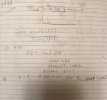 T0) ramp 10 A SSm
MATLAB code starts here --------- clear T0=2; w0=2*pi/T0; f0=1/T0; Tmax=4; Nmax=15; %--- i=1; for t=-Tmax: .01:Tmax...
 MATLAB
code starts here ---------
clear
T0=2;
w0=2*pi/T0;
f0=1/T0;
Tmax=4;
Nmax=15;
%---
i=1;
for t=-Tmax: .01:Tmax
T(i)=t;
if t>=(T0/2)
while (t>T0/2)
t=t-T0;
end
elseif t<=-(T0/2)
while (t<=-T0/2)
t=t+T0;
end
end
if abs(t)<=(T0/4)
y(i)=1;
else
y(i)=0;
end
i=i+1;
end
plot(T,y),grid, xlabel('Time (sec)'); title('y(t) square wave');
shg
disp('Hit return..');
pause
%---
a0=1/2;
F(1)=0; %dc freq
C(1)=a0;
for n=1:Nmax
a(n)=(2/(n*pi))*sin((n*pi)/2);
b(n)=0;
C(n+1)=sqrt(a(n)^2+b(n)^2);
F(n+1)=n*f0;
end
stem(F,abs,(C)), grid, title(['Line Spectrum: Harmonics = '
num2str(Nmax)]);
xlabel('Freq(Hz)'), ylabel('Cn'), shg
disp('Hit return...');
pause
%---
yest=a0*ones(1,length(T));
for n=1:Nmax
yest=yest+a(n)*cos(2*n*pi*T/T0)+b(n)*sin(2*n*pi*T/T0);...
MATLAB
code starts here ---------
clear
T0=2;
w0=2*pi/T0;
f0=1/T0;
Tmax=4;
Nmax=15;
%---
i=1;
for t=-Tmax: .01:Tmax
T(i)=t;
if t>=(T0/2)
while (t>T0/2)
t=t-T0;
end
elseif t<=-(T0/2)
while (t<=-T0/2)
t=t+T0;
end
end
if abs(t)<=(T0/4)
y(i)=1;
else
y(i)=0;
end
i=i+1;
end
plot(T,y),grid, xlabel('Time (sec)'); title('y(t) square wave');
shg
disp('Hit return..');
pause
%---
a0=1/2;
F(1)=0; %dc freq
C(1)=a0;
for n=1:Nmax
a(n)=(2/(n*pi))*sin((n*pi)/2);
b(n)=0;
C(n+1)=sqrt(a(n)^2+b(n)^2);
F(n+1)=n*f0;
end
stem(F,abs,(C)), grid, title(['Line Spectrum: Harmonics = '
num2str(Nmax)]);
xlabel('Freq(Hz)'), ylabel('Cn'), shg
disp('Hit return...');
pause
%---
yest=a0*ones(1,length(T));
for n=1:Nmax
yest=yest+a(n)*cos(2*n*pi*T/T0)+b(n)*sin(2*n*pi*T/T0);...
QUESTION 10 Which of the following elements is the most electronegative? O S ose O Te...
 QUESTION 10 Which of the following elements is the most electronegative? O S ose O Te O Po QUESTION 11 Which of the following would you expect to have ionic bonds? O HBr O CO Oicl O CsF NF3
 thevenin and norton equivalent
ECE 231 Final Te Problem #2 Find Thevenin and Norton equivalents of a circuit shown in Fg Extra credit: Verify your solution by finding I. 0,5% 10 20 t0 20 20 io Figure 2
ECE 231 Final Te Problem #2 Find Thevenin and Norton equivalents of a circuit shown in Fg Extra credit: Verify your solution by finding I. 0,5% 10 20 t0 20 20 io Figure 2
thevenin and norton equivalent
ECE 231 Final Te Problem #2 Find Thevenin and Norton equivalents of a circuit shown in Fg Extra credit: Verify your solution by finding I. 0,5% 10 20 t0 20 20 io Figure 2
ECE 231 Final Te Problem #2 Find Thevenin and Norton equivalents of a circuit shown in Fg Extra credit: Verify your solution by finding I. 0,5% 10 20 t0 20 20 io Figure 2
 EXAMPLE 1 (a) Find the derivative of r(t) = (3 + t4)1+ te-y + sin(40k. (b) Find the unit tangent vector at the point t0. SOLUTION (a) According to this theorem, we differentiate each component of r: t 45 cos (4t) r(t) + 3 (b) Since r(0)= and r(o) j+4k, the unit tangent vector at the point (3, 0, 0) is i+ 4k T(0) = L'(0)--
EXAMPLE 1 (a) Find the derivative of r(t) = (3 + t4)1+ te-y +...
EXAMPLE 1 (a) Find the derivative of r(t) = (3 + t4)1+ te-y + sin(40k. (b) Find the unit tangent vector at the point t0. SOLUTION (a) According to this theorem, we differentiate each component of r: t 45 cos (4t) r(t) + 3 (b) Since r(0)= and r(o) j+4k, the unit tangent vector at the point (3, 0, 0) is i+ 4k T(0) = L'(0)--
EXAMPLE 1 (a) Find the derivative of r(t) = (3 + t4)1+ te-y +...
 17 pointsl Find an Cauchy-Buler differential equation that has a general solution
 17 pointsl Find an Cauchy-Buler differential equation that has a general solution
 Given that i(t) -18e- 6e0.4t A for t0 in the network in the accompanying figure, find the following (a) vc(0) (b) vct 2 s) (c) the capacitance C. oc(t) i(t) 2? (a) To
 1. A particle's position at time t is r(t) (t, 2et, e2t). Find the following in terms of t: nd the following in termns o (i) the distance traveled from the initial position at t0 (ii) the curvature κ and torsion τ of the path (iii) the unit tangent, principal normal and binormal vectors T, N and B (iv) the tangential and normal components of the acceleration vector
1. A particle's position at time t is r(t) (t, 2et, e2t)....
1. A particle's position at time t is r(t) (t, 2et, e2t). Find the following in terms of t: nd the following in termns o (i) the distance traveled from the initial position at t0 (ii) the curvature κ and torsion τ of the path (iii) the unit tangent, principal normal and binormal vectors T, N and B (iv) the tangential and normal components of the acceleration vector
1. A particle's position at time t is r(t) (t, 2et, e2t)....
 T0) ramp 10 A SSm
 MATLAB
code starts here ---------
clear
T0=2;
w0=2*pi/T0;
f0=1/T0;
Tmax=4;
Nmax=15;
%---
i=1;
for t=-Tmax: .01:Tmax
T(i)=t;
if t>=(T0/2)
while (t>T0/2)
t=t-T0;
end
elseif t<=-(T0/2)
while (t<=-T0/2)
t=t+T0;
end
end
if abs(t)<=(T0/4)
y(i)=1;
else
y(i)=0;
end
i=i+1;
end
plot(T,y),grid, xlabel('Time (sec)'); title('y(t) square wave');
shg
disp('Hit return..');
pause
%---
a0=1/2;
F(1)=0; %dc freq
C(1)=a0;
for n=1:Nmax
a(n)=(2/(n*pi))*sin((n*pi)/2);
b(n)=0;
C(n+1)=sqrt(a(n)^2+b(n)^2);
F(n+1)=n*f0;
end
stem(F,abs,(C)), grid, title(['Line Spectrum: Harmonics = '
num2str(Nmax)]);
xlabel('Freq(Hz)'), ylabel('Cn'), shg
disp('Hit return...');
pause
%---
yest=a0*ones(1,length(T));
for n=1:Nmax
yest=yest+a(n)*cos(2*n*pi*T/T0)+b(n)*sin(2*n*pi*T/T0);...
MATLAB
code starts here ---------
clear
T0=2;
w0=2*pi/T0;
f0=1/T0;
Tmax=4;
Nmax=15;
%---
i=1;
for t=-Tmax: .01:Tmax
T(i)=t;
if t>=(T0/2)
while (t>T0/2)
t=t-T0;
end
elseif t<=-(T0/2)
while (t<=-T0/2)
t=t+T0;
end
end
if abs(t)<=(T0/4)
y(i)=1;
else
y(i)=0;
end
i=i+1;
end
plot(T,y),grid, xlabel('Time (sec)'); title('y(t) square wave');
shg
disp('Hit return..');
pause
%---
a0=1/2;
F(1)=0; %dc freq
C(1)=a0;
for n=1:Nmax
a(n)=(2/(n*pi))*sin((n*pi)/2);
b(n)=0;
C(n+1)=sqrt(a(n)^2+b(n)^2);
F(n+1)=n*f0;
end
stem(F,abs,(C)), grid, title(['Line Spectrum: Harmonics = '
num2str(Nmax)]);
xlabel('Freq(Hz)'), ylabel('Cn'), shg
disp('Hit return...');
pause
%---
yest=a0*ones(1,length(T));
for n=1:Nmax
yest=yest+a(n)*cos(2*n*pi*T/T0)+b(n)*sin(2*n*pi*T/T0);...
 QUESTION 10 Which of the following elements is the most electronegative? O S ose O Te O Po QUESTION 11 Which of the following would you expect to have ionic bonds? O HBr O CO Oicl O CsF NF3
Most questions answered within 3 hours.
-
Where is the error in this code sequence?
String s1 = "Hello";
String s2 = "ello";...
asked 11 months ago -
Financial data for Joel de Paris, Inc., for last year
follow:
Joel de Paris, Inc.
Balance...
asked 11 months ago -
Consider this reaction:
Al2(SO4)3 (aq)+ BaCl3
(aq) Al2Cl6 (aq)- +
3BaSO4(s) . What is the...
asked 11 months ago -
Suppose that Savneet is considering increasing her
recent random sample from 20 car rentals to 40...
asked 11 months ago -
Trucks arrive at an unloading terminal at an average rate of 120
per hour.
Trucks arrive...
asked 11 months ago -
Why are methanol and ethanol completely soluble in water while
octanol is not very little soluble....
asked 11 months ago -
A facilities manager at a university reads in a research report
that the mean amount of...
asked 11 months ago -
When the CuSO4 is rehydrated by adding water to the anhydrous
compound, is this an endothermic...
asked 11 months ago -
A ray of sunlight is passing from diamond into crown glass; the
angle of incidence is...
asked 11 months ago -
A block of mass 0.249 kg is placed on top of a light, vertical
spring of...
asked 11 months ago -
how do the kidneys compensate in the presences of acidosis
a) trigger hyperventilate
b) reserve acid...
asked 11 months ago -
Question 501 pts
The rental rate of capital to the firm increases. Which of the
following...
asked 11 months ago