
Homework Answers
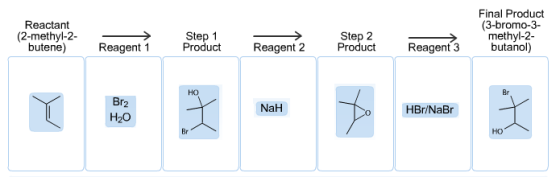
The concept used to solve this problem is by using the given reagents, possible products will be formed in each step and then label them in the given boxes in order to form the exact product.
The starting material is 2-methyl-2-butene and the final product is 3-bromo-3-methyl-2-butanol.
Sodium hydride, NaH is a strong base and is used for the proton abstraction.
Bromination of alkane in the presence of sunlight gives radical substitution.
Addition of bromine molecule and water to an alkene forms halohydrin product.
Phosphorous tribromide is used for the conversion of alcohol to alkyl halide.
The reaction is as follows:

The reaction is as follows:

The reaction is as follows:

The reagents used for the synthesis of 3-bromo-3-methyl-2-butanol from 2-methyl-2-butene are as follows:
Add Answer to:
Construct a three-step synthesis of 3-bromo-3-methyl-2-butanol from 2-methyl-2-butene by dragging the appropriate form...
Construct a three-step synthesis of 3-bromo-3-methyl-2-butanol from 2-methyl-2-butene by dragging the appropriate formulas into the bins....
 Construct a three-step synthesis of 3-bromo-3-methyl-2-butanol
from 2-methyl-2-butene by dragging the appropriate formulas into
the bins. Note that each bin will hold only one item, and not all
of the given reagents or structures will be used.
Construct a three-step synthesis of 3-bromo-3-methyl-2-butanol
from 2-methyl-2-butene by dragging the appropriate formulas into
the bins. Note that each bin will hold only one item, and not all
of the given reagents or structures will be used.
Construct a three-step synthesis of 2-methyl-2-butanol from 3-methyl-2-butanol by dragging the appropriate formulas into the bins....
 Construct a three-step synthesis of 2-methyl-2-butanol from 3-methyl-2-butanol by dragging the appropriate formulas into the bins. Note that each bin will hold only one item, and not all of the given reagents or structures will be used.
Construct a three-step synthesis of 2-methyl-2-butanol from 3-methyl-2-butanol by dragging the appropriate formulas into the bins....
 Construct a three-step synthesis of 2-methyl-2-butanol from 3-methyl-2-butanol by dragging the appropriate formulas into the bins. Note that each bin will hold only one item, and not all of the given reagents or structures will be used.
Construct a three-step synthesis of 2-methyl-2-butanol from 3-methyl-2-butanol by dragging the appropriate formulas into the bins....
 Construct a three-step synthesis of 2-methyl-2-butanol from 3-methyl-2-butanol by dragging the appropriate formulas into the bins. Note that each bin will hold only one item, and not all of the given reagents or structures will be used.
Construct a three-step synthesis of 2-methyl-2-butanol from 3-methyl-2-butanol by dragging the appropriate formulas into the bins....
 Construct a three-step synthesis of 2-methyl-2-butanol from
3-methyl-2-butanol by dragging the appropriate formulas into the
bins. Note that each bin will hold only one item, and not all of
the given reagents or structures will be used.
Construct a three-step synthesis of 2-methyl-2-butanol from
3-methyl-2-butanol by dragging the appropriate formulas into the
bins. Note that each bin will hold only one item, and not all of
the given reagents or structures will be used.
Construct a three-step synthesis of 1,2-epoxycyclopentane from cyclopentanol by dragging the appropriate formulas into the bins....
 Construct a three-step synthesis of 1,2-epoxycyclopentane from cyclopentanol by dragging the appropriate formulas into the bins. Note that each bin will hold only one item, and not all of the given reagents or structures will be used. Reactant Final Product (cyclopentanol) Reagent 1rightarrow Step 1 Product Reagent 2rightarrow Step 2 Product Reagent 3rightarrow (1,2-epoxycyclopentane)
Construct a three-step synthesis of trans-2-pentene from acetylene by dragging the appropriate formulas into the bins....
 Construct a three-step synthesis
of trans-2-pentene from acetylene by dragging the appropriate
formulas into the bins. Note that each bin will hold only one item,
and not all of the given reagents or structures will be used. (Me =
methyl, CH3; Et = ethyl, CH3CH2.)
Question 20 of 20 sapling learning Construct a three-step synthesis of trans-2-pentene from acetylene by dragging the appropriate formulas into the bins. Note that each bin will hold only one item, and not all of...
Construct a three-step synthesis
of trans-2-pentene from acetylene by dragging the appropriate
formulas into the bins. Note that each bin will hold only one item,
and not all of the given reagents or structures will be used. (Me =
methyl, CH3; Et = ethyl, CH3CH2.)
Question 20 of 20 sapling learning Construct a three-step synthesis of trans-2-pentene from acetylene by dragging the appropriate formulas into the bins. Note that each bin will hold only one item, and not all of...
Construct a three-step synthesis of trans-2-pentene from acetylene by dragging the appropriate formulas into the bins....
 Construct a three-step synthesis of trans-2-pentene from acetylene
by dragging the appropriate formulas into the bins. Note that each
bin will hold only one item, and not all of the given reagents or
structures will be used. (Me = methyl, CH3; Et = ethyl,
CH3CH2.)
Construct a three-step synthesis of trans-2-pentene from acetylene
by dragging the appropriate formulas into the bins. Note that each
bin will hold only one item, and not all of the given reagents or
structures will be used. (Me = methyl, CH3; Et = ethyl,
CH3CH2.)
Construct a three-step synthesis of trans-2-pentene from acetylene by dragging the appropriate formulas into the bins....
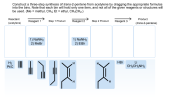 Construct a three-step synthesis of trans-2-pentene from
acetylene by dragging the appropriate formulas into the bins. Note
that each bin will hold only one item, and not all of the given
reagents or structures will be used. (Me = methyl, CH3; Et = ethyl,
CH3CH2.)
Construct a three-step synthesis of trans-2-pentene from
acetylene by dragging the appropriate formulas into the bins. Note
that each bin will hold only one item, and not all of the given
reagents or structures will be used. (Me = methyl, CH3; Et = ethyl,
CH3CH2.)
Construct a three-step synthesis of trans-2-pentene from acetylene by dragging the appropriate formulas into the bins....
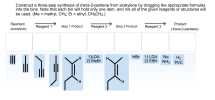 Construct a three-step synthesis of trans-2-pentene from acetylene by dragging the appropriate formulas into the bins. Note that each bin will hold only one item, and not all of the given reagents or structures will be used. (Me = methyl, CH_3; Et = ethyl, CH_3 CH_2.)
 Construct a three-step synthesis of 3-bromo-3-methyl-2-butanol
from 2-methyl-2-butene by dragging the appropriate formulas into
the bins. Note that each bin will hold only one item, and not all
of the given reagents or structures will be used.
Construct a three-step synthesis of 3-bromo-3-methyl-2-butanol
from 2-methyl-2-butene by dragging the appropriate formulas into
the bins. Note that each bin will hold only one item, and not all
of the given reagents or structures will be used.
 Construct a three-step synthesis of 2-methyl-2-butanol from 3-methyl-2-butanol by dragging the appropriate formulas into the bins. Note that each bin will hold only one item, and not all of the given reagents or structures will be used.
 Construct a three-step synthesis of 2-methyl-2-butanol from 3-methyl-2-butanol by dragging the appropriate formulas into the bins. Note that each bin will hold only one item, and not all of the given reagents or structures will be used.
 Construct a three-step synthesis of 2-methyl-2-butanol from 3-methyl-2-butanol by dragging the appropriate formulas into the bins. Note that each bin will hold only one item, and not all of the given reagents or structures will be used.
 Construct a three-step synthesis of 2-methyl-2-butanol from
3-methyl-2-butanol by dragging the appropriate formulas into the
bins. Note that each bin will hold only one item, and not all of
the given reagents or structures will be used.
Construct a three-step synthesis of 2-methyl-2-butanol from
3-methyl-2-butanol by dragging the appropriate formulas into the
bins. Note that each bin will hold only one item, and not all of
the given reagents or structures will be used.
 Construct a three-step synthesis of 1,2-epoxycyclopentane from cyclopentanol by dragging the appropriate formulas into the bins. Note that each bin will hold only one item, and not all of the given reagents or structures will be used. Reactant Final Product (cyclopentanol) Reagent 1rightarrow Step 1 Product Reagent 2rightarrow Step 2 Product Reagent 3rightarrow (1,2-epoxycyclopentane)
 Construct a three-step synthesis
of trans-2-pentene from acetylene by dragging the appropriate
formulas into the bins. Note that each bin will hold only one item,
and not all of the given reagents or structures will be used. (Me =
methyl, CH3; Et = ethyl, CH3CH2.)
Question 20 of 20 sapling learning Construct a three-step synthesis of trans-2-pentene from acetylene by dragging the appropriate formulas into the bins. Note that each bin will hold only one item, and not all of...
Construct a three-step synthesis
of trans-2-pentene from acetylene by dragging the appropriate
formulas into the bins. Note that each bin will hold only one item,
and not all of the given reagents or structures will be used. (Me =
methyl, CH3; Et = ethyl, CH3CH2.)
Question 20 of 20 sapling learning Construct a three-step synthesis of trans-2-pentene from acetylene by dragging the appropriate formulas into the bins. Note that each bin will hold only one item, and not all of...
 Construct a three-step synthesis of trans-2-pentene from acetylene
by dragging the appropriate formulas into the bins. Note that each
bin will hold only one item, and not all of the given reagents or
structures will be used. (Me = methyl, CH3; Et = ethyl,
CH3CH2.)
Construct a three-step synthesis of trans-2-pentene from acetylene
by dragging the appropriate formulas into the bins. Note that each
bin will hold only one item, and not all of the given reagents or
structures will be used. (Me = methyl, CH3; Et = ethyl,
CH3CH2.)
 Construct a three-step synthesis of trans-2-pentene from
acetylene by dragging the appropriate formulas into the bins. Note
that each bin will hold only one item, and not all of the given
reagents or structures will be used. (Me = methyl, CH3; Et = ethyl,
CH3CH2.)
Construct a three-step synthesis of trans-2-pentene from
acetylene by dragging the appropriate formulas into the bins. Note
that each bin will hold only one item, and not all of the given
reagents or structures will be used. (Me = methyl, CH3; Et = ethyl,
CH3CH2.)
 Construct a three-step synthesis of trans-2-pentene from acetylene by dragging the appropriate formulas into the bins. Note that each bin will hold only one item, and not all of the given reagents or structures will be used. (Me = methyl, CH_3; Et = ethyl, CH_3 CH_2.)
Most questions answered within 3 hours.
-
Where is the error in this code sequence?
String s1 = "Hello";
String s2 = "ello";...
asked 10 months ago -
Financial data for Joel de Paris, Inc., for last year
follow:
Joel de Paris, Inc.
Balance...
asked 10 months ago -
Consider this reaction:
Al2(SO4)3 (aq)+ BaCl3
(aq) Al2Cl6 (aq)- +
3BaSO4(s) . What is the...
asked 10 months ago -
Suppose that Savneet is considering increasing her
recent random sample from 20 car rentals to 40...
asked 10 months ago -
Trucks arrive at an unloading terminal at an average rate of 120
per hour.
Trucks arrive...
asked 10 months ago -
Why are methanol and ethanol completely soluble in water while
octanol is not very little soluble....
asked 10 months ago -
A facilities manager at a university reads in a research report
that the mean amount of...
asked 10 months ago -
When the CuSO4 is rehydrated by adding water to the anhydrous
compound, is this an endothermic...
asked 10 months ago -
A ray of sunlight is passing from diamond into crown glass; the
angle of incidence is...
asked 10 months ago -
A block of mass 0.249 kg is placed on top of a light, vertical
spring of...
asked 10 months ago -
how do the kidneys compensate in the presences of acidosis
a) trigger hyperventilate
b) reserve acid...
asked 10 months ago -
Question 501 pts
The rental rate of capital to the firm increases. Which of the
following...
asked 10 months ago