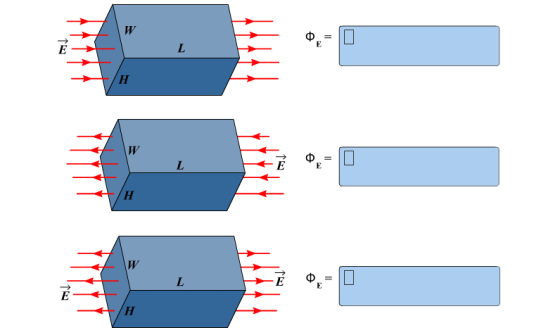
In each figure below is shown a rectangular box with dimensions L × W × H, placed in various electric fields of uniform...
In each figure below is shown a rectangular box with dimensions L × W × H, placed in various electric fields of uniform magnitude E. For each case, find an expression for the net electric flux ΦE out of the box in terms of E, L, W, and H. The field in each case is assumed to be perpendicular to the side faces of the box.
Homework Answers
The concept of electric flux is required to solve the problem.
First, determine the area of each face using the length and width of the face. Then, use the relation of electric flux and the angle between the area vector and electric field to determine the electric flux through each face. Finally, determine the net electric flux by adding the electric flux through each face.
The electric flux is defined as the number of electric field lines passing through a surface. The electric flux through a surface of area A is,
Here, E is the electric field vector, A is the area of the surface, and is the angle between the electric field and area vector which points perpendicular to the surface.
(1)
The electric flux is given as,
For the right face:
The area of the right face of the rectangular box is given as,
Here, W is the width of the rectangular box and H is the height of the rectangular box.
The area vector for the right face is normal to the right face of the box and it is towards right. The electric field is also towards right. Hence, the angle between the area vector and electric field is .
Substitute for , for A, and for in the equation .
For the left face:
The area of the left face of the rectangular box is given as,
Here, W is the width of the rectangular box and H is the height of the rectangular box.
The area vector for the left face is normal to the left face of the box and it is towards left. The electric field is towards right. Hence, the angle between the area vector and electric field is .
Substitute for , for A, and for in the equation .
For the other faces:
For all the other faces of the cube the area vector is perpendicular to the electric field. Hence, the angle between the area vector and electric field is .
Substitute for and for in the equation .
Here, is the electric flux for the remaining faces of the box.
The net electric flux is given as,
Substitute for , for , and 0 for in the equation .
(2)
The electric flux is given as,
For the right face:
The area of the right face of the rectangular box is given as,
Here, W is the width of the rectangular box and H is the height of the rectangular box.
The area vector for the right face is normal to the right face of the box and it is towards right. The electric field is towards left. Hence, the angle between the area vector and electric field is .
Substitute for , for A, and for in the equation .
For the left face:
The area of the left face of the rectangular box is given as,
Here, W is the width of the rectangular box and H is the height of the rectangular box.
The area vector for the left face is normal to the left face of the box and it is towards left. The electric field is also towards left. Hence, the angle between the area vector and electric field is .
Substitute for , for A, and for in the equation .
For the other faces:
For all the other faces of the cube the area vector is perpendicular to the electric field. Hence, the angle between the area vector and electric field is .
Substitute for and for in the equation .
Here, is the net electric flux for the remaining faces of the box.
The net electric flux is given as,
Substitute for , for , and 0 for in the equation .
(3)
The electric flux is given as,
For the right face:
The area of the right face of the rectangular box is given as,
Here, W is the width of the rectangular box and H is the height of the rectangular box.
The area vector for the right face is normal to the right face of the box and it is towards right. The electric field is also towards right. Hence, the angle between the area vector and electric field is .
Substitute for , for A, and for in the equation .
For the left face:
The area of the left face of the rectangular box is given as,
Here, W is the width of the rectangular box and H is the height of the rectangular box.
The area vector for the left face is normal to the left face of the box and it is towards left. The electric field is also towards left. Hence, the angle between the area vector and electric field is .
Substitute for , for A, and for in the equation .
For the other faces:
For all the other faces of the cube the area vector is perpendicular to the electric field. Hence, the angle between the area vector and electric field is .
Substitute for and for in the equation .
Here, is the net electric flux for the remaining faces of the box.
The net electric flux is given as,
Substitute for , for , and 0 for in the equation .
Ans: Part 1
The net electric flux out of the box is 0.
Add Answer to:
In each figure below is shown a rectangular box with dimensions L × W × H, placed in various electric fields of uniform...
The steady current carrying rectangular conductor is placed in a uniform magnetic field as shown in...
 The steady current carrying rectangular conductor is placed in a
uniform magnetic field as shown in
5. The steady current carrying rectangular conductor is placed in a uniform magnetic field as shown in Figure 3. a) What is the voltage difference, V between the side (shown with w) of the conductor in terms of the parameters given in Figure? b) What would be the voltage difference, V between the side of the conductor if B=0? L w h 1 B...
The steady current carrying rectangular conductor is placed in a
uniform magnetic field as shown in
5. The steady current carrying rectangular conductor is placed in a uniform magnetic field as shown in Figure 3. a) What is the voltage difference, V between the side (shown with w) of the conductor in terms of the parameters given in Figure? b) What would be the voltage difference, V between the side of the conductor if B=0? L w h 1 B...
A uniform E-field (in N/C) is given by -6i + 2j + 3k. A rectangular box...
A uniform E-field (in N/C) is given by -6i + 2j + 3k. A rectangular box is at rest on the origin of the axis system such that one of its faces has an area of 2.0 m^2 in the y/z plane. What is the magnitude of the electric flux ( in Nm^2/C) through the face? Refer to the situation above, what is the total flux ( in NM^2/C) for the entire rectangular surface of the box?
Q3. Uniform electric and magnetic fields are oriented at right angles and perpendicular to each other....
 Q3. Uniform electric and magnetic fields are oriented at right angles and perpendicular to each other. An electron moves at right angles to both the fields and passes undeflected through the field. If the magnitude of the electric filed intensity is 2000 V/m, determine the value of magnetic flux density and magnetic field intensity (assume free space conditions).
A flat rectangular loop of wire is placed between the poles of amagnet, as shown...
 A flat rectangular loop of wire is placed between the poles of a
magnet, as shown in the figure. It has dimensions w =
0.60 m and L = 1.0 m, and carries a current I = 2.0 A in the
direction shown. The magnetic field due to the magnet is uniform
and of magnitude 0.80 T. The loop rotates in the magnetic field and
at one point the plane of the loop is parallel to the field, as
shown.A)...
A flat rectangular loop of wire is placed between the poles of a
magnet, as shown in the figure. It has dimensions w =
0.60 m and L = 1.0 m, and carries a current I = 2.0 A in the
direction shown. The magnetic field due to the magnet is uniform
and of magnitude 0.80 T. The loop rotates in the magnetic field and
at one point the plane of the loop is parallel to the field, as
shown.A)...
Problem 2. A rectangular conducting frame with a width w and height h is placed in...
 Problem 2. A rectangular conducting frame with a width w and height h is placed in a uniform ating magnetic field B-Bo cos co, where Bo is a given amplitude and co is a given frequency e field is in the "horizontal" direction as shown. Three possible positions of the frame are (a) in the plane of the figure, (b) perpendicular to it, and (c) at 45°. The resistance of the frame is R and its own magnetic field can...
A cube has sides of length L 0.350 m. It is placed with one corner at the origin as shown in the figure (Figure 1).
 A cube has sides of length L 0.350 m. It is placed with one corner at the origin as shown in the figure (Figure 1). The electric field is not uniform but is given by E= (-4.11 N/(C.m))xi +(2.88 N/(C.m) )zk.Part AFind the electric flux through each of the six cube faces S1, S2, S3, S4, S, and S6. Part B Find the total electric charge inside the cube.
O webwork.phys.yorku.ca/webwork2/PHYS1010/w (1 point) . THE PROBLEM A laboratory room is filled with a constant electric...
 O webwork.phys.yorku.ca/webwork2/PHYS1010/w (1 point) . THE PROBLEM A laboratory room is filled with a constant electric field which enters through the left wall and exists through the right wall. An empty wooden cube sits on the floor of the lab. The field has magnitude E-1.71 kN/C and the cube has dimensions 1x L × L where L-122 cm. Calculate the electric flux through each of the six sides on the wooden cube when (a) its left side faces the left...
Suppose a disk with area A is placed in a uniform electric field of magnitude E....
 Suppose a disk with area A is placed in a uniform electric field of magnitude E. The disk is oriented so that the vector normal to its surface, n, makes an angle theta with the electric field as shown in the figure. Part A What is the electric flux Phi_E through the surface of the disk that is facing right (the normal vector to this surface is shown in the figure)? Assume that the presence of the disk does not...
2. An imaginary cubical surface of side L is in a region of uniform electric field...
 2. An imaginary cubical surface of side L is in a region of uniform electric field E. Find the electric flux through each face of the cube and the total flux through the cube when (a) it is oriented with two of its faces perpendiculars to E(b) the cube is turned by an angle about the vertical axis. (a) ol HA 190 - 0 S
The figure below shows the instant when a hollow metal box is placed in a uniform...
 The figure below shows the instant when a hollow metal box is
placed in a uniform electric field, and its effect on the external
field is not shown.
a. Indicate the electric charge distribution in the metal due to
the external electric field. Note: If electrons move from one part
of the box to another, the part with a deficiency of negatively
charged electrons is now positively charged, and the part with an
excess of electrons is negatively charged.
b....
The figure below shows the instant when a hollow metal box is
placed in a uniform electric field, and its effect on the external
field is not shown.
a. Indicate the electric charge distribution in the metal due to
the external electric field. Note: If electrons move from one part
of the box to another, the part with a deficiency of negatively
charged electrons is now positively charged, and the part with an
excess of electrons is negatively charged.
b....
 The steady current carrying rectangular conductor is placed in a
uniform magnetic field as shown in
5. The steady current carrying rectangular conductor is placed in a uniform magnetic field as shown in Figure 3. a) What is the voltage difference, V between the side (shown with w) of the conductor in terms of the parameters given in Figure? b) What would be the voltage difference, V between the side of the conductor if B=0? L w h 1 B...
The steady current carrying rectangular conductor is placed in a
uniform magnetic field as shown in
5. The steady current carrying rectangular conductor is placed in a uniform magnetic field as shown in Figure 3. a) What is the voltage difference, V between the side (shown with w) of the conductor in terms of the parameters given in Figure? b) What would be the voltage difference, V between the side of the conductor if B=0? L w h 1 B...
 Q3. Uniform electric and magnetic fields are oriented at right angles and perpendicular to each other. An electron moves at right angles to both the fields and passes undeflected through the field. If the magnitude of the electric filed intensity is 2000 V/m, determine the value of magnetic flux density and magnetic field intensity (assume free space conditions).
 A flat rectangular loop of wire is placed between the poles of a
magnet, as shown in the figure. It has dimensions w =
0.60 m and L = 1.0 m, and carries a current I = 2.0 A in the
direction shown. The magnetic field due to the magnet is uniform
and of magnitude 0.80 T. The loop rotates in the magnetic field and
at one point the plane of the loop is parallel to the field, as
shown.A)...
A flat rectangular loop of wire is placed between the poles of a
magnet, as shown in the figure. It has dimensions w =
0.60 m and L = 1.0 m, and carries a current I = 2.0 A in the
direction shown. The magnetic field due to the magnet is uniform
and of magnitude 0.80 T. The loop rotates in the magnetic field and
at one point the plane of the loop is parallel to the field, as
shown.A)...
 Problem 2. A rectangular conducting frame with a width w and height h is placed in a uniform ating magnetic field B-Bo cos co, where Bo is a given amplitude and co is a given frequency e field is in the "horizontal" direction as shown. Three possible positions of the frame are (a) in the plane of the figure, (b) perpendicular to it, and (c) at 45°. The resistance of the frame is R and its own magnetic field can...
 O webwork.phys.yorku.ca/webwork2/PHYS1010/w (1 point) . THE PROBLEM A laboratory room is filled with a constant electric field which enters through the left wall and exists through the right wall. An empty wooden cube sits on the floor of the lab. The field has magnitude E-1.71 kN/C and the cube has dimensions 1x L × L where L-122 cm. Calculate the electric flux through each of the six sides on the wooden cube when (a) its left side faces the left...
 Suppose a disk with area A is placed in a uniform electric field of magnitude E. The disk is oriented so that the vector normal to its surface, n, makes an angle theta with the electric field as shown in the figure. Part A What is the electric flux Phi_E through the surface of the disk that is facing right (the normal vector to this surface is shown in the figure)? Assume that the presence of the disk does not...
 2. An imaginary cubical surface of side L is in a region of uniform electric field E. Find the electric flux through each face of the cube and the total flux through the cube when (a) it is oriented with two of its faces perpendiculars to E(b) the cube is turned by an angle about the vertical axis. (a) ol HA 190 - 0 S
 The figure below shows the instant when a hollow metal box is
placed in a uniform electric field, and its effect on the external
field is not shown.
a. Indicate the electric charge distribution in the metal due to
the external electric field. Note: If electrons move from one part
of the box to another, the part with a deficiency of negatively
charged electrons is now positively charged, and the part with an
excess of electrons is negatively charged.
b....
The figure below shows the instant when a hollow metal box is
placed in a uniform electric field, and its effect on the external
field is not shown.
a. Indicate the electric charge distribution in the metal due to
the external electric field. Note: If electrons move from one part
of the box to another, the part with a deficiency of negatively
charged electrons is now positively charged, and the part with an
excess of electrons is negatively charged.
b....
Most questions answered within 3 hours.
-
Where is the error in this code sequence?
String s1 = "Hello";
String s2 = "ello";...
asked 11 months ago -
Financial data for Joel de Paris, Inc., for last year
follow:
Joel de Paris, Inc.
Balance...
asked 11 months ago -
Consider this reaction:
Al2(SO4)3 (aq)+ BaCl3
(aq) Al2Cl6 (aq)- +
3BaSO4(s) . What is the...
asked 11 months ago -
Suppose that Savneet is considering increasing her
recent random sample from 20 car rentals to 40...
asked 11 months ago -
Trucks arrive at an unloading terminal at an average rate of 120
per hour.
Trucks arrive...
asked 11 months ago -
Why are methanol and ethanol completely soluble in water while
octanol is not very little soluble....
asked 11 months ago -
A facilities manager at a university reads in a research report
that the mean amount of...
asked 11 months ago -
When the CuSO4 is rehydrated by adding water to the anhydrous
compound, is this an endothermic...
asked 11 months ago -
A ray of sunlight is passing from diamond into crown glass; the
angle of incidence is...
asked 11 months ago -
A block of mass 0.249 kg is placed on top of a light, vertical
spring of...
asked 11 months ago -
how do the kidneys compensate in the presences of acidosis
a) trigger hyperventilate
b) reserve acid...
asked 11 months ago -
Question 501 pts
The rental rate of capital to the firm increases. Which of the
following...
asked 11 months ago