1. Why might some prefer a prix fixe (fixed price) dinner costing about the same as an à la carte one (where you pay ind...
1. Why might some prefer a prix fixe (fixed price) dinner costing about the same as an à la carte one (where you pay individually for each item)? (Assume the food is identical.)
2. Consider a person with the following utility function over wealth: u(w) = ew, where e is the exponential function (approximately equal to 2.7183) and w = wealth in hundreds of thousands of dollars. Suppose that this person has a 40% chance of wealth of $100,000 and a 60% chance of wealth of $2,000,000 as summarized by P(0.40, $100,000, $2,000,000).
a. What is the expected value of wealth?
b. Construct a graph of this utility function (recall your excel?).
c. Is this person risk averse, risk neutral, or a risk seeker?
d. What is this person’s certainty equivalent for the prospect?
3. Consider two prospects.
Problem 1: Choose between
|
Prospect A: |
$2,500 with probability |
0.33 |
|
$2,400 with probability |
0.66 |
|
|
Zero with probability |
0.01 |
|
|
Prospect B: |
$2,400 with probability |
1.00 |
Problem 2: Choose between
|
Prospect C: |
$2,500 with probability |
0.33 |
|
Zero with probability |
0.67 |
|
|
Prospect D: |
$2,400 with probability |
0.34 |
|
Zero with probability |
0.66 |
It has been shown by Daniel Kahneman and Amos Tversky (1979, “Prospect theory: An analysis of decision under risk,” Econometrica 47(2), 263-291) that more people choose B when presented with problem 1 and when presented with problem 2, most people choose C. These choices violate expected utility theory. Why?
Homework Answers
Answer:
1)

2) c) Risk seeker, because the
graph is convex
c) Risk seeker, because the
graph is convex
d) ew = 13,216.54 gives w = 9.4892244 or$948,922.44
3)
This is an example of the Allais paradox.
The first choice suggests that ;
u(2,400) > 0.33u(2,500) + 0.66u(2,400) or 0.34u(2,400) > 0.33 u(2,500)
while, the second choice suggests just the opposite inequality.
This can simply be understood by the following image:
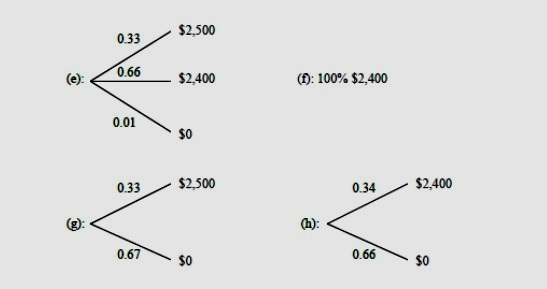
In other words;
u(2400) > 0.33u(2500) + 0.66u(2400) + 0.01u(0)
u(2400) > 0.33u(2500) + 0.66u(2400)
deducting 0.66u(2400)
0.34u(2400) > 0.33u(2500)
Similarly;
Reversing in second case;
0.34u(2400) < 0.33u(2500)
Hence, looking from the diagram also, it can be said that (e) is preferred in first case and (g) from the second.
Add Answer to:
1. Why might some prefer a prix fixe (fixed price) dinner costing about the same as an à la carte one (where you pay ind...
Most questions answered within 3 hours.
-
Where is the error in this code sequence?
String s1 = "Hello";
String s2 = "ello";...
asked 10 months ago -
Financial data for Joel de Paris, Inc., for last year
follow:
Joel de Paris, Inc.
Balance...
asked 10 months ago -
Consider this reaction:
Al2(SO4)3 (aq)+ BaCl3
(aq) Al2Cl6 (aq)- +
3BaSO4(s) . What is the...
asked 10 months ago -
Suppose that Savneet is considering increasing her
recent random sample from 20 car rentals to 40...
asked 10 months ago -
Trucks arrive at an unloading terminal at an average rate of 120
per hour.
Trucks arrive...
asked 10 months ago -
Why are methanol and ethanol completely soluble in water while
octanol is not very little soluble....
asked 10 months ago -
A facilities manager at a university reads in a research report
that the mean amount of...
asked 10 months ago -
When the CuSO4 is rehydrated by adding water to the anhydrous
compound, is this an endothermic...
asked 10 months ago -
A ray of sunlight is passing from diamond into crown glass; the
angle of incidence is...
asked 10 months ago -
A block of mass 0.249 kg is placed on top of a light, vertical
spring of...
asked 10 months ago -
how do the kidneys compensate in the presences of acidosis
a) trigger hyperventilate
b) reserve acid...
asked 10 months ago -
Question 501 pts
The rental rate of capital to the firm increases. Which of the
following...
asked 10 months ago