MATLAB Write a function with the header function [s, count] = myMonteCarlo(f, xLeft, xRight, tol) which uses bracketing...
MATLAB
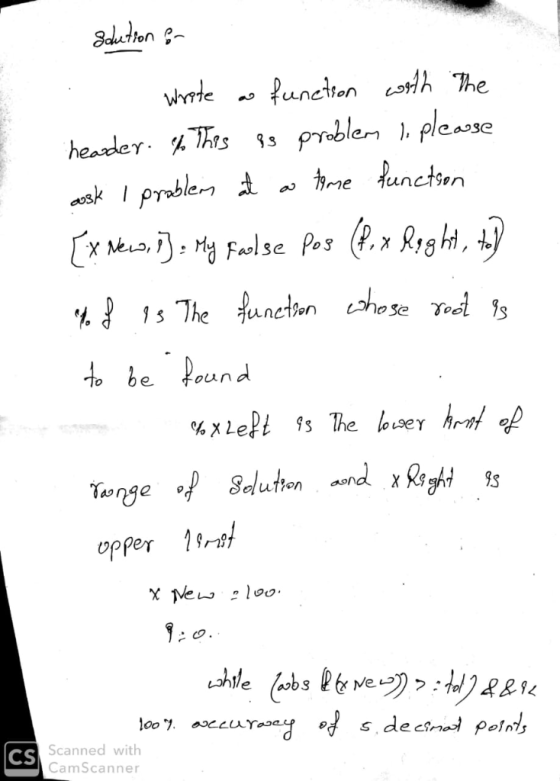
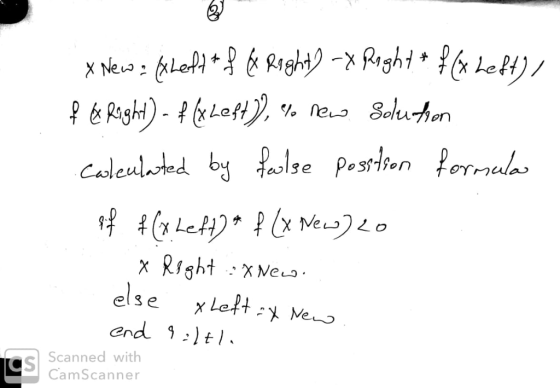
Write a function with the header function [s, count] = myMonteCarlo(f, xLeft, xRight, tol) which uses bracketing logic and random numbers to solve for the root of f.
Start from your code for Problem 1, then modify the update equation to randomly choose a number between xLeft and xRight. That is your xNew. Note your code will take a different number of iterations to find the root every time you run it, even for the exact same initial bracket, xLeft, and xRight.
Tips: • Be sure to include an iteration counter which will stop the while-loop if the number of iterations gets greater than 1000. •
Print out a convergence table within the while loop.
Test Cases: [s, count] = myFalsePos(f, 0, 2, .00000000001) s = 0.958192178746198 count = 6
Homework Answers
![Command Window >>f-e (x) 2* (1-cos (x)) +4* (1-sqrt (1-(.5 sin(x)). *2))-1.2: >s,count]-myFalsePos (f, 0,2,.00000000001) 0.95](http://img.homeworklib.com/images/82bb21b1-2b6c-4ccc-a65d-edf5beeebb31.png?x-oss-process=image/resize,w_560)
Add Answer to:
MATLAB Write a function with the header function [s, count] = myMonteCarlo(f, xLeft, xRight, tol) which uses bracketing...
Programming Language: MATLAB Problem 3: (5 Points) Write a function with the header: function [R] -myNewtonRaphson...
 Programming Language: MATLAB
Problem 3: (5 Points) Write a function with the header: function [R] -myNewtonRaphson (f, fp, x0, tol) which takes as input f: a function handle fp: a function handle to the derivative of f (note how I do it in the test case). x0: the initial guess of the root tol: a tolerance above which the algorithm will keep iterating. Tips: . Be sure to include an iteration counter which will stop the while-loop if the number...
Programming Language: MATLAB
Problem 3: (5 Points) Write a function with the header: function [R] -myNewtonRaphson (f, fp, x0, tol) which takes as input f: a function handle fp: a function handle to the derivative of f (note how I do it in the test case). x0: the initial guess of the root tol: a tolerance above which the algorithm will keep iterating. Tips: . Be sure to include an iteration counter which will stop the while-loop if the number...
clearvars close all clc tol = 0.0001; % this is the tolerance for root identification xold...
 clearvars
close all
clc
tol = 0.0001; % this is the tolerance for root identification
xold = 0.5; % this is the initial guess
test = 1; % this simply ensures we have a test value to enter the loop below.
%If we don't preallocate this, MATLAB will error when it trys to start the
%while loop below
k = 1; %this is the iteration counter. Similar to "test" we need to preallocate it
%to allow the while loop to...
clearvars
close all
clc
tol = 0.0001; % this is the tolerance for root identification
xold = 0.5; % this is the initial guess
test = 1; % this simply ensures we have a test value to enter the loop below.
%If we don't preallocate this, MATLAB will error when it trys to start the
%while loop below
k = 1; %this is the iteration counter. Similar to "test" we need to preallocate it
%to allow the while loop to...
% Bisection.m Lines of code 17-26 and 43-47 are bold % This code finds the root...
 % Bisection.m Lines of code 17-26 and 43-47 are bold
% This code finds the root of a function f(x) in the interval
[a, b] using the Bisection method
%
% It uses f.m to define f(x), and assumes f(x) is continuous
% It requires specification of a, b and the maximum error
% It defines error using |f(xnew)|
% Define inputs for problem
a=0; %Defines lower limit of initial bracketing interval
b=1; %Defines upper limit of initial bracketing interval...
% Bisection.m Lines of code 17-26 and 43-47 are bold
% This code finds the root of a function f(x) in the interval
[a, b] using the Bisection method
%
% It uses f.m to define f(x), and assumes f(x) is continuous
% It requires specification of a, b and the maximum error
% It defines error using |f(xnew)|
% Define inputs for problem
a=0; %Defines lower limit of initial bracketing interval
b=1; %Defines upper limit of initial bracketing interval...
USING MATLAB. Design a program which uses a for…end loop to add 10 to a variable...
USING MATLAB. Design a program which uses a for…end loop to add 10 to a variable V five times. Use a counter variable to count the number of iterations that pass and display this count after the program exits the loop. To design your program, create a flow chart and iteration table (choose he starting variable V = 20). Once it is designed, code it and step through the loop to confirm your iteration table.
MATLAB help! I have some MATLAB Assignment to do, the proffesor requires all the small parts...
 MATLAB help!
I have some MATLAB Assignment to do, the proffesor requires
all the small parts in order to get full credit. Help me out, thank
you
f LAB SECTION NAME HW6P3 (30 points) following are infinite series representations of the function, un pra i a script file HW6P3 that determines the value of the function from the sum of the series for a given value of x. The program (1 pt) must prompt the user to enter a value...
MATLAB help!
I have some MATLAB Assignment to do, the proffesor requires
all the small parts in order to get full credit. Help me out, thank
you
f LAB SECTION NAME HW6P3 (30 points) following are infinite series representations of the function, un pra i a script file HW6P3 that determines the value of the function from the sum of the series for a given value of x. The program (1 pt) must prompt the user to enter a value...
[USING R] Write a function bisect(f, lower, upper, tol = 1e-6) to find the root of...
[USING R] Write a function bisect(f, lower, upper, tol = 1e-6) to find the root of the univariate function f on the interval [lower, upper] with precision tolerance =< tol (defaulted to be 10-6 ) via bisection, which returns a list consisting of root, f.root (f evaluated at root), iter (number of iterations) and estim.prec (estimated precision). Apply it to the function f(x) = x3 - x - 1 on [1, 2] with precision tolerance 10-6 . Compare it with...
I'm working on the newton's method on matlab, could someone help me and show what two...
I'm working on the newton's method on matlab, could someone help me and show what two lines are needed to be added in the codes in order to make this function work? function sample_newton(f, xc, tol, max_iter) % sample_newton(f, xc, tol, max_iter) % finds a root of the given function f over the interval [a, b] using Newton-Raphson method % IN: % f - the target function to find a root of % function handle with two outputs, f(x), f'(x)...
-Create a "f(p)" MATLAB function (name it Price.m) so that it outputs the vlue of the...
 -Create a "f(p)" MATLAB function (name it Price.m) so that it
outputs the vlue of the function f(P)= P2_19P+
24/P
-Create a plot of f(P) over the range $0.00 to $20.00
-Finish code by writing own Secant Method to converge on the
final solution for P:
%%%%%%%%%%%%%%%% %%%%%%%%%%%%%%%%%%%%%%%%%%%%%%%%
%%%%%%%%%%%%%
% This script solves for the Equilibrium Price P, from the
equation f(P)=0
%
% THIS IS JUST THE INITIAL CODE FRAGMENT. YOU NEED TO COMPLETE THE
SCRIPT.
% *** ADD...
-Create a "f(p)" MATLAB function (name it Price.m) so that it
outputs the vlue of the function f(P)= P2_19P+
24/P
-Create a plot of f(P) over the range $0.00 to $20.00
-Finish code by writing own Secant Method to converge on the
final solution for P:
%%%%%%%%%%%%%%%% %%%%%%%%%%%%%%%%%%%%%%%%%%%%%%%%
%%%%%%%%%%%%%
% This script solves for the Equilibrium Price P, from the
equation f(P)=0
%
% THIS IS JUST THE INITIAL CODE FRAGMENT. YOU NEED TO COMPLETE THE
SCRIPT.
% *** ADD...
5.1.2 Open Methods - Newton-Raphson Method Xi+1= xi – FOTO Matlab Code Example:4 function mynewtraph (f,...
 5.1.2 Open Methods - Newton-Raphson Method Xi+1= xi – FOTO Matlab Code Example:4 function mynewtraph (f, f1,x0,n) Xx0; for ilin x = x - f(x)/f1(x); disp (li if f(x) <0.01 f(x))) break end end end Matlab Code from Chapra function [root, ea, iter)=newtraph (func,dfunc, xr, es,maxit,varargin) newtraph: Newton-Raphson root location zeroes 8 [root, ea, iter)-newtraph (func, dfunc, xr, es,maxit,pl,p2, ...): $uses Newton-Raphson method to find the root of fune input: func- name of function 8dfunc = name of derivative of...
Consider the following function with a real variable, x: ?(?) = ?3 - 3?2 + 6?...
Consider the following function with a real variable, x: ?(?) = ?3 - 3?2 + 6? + 10 a. Write a Python function for the derivative of f(x) that takes x and returns the derivative of f(x). Take the derivative of f(x) analytically with respect to x before writing the function. b. Write a Python code that approximately finds the real root, x0, of f(x) such that f(x0)~0 using the Newton-Raphson method. The code is expected to get an initial...
 Programming Language: MATLAB
Problem 3: (5 Points) Write a function with the header: function [R] -myNewtonRaphson (f, fp, x0, tol) which takes as input f: a function handle fp: a function handle to the derivative of f (note how I do it in the test case). x0: the initial guess of the root tol: a tolerance above which the algorithm will keep iterating. Tips: . Be sure to include an iteration counter which will stop the while-loop if the number...
Programming Language: MATLAB
Problem 3: (5 Points) Write a function with the header: function [R] -myNewtonRaphson (f, fp, x0, tol) which takes as input f: a function handle fp: a function handle to the derivative of f (note how I do it in the test case). x0: the initial guess of the root tol: a tolerance above which the algorithm will keep iterating. Tips: . Be sure to include an iteration counter which will stop the while-loop if the number...
 clearvars
close all
clc
tol = 0.0001; % this is the tolerance for root identification
xold = 0.5; % this is the initial guess
test = 1; % this simply ensures we have a test value to enter the loop below.
%If we don't preallocate this, MATLAB will error when it trys to start the
%while loop below
k = 1; %this is the iteration counter. Similar to "test" we need to preallocate it
%to allow the while loop to...
clearvars
close all
clc
tol = 0.0001; % this is the tolerance for root identification
xold = 0.5; % this is the initial guess
test = 1; % this simply ensures we have a test value to enter the loop below.
%If we don't preallocate this, MATLAB will error when it trys to start the
%while loop below
k = 1; %this is the iteration counter. Similar to "test" we need to preallocate it
%to allow the while loop to...
 % Bisection.m Lines of code 17-26 and 43-47 are bold
% This code finds the root of a function f(x) in the interval
[a, b] using the Bisection method
%
% It uses f.m to define f(x), and assumes f(x) is continuous
% It requires specification of a, b and the maximum error
% It defines error using |f(xnew)|
% Define inputs for problem
a=0; %Defines lower limit of initial bracketing interval
b=1; %Defines upper limit of initial bracketing interval...
% Bisection.m Lines of code 17-26 and 43-47 are bold
% This code finds the root of a function f(x) in the interval
[a, b] using the Bisection method
%
% It uses f.m to define f(x), and assumes f(x) is continuous
% It requires specification of a, b and the maximum error
% It defines error using |f(xnew)|
% Define inputs for problem
a=0; %Defines lower limit of initial bracketing interval
b=1; %Defines upper limit of initial bracketing interval...
 MATLAB help!
I have some MATLAB Assignment to do, the proffesor requires
all the small parts in order to get full credit. Help me out, thank
you
f LAB SECTION NAME HW6P3 (30 points) following are infinite series representations of the function, un pra i a script file HW6P3 that determines the value of the function from the sum of the series for a given value of x. The program (1 pt) must prompt the user to enter a value...
MATLAB help!
I have some MATLAB Assignment to do, the proffesor requires
all the small parts in order to get full credit. Help me out, thank
you
f LAB SECTION NAME HW6P3 (30 points) following are infinite series representations of the function, un pra i a script file HW6P3 that determines the value of the function from the sum of the series for a given value of x. The program (1 pt) must prompt the user to enter a value...
 -Create a "f(p)" MATLAB function (name it Price.m) so that it
outputs the vlue of the function f(P)= P2_19P+
24/P
-Create a plot of f(P) over the range $0.00 to $20.00
-Finish code by writing own Secant Method to converge on the
final solution for P:
%%%%%%%%%%%%%%%% %%%%%%%%%%%%%%%%%%%%%%%%%%%%%%%%
%%%%%%%%%%%%%
% This script solves for the Equilibrium Price P, from the
equation f(P)=0
%
% THIS IS JUST THE INITIAL CODE FRAGMENT. YOU NEED TO COMPLETE THE
SCRIPT.
% *** ADD...
-Create a "f(p)" MATLAB function (name it Price.m) so that it
outputs the vlue of the function f(P)= P2_19P+
24/P
-Create a plot of f(P) over the range $0.00 to $20.00
-Finish code by writing own Secant Method to converge on the
final solution for P:
%%%%%%%%%%%%%%%% %%%%%%%%%%%%%%%%%%%%%%%%%%%%%%%%
%%%%%%%%%%%%%
% This script solves for the Equilibrium Price P, from the
equation f(P)=0
%
% THIS IS JUST THE INITIAL CODE FRAGMENT. YOU NEED TO COMPLETE THE
SCRIPT.
% *** ADD...
 5.1.2 Open Methods - Newton-Raphson Method Xi+1= xi – FOTO Matlab Code Example:4 function mynewtraph (f, f1,x0,n) Xx0; for ilin x = x - f(x)/f1(x); disp (li if f(x) <0.01 f(x))) break end end end Matlab Code from Chapra function [root, ea, iter)=newtraph (func,dfunc, xr, es,maxit,varargin) newtraph: Newton-Raphson root location zeroes 8 [root, ea, iter)-newtraph (func, dfunc, xr, es,maxit,pl,p2, ...): $uses Newton-Raphson method to find the root of fune input: func- name of function 8dfunc = name of derivative of...
Most questions answered within 3 hours.
-
Where is the error in this code sequence?
String s1 = "Hello";
String s2 = "ello";...
asked 11 months ago -
Financial data for Joel de Paris, Inc., for last year
follow:
Joel de Paris, Inc.
Balance...
asked 11 months ago -
Consider this reaction:
Al2(SO4)3 (aq)+ BaCl3
(aq) Al2Cl6 (aq)- +
3BaSO4(s) . What is the...
asked 11 months ago -
Suppose that Savneet is considering increasing her
recent random sample from 20 car rentals to 40...
asked 11 months ago -
Trucks arrive at an unloading terminal at an average rate of 120
per hour.
Trucks arrive...
asked 11 months ago -
Why are methanol and ethanol completely soluble in water while
octanol is not very little soluble....
asked 11 months ago -
A facilities manager at a university reads in a research report
that the mean amount of...
asked 11 months ago -
When the CuSO4 is rehydrated by adding water to the anhydrous
compound, is this an endothermic...
asked 11 months ago -
A ray of sunlight is passing from diamond into crown glass; the
angle of incidence is...
asked 11 months ago -
A block of mass 0.249 kg is placed on top of a light, vertical
spring of...
asked 11 months ago -
how do the kidneys compensate in the presences of acidosis
a) trigger hyperventilate
b) reserve acid...
asked 11 months ago -
Question 501 pts
The rental rate of capital to the firm increases. Which of the
following...
asked 11 months ago