

Homework Answers
Add Answer to:
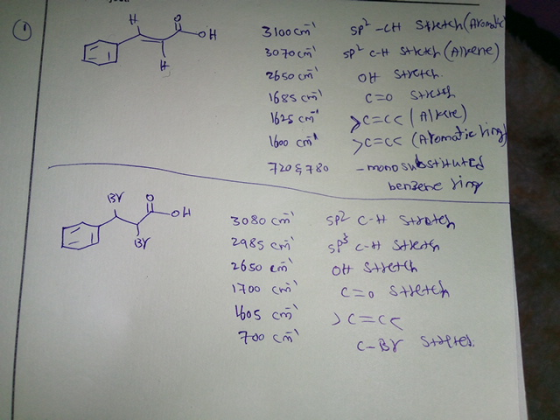
3. Two IR spectra are available for this experiment, one of them is your starting martial the other is your produc...
The product was 2,3-dibromo-3-phenylpropanoic acid, with a melting point of 198-200 °C . So a racemic...
 The product was 2,3-dibromo-3-phenylpropanoic acid, with a
melting point of 198-200 °C . So a racemic mixture of (2R,3S) and
(2S,3R).
Based on your knowledge of the bromination of alkenes, did this alkene behave like other alkenes, or was the mechanism different than what you expected? (1 pt) ОН NHBrz acetic acid NHBr Br 0 OH Br 2,3-dibromo-3- phenylpropanoic acid pyridinium bromide trans cinnamic acid pyridinium bromide perbromide
The product was 2,3-dibromo-3-phenylpropanoic acid, with a
melting point of 198-200 °C . So a racemic mixture of (2R,3S) and
(2S,3R).
Based on your knowledge of the bromination of alkenes, did this alkene behave like other alkenes, or was the mechanism different than what you expected? (1 pt) ОН NHBrz acetic acid NHBr Br 0 OH Br 2,3-dibromo-3- phenylpropanoic acid pyridinium bromide trans cinnamic acid pyridinium bromide perbromide
prelab wants me to draw a mechanism for both pairs. so one mechanism for the 93-95...
 prelab wants me to draw a mechanism for both pairs. so one
mechanism for the 93-95 C pair and another mechanism for the
202-204 C pair. Please draw out full mechanism with arrow pushing
please for both!
trans-cinnamic acid Bromination of trans-cinnamic acid can result in the formation of two different pairs of enantiomers (see Figure 4). Fortunately, the pairs of enantiomers have very different melting points. Thus, we can determine the result of this reaction by examining the melting...
prelab wants me to draw a mechanism for both pairs. so one
mechanism for the 93-95 C pair and another mechanism for the
202-204 C pair. Please draw out full mechanism with arrow pushing
please for both!
trans-cinnamic acid Bromination of trans-cinnamic acid can result in the formation of two different pairs of enantiomers (see Figure 4). Fortunately, the pairs of enantiomers have very different melting points. Thus, we can determine the result of this reaction by examining the melting...
Hydrolysis of Benzonitrile Which one of these IR spectra correponds to the starting material, benzonitrile, and...
 Hydrolysis of Benzonitrile
Which one of these IR spectra correponds to the starting
material, benzonitrile, and the product of the hydrolysis reaction,
benzoic acid? Please explain your answer.
IRsolution omment, Page 1 Start No. of Scans, 10 IR solution Benzonitrile,PNG Paint ESHIMADzu Date/Time: 3/18/2015 6:48:26 PM Faculty 1:01 PM
Hydrolysis of Benzonitrile
Which one of these IR spectra correponds to the starting
material, benzonitrile, and the product of the hydrolysis reaction,
benzoic acid? Please explain your answer.
IRsolution omment, Page 1 Start No. of Scans, 10 IR solution Benzonitrile,PNG Paint ESHIMADzu Date/Time: 3/18/2015 6:48:26 PM Faculty 1:01 PM
4. IR SPECTROSCOPY Run the IR spectrum of your product using the Nujol mull technique; attach...
 4. IR SPECTROSCOPY Run the IR spectrum of your product using the Nujol mull technique; attach the spectrum to your report. Cinnamic acid contains a carboxyl group (-CO,H) in which the carbon-oxygen double bond is "conjugated" with the carbon-carbon double bond (C=C-C=O). The C=O stretching absorption appears at about 1685 cm in cinnamic acid. (a) What is the frequency of the CO stretching absorption in your product? (b) What effect does conjugation have on the frequency of the CEO stretching...
With the values of the possible products. 4) Discuss the IR spectra of your starting materials....
 With the values of the possible products. 4) Discuss the IR spectra of your starting materials. Based on your spectra determine which unknown was the aldehyde and which was the ketone. You should discuss the key peaks you used to make these assignments. If your IR spectra were helpful in identifying which ketone or aldehyde you had, discuss this as well. For additional info, see the IR modes handout on the class web site. 5) Assign the peaks in the...
starting material is propanic acide and isoyml acid. end product is isoyml acetate starting material- isoamyl...
 starting material is propanic acide and isoyml acid. end
product is isoyml acetate
starting material- isoamyl alchol and propanic acid.
2. (3 Points) NMR spectroscopy could have been used to characterize the products in this experiment (we didn't use it because many of the products give spectra with overlapping peaks). NMR could have been advantageous, as the IR spectrum can give a false negative on the product if water or remaining carboxylic acid are in the product (presence of an...
starting material is propanic acide and isoyml acid. end
product is isoyml acetate
starting material- isoamyl alchol and propanic acid.
2. (3 Points) NMR spectroscopy could have been used to characterize the products in this experiment (we didn't use it because many of the products give spectra with overlapping peaks). NMR could have been advantageous, as the IR spectrum can give a false negative on the product if water or remaining carboxylic acid are in the product (presence of an...
2. Obtain an IR of your product and label the peaks Calculations: I. Calculate a percent...
 2. Obtain an IR of your product and label the peaks Calculations: I. Calculate a percent yield for your product based on the 5 g of starting material. 2. Assign IR peaks and attach to your report. Questions: I. What can your product be used for? What can you make from terephthalic acid? 2. What waste material did you generate in this recycling process? 3. Draw the chemical structure of the other types of plastics HDPE (high density polyethylene) PVC...
using the IR, the 13C, and DEPT NMR spectra of your product determine the identity of...
 using the IR, the 13C, and DEPT NMR spectra of your product
determine the identity of your unknown ester from a C-4 or C-5
alcohol. the identity of the C-4 or C-5 alcohol also needs to be
determined.
The following C-4 or C-5 alcohols will be used in this
experiment:
1-butanol (n-butyl alcohol)
2-butanol (sec-butyl alcohol)
2-methyl-1-propanol (isobutyl alcohol)
3-methyl-1-butanol (isopentyl alcohol)
1-pentanol (n-pentyl alcohol)
2-pentanol
3-pentanol
cyclopentanol
Questions:
1. Why is the mixture extracted with aqueous sodium
bicarbonate solution?...
using the IR, the 13C, and DEPT NMR spectra of your product
determine the identity of your unknown ester from a C-4 or C-5
alcohol. the identity of the C-4 or C-5 alcohol also needs to be
determined.
The following C-4 or C-5 alcohols will be used in this
experiment:
1-butanol (n-butyl alcohol)
2-butanol (sec-butyl alcohol)
2-methyl-1-propanol (isobutyl alcohol)
3-methyl-1-butanol (isopentyl alcohol)
1-pentanol (n-pentyl alcohol)
2-pentanol
3-pentanol
cyclopentanol
Questions:
1. Why is the mixture extracted with aqueous sodium
bicarbonate solution?...
1. In the H NMR, draw the structure of the molecule directly on the spectrum and...
 1. In the H NMR, draw the structure of the molecule directly on
the spectrum and identify each unique proton. Indicate which proton
is responsible for each peak.
2. In the IR spectrum, indicate which functional group is
responsible for each important peak. Attempt to identify at least
five important peaks. In you discussion, indicate which peaks are
most helpful in determining whether or not you converted the
starting material to the desired product.
3. Compare the IR spectrum of...
1. In the H NMR, draw the structure of the molecule directly on
the spectrum and identify each unique proton. Indicate which proton
is responsible for each peak.
2. In the IR spectrum, indicate which functional group is
responsible for each important peak. Attempt to identify at least
five important peaks. In you discussion, indicate which peaks are
most helpful in determining whether or not you converted the
starting material to the desired product.
3. Compare the IR spectrum of...
Compare your IR spectra (starting material vs. product(s)). Provide a brief summary of what you see...
 Compare your IR spectra (starting material vs. product(s)).
Provide a brief summary of what you see in terms of functional
groups for both. Do your results indicate that your dehydration
reaction was successful? Identify the major peaks in the
spectra.
0 500 009 700 800 006 1100 1200 1300 1400 1500 1600 1700 1800 0061 2000 27 2400 2600 2800 3000 3200 3400 3600 800 -+:+- LIULUI " -* " " + + + . . ii.ii + + +...
Compare your IR spectra (starting material vs. product(s)).
Provide a brief summary of what you see in terms of functional
groups for both. Do your results indicate that your dehydration
reaction was successful? Identify the major peaks in the
spectra.
0 500 009 700 800 006 1100 1200 1300 1400 1500 1600 1700 1800 0061 2000 27 2400 2600 2800 3000 3200 3400 3600 800 -+:+- LIULUI " -* " " + + + . . ii.ii + + +...
 The product was 2,3-dibromo-3-phenylpropanoic acid, with a
melting point of 198-200 °C . So a racemic mixture of (2R,3S) and
(2S,3R).
Based on your knowledge of the bromination of alkenes, did this alkene behave like other alkenes, or was the mechanism different than what you expected? (1 pt) ОН NHBrz acetic acid NHBr Br 0 OH Br 2,3-dibromo-3- phenylpropanoic acid pyridinium bromide trans cinnamic acid pyridinium bromide perbromide
The product was 2,3-dibromo-3-phenylpropanoic acid, with a
melting point of 198-200 °C . So a racemic mixture of (2R,3S) and
(2S,3R).
Based on your knowledge of the bromination of alkenes, did this alkene behave like other alkenes, or was the mechanism different than what you expected? (1 pt) ОН NHBrz acetic acid NHBr Br 0 OH Br 2,3-dibromo-3- phenylpropanoic acid pyridinium bromide trans cinnamic acid pyridinium bromide perbromide
 prelab wants me to draw a mechanism for both pairs. so one
mechanism for the 93-95 C pair and another mechanism for the
202-204 C pair. Please draw out full mechanism with arrow pushing
please for both!
trans-cinnamic acid Bromination of trans-cinnamic acid can result in the formation of two different pairs of enantiomers (see Figure 4). Fortunately, the pairs of enantiomers have very different melting points. Thus, we can determine the result of this reaction by examining the melting...
prelab wants me to draw a mechanism for both pairs. so one
mechanism for the 93-95 C pair and another mechanism for the
202-204 C pair. Please draw out full mechanism with arrow pushing
please for both!
trans-cinnamic acid Bromination of trans-cinnamic acid can result in the formation of two different pairs of enantiomers (see Figure 4). Fortunately, the pairs of enantiomers have very different melting points. Thus, we can determine the result of this reaction by examining the melting...
 Hydrolysis of Benzonitrile
Which one of these IR spectra correponds to the starting
material, benzonitrile, and the product of the hydrolysis reaction,
benzoic acid? Please explain your answer.
IRsolution omment, Page 1 Start No. of Scans, 10 IR solution Benzonitrile,PNG Paint ESHIMADzu Date/Time: 3/18/2015 6:48:26 PM Faculty 1:01 PM
Hydrolysis of Benzonitrile
Which one of these IR spectra correponds to the starting
material, benzonitrile, and the product of the hydrolysis reaction,
benzoic acid? Please explain your answer.
IRsolution omment, Page 1 Start No. of Scans, 10 IR solution Benzonitrile,PNG Paint ESHIMADzu Date/Time: 3/18/2015 6:48:26 PM Faculty 1:01 PM
 4. IR SPECTROSCOPY Run the IR spectrum of your product using the Nujol mull technique; attach the spectrum to your report. Cinnamic acid contains a carboxyl group (-CO,H) in which the carbon-oxygen double bond is "conjugated" with the carbon-carbon double bond (C=C-C=O). The C=O stretching absorption appears at about 1685 cm in cinnamic acid. (a) What is the frequency of the CO stretching absorption in your product? (b) What effect does conjugation have on the frequency of the CEO stretching...
 With the values of the possible products. 4) Discuss the IR spectra of your starting materials. Based on your spectra determine which unknown was the aldehyde and which was the ketone. You should discuss the key peaks you used to make these assignments. If your IR spectra were helpful in identifying which ketone or aldehyde you had, discuss this as well. For additional info, see the IR modes handout on the class web site. 5) Assign the peaks in the...
 starting material is propanic acide and isoyml acid. end
product is isoyml acetate
starting material- isoamyl alchol and propanic acid.
2. (3 Points) NMR spectroscopy could have been used to characterize the products in this experiment (we didn't use it because many of the products give spectra with overlapping peaks). NMR could have been advantageous, as the IR spectrum can give a false negative on the product if water or remaining carboxylic acid are in the product (presence of an...
starting material is propanic acide and isoyml acid. end
product is isoyml acetate
starting material- isoamyl alchol and propanic acid.
2. (3 Points) NMR spectroscopy could have been used to characterize the products in this experiment (we didn't use it because many of the products give spectra with overlapping peaks). NMR could have been advantageous, as the IR spectrum can give a false negative on the product if water or remaining carboxylic acid are in the product (presence of an...
 2. Obtain an IR of your product and label the peaks Calculations: I. Calculate a percent yield for your product based on the 5 g of starting material. 2. Assign IR peaks and attach to your report. Questions: I. What can your product be used for? What can you make from terephthalic acid? 2. What waste material did you generate in this recycling process? 3. Draw the chemical structure of the other types of plastics HDPE (high density polyethylene) PVC...
 using the IR, the 13C, and DEPT NMR spectra of your product
determine the identity of your unknown ester from a C-4 or C-5
alcohol. the identity of the C-4 or C-5 alcohol also needs to be
determined.
The following C-4 or C-5 alcohols will be used in this
experiment:
1-butanol (n-butyl alcohol)
2-butanol (sec-butyl alcohol)
2-methyl-1-propanol (isobutyl alcohol)
3-methyl-1-butanol (isopentyl alcohol)
1-pentanol (n-pentyl alcohol)
2-pentanol
3-pentanol
cyclopentanol
Questions:
1. Why is the mixture extracted with aqueous sodium
bicarbonate solution?...
using the IR, the 13C, and DEPT NMR spectra of your product
determine the identity of your unknown ester from a C-4 or C-5
alcohol. the identity of the C-4 or C-5 alcohol also needs to be
determined.
The following C-4 or C-5 alcohols will be used in this
experiment:
1-butanol (n-butyl alcohol)
2-butanol (sec-butyl alcohol)
2-methyl-1-propanol (isobutyl alcohol)
3-methyl-1-butanol (isopentyl alcohol)
1-pentanol (n-pentyl alcohol)
2-pentanol
3-pentanol
cyclopentanol
Questions:
1. Why is the mixture extracted with aqueous sodium
bicarbonate solution?...
 1. In the H NMR, draw the structure of the molecule directly on
the spectrum and identify each unique proton. Indicate which proton
is responsible for each peak.
2. In the IR spectrum, indicate which functional group is
responsible for each important peak. Attempt to identify at least
five important peaks. In you discussion, indicate which peaks are
most helpful in determining whether or not you converted the
starting material to the desired product.
3. Compare the IR spectrum of...
1. In the H NMR, draw the structure of the molecule directly on
the spectrum and identify each unique proton. Indicate which proton
is responsible for each peak.
2. In the IR spectrum, indicate which functional group is
responsible for each important peak. Attempt to identify at least
five important peaks. In you discussion, indicate which peaks are
most helpful in determining whether or not you converted the
starting material to the desired product.
3. Compare the IR spectrum of...
 Compare your IR spectra (starting material vs. product(s)).
Provide a brief summary of what you see in terms of functional
groups for both. Do your results indicate that your dehydration
reaction was successful? Identify the major peaks in the
spectra.
0 500 009 700 800 006 1100 1200 1300 1400 1500 1600 1700 1800 0061 2000 27 2400 2600 2800 3000 3200 3400 3600 800 -+:+- LIULUI " -* " " + + + . . ii.ii + + +...
Compare your IR spectra (starting material vs. product(s)).
Provide a brief summary of what you see in terms of functional
groups for both. Do your results indicate that your dehydration
reaction was successful? Identify the major peaks in the
spectra.
0 500 009 700 800 006 1100 1200 1300 1400 1500 1600 1700 1800 0061 2000 27 2400 2600 2800 3000 3200 3400 3600 800 -+:+- LIULUI " -* " " + + + . . ii.ii + + +...
Most questions answered within 3 hours.
-
Where is the error in this code sequence?
String s1 = "Hello";
String s2 = "ello";...
asked 10 months ago -
Financial data for Joel de Paris, Inc., for last year
follow:
Joel de Paris, Inc.
Balance...
asked 10 months ago -
Consider this reaction:
Al2(SO4)3 (aq)+ BaCl3
(aq) Al2Cl6 (aq)- +
3BaSO4(s) . What is the...
asked 10 months ago -
Suppose that Savneet is considering increasing her
recent random sample from 20 car rentals to 40...
asked 10 months ago -
Trucks arrive at an unloading terminal at an average rate of 120
per hour.
Trucks arrive...
asked 10 months ago -
Why are methanol and ethanol completely soluble in water while
octanol is not very little soluble....
asked 10 months ago -
A facilities manager at a university reads in a research report
that the mean amount of...
asked 10 months ago -
When the CuSO4 is rehydrated by adding water to the anhydrous
compound, is this an endothermic...
asked 10 months ago -
A ray of sunlight is passing from diamond into crown glass; the
angle of incidence is...
asked 10 months ago -
A block of mass 0.249 kg is placed on top of a light, vertical
spring of...
asked 10 months ago -
how do the kidneys compensate in the presences of acidosis
a) trigger hyperventilate
b) reserve acid...
asked 10 months ago -
Question 501 pts
The rental rate of capital to the firm increases. Which of the
following...
asked 10 months ago